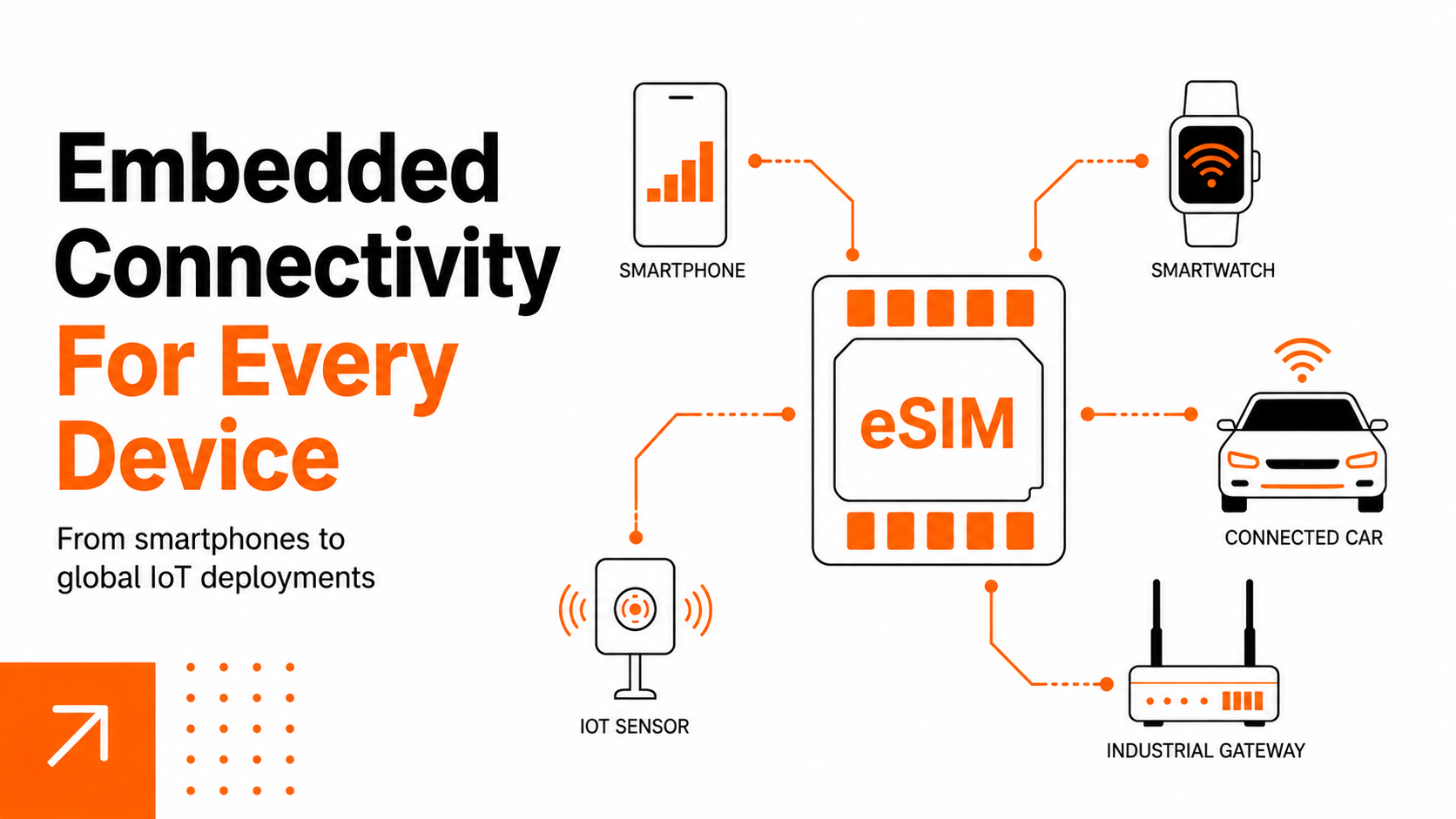
An eSIM (embedded SIM) is a reprogrammable chip built directly into a device that performs the same function as a plastic SIM card without the removable card itself. It can store one or more carrier profiles that are downloaded and switched over the air, allowing a phone, tablet, or IoT device to connect to a network and change carriers without physically swapping anything. That makes eSIM a key building block for modern global and IoT connectivity.
eSIM is no longer just a smartphone feature. It now sits at the center of enterprise mobility, IoT connectivity, connected products, and digital-first telecom services. At the same time, the ecosystem has become more complex, introducing new standards, provisioning methods, connectivity platforms, and business models.
This hub organizes our eSIM content into practical learning paths. Start with the fundamentals if you’re new to eSIM. Explore standards and provisioning if you’re evaluating devices. Dive into IoT and connectivity management if you’re building connected products. Or jump directly to marketplaces and monetization if you’re exploring branded connectivity offerings.
Whether you’re deploying devices, managing connectivity, or launching an eSIM-enabled service, this guide will help you navigate the ecosystem and find the right resources for your next step.
eSIM Fundamentals
Think of a traditional SIM card as a physical key tied to a single lock. An eSIM turns that key into software. Instead of swapping plastic cards, carrier profiles can be downloaded, updated, and managed remotely.
This seemingly simple change has major implications. Consumers gain flexibility when changing carriers or traveling internationally. Businesses eliminate SIM logistics and simplify deployments. IoT providers can provision devices globally without physically touching them after manufacturing.
The result is a more flexible connectivity model that reduces operational friction while making large-scale deployments easier to manage.
The biggest misconception about eSIM technology is that it is primarily a consumer convenience feature. In reality, some of the most significant benefits emerge in enterprise and IoT deployments, where eliminating physical SIM distribution, inventory management, and device handling can dramatically reduce operational complexity. At scale, remote provisioning and carrier switching often deliver far greater value than the convenience of not having to insert a SIM card.
Build Your eSIM Foundation:
- Introduction to eSIM in IoT connectivity tells you how eSIM is transforming IoT connectivity and what it means for businesses.
- How Dual-SIM with eSIM Lets You Run 2 Numbers on One Phone. You will see benefits, setup tips, and cost savings explained.
- eSIM Myths 2026: Common Misconceptions Debunked answers the question “Is eSIM safe, cheaper, or iPhone-only?” The facts behind common myths.
- eSIM Orchestration for IoT: Benefits & Use Cases. Talks about how orchestration simplifies global deployments.
- Unified Connectivity Management: Transform IoT Ops in 2026 shows how organizations unify eSIM management, carrier orchestration, and IoT operations.
eSIM vs Physical SIM and Form Factors
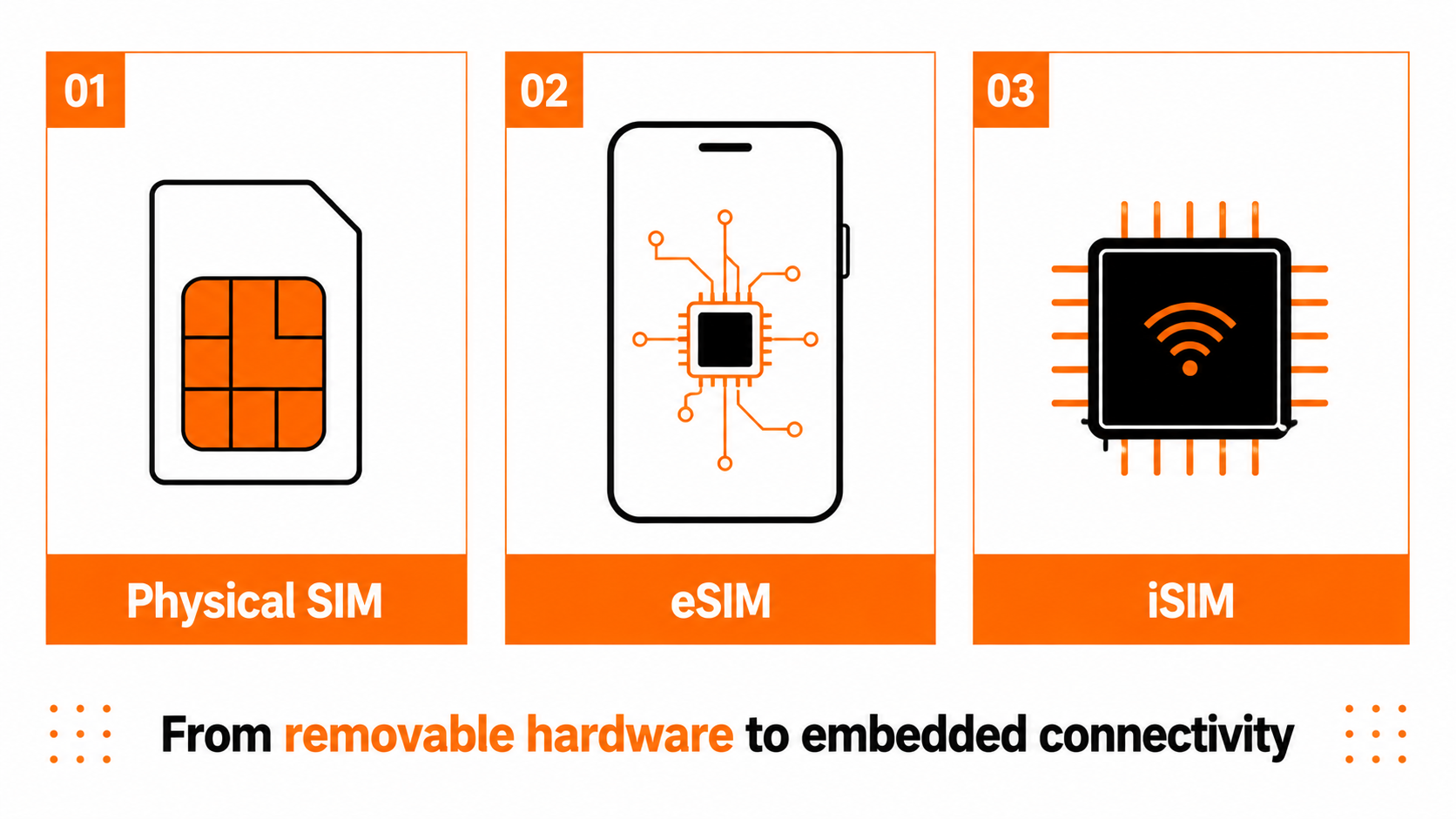
The SIM card has evolved significantly over the last three decades. Today, organizations evaluating connectivity typically encounter three options: physical SIMs, eSIMs, and iSIMs. Each serves a different purpose depending on device requirements, deployment scale, and long-term connectivity strategy.
| Feature | Physical SIM | eSIM | iSIM |
|---|---|---|---|
| Form Factor | Removable card | Embedded chip | Integrated into the processor |
| Carrier Switching | Manual replacement | Remote profile download | Remote profile download |
| Remote Provisioning | Not supported | Supported | Supported |
| Durability | Can be lost or damaged | No removable parts | Fully integrated |
| Enterprise Scalability | Limited | Strong | Emerging |
| IoT Suitability | Basic deployments | Ideal for most deployments | Best for ultra-compact devices |
| Technology Maturity | Established | Widely adopted | Early stage |
While physical SIMs remain widely used, eSIM has emerged as the preferred choice for most enterprise and IoT deployments because it combines flexibility, scalability, and proven adoption. iSIM takes this evolution a step further by embedding SIM functionality directly into the device processor. Although iSIM is expected to play a larger role in future connected devices, eSIM currently offers the most practical balance between maturity, global support, and remote connectivity management.
Explore SIM Technologies and Form Factors:
- SIM vs eSIM: The Airport Decision Every Traveler Faces breaks down cost, setup time, security, and compatibility compared.
- eSIM vs Traditional SIM: Choosing the Best IoT Connectivity breaks down scalability, cost, and management for IoT deployments.
- eSIM vs Traditional SIMs: Which Is Right for Your Business? Is a business-focused breakdown.
- iSIM vs eSIM: Next-Gen Cellular IoT Connectivity Explained, impact on device connectivity, security, and deployment.
- SIM Card Types 2026: From Nano-SIM to MFF2 to eSIM to iSIM has every form factor compared, with use cases and SGP.32 readiness.
eSIM Standards, RSP, and Provisioning
Every eSIM device follows a set of technical rules defined by the GSMA. The two standards that matter most today are SGP.22 for consumer devices like phones and tablets, and SGP.32 for unattended IoT devices that have no screen and no user present to tap through a setup flow.
Remote SIM Provisioning (RSP) is the mechanism that makes all of this work. Think of it like an app store for your device’s network identity: the right carrier profile gets delivered over the air, silently and securely, without anyone physically touching the hardware.
Understanding these frameworks early can help organizations choose the right hardware, simplify deployments, and avoid costly redesigns later.
Hardware decisions often outlive connectivity decisions. Choosing devices that support the right provisioning standard today can create significantly more flexibility over the next five to ten years, especially as carriers evolve, networks sunset, and fleet requirements change.
Master eSIM Standards and Provisioning:
- SGP.22 vs SGP.32: The 2026 IoT eSIM Guide explains Consumer vs IoT standards, with guidance on which to choose.
- SGP.32 Explained: Simplifying eSIM Management for All Devices. The GSMA standard that merges consumer and M2M specs.
- What Is Remote SIM Provisioning (RSP)? OTA eSIM management with SGP.32, including SM-DP+ and eIM.
- What Is Remote eSIM Provisioning? Instant, secure global connectivity with no physical SIM swap.
- Deploy Multi-Network eSIM with RSP Aggregation explains OTA provisioning across carriers using a unified aggregation platform.
- Multi-IMSI vs eUICC: Choosing the Best IoT SIM discusses two approaches to global connectivity, compared in detail.
Cellular Identifiers
Every SIM and device carries a set of identifiers. Think of them as a device’s digital passport. The ICCID identifies the SIM. The IMSI is the subscriber identity on the network. The IMEI identifies the physical hardware. The EID is unique to the eSIM chip. Knowing which is which matters when you are provisioning devices, troubleshooting connectivity issues, or managing a field deployment.
Decode the Cellular Identity Layer:
- Cellular Identifiers Hub: ICCID, IMSI, IMEI, EID, MSISDN, TAC, and EUICCID Decoded is the complete guide with a free ICCID lookup tool.
- What Is an ICCID Number? IoT SIM Management Guide 2026 decodes ICCID digits and the difference between IMSI and IMEI.
eSIM for IoT Connectivity
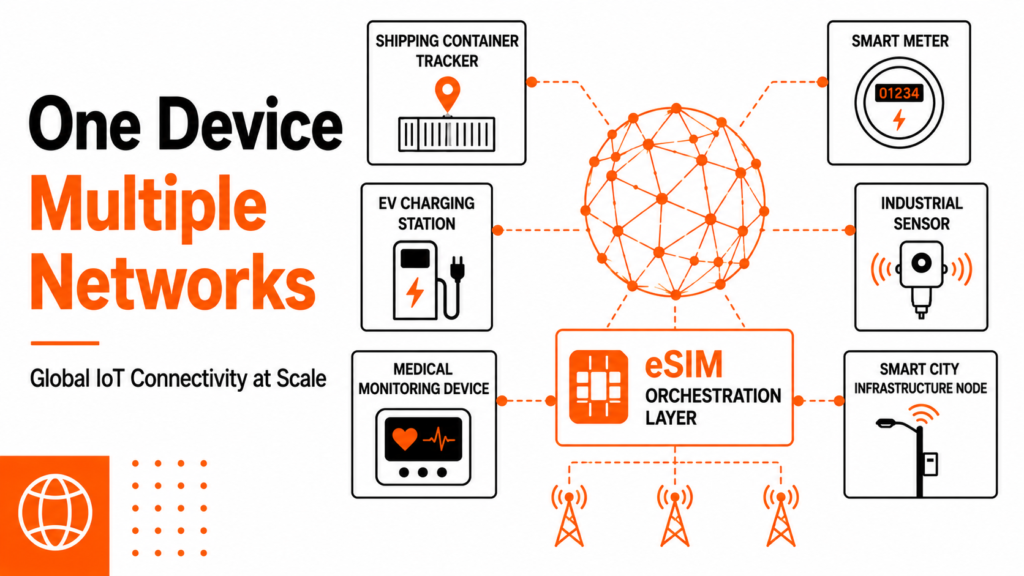
The value of eSIM becomes most apparent at scale. While managing a few smartphones is straightforward, deploying thousands of connected devices across regions is not. eSIM enables organizations to provision, manage, and update connectivity remotely, eliminating the need for physical SIM replacements and simplifying global deployments across asset tracking, smart metering, healthcare, industrial IoT, and other connected-device use cases.
GSMA Intelligence forecasts global IoT connections will reach 40.8 billion by 2030 and 52.9 billion by 2035. Much of this growth is expected to come from enterprise and industrial deployments, increasing demand for scalable technologies discussed in this blog.
Build your eSIM IoT Connectivity Stack:
- Introduction to eSIM in IoT Connectivity to learn how eSIM simplifies device management and drives scalability.
- eSIM Orchestration for IoT: Benefits and Use Cases to automate connectivity and reduce costs with a unified platform.
- Eliminate IIoT Carrier Lock-In with eSIM. Break free from single-carrier dependencies.
- Smart City IoT Connectivity Management Playbook 2026 to explore large-scale connectivity strategies for smart city deployments.
- Top IoT eSIM Providers 2026: Compare & Choose compares leading providers by coverage, features, and deployment flexibility.
IoT Connectivity Platforms, Networks, and Pricing
Managing an IoT fleet is more than provisioning SIMs. You need visibility into every device, control over data usage, automated carrier switching, and billing that scales with your business. This is where a Connectivity Management Platform (CMP) becomes crucial.
At the same time, selecting the right network technology and pricing model can have a major impact on performance and operational costs. LTE-M, NB-IoT, 5G RedCap, roaming strategies, and APN architecture all influence how a deployment behaves at scale.
Platforms and Management
Connectivity Management Platforms (CMPs) act as the operational layer between devices and carriers. They provide a centralized view of deployments while simplifying provisioning, monitoring, automation, and troubleshooting.
When evaluating a connectivity platform, ask three questions first: How deep is the eSIM support? How complete are the APIs? And who owns the customer data? These factors often matter more over the long term than pricing alone.
Platforms and Management blogs worth exploring to reduce operations overhead:
- Best IoT Connectivity Management Platforms in 2026 compares top CMPs by SGP.32 readiness, satellite integration, and enterprise scale.
- How to Choose the Best IoT CMP: Key features and evaluation criteria for enterprise IoT platforms.
- IoT Connectivity Platforms: The Enterprise Guide talks about solving multi-carrier fragmentation at scale.
- How to Optimize IoT Deployments with a CMP in 2026 keeps you up to date with the latest trends to automate scaling, reduce latency, and cut costs.
- Unified Connectivity Management: Transform IoT Ops in 2026 simplifies end provider fragmentation with a single management layer.
- IoT SIM Management: The Complete Guide. Start here if you are new to learn provisioning, monitoring, and lifecycle management.
Networks and Technologies
Different deployments require different connectivity technologies. Smart meters may prioritize battery life. Video surveillance systems need bandwidth. Asset trackers often require a balance between coverage, mobility, and cost.
Understanding the strengths and tradeoffs of LTE-M, NB-IoT, 5G RedCap, roaming models, and APN strategies is essential when designing connected products.
The Networks and Technologies Goldmine for eSIM Technology:
- NB-IoT vs LTE-M vs 5G RedCap: IoT Connectivity Guide (2026) helps gain insights on speed, battery life, module cost, and coverage benchmarks.
- NB-IoT vs LTE-M: Which Is Right for You? Is a focused LPWAN comparison for deployment decisions.
- IoT SIM Cards Explained (2026): Explore the types, form factors, plans, and eUICC options compared.
- What Is IoT Roaming? How It Works and Why It Matters: Permanent roaming risks and the Local Breakout standard.
- What the 2G/3G Sunset Means for Your IoT Strategy in 2026 dives deep into the migration risks, bricked device scenarios, and your options.
- Future of IoT Connectivity: Multi-Carrier, NTN/Satcom, and eUICC includes emerging technologies shaping the future of IoT connectivity.
- What Is APN? Complete IoT Access Point Name Guide (2026) to learn APN configuration, private APNs, and security best practices.
Pricing and Cost Optimization
Connectivity pricing often looks straightforward until deployments scale. Device behavior varies, usage patterns change, and pricing structures that seem economical initially can become expensive over time.
Choosing the right pricing model is just as important as choosing the right network.
| Pricing Model | Best For | Primary Advantage |
|---|---|---|
| Pay-as-you-go | Seasonal or low-usage devices | No spending on inactive devices |
| Subscription | Predictable deployments | Easier budgeting |
| Pooled Data | Mixed device fleets | Better utilization across devices |
Read these pricing insights:
- IoT Data Plans: How to Cut Connectivity Costs to compare pooled vs. per-device pricing and avoid bill shock.
- IoT eSIM Pricing: Pay-as-You-Go vs Subscription to check which pricing model fits your connectivity use case and budget.
eSIM for Business and Enterprise
For enterprise teams, eSIM is less about hardware and more about control. When a company manages hundreds of employee devices across multiple countries, provisioning and revoking mobile plans from a single dashboard becomes operationally transformative. BYOD (Bring Your Own Device) policies become easier to enforce when the SIM is digital and policy-controlled. Device brands can embed connectivity directly into their products and own the customer experience end to end.
eSIM enables businesses to activate devices faster, simplify carrier management, reduce logistics costs, and improve the customer experience around connectivity.
See How Enterprises Are Using eSIM:
- eSIM for Enterprises as a Business Enabler talks about driving seamless connectivity and operational efficiency at scale.
- eSIM for Smart Devices: The Ultimate Guide for Brands discusses how device brands embed and monetize connectivity.
- How Embedded Connectivity Is Reshaping Tech Products covers the shift toward connectivity as a core product feature.
- Why eSIM and BYOD Are Made for Each Other is an explainer for remote management, cost efficiency, and seamless connectivity for distributed teams.
- eSIM for Auto Transport: Multi-Network Connectivity Trends ensuring 100% uptime for logistics fleets with no dead zones.
- Connectivity as a Benefit: Why Your Stipend is Failing to learn why embedded connectivity outperforms traditional reimbursement models.
eSIM for Travel and Consumers
Before eSIM, landing in a new country meant hunting for a local SIM vendor, handing over your passport for registration, and hoping the card worked in your unlocked phone. With eSIM, you download a local data plan before boarding and connect the moment you land. For brands in travel, hospitality, and consumer electronics, this is not just a convenience story. It is a revenue one.
A travel app that bundles a local eSIM plan becomes a full service. A smartwatch that ships with connectivity already loaded commands a premium.
Explore Consumer and Travel eSIM Use Cases:
- Travel eSIM Solutions: Monetizing Smart Devices, turn device connectivity into a recurring revenue opportunity.
eSIM Marketplaces, Monetization, and MVNOs
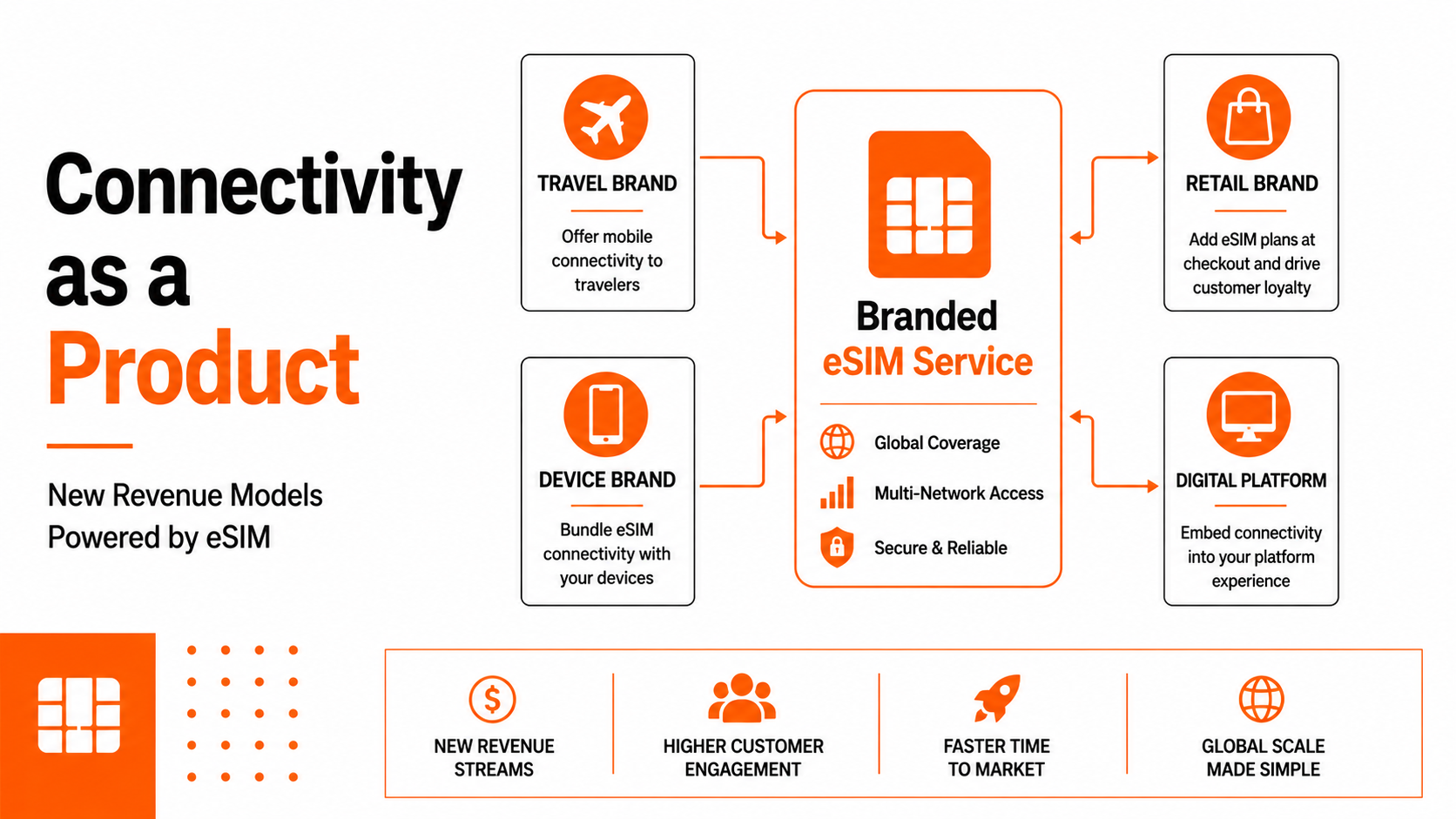
This is where eSIM becomes a business model rather than just a technology choice. Any brand with an engaged audience and a connected product can now launch its own eSIM service without owning spectrum, without carrier negotiations, without a telecom engineering team.
eSIM-only MVNOs take this further. By skipping physical SIM distribution entirely, a new class of digital-first operators can launch with lower overhead, faster activation flows, and greater flexibility on pricing. The MVNO market is being reshaped by this shift, and the entry bar has never been lower.
Most brands we work with start as a Light MVNO or branded reseller, validate customer demand, and then gradually add operational control as scale justifies it. Launching as a Full MVNO on day one is often the most expensive way to discover that your pricing strategy needs adjustment. Start lean, then scale what works.
To own a profitable eSIM business model, read:
- Launching Your Branded eSIM Marketplace: White-label solutions for building your own eSIM store.
- eSIM-Only MVNOs: Digital-First Business Models shares how to leverage eSIM connectivity for a modern mobile service.
- eSIM and 5G: How MVNOs Can Win breaks down strategies for digital-first MVNOs in a 5G world.
- How eSIM Is Disrupting the MVNO Market includes the advantages, challenges, and real-world success stories.
- eSIM Technology Revolutionizing IoT MVNO Services tells how embedded SIMs are transforming device connectivity for MVNOs.
- Steps for MVNOs to Implement eSIM Technology include provisioning, integration, and security essentials.
- Sell Phones and eSIMs on Shopify with Spenza. An e-commerce approach to device and connectivity sales.
- Reinventing Loyalty Programs with eSIM Data Plans: How tailored mobile plans drive brand loyalty and repeat engagement.
- Monetizing Brand Loyalty with Spenza Mobile eSIM Plans, turning customer engagement into recurring connectivity revenue.
- Ultimate MVNO Guide: What Is an MVNO? Types, Benefits & Key Insights complete guide to MVNO Business Models, Operations, and Launch Strategies.
eSIM Trends and Market Outlook
The transition away from physical SIM cards is already underway, but the eSIM ecosystem continues to evolve. Several trends are shaping the next phase of adoption.
SGP.32 adoption is accelerating as enterprises and IoT providers standardize around remote provisioning for unattended devices. Multi-carrier connectivity is replacing traditional single-carrier deployments, giving organizations greater resilience and flexibility. AI-driven orchestration is beginning to influence connectivity management, helping organizations automate carrier selection, optimize costs, and improve operational efficiency. Satellite and terrestrial connectivity convergence is creating new opportunities for global coverage, particularly in remote environments. iSIM adoption is expected to increase as device manufacturers prioritize smaller footprints and greater integration.
Ericsson’s latest Mobility Report forecasts nearly 6.3 billion 5G subscriptions by 2030, representing around two-thirds of all mobile subscriptions globally. As 5G expands and connected devices proliferate, eSIM is becoming a key enabler of scalable, remotely managed connectivity.
Track the Future of eSIM Connectivity:
- IoT eSIM Trends 2026: Latest News, iSIM, and Multi-Carrier Shift include iSIM, AI-driven orchestration, and the multi-carrier transition.
- Top IoT eSIM Providers 2026: Compare and Choose among features like global coverage, multi-network switching, security, APIs, and cost controls.
- Top IoT Trends to Watch in 2026: SGP.32 innovation, satellite integration, unified platforms, and AIoT.
Deploy and Manage eSIM at Scale with Spenza
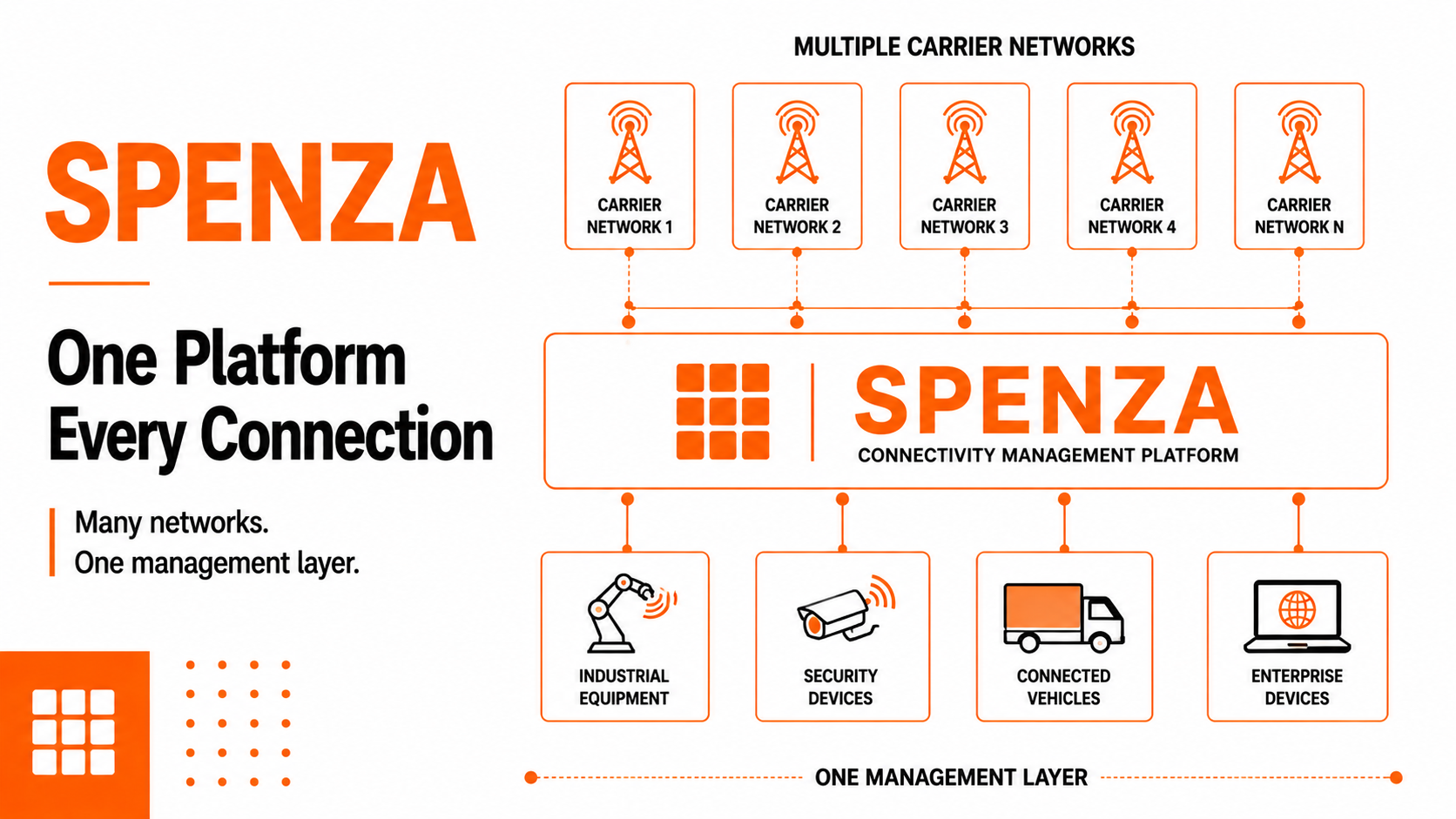
eSIM is changing how connectivity is delivered, managed, and monetized. What began as a replacement for the plastic SIM card has evolved into the foundation for global IoT deployments, enterprise mobility, connected products, and digital-first telecom services. As adoption grows, the challenge is no longer simply activating devices. It is managing connectivity across carriers, countries, technologies, and millions of connections throughout their lifecycle.
That’s where platforms like Spenza come in. Spenza helps enterprises, device manufacturers, and service providers simplify eSIM connectivity through multi-carrier orchestration, remote provisioning, connectivity management, and monetization tools. Whether you’re deploying connected devices, managing global IoT fleets, launching a branded eSIM marketplace, or building the next generation of connected products, Spenza provides the infrastructure to scale without carrier lock-in.
FAQs
See how Spenza can help simplify your eSIM strategy, reduce operational complexity, and accelerate deployments. Book a demo and explore eSIM Connectivity.