What Is the Difference Between an eSIM and a Traditional SIM for IoT?
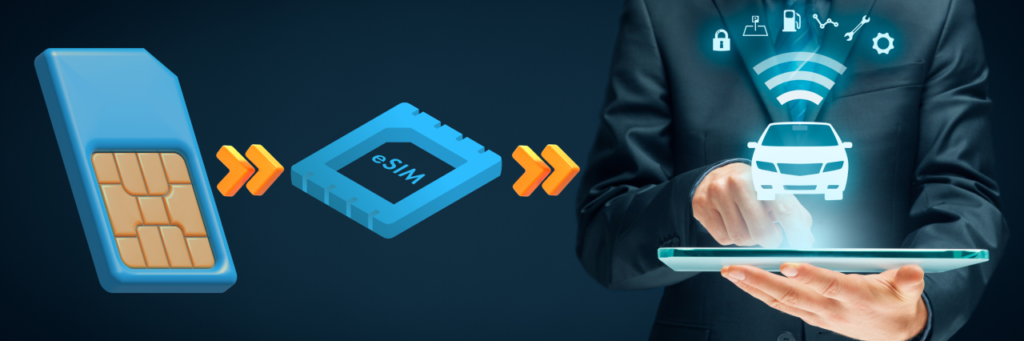
A traditional SIM is a removable physical card that stores a mobile subscriber profile, while an eSIM uses an embedded eUICC that can securely store and manage operator profiles remotely. For IoT deployments, eSIM technology can reduce the need for physical SIM replacement and enable remote provisioning and profile management.
Introduction to SIM Technologies in IoT
In today’s hyper-connected world, the Internet of Things (IoT) is revolutionizing industries, and at the core of this transformation lies the often-overlooked yet critical technology: SIM cards. But not just any SIM card. The landscape is rapidly evolving, shifting from traditional physical SIMs to the more versatile eSIM.
This blog delves into the essential role of SIM technologies in IoT connectivity, exploring the fundamental differences and advantages of traditional SIMs versus eSIMs. Understanding these distinctions is crucial, as they directly impact the efficiency, scalability, and success of your IoT deployments.
The Evolution of Connectivity in IoT Devices
IoT connectivity has undergone a dramatic transformation, rapidly moving from basic, localized connections to complex, global networks. Initially, traditional SIM cards, the stalwarts of mobile communication, adapted to early IoT deployments. However, as IoT ecosystems exploded in scale and complexity, the inherent limitations of these physical SIMs became glaringly obvious. This surge in demand for scalability and flexibility directly propelled the rise of embedded SIM (eSIM) technology, marking a pivotal shift in IoT connectivity.
The Growing Importance of Choosing the Right SIM Technology
The selection of SIM technology for IoT projects has transitioned from a simple consideration to a critical strategic decision. As the number of IoT devices surges, projected to reach a staggering 30.9 billion by 2025, businesses can no longer afford to overlook this choice. Organizations must meticulously assess their connectivity options, ensuring alignment with operational needs, global reach, and long-term goals.
The decision between traditional SIMs and eSIMs directly impacts deployment agility, cost-effectiveness, and future growth potential. Choosing the correct SIM type is a core component of successful IoT implementation. To fully understand the weight of this decision, it is important to first understand the basics of the traditional SIM card.
Understanding Traditional SIM Cards in IoT
Traditional SIM cards have provided the fundamental cellular connectivity for decades, playing a crucial role in early IoT adoption. However, their physical nature presents limitations in modern IoT deployments.
Physical Characteristics and Form Factors
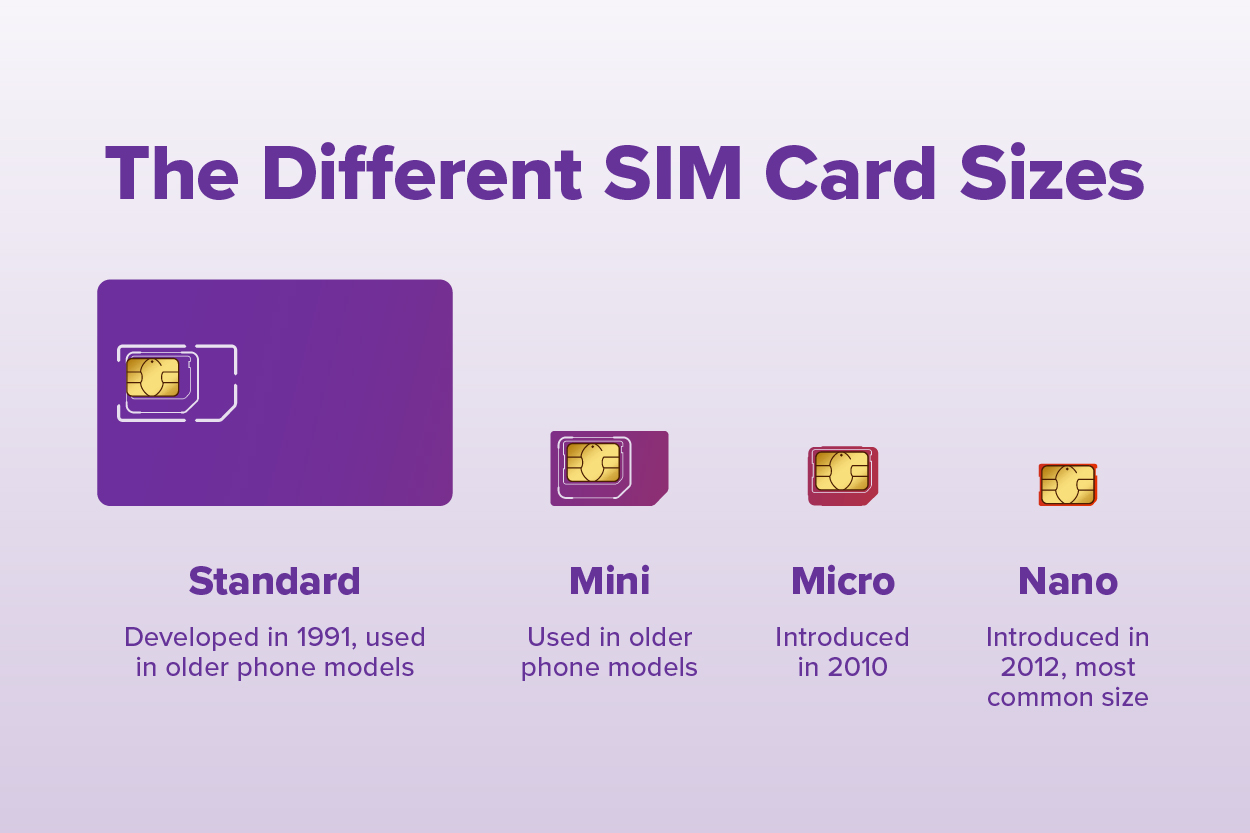
Traditional SIM cards come in various sizes, each progressively smaller: Standard, Mini, Micro, and Nano. Nano SIMs are now the most common in modern IoT devices due to their compact size. However, these physical SIMs require a dedicated slot, which can impact device design and durability, and increase vulnerability to environmental factors.
Operational Principles in IOT Environments
Traditional SIMs store fixed network credentials, tying them to a single Mobile Network Operator (MNO). This results in:
- Changing providers requires physically accessing the device.
- Manual insertion during setup.
- Managing SIM inventory across different regions can be complex.
This operator lock-in creates logistical problems for IoT deployments.
The Emergence of eSIM Technology
The embedded SIM (eSIM) is a revolutionary advancement in device connectivity, unlocking new potential for IoT deployments.
What is an eSIM (eUICC Explained)
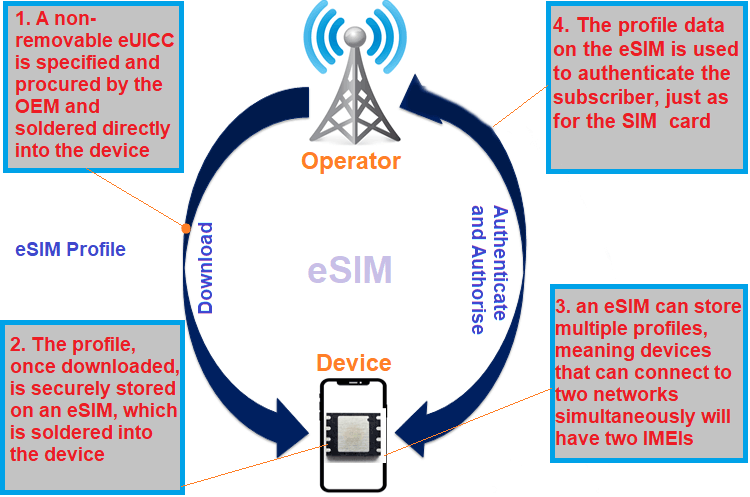
An eSIM is a SIM card permanently integrated into a device during manufacturing. Unlike traditional SIMs, eSIMs, powered by embedded Universal Integrated Circuit Card (eUICC) technology, can store multiple operator profiles. This enables Remote SIM Provisioning (RSP), eliminating the need for physical SIM swaps. This is particularly advantageous in scenarios where devices are deployed in remote or difficult-to-access locations.
Technical Architecture and Standards
eSIM technology adheres to the GSMA’s Remote SIM Provisioning specifications, ensuring industry-wide standardization. eSIM implementations use GSMA-defined remote SIM provisioning architectures. For IoT deployments, the GSMA’s SGP.31/SGP.32 specifications define an eSIM IoT architecture and technical framework for remote provisioning and management of eUICCs, particularly for network- and user-interface-constrained devices. The GSMA published SGP.32 v1.3 in May 2026, making the newer IoT-specific framework an important part of the current eSIM landscape.
Remote Provisioning Capabilities
The defining feature of eSIM technology is its remote provisioning capability, which allows:
- Over-the-air (OTA) profile downloads and updates.
- Seamless switching between network operators.
- On-demand connectivity activation.
This remote provisioning is the most important advantage of the eSIM.
Comprehensive Comparison: Traditional SIM vs. eSIM
Understanding the key differences between these technologies is essential for making informed decisions in IoT deployments.
| Feature | Traditional SIM | eSIM |
|---|---|---|
| Form Factor and Physical Integration | Physical, removable card requiring a dedicated slot; Larger device footprint; Vulnerable to environmental factors. | Embedded chip soldered to the motherboard; Smaller device footprint; Enhanced durability and resistance to environmental conditions; Greater design flexibility. |
| Deployment and Activation | manual physical insertion; Pre-activation or batch activation; Physical inventory management. | One-time manufacturing installation; Remote activation at any point; Digital profile management. |
| Network Flexibility and Operator Switching | Locked to a single operator; Requires physical SIM swap to change providers. | Supports multiple operator profiles; Remote switching; Dynamic network selection; Global deployment flexibility; Reduced vendor lock-in. |
| Security and Authentication | Hardware-level security; Subject to physical tampering risk; Standard authentication protocols. | Enhanced hardware-level encryption; Secure remote provisioning; Reduced physical tampering risk; Advanced identity management. |
| Scalability | Logistically complex for large-scale deployments; Inventory and physical access issues. | Highly scalable due to remote management and provisioning; Streamlined global deployments; Simplified fleet management. |
| Cost | Potentially lower initial SIM cost; Higher long-term operational costs due to physical management. | Higher initial hardware cost; Lower long-term operational costs due to remote management; Reduced logistics expenses. |
| Environmental Impact | More waste generated due to physical SIM production and disposal. | Less waste due to reduced physical components and shipping. |
| Device Design | Constrains design flexibility, requiring dedicated SIM slots. | Enables sleeker, more compact designs with fewer external ports. |
Advantages of Traditional SIMs and eSIMs in IoT Connectivity
Both traditional SIMs and eSIMs offer distinct advantages for IoT deployments, depending on specific use cases and requirements.
Traditional SIM Advantages:
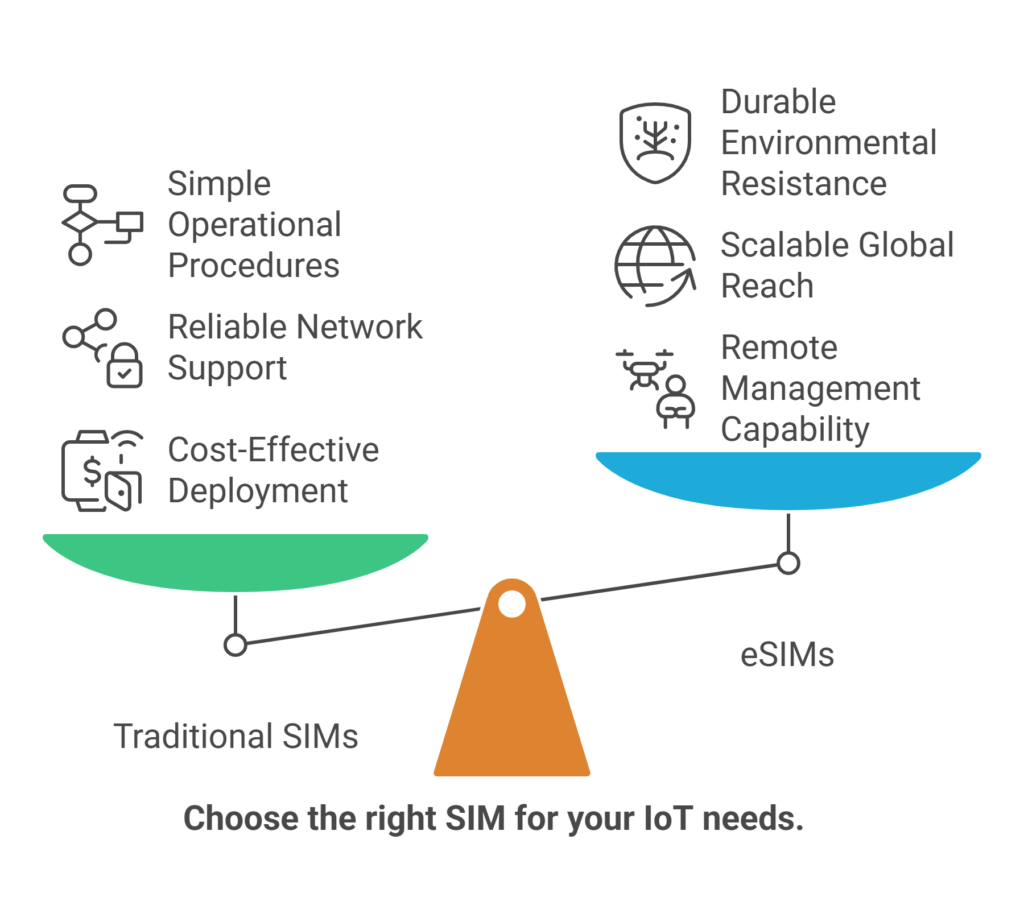
- Cost-Effective: Lower initial costs for small, local deployments.
- Reliable: Universal network support and easy physical replacement.
- Simple: Established ecosystem with proven operational procedures.
eSIM Advantages:
- Remote Management: Over-the-air updates and dynamic network selection.
- Scalable: Streamlined global deployments with a single hardware design.
- Durable: Enhanced resistance to environmental factors and longer device lifespan.
- Efficient: Simplified logistics and inventory management.
Traditional SIMs suit cost-sensitive, simple deployments; eSIMs excel in scalable, remote, and durable applications.
Challenges and Limitations in IoT Environments
Both traditional SIMs and eSIMs face challenges in IoT deployments.
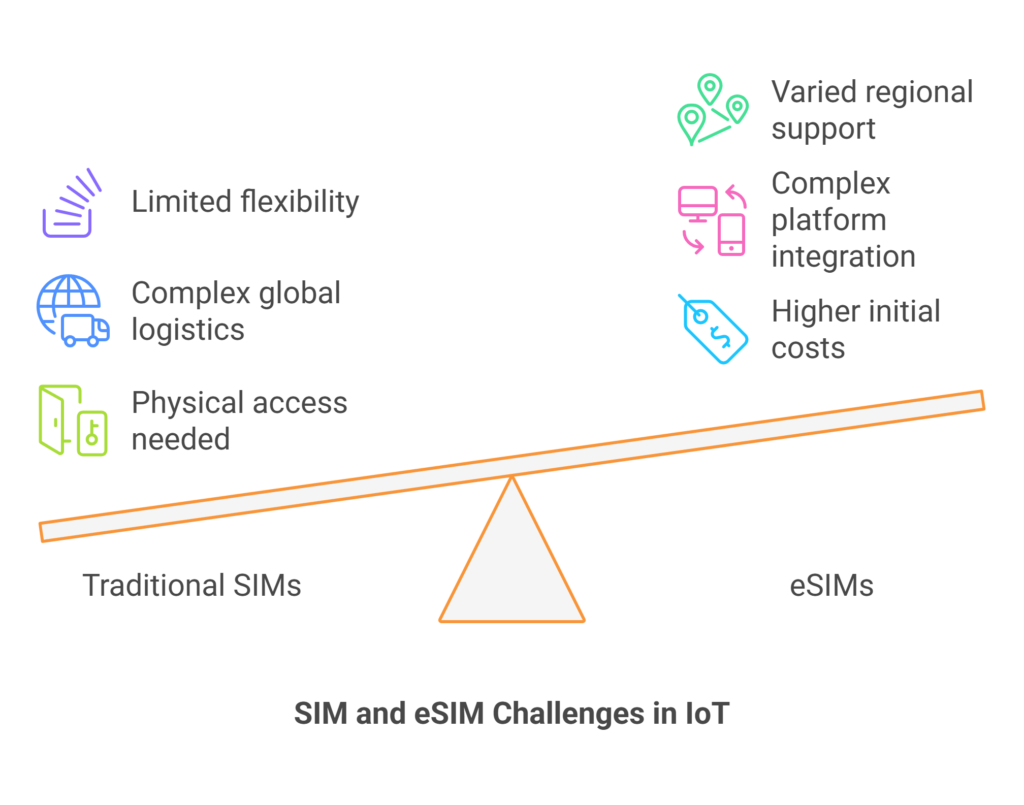
Traditional SIM Pain Points in IoT Ecosystems
- Physical access is needed for changes.
- Complex global logistics.
- Limited flexibility.
Current eSIM Adoption Challenges
- Higher initial costs.
- Complex platform integration.
- Varied regional support.
Overcoming Implementation Barriers
- Phased migration strategies from traditional to eSIM
- Hybrid approaches leveraging both technologies where appropriate
- Partnership with experienced connectivity management platforms
Cost Comparison: Traditional SIM vs eSIM in IoT Projects
Understanding the financial implications is crucial for technology selection.
| Cost Factor | Traditional SIM | eSIM |
|---|---|---|
| Initial Implementation Expenditures | Lower hardware costs; Higher integration expenses; Simpler hardware, complex logistics | Higher hardware costs; Lower integration expenses; Complex hardware, simple logistics |
| Ongoing Operational Considerations | Higher management and replacement costs; Physical intervention required; Higher long term costs | Lower management and remote update costs; Remote management; Lower long term costs |
| Total Cost of Ownership (TCO) | Lower TCO for small, static deployments; Higher TCO for large scale deployments | Higher TCO for small deployments; Lower TCO for large, dynamic, or global deployments |
| Network Flexibility Impact | Higher data costs due to operator lock-in. | Lower data costs through dynamic operator selection. |
| Deployment Scale Impact | Cost effective for small deployments | Cost effective for large deployments |
| Device Lifecycle Impact | Higher cost for long life cycle devices due to replacement costs | Lower cost for long life cycle devices due to remote management |
Future of IoT Connectivity
The future of IoT connectivity is dynamic, with SIM technology evolving to meet the demands of increasingly complex and global deployments. Here are some key trends shaping this evolution:
- IoT eSIM standardization: GSMA’s SGP.31/SGP.32 specifications are advancing standardized remote provisioning and management for IoT eSIM deployments, particularly for constrained devices.
- iSIM: Integrated SIM technology embeds SIM functionality into the device’s system-on-chip, supporting smaller and potentially more power-efficient connected devices.
- Automated connectivity management: As IoT fleets scale, remote provisioning, profile management, operator selection, and centralized connectivity management are becoming increasingly important for reducing manual intervention.
- Global Interoperability and Standardization: eSIM standardization is needed for seamless global IoT connectivity.
- AI-Powered SIM Management: AI will automate eSIM management to optimize IoT connectivity and costs.
IoT Device Management: Comparing Approaches – SIM vs. eSIM
Effective device management strategies differ between the two technologies.
| Management Aspect | Traditional SIM | eSIM |
|---|---|---|
| Fleet Management Capabilities | Physical inventory tracking; Manual processes; Complex integration with IoT systems | Centralized digital management; Specialized platforms; Simplified integration with IoT systems |
| Provisioning and Updating Mechanisms | Pre-provisioning; Physical access for changes; Limited over-the-air updates | Dynamic over-the-air provisioning; Remote profile updates; Batch operations and automation |
| Lifecycle Management Strategies | Physical decommissioning; Repurposing challenges; Network sunset management complexity | Remote decommissioning; Flexible repurposing; Simplified network sunset management |
| Scalability of Management | Manual management limits scalability | Remote management allows for high scalability |
| Automation | Limited automation capabilities | High automation capabilities |
| Device Repurposing | Difficult to repurpose devices for different regions or operators | Easy to repurpose devices for different regions or operators |
Making the Right Choice for Your IoT Deployment
Selecting the best technology requires careful evaluation of specific requirements.
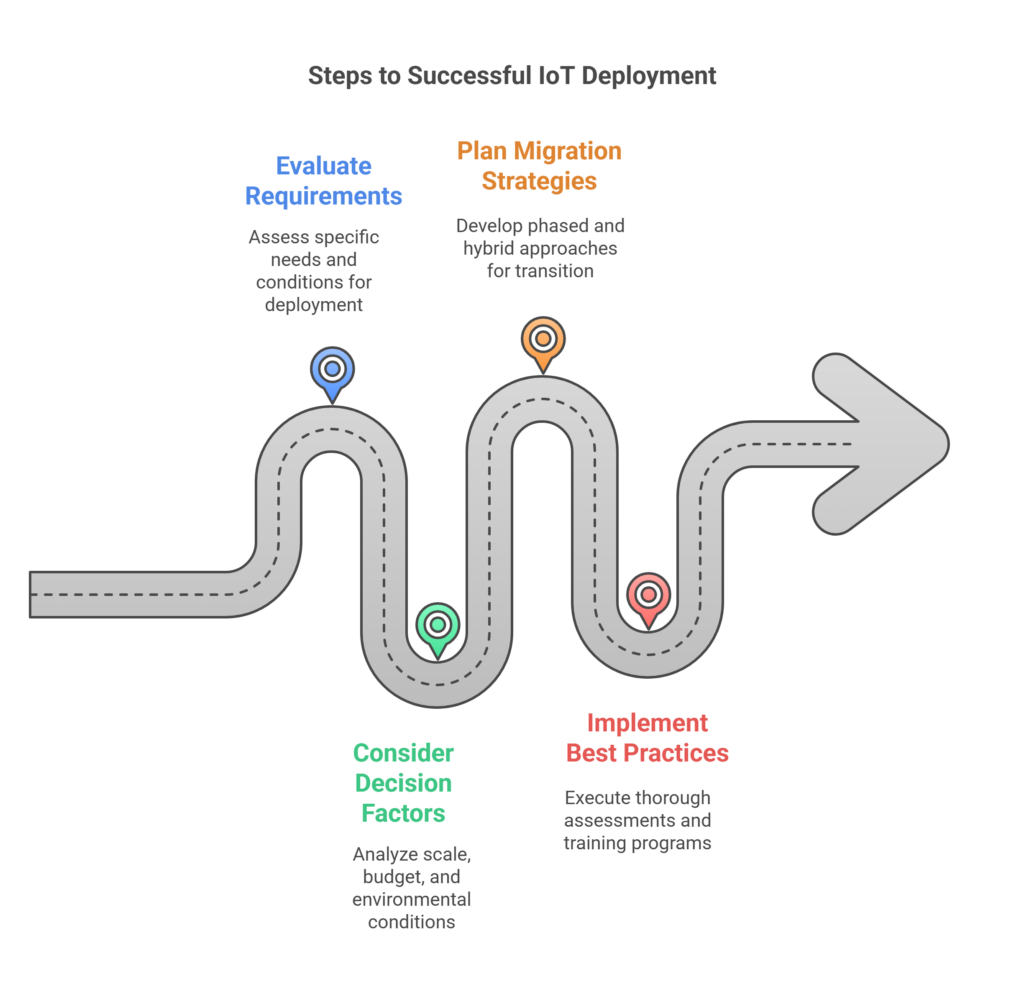
Should IoT Businesses Choose eSIM or Traditional SIM?
eSIM is generally better suited to large, distributed, long-life, or difficult-to-access IoT deployments where remote provisioning, operator flexibility, and centralized management are important. Traditional SIMs can remain suitable for smaller, localized deployments where physical access is easy and initial hardware cost and operational simplicity are priorities. A hybrid approach can be appropriate when an organization is migrating an existing fleet gradually.
Key Decision Factors to Consider
- Deployment scale and geographic distribution.
- Device lifecycle and maintenance approach.
- Budget constraints and ROI expectations.
- Environmental conditions and hardware requirements.
Migration Strategies from Traditional to eSIM
- Phased approach beginning with new deployments.
- Hybrid connectivity solutions during transition periods.
- Testing and validation processes for new workflows.
Best Practices for Implementation
- Thorough needs assessment before technology selection.
- Pilot programs to validate assumptions and processes.
- Comprehensive training and change management.
- Partnership with experienced connectivity providers
How Spenza is Transforming IoT Connectivity Solutions
Spenza is revolutionizing the IoT connectivity landscape as an operator-neutral connectivity enablement platform for businesses. Positioned as the “Stripe for connectivity,” Spenza offers a comprehensive solution that bridges the gap between traditional and emerging connectivity technologies.
The platform enables:
- Procure-to-pay SaaS with an integrated marketplace of operator mobile plans
- APIs, SaaS platforms, and white-label consumer apps that enable businesses to become MVNOs
- The ability for B2B and B2C businesses to launch branded mobile plans for their devices and users
Comprehensive Management Platform Features
- Multi-operator SIM capabilities with configurable preferred network order
- A “single pane of glass” for consolidating spend, inventory management, and automating operations
- IoT aggregation platform for companies deploying services with multiple IoT service providers
- Hierarchical billing systems that support complex business models
Customer Success Stories and Implementation Benefits
- Butlr, an IoT home automation company, uses Spenza to procure plans across multiple countries (US, UK, France, Netherlands, Germany) while managing services in one place and paying with a single bill
- Companies like Angel Watch are reselling mobile plans in multiple countries through Spenza’s platform
Spenza’s multi-operator SIM technology is particularly game-changing for IoT connectivity in enterprises, enabling truly operator-neutral connectivity solutions that adapt to coverage, pricing, and quality of service requirements.
Conclusion: Navigating the SIM Technology Landscape
Choosing between traditional SIMs and eSIMs for IoT deployments hinges on specific needs. Traditional SIMs offer simplicity and lower initial costs, suitable for small, local projects. eSIMs provide flexibility, remote management, and long-term savings, ideal for large, global deployments. Hybrid solutions can ease transitions.
FAQs
Ready to Transform Your IoT Connectivity? Discover how Spenza’s innovative platform can optimize your IoT deployments today!