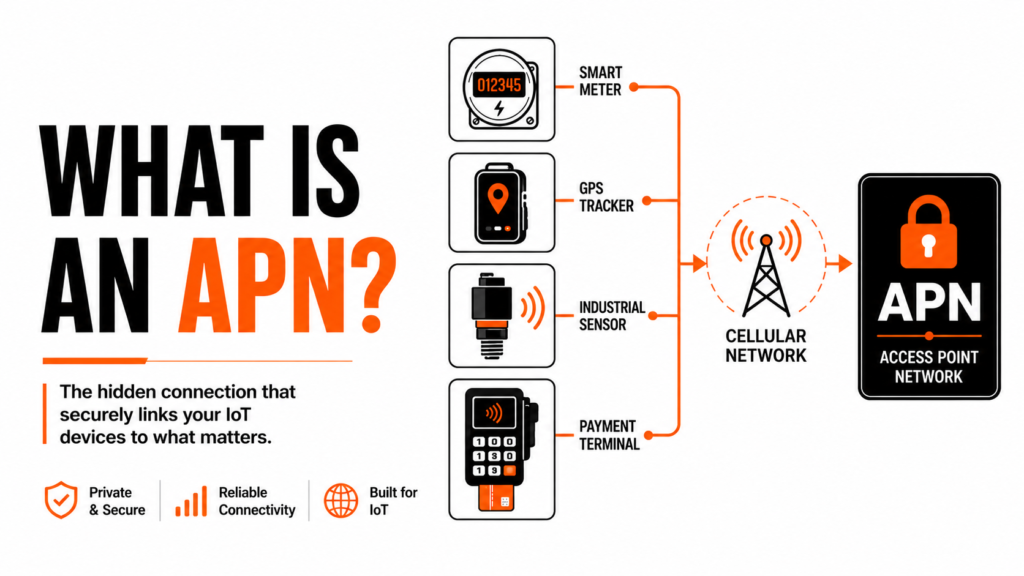
An APN (Access Point Name) is the gateway that connects a cellular device to a data network. It defines the IP address, routing path, security rules, and quality-of-service settings a device receives. IoT deployments use public or private APNs depending on their security and routing needs.
If you have ever wondered why two devices on the same carrier can behave differently, the APN is often the reason. This guide covers what an APN is, how it works in IoT, the differences between public and private APNs, common troubleshooting issues, and how enterprises manage connectivity at scale. Whether you are deploying a single device or a global IoT fleet, understanding APNs is key to reliable and secure connectivity.
What Is an APN?
APN stands for Access Point Name. It is a network identifier configured on a SIM card or device that tells the mobile carrier how to route data traffic, whether to the public internet or a private network.
If you have ever set up a new SIM card and noticed your phone asking for an “APN setting,” you have already come across one of the most foundational pieces of mobile connectivity without knowing it.
In the simplest terms, an APN tells the mobile network three things:
- Where should this device’s traffic go?
- What kind of IP address should it receive?
- What security or routing rules apply?
Think of it like a postal address on a package moving through a distribution hub. Without the right address, the package gets stuck. Without the right APN, the device connects to the network but cannot route data properly.
Each SIM carries unique cellular identifiers that work alongside APN settings during network authentication. As per GSMA TS 23.003, an APN has two structural components –
1. Network Identifier: Defines what service you want to reach.
2. Operator Identifier: Defines which carrier’s gateway handles it.
Together, they form a string like internet.carrier.net or enterprise.private.apn.
The term Access Point Name (APN) originates from the 3GPP standards that define how mobile data sessions are established between a device and a carrier network. In modern 5G networks, the equivalent concept is called a DNN (Data Network Name). While the terminology has evolved, the underlying function remains largely the same: defining how a device connects to external data networks, what routing policies apply, and which services it can access.
How APNs Work in IoT
To see why APNs matter, it helps to understand the process that takes place when an IoT device powers on and connects to a cellular tower; the APN negotiation happens automatically in the background. Here is what the process looks like:
Step 1: Network Attachment
The device powers on, and the SIM card inside the device activates and authenticates with the carrier. The device joins the cellular mobile network.
Step 2: APN Request
The device presents its configured APN string to the carrier’s gateway along with any required authentication details. It is essentially saying: “I want a data session using these routing rules.”
Step 3: Policy Validation
The carrier checks whether this SIM is authorized for the requested APN, what IP type to assign (public or private), and whether any traffic restrictions apply.
Step 4: Data Session Creation
The gateway assigns an IP address and routes traffic to the appropriate destination, whether that is the public internet, a cloud server, or a private enterprise backend, and establishes a data session.
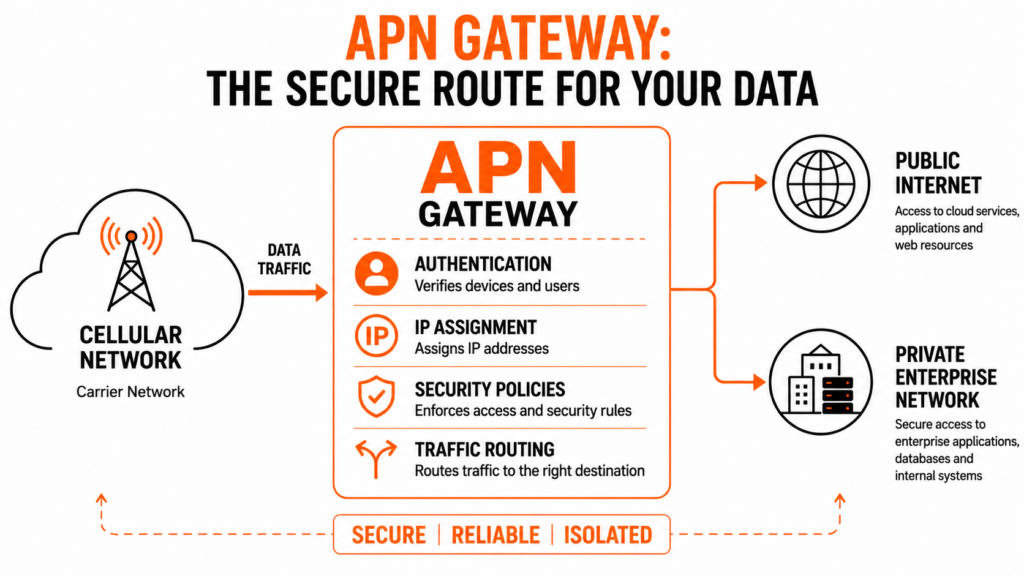
Consider a company operating 20,000 connected vending machines that continuously send inventory, payment, and pricing data. With a public APN, that traffic travels over the shared internet. With a private APN, it is routed directly to the company’s secure backend. That single APN decision can significantly impact the deployment’s security.
Devices on the same carrier network can use different APNs and follow entirely different routing and security policies. For example, a fleet of GPS trackers might use a private APN, while a consumer smartwatch on the same network uses a public APN.
APN settings can be stored directly on the SIM card or configured within the device’s firmware. For large-scale IoT deployments, most connectivity platforms support Over-the-Air (OTA) provisioning, allowing administrators to update APN configurations across thousands of deployed devices remotely. This eliminates the need for physical access to devices and significantly simplifies fleet-wide connectivity management.
Private APN vs Public APN: What Is the Difference?
Once you understand how APNs work, the next question is which type you should use. This is where most IoT decisions get made, and where the stakes are highest.
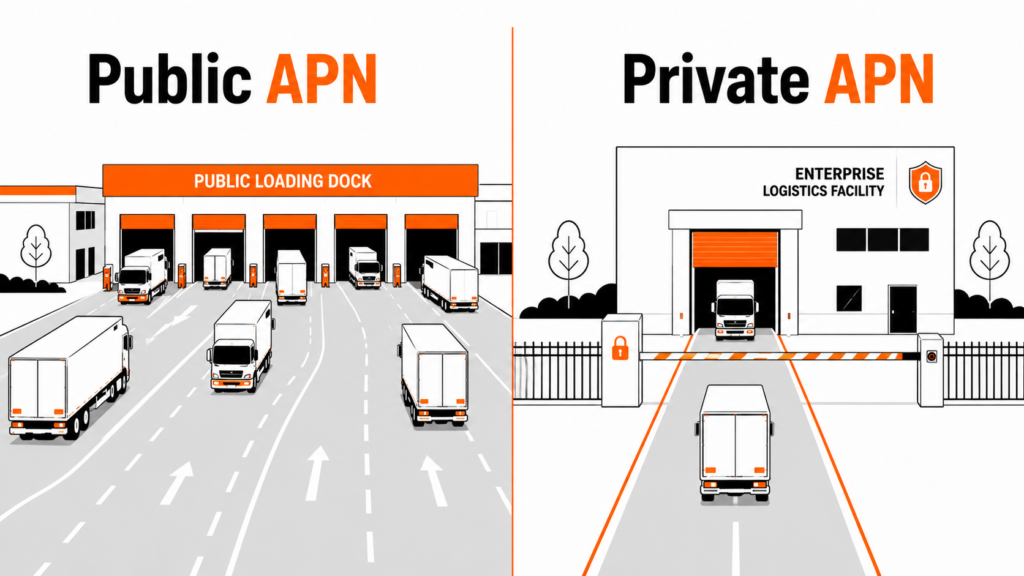
A public APN is the default connection provided by carriers. It is shared infrastructure. When you pop a SIM into a phone and it connects automatically, that is a public APN doing its job.
A private APN is a dedicated, organization-specific connection. Traffic does not touch the public internet. It routes directly into your company’s systems through a controlled, isolated path.
Here is a side-by-side comparison:
| Feature | Public APN | Private APN |
|---|---|---|
| Access | Shared with all carrier users | Dedicated to your organization |
| IP Addressing | Dynamic, shared public IPs | Static, private IP ranges |
| Security | Standard internet-level security | High security with isolated traffic and VPN support |
| Traffic Routing | Public internet | Private network or corporate backend |
| Visibility | Shared infrastructure | Fully controlled environment |
| Compliance Support | Limited | Strong, with data remaining within a controlled perimeter |
| Cost | Lower, often included with carrier plans | Higher due to setup and management fees |
| Setup Complexity | Simple and usually pre-configured | Requires carrier coordination and configuration |
| Best For | Consumer devices and low-risk applications | Enterprise IoT, healthcare, finance, and critical infrastructure |
For early-stage or low-sensitivity projects, a public APN is perfectly fine. But once you are handling sensitive data, managing thousands of devices, or operating in regulated industries, the limitations of a public APN become a liability. For a broader look at how connectivity options compare, see our IoT connectivity comparison.
Some carriers offer enhanced public APNs that include additional authentication and access-control mechanisms beyond a standard public APN. These solutions provide a practical middle ground between traditional public APNs and fully dedicated private APN deployments. For organizations managing mid-scale IoT deployments, they can deliver improved security and network control without the cost, complexity, and operational overhead typically associated with a private APN architecture.
Why Private APNs Matter for Enterprise IoT
Picture two delivery systems at a busy logistics facility. One is an open public dock where anyone can drop off or pick up goods. The other is a secured loading bay accessible only to pre-approved vehicles with verified credentials.
A private APN is the secured loading bay for your data.
Enterprises managing thousands of IoT devices need greater control over how their data moves. Private APNs provide that control through:
Security Benefits
- Devices are not exposed to the public internet unless explicitly configured.
- Authentication is required before any connection is established.
- Traffic can be routed through IPSec or VPN tunnels between devices and backend servers.
- Access controls can be enforced at a granular level.
Consider connected ATMs as an example. On a public APN, those machines are technically reachable through shared public infrastructure. On a private APN, all traffic flows through an encrypted tunnel directly into the bank’s internal systems. External access is blocked by design.
According to IBM’s 2025 Cost of a Data Breach Report, the average cost of a data breach reached $4.4 Million globally, with critical infrastructure sectors seeing even higher figures. For enterprises in finance, healthcare, or utilities, traffic isolation through a private APN is not optional. It is a baseline requirement.
Traffic Isolation
Traffic isolation provides greater operational visibility and control. When all device traffic flows through a controlled APN, unusual activity can be identified more easily, and QoS (Quality of Service) policies can prioritize critical data. It also simplifies compliance by helping organizations demonstrate that sensitive information remains within a controlled environment.
For organizations exploring branded connectivity services or building their own mobile offering, private APN architecture is also central to launching an MVNO and controlling end-to-end traffic routing.
While a private APN adds an important layer of protection, it works best when combined with encryption and robust device authentication. It is one layer of a broader security strategy, not the entire stack.
APN as a Security Control
Most people think of APNs as a connectivity setting. In enterprise IoT, they function as a network-layer security control. The architecture can be understood through the key components below.
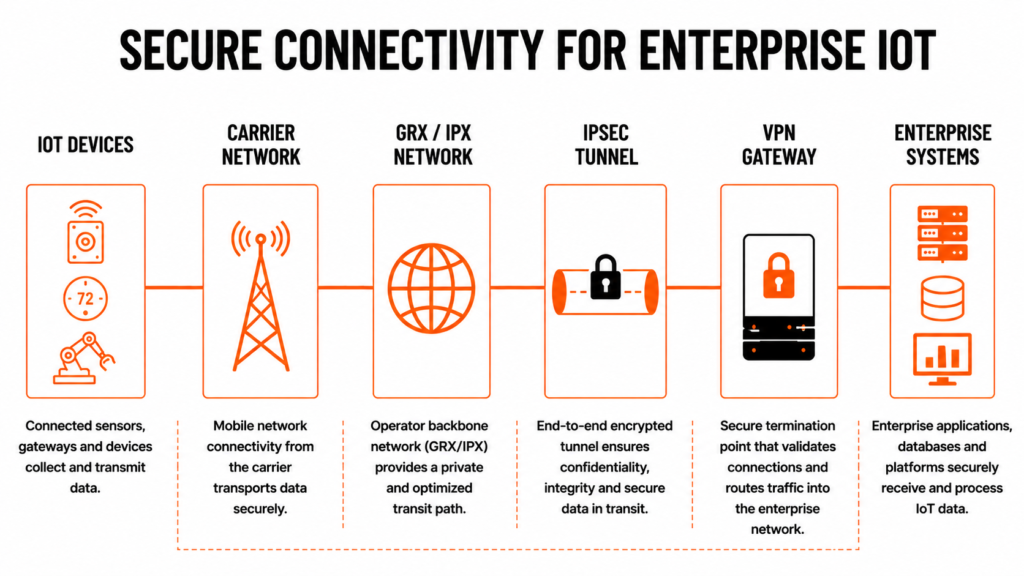
GRX/IPX Roaming: When devices roam internationally, traffic passes through a GRX (GPRS Roaming Exchange) or IPX network. Private APNs can be configured to keep traffic within this controlled roaming infrastructure rather than breaking out to the public internet.
IPSec Tunnels: Traffic between the device and the enterprise backend travels through an IPSec tunnel. This encrypts everything in transit, even if the carrier infrastructure itself is shared.
VPN Integration: Private APNs can terminate directly into a corporate VPN, meaning device traffic arrives inside the enterprise network perimeter as if the device were physically on-site.
Firewall at the APN Gateway: Access policies can be enforced at the gateway level, blocking unauthorized destinations before traffic even reaches the enterprise network.
This layered approach is why industries like manufacturing, energy, and healthcare treat private APN configuration as an infrastructure decision rather than a network setting.
APN Settings by Carrier
Different carriers use different APN strings, authentication types, and IP configurations. Here is a reference table for common enterprise carriers:
| Carrier | APN String | Authentication Type | Notes |
|---|---|---|---|
| T-Mobile (US) | fast.t-mobile.com | None (Public) | For IoT deployments, use iot.t-mobile.com |
| AT&T (US) | broadband | None (Public) | Enterprise customers can request a custom private APN |
| Verizon (US) | vzwinternet | None (Public) | Private APN services require a business account |
| Vodafone (UK/EU) | internet | PAP/CHAP | Enterprise private APNs available upon request |
| Orange (EU) | orange.fr | PAP | Private APN options available for enterprise fleets |
| NTT Docomo (JP) | spmode.ne.jp | PAP/CHAP | IoT deployments may use iot.docomo.ne.jp |
| KDDI (JP) | au.au-net.ne.jp | CHAP | Enterprise APN configurations available |
For IoT modules, APN settings are usually configured using AT commands rather than entered manually. Since APN values can vary by carrier, region, and plan, always verify the correct settings before deployment.
How to Set Up an APN (Device + Module)
Configure APN on Android
- Open Settings.
- Navigate to Network & Internet → Mobile Network → Access Point Names.
- Select Add New APN.
- Enter the APN string, authentication type, and any required credentials provided by your carrier.
- Save the configuration and activate the new APN profile.
Configure APN on iPhone
- Open Settings.
- Navigate to Cellular → Cellular Data Network.
- Enter the APN value in the Cellular Data field.
- Save the changes and restart the device if required.
For private APNs, carriers often distribute configuration profiles automatically rather than requiring manual setup.
Configure APN on IoT Modules
Unlike smartphones, IoT modules are typically configured using AT commands. During device provisioning, the APN string is specified within the PDP context configuration command.
These commands follow the 3GPP TS 27.007 standard. In most cases, the APN string is entered as the third parameter within the “CGDCONT” command. If you are unsure of what IoT module fits your deployment the best, check Spenza’s IoT device buyer’s guide.
APN Troubleshooting: 10 Common Failures
Many IoT connectivity issues can be traced back to incorrect APN configurations. Here is a decision tree of the ten failures you are most likely to encounter:
| Failure | Likely Cause | Fix |
|---|---|---|
| No data connection | Wrong APN string | Verify the APN string character by character |
| Authentication error | Wrong PAP/CHAP credentials | Re-enter username and password exactly as provided |
| No IP address assigned | SIM not provisioned for APN | Contact the carrier to enable APN on the SIM profile |
| Connection drops in roaming | Roaming is not enabled for the private APN | Confirm roaming agreement supports private APN routing |
| IPv4/IPv6 mismatch | Device requests the wrong IP type | Set IP type to IPV4V6 in the “CGDCONT” command |
| High latency or packet loss | MTU size mismatch | Reduce MTU to 1400 and test |
| Carrier provisioning delay | APN enabled but not propagated | Wait 2-4 hours after SIM activation |
| SIM rejected by the network | SIM not activated | Activate the SIM through the carrier portal first |
| APN typo not caught | Case sensitivity or extra space | APNs are case-sensitive; remove all whitespace |
| Config not applying after update | Firmware cache holding old settings | Reboot the module and re-issue AT commands |
According to Ericsson’s Mobility Report, the number of cellular IoT connections is projected to reach 7.4 billion by 2030, driven by growing adoption across manufacturing, logistics, utilities, healthcare, and smart city deployments. At that scale, even a small configuration error rate can translate into thousands of non-functional devices in the field.
APN, Static IP, and Roaming
Not all APNs assign IP addresses in the same way. Depending on the deployment requirements, devices may receive either dynamic or static IP addresses, each offering different trade-offs in terms of cost, accessibility, and network management.
Dynamic vs. Static IP
By default, most APNs assign dynamic IP addresses. This means a device may receive a different IP address each time it reconnects to the network. For many IoT deployments, that’s perfectly fine. Devices simply send data to the cloud, and the specific IP address rarely matters.
Some use cases, however, require a more predictable setup. A static IP APN assigns the same IP address every time a device connects. This makes it easier to manage firewall rules, whitelist devices, and support applications where backend systems need to initiate communication with a device rather than wait for it to send data first.
In general, dynamic IPs work well for large-scale deployments focused on outbound communication and cost efficiency. Static IPs are more common in enterprise environments where security policies, remote access requirements, or consistent device identification are important.
APN Behavior Across Borders
As IoT deployments expand across countries, APN configuration becomes more complex. A setup that works in one region may behave differently when devices roam onto partner networks. While public APNs are usually handled automatically, private APNs require roaming carrier support to maintain secure routing. Without it, traffic may be routed over the public internet, reducing the benefits of a private APN.
For multi-country deployments using multi-carrier IoT SIMs, APN configuration becomes especially critical. Organizations must ensure their APN works across all target networks or enable dynamic APN switching to select the appropriate APN based on the carrier and region.
eSIM technology helps simplify global APN management by allowing carriers and connectivity profiles to be updated remotely. Instead of replacing physical SIM cards, organizations can adapt connectivity settings over the air, making large-scale international deployments easier to manage.
APN Management at Scale
Enterprises often struggle with fragmented carrier portals, inconsistent policies, and limited visibility, turning APN management into an operational challenge rather than a simple networking task.
Spenza’s connectivity management platform solves this by centralizing multi-carrier APN management into a single operational layer. Instead of configuring APN settings carrier by carrier, enterprises define policies once and apply them consistently across networks.
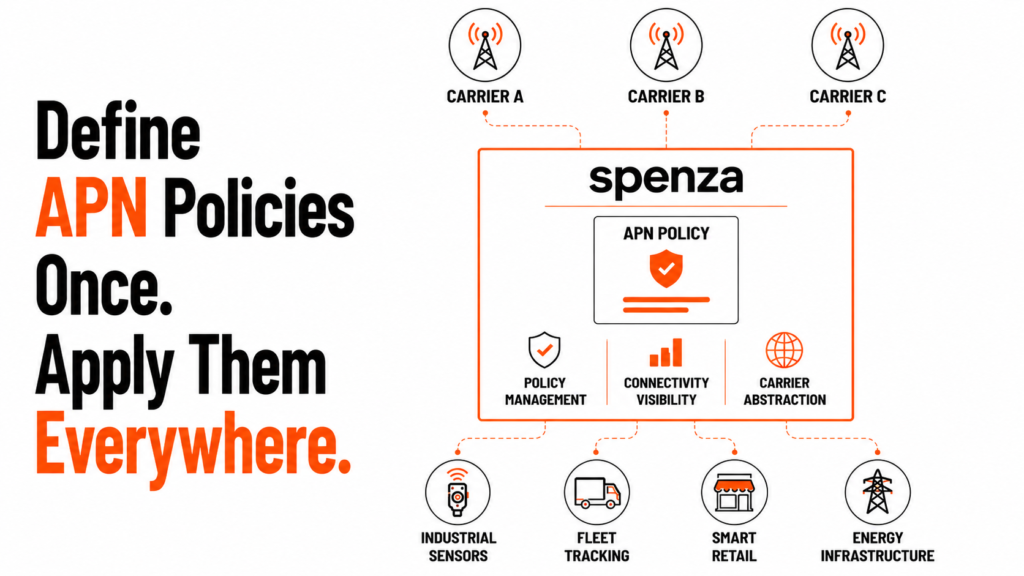
With Spenza, organizations can:
- Configure public and private APN settings from one interface, abstracting carrier-specific formats.
- Standardize routing and IP policies across regions and carriers.
- Maintain traffic isolation and access controls at scale.
- Push APN configuration updates to large SIM fleets without touching multiple carrier portals.
- Monitor device session activity and connectivity status from a unified dashboard.
This shift moves organizations from fragmented, carrier-by-carrier control to a structured, security-aligned connectivity architecture. It aligns with the broader telecom-as-a-service model, where connectivity infrastructure is abstracted and centrally orchestrated.
Conclusion
An APN is one of those settings that stays invisible when everything works and becomes critical when it doesn’t. For anyone just beginning to explore IoT connectivity, understanding what an APN does and what decisions surround it is genuinely foundational.
For small projects, a public APN gets you online quickly. Larger and more complex deployments depend on well-managed APN infrastructure to maintain security, consistency, and reliability.
The right APN strategy is not a technical checkbox. It is the routing foundation that determines how securely, efficiently, and reliably your devices operate in the real world.
FAQs
Explore how Spenza enables secure, multi-carrier APN IoT management from a single platform. Schedule your personalized demo today!