
The sections below set out what we could verify as of 16 Nov 2026 and the questions to resolve before shipment. This is not legal advice. Each source is dated where it gives a date and labeled by type, and most are law-firm, analyst or trade-press summaries rather than regulator text. Country-by-country guides may follow.
What Is Permanent Roaming for IoT Devices?
Permanent roaming usually describes a SIM or device using a visited network on an ongoing rather than temporary basis. There is no global rule that makes every deployment permanent after 90 days. Transforma Insights (undated report page) says roaming typically becomes "permanent" beyond about 90 to 120 days on a foreign network, drawing on a survey of regulators in over 80 countries. That is an analyst's working range, not a legal definition.
Some countries set a fixed allowance for foreign SIMs, and a rule may count consecutive or cumulative days, or depend on the roaming contract. Document the rule, the counting method, the evidence date and the operator conditions for each destination.
The BEREC report on M2M and permanent roaming (BoR (24) 165, 5 Dec 2024) notes that some countries restrict permanent M2M roaming, and its summary mentions local profiles as one response. The report page states no day threshold.
Which Countries Restrict Permanent IoT Roaming?
Analysts sort countries into those that prohibit permanent roaming, those that cap it and those that permit it with conditions. The table gives each country's reported status with the evidence type and date, so you can weigh how much to rely on it.
| Country | Reported status | Key restriction | Evidence and date | Before you ship |
|---|---|---|---|---|
| Brazil | Restrictive | ANATEL, Brazil's telecom regulator, was reported to prohibit permanent roaming for IoT/M2M (as of Jan 2025); the rules are under review | Regulatory analysis: Cullen International, 29 Jan 2025 | Confirm foreign-SIM status with a Brazilian carrier; see the Brazil update below |
| Turkey | Restrictive | Permanent roaming not allowed under Law 5809; foreign profiles installable only outside the customs zone | Legal analysis: IAPP, 24 Apr 2019 | Confirm IMEI registration and local profile rules with a carrier and counsel |
| India | Restrictive | Listed as prohibiting permanent roaming for IoT/M2M | Regulatory analysis: Cullen International, 9 Apr 2026 | Verify current DoT instructions, M2M registration and KYC with the licensed provider |
| China | Restrictive | Listed as prohibiting permanent roaming for IoT/M2M; whether profile switching is accepted is not verified | Regulatory analysis: Cullen International, 9 Apr 2026 | Do not assume a local-profile switch is accepted; confirm with a local carrier |
| Saudi Arabia | Capped | Foreign SIM cards for up to 120 days, then local cards | Consultancy summary: Eleos Compliance, 23 Aug 2024 | Read the CST IoT regulations; confirm conditions, equipment approval and operator terms |
| Oman | Capped | No more than 90 days on local networks; exceptions through TRA, Oman's telecom regulator | Newspaper report of a TRA directive: Oman Observer, 19 Apr 2023 | Confirm the current directive with TRA or a carrier |
| Nigeria | Effectively prevented | National-ID SIM registration requirements effectively prevent permanent roaming on foreign SIMs | Regulatory analysis: Cullen International, 16 Mar 2026 | Plan local connectivity; confirm with a Nigerian provider |
| Belgium | Generally restrictive | Most restrictive in Europe; generally prohibits, with exceptions such as eCall | Regulatory analysis: Cullen International, Oct 2025 | Confirm whether an exception covers your service |
Cullen's Jan 2025 article names Costa Rica alongside Brazil as applying a stricter regime, but we did not find Costa Rica's rule, and its Feb 2026 Americas summary does not mention it.
Turkey: what the sources do and do not say
Legal 500 (9 Jan 2020) states that permanent roaming is not allowed in Turkey and that devices brought into the country get 120 days of international roaming. That is a temporary window, not an IoT permit. The same article says the BTK decision of 12 Feb 2019 requires localization of data storage and eSIMs, and that how it applies to M2M was "not yet clear." The Turkish law firm ESIN (4 Apr 2019) describes that decision as limiting data services through international roaming to 120 days for devices brought in or imported for use in Turkey, for SIMs and eSIMs alike, and as requiring that Turkish operators have sole control of eSIM profiles.
A BTK decision of 20 September 2019 (2019/DK-BTD/183) is reported to define permanent data roaming as 91 accumulated days or more within a 120-day period. We could not retrieve its text, because the published link returns an error, and vendor pages give conflicting versions (91 in 120 days, or 90 in four months). So we do not treat any of these as a standing limit for IoT deployments. Confirm the current IMEI registration, local profile and operator requirements with a Turkish carrier and local counsel before shipping.
India: a recommendation is not a deadline
According to Khaitan & Co., the Telecom Regulatory Authority of India (TRAI) recommended on 21 Mar 2024 that profiles on M2M eSIMs in imported devices be converted within 6 months of activation on an Indian network or an ownership change, whichever comes first. The Department of Telecommunications (DoT) issued instructions on the usage of embedded SIM for M2M on 26 Jun 2025 that say the government considered TRAI's recommendations. As far as we could read them, they set no six-month conversion deadline for imported devices. They say licensees must follow instructions on roaming of foreign M2M SIMs as the government notifies them from time to time.
For a live deployment, verify the current DoT instructions, M2M registration and know-your-customer (KYC) requirements (Khaitan & Co., Feb 2022) and the permitted local provisioning model with the licensed provider.
Where permanent roaming is permitted, with conditions
Not every market is restrictive, but "permitted" does not mean "automatically deployable." Cullen International (5 Feb 2026) says that across most of the Americas markets it surveyed, permanent roaming is treated as legally permissible because foreign-issued SIMs may be used absent an explicit prohibition, and Brazil is "a notable exception." In Europe, Cullen (Oct 2025) finds that most countries allow permanent roaming for IoT through commercial agreements, and Germany allows it only for services that meet the legal M2M definition. Operators may require commercial agreements, and SIM registration, numbering and authorization rules can differ by country and service model, so check each one.
In Africa, the same publisher's 16 Mar 2026 report says South Africa allows long-term foreign SIMs via bilateral roaming, while Egypt and Kenya permit it with approval and license conditions.
Countries missing from this post, including Indonesia, the UAE, Mexico, Vietnam and Russia, are missing because we could not support a rule with a source we trust. Absence is not permission.
Permanent Roaming Time Limits by Country
No limit applies everywhere. The table lists the day counts and periods reported, with who reported them and what they cover. Treat each as a pointer to the rule, not the rule.
| Country | Time limit or period | What it covers | Evidence and date |
|---|---|---|---|
| Turkey | 120 days of international roaming for devices brought in; 91 in 120 not verified | Temporary window for brought-in and imported devices | Legal 500, 9 Jan 2020 |
| Saudi Arabia | Up to 120 days, then local cards | Foreign SIM cards in IoT devices | Eleos Compliance, 23 Aug 2024 |
| Oman | No more than 90 days | IoT roaming SIMs on local networks | Oman Observer, 19 Apr 2023 |
| India | 6 months (a TRAI recommendation) | Converting profiles on imported M2M eSIMs; DoT's 2025 instructions set no such deadline as far as we could read | Khaitan & Co., Mar 2024 |
| Brazil | No day limit verified for foreign-issued IoT SIMs | Separate: a 12-month minimum termination period for certain national roaming contracts (not a foreign-SIM cap) | Teletime, 10 Nov 2026 |
Turkey and Saudi Arabia both show 120 days, but they are different things. Turkey's is a window for devices brought in or imported (Legal 500, 2020), while Saudi Arabia's is reported as an allowance for foreign IoT SIM cards (a consultancy summary).
Brazil's Roaming Rules: November 2026 Update
Brazil raises two different roaming questions, and they should be evaluated separately: use of foreign-issued IoT SIMs on Brazilian networks, and roaming arrangements between Brazilian operators. Cullen International (Jan 2025) reports that ANATEL prohibits permanent roaming for IoT/M2M. The 2026 reporting below concerns ANATEL's permanent-roaming rules for M2M/IoT and its market competition plan, the PGMC.
On 6 Aug 2026, according to Teletime, the ANATEL board postponed its decision on the rules for permanent roaming on M2M/IoT, sending the matter back for further review with a 90-day deadline to deliberate. Councillor Alexandre Freire said the board should not yet conclude on the sanctions regime. That period would have run to about 4 Nov, and the 10 Nov report below does not mention a decision on the sanctions regime.
On 10 Nov 2026, Teletime says the board approved changes to the PGMC. Certain M2M/IoT national roaming contracts signed by 8 Sep 2025 keep continuity until 31 Dec 2030. The minimum contract-termination period for permanent roaming rose from 9 to 12 months, and termination is not automatic at 12 months. The report adds that the decision does not prevent fines from the 91st day of noncompliance. It gives no day limit for foreign-issued SIMs.
On our reading, these provisions concern roaming contracts between Brazilian operators, and they are not a permission for a foreign-issued IoT SIM to roam permanently. The ANATEL rule for M2M/IoT permanent roaming is the separate item that was still under review. Verify the published ANATEL decision and your contract before changing live devices.
When Should You Use a Roaming SIM or Local Profile?
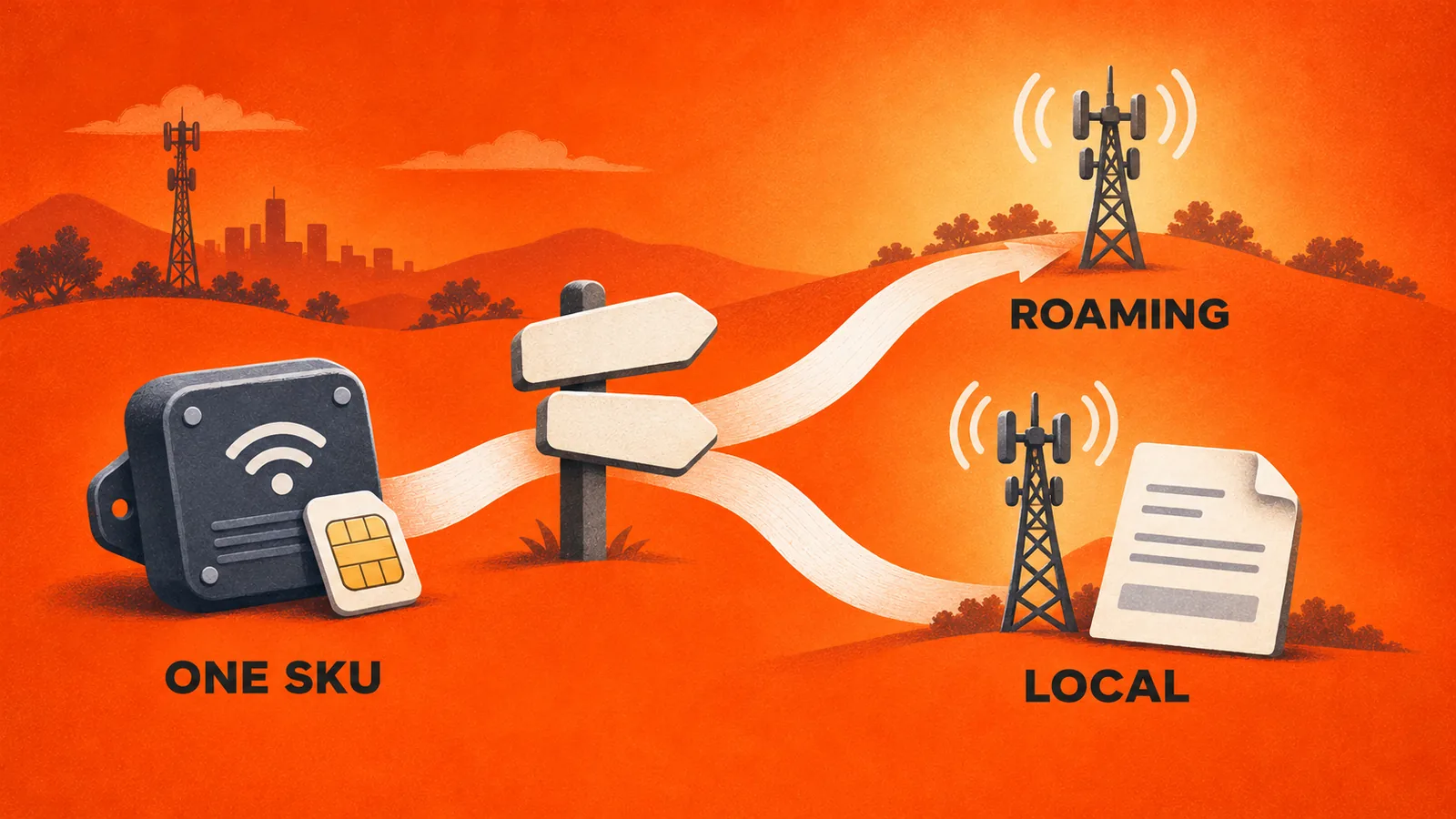
A roaming SIM may simplify testing and cross-border movement where roaming is allowed by local rules and the operator agreement. It should not automatically be the default for a first launch in a restrictive country. Our global IoT connectivity guide points the same way: a local arrangement where long-lived stationary devices need one, and a dated record of each country's constraints.
For fixed devices expected to operate for years, determine before shipment whether a local operator profile is required, when any temporary permission expires, whether the eUICC can lawfully load that profile and what recovery process applies if switching fails. Device registration, radio compatibility and network availability must be validated separately. The next table is Spenza's planning view, not a legal reading.
| Situation | Roaming SIM | Local profile |
|---|---|---|
| Pilot in a market where local rules and the operator agreement allow roaming | Can fit, within those terms | Not needed yet |
| Mobile asset crossing borders | Fits the use case | Rarely practical |
| Stationary, long-life device in a country on the restrictive list | Do not assume it is permitted | Plan it before shipment |
| Country that caps foreign SIM time (Saudi Arabia, Oman) | Only within the cap and its conditions | Needed before the cap ends |
| Turkey: permanent roaming not allowed (2019-2020 sources), a 120-day window for brought-in devices, and an open question on how the 2019 eSIM decision applies to M2M | Temporary only; do not plan on it for years | Ask the regulator and carrier first |
Illustrative example: a water meter will remain in one building for several years. Before shipment, the OEM checks whether the destination country allows temporary roaming for that device and application. If so, it documents the permitted period and a tested switch to a local profile. Otherwise it arranges compliant local connectivity before activation. The device record stores the regulator source, the carrier confirmation, the switch owner and the failure-recovery plan. For the record-keeping side, see our IoT SIM management guide.
How SGP.32 Supports Multi-Country IoT Deployments
SGP.32 is the GSMA's eSIM IoT technical specification (GSMA eSIM specifications), a standard architecture for remote provisioning of compatible IoT eUICC profiles, including devices with network or user-interface constraints. Our orchestration explainer describes the flow: the IoT Profile Assistant (IPA) acts as a proxy between the profile server (SM-DP+) and the IoT remote manager (eIM), and the eIM sends profile operations to the eUICC, for one device or a fleet. It does not guarantee one hardware SKU will work everywhere or make a deployment lawful.
Validation still requires suitable radio bands, equipment approvals, local subscriptions, supported eUICC and module combinations, profile-server and eIM interoperability, bootstrap connectivity and recovery testing. Confirm which SGP.32 version your module and eUICC support. Treat "SGP.32 ready" with care: it is not a full compatibility statement for your hardware, carrier and platform combination.
Two country limits apply. In Turkey, IAPP says foreign profiles can be installed only outside the customs zone, and the 2019 decision covers eSIM localization. If that localization rule applies to IoT at all, which the sources leave open, a switchable profile would not remove the issue, so confirm with the regulator. In China, Cullen lists permanent roaming as prohibited, and we found no source that settles whether profile switching is accepted, so we make no claim either way.
For the standards background, read our guides on multi-IMSI versus eUICC and on SGP.22 versus SGP.32. For the risk of depending on one carrier in the first place, see single-carrier IoT risks.
IoT Country-Readiness Checklist
Before a device ships to a new country, work through these checks and write the answers down with a date.
| Check | Owner and required evidence |
|---|---|
| Status: restricted, capped, conditional or open | Local counsel: the regulator's rule and the applicable service category |
| Counting method and deadline | Regulator, local counsel and carrier: whether days are accumulated, consecutive or contract-based |
| Registration, numbering and licensing | Regulator and carrier: KYC and market-entry documents |
| Local profile and hardware validation | OEM, eUICC and connectivity provider: a lab-tested configuration |
| Data or eSIM localization | Local adviser: storage, profile loading and backend requirements |
| Operational recovery plan | IoT operations: bootstrap profile, failed download, rollback and an owner |
| Governance record | Compliance owner: primary source URL, last-checked date and next review date |
Rules change, as the Brazil update above shows, so schedule the next review before you ship.
Planning an IoT deployment across multiple countries? Spenza helps connected-device teams simplify multi-carrier connectivity operations, provisioning workflows and subscription visibility. Discuss your target markets, device design and rollout requirements with the team.
Multi-Country Deployment Example: Butlr
Butlr illustrates the operational benefits of centralizing multi-country connectivity administration. Spenza's published case study reports that Butlr expanded across the US, UK, France and beyond, that launch time to a new region fell from 60 days to 7, that connectivity management costs dropped 40%, and that financial admin overhead fell by more than 50%.
These are customer-reported operating outcomes with no year given. They are not evidence that any specific roaming arrangement satisfies a national regulator. The case study does not break the results down by country. It lists what the Spenza platform covers: eSIM orchestration, provisioning, billing, reconciliation and pre-integrated compliance (SOC2, KYC, tax, telecom, privacy). That describes platform scope, not a guarantee that your device meets a given country's rules. Country approval, device compliance and provider agreements still need their own verification.
FAQs
Prepared by Spenza, a connectivity management and telecom platform provider. Contact the Spenza team for product-scope questions.