eSIM orchestration coordinates profile operations, carrier services and business policies across connected devices. Remote provisioning provides the mechanisms for profile management; orchestration determines authorized actions, records their results and handles exceptions. For an IoT fleet, a successful API request is only one step toward working service.
The practical buying question is whether a platform can manage the complete change: choosing an eligible profile, reaching the device, confirming service and recovering when a step fails. A shared console cannot make incompatible hardware work or create coverage where none exists. This guide builds on the eSIM overview and explains how to evaluate the architecture, operating rules and evidence behind a multi-carrier deployment.
What does eSIM orchestration do beyond provisioning?
eSIM orchestration connects business decisions with profile operations and service verification across a fleet. Remote SIM provisioning handles secure profile delivery and management. A connectivity management platform usually supplies inventory, usage and operational controls. These functions can overlap within one product, so evaluate demonstrated workflows instead of assuming a fixed product hierarchy.
The useful distinction is responsibility, not a claim that provisioning is always manual.
| Function | Primary task | Buyer should verify |
|---|---|---|
| Remote SIM provisioning | Download and manage supported profiles | Compatible device, profile source and operation results |
| Connectivity management | Maintain inventory, usage and service controls | Data freshness, carrier coverage and control permissions |
| Orchestration | Coordinate approved changes and exceptions | Eligibility checks, recovery behavior and outcome evidence |
| Commercial operations | Manage subscriptions, charges and reconciliation | Entitlements, cancellation state and invoice records |
Source: editorial evaluation framework informed by the GSMA architecture references below. Product boundaries vary by implementation.
RSP can perform repeated remote operations throughout a device lifecycle. A CMP can also contain automation and policy features. Buying an additional product called an orchestrator is useful only when it fills an operational gap, such as coordinating a change across profile, carrier and application systems.
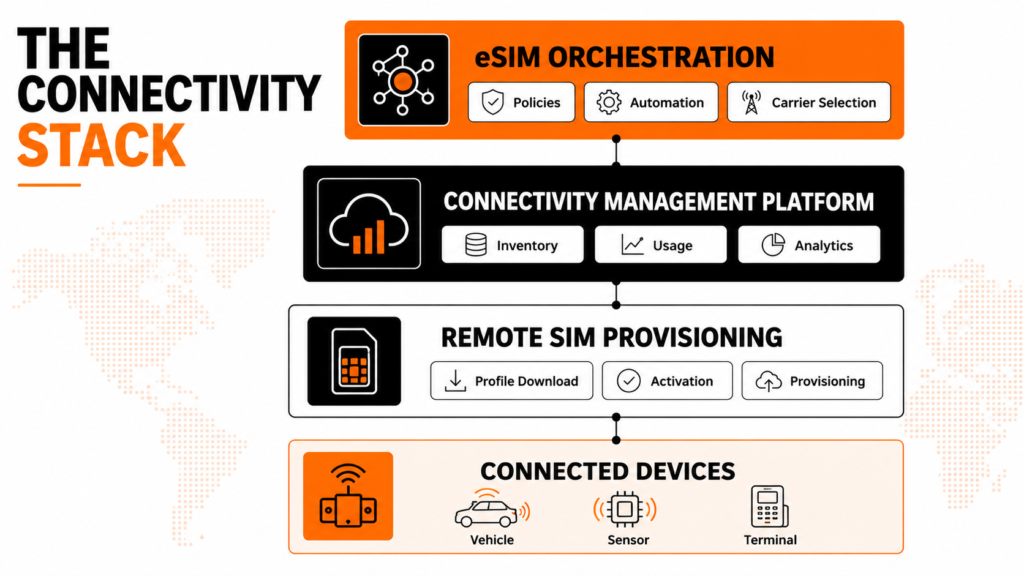
Review your connected-device architecture around those responsibilities and the exact device cohort you intend to operate.
Where does RSP aggregation fit?
RSP aggregation brings supported profile sources and carrier integrations behind a common operating interface. The benefit is fewer separate workflows for enterprise applications to maintain. Aggregation still depends on available profiles, commercial agreements, device compatibility and the scope of each integration; a common API does not create universal operator access.
A useful aggregation layer normalizes inventory identifiers, order requests, operation status and error handling. The underlying carrier systems may expose different capabilities or report events at different times. Record those differences in the integration contract so a shared status field does not conceal missing information.
For example, an order accepted by a marketplace is not confirmation that a profile is installed. A profile installed on an eUICC is not confirmation that the carrier account can use data. Preserve those distinctions when events arrive through one endpoint.
Bring Your Own Network arrangements can retain existing carrier relationships, subject to commercial and technical support. Check who owns the subscription, who can request or revoke profiles, who receives invoices and who handles a disputed operation. Consolidated billing and profile aggregation are separate capabilities, even when a supplier offers both.
The enterprise eSIM management guide explains how inventory and costs connect to business ownership. Use that operating record alongside the technical profile record.
Map SGP.32 roles without conflating consumer provisioning
SGP.32 defines an IoT remote provisioning architecture for devices with network or user-interface constraints. Its eSIM IoT Manager, IoT Profile Assistant, SM-DP+ and eUICC have distinct roles. SGP.22 defines the consumer architecture using a Local Profile Assistant. A shared management interface must preserve the requirements of each supported architecture.
The GSMA SGP.32 specification describes the IoT interfaces and operations. The IPA can reside in the device as IPAd or in the eUICC as IPAe. The eIM supports remote management, while the SM-DP+ prepares and delivers protected profiles for the eUICC.
Direct and indirect download paths are supported architecture options. Their existence does not mean every deployment supports every option. The device, IPA, eIM and profile service must implement compatible versions and interfaces. Document that combination rather than accepting “SGP.32 ready” as a complete compatibility statement.
The GSMA SGP.22 specification describes consumer provisioning. A phone activation flow cannot simply be applied to an unattended sensor. The SGP.22 versus SGP.32 comparison helps separate those designs.
Business policy engines, billing systems and a product marketed as an eSIM orchestrator sit around these mechanisms. They are not interchangeable names for the eIM. Bootstrap connectivity also needs an explicit design: a bootstrap profile or another supported connection must reach the required services. The remote SIM provisioning guide covers that first connection.
Turn connectivity policies into controlled campaigns
Orchestration policies should specify eligible devices, permitted actions, required observations and a recovery plan. A campaign applies a versioned policy to a defined cohort. Cost, location or service quality can inform the decision, but an observed condition should trigger a controlled workflow rather than an unrestricted change across every device.
Start by naming the business outcome. A regional deployment may need an approved local service offer; a renewal may require a different commercial plan without any profile change. Distinguishing plan changes from profile changes prevents unnecessary operations and makes approval responsibilities clearer.
A usable policy includes the conditions for stopping, not just the condition for starting.
| Policy element | Record before execution | Failure question |
|---|---|---|
| Eligibility | Device configuration, market and approved profile | What happens to an unsupported device? |
| Authority | Requesting role, approval and policy version | Can an unauthorized change reach the fleet? |
| Observation | Telemetry source, freshness and acceptance window | Can stale information trigger a change? |
| Recovery | Stop condition, retry limits and escalation owner | What remains possible if contact is lost? |
Source: proposed campaign worksheet, not a GSMA-mandated business policy or measured customer process.
Limit the initial cohort and expand only after reviewing results. Keep the previous policy version, device membership and action history. Otherwise, an operator cannot distinguish a policy error from an incompatible profile or an unreachable device when a campaign stalls.
Verify service and test the recovery path
Profile-change success requires evidence beyond a completed download request. Operations teams should distinguish installation, enablement, network registration and application behavior. Recovery must be tested on the intended device configuration, including loss of connectivity. A remote management platform cannot issue a new command to a device that has no usable communications path.
| Check | Required observation |
|---|---|
| Profile result | Download and enable status for the intended profile and device. |
| Network service | Registration, data path and required service confirmed. |
| Application result | Expected telemetry or transaction received after the change. |

For each campaign, retain the device identifier, intended profile, request identifier, timestamps, returned operation status and application result. Correlate asynchronous events so a late response from an earlier attempt cannot close the wrong request. Check repeated requests and partial completion before allowing unattended retries.
A practical failure drill should include an unreachable device, a rejected profile operation, a profile that enables but cannot provide the required service, and a device that reconnects after the campaign window. Define whether each outcome should retry, pause, recover through a supported local mechanism or escalate for intervention.
Do not assume an alternate stored profile provides automatic fallback. The device and eUICC behavior, configured recovery mechanisms, authorized service and available coverage determine what can happen without a fresh remote command. A profile change may interrupt an application session, and recovery time must be measured for the actual design.
Simplex Wireless describes implementation lessons involving IPA variants and recovery. That provider experience reinforces the need to test the complete combination; it does not establish that another platform supports the same behavior.
Choose use cases around service requirements
IoT orchestration is most useful where repeated connectivity changes or fragmented operations create a meaningful burden. Logistics, remote monitoring, agriculture and industrial deployments have different availability, power and access requirements. The right workflow follows those requirements; the presence of multiple countries or carriers alone does not prove that automatic switching is necessary.
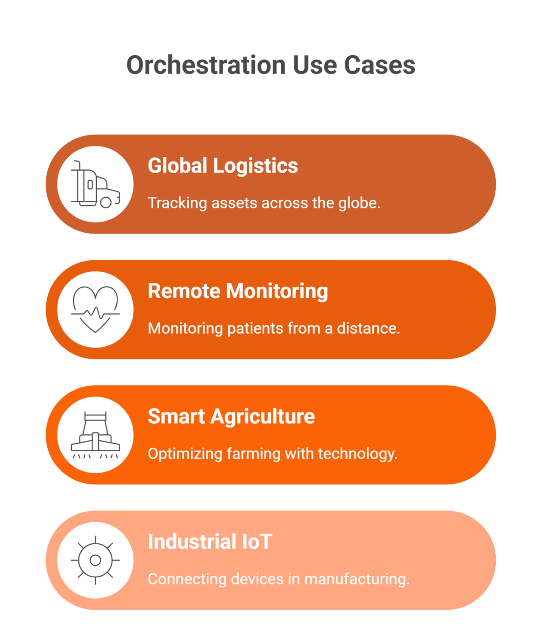
A mobile tracker may need to retain location reports while crossing service areas. Evaluate coverage and recovery along the route, and define how the application handles missing reports. A stationary agricultural sensor may instead prioritize power consumption and a maintenance schedule that matches its communication windows.
Industrial monitoring may involve approved private and public network arrangements. Profile management does not by itself supply the required radio support, network authorization or application routing. For healthcare or other critical applications, validate the complete service design and its required fallback behavior; eSIM orchestration alone is not a continuity or safety assurance.
A common device SKU can reduce provisioning variation where radio bands, product approvals and carrier services align. Remote profiles cannot remove those physical and commercial constraints. See the IoT eSIM deployment guide for the wider device and network requirements.
A smaller, stable deployment may be adequately served by existing carrier controls and documented manual procedures. Compare the operating burden and failure exposure before adding another platform or integration.
Evaluate a platform with a scoped pilot and operating record
An eSIM orchestration pilot should demonstrate supported device operations, recovery and commercial reconciliation on a defined cohort. The published Butlr case provides an approved example of regional connectivity coordination through Spenza. Its evidence supports tailored plans, centralized management and unified billing; it does not identify a tested SGP.32 profile-switching implementation.
Butlr needed to coordinate sensor connectivity across markets including the US, UK and France. The published Butlr case study describes plans matched to device requirements and simpler service and financial management. Apply that lesson by joining technical records to the regional service and billing process.
Accept a pilot only when technical and operating records agree.
| Review area | Evidence to retain | Responsible team |
|---|---|---|
| Compatibility | Versioned configuration and approved profile matrix | Product and delivery engineering |
| Campaign result | Profile, network and application results, including failures | Engineering and fleet operations |
| Operating control | Permissions, audit trail and escalation record | Platform operations |
| Commercial closure | Usage, charges, cancellation and final invoice reconciliation | Operations and finance |
Source: proposed acceptance framework. Kigen’s published multi-vendor demonstration illustrates the value of naming the tested environment, rather than treating a demo as universal compatibility.
Compare total operating cost across equivalent cohorts and observation periods. Include platform charges, connectivity, support, failed changes and field recovery. Retiring a device also requires closing the carrier subscription and reconciling final charges; disabling a profile alone does not establish commercial cancellation.
Bring your device configuration and regional service requirements to an architecture review so the proposed pilot has clear boundaries.
eSIM orchestration earns its place when it makes connectivity changes controlled, observable and recoverable. Start with the device configuration and authorized service, identify the profile-management architecture, then write policies with explicit stop conditions. Require separate evidence for profile operations, network service and application behavior. Keep subscription and billing closure in the same operating process. The next step is a scoped pilot with an agreed acceptance record, followed by expansion only after the results support it. Review that pilot with Spenza before making broader claims about automation or resilience.
eSIM orchestration FAQs
eSIM orchestration questions often combine standards, platform features and commercial responsibilities. The answers below separate those topics so buyers can define an acceptance test for their own fleet. Confirm the exact device, profile source and service arrangement before treating a capability described for one implementation as available in another.
Is eSIM orchestration the same as remote SIM provisioning?
No. RSP provides mechanisms for remotely delivering and managing supported profiles. Orchestration coordinates authorized decisions, execution, observations and exceptions across the operating workflow. The same product can contain both functions. Evaluate the required behavior and evidence instead of assuming that an RSP label means manual or one-time provisioning.
Does SGP.32 automatically choose the cheapest carrier?
No. SGP.32 defines IoT profile-management mechanisms and interfaces, not a universal commercial optimization policy. Choosing a carrier depends on authorized offers, service requirements, device compatibility and business rules. A platform may implement that decision process, but buyers should verify its inputs, permissions, execution controls and measured results.
Can orchestration recover a device that is completely offline?
A platform cannot send a fresh remote command without a usable path to the device. Recovery may depend on previously configured device or eUICC behavior, an available alternate service or physical intervention. Test the supported recovery design before deployment, including what happens when the device returns after the campaign expires.
Does RSP aggregation remove every carrier integration?
No. Aggregation can place supported integrations behind a common interface, reducing repeated work for enterprise applications. The platform still needs compatible profile sources and carrier processes, while commercial agreements remain necessary. Confirm supported operations, error mapping, event timing and responsibility for integrations that fall outside the platform’s existing coverage.
Can one platform manage SGP.22 and SGP.32 devices?
A platform may expose both through a shared operating interface if it supports the required integrations. Consumer SGP.22 and IoT SGP.32 still use different architectures and device components. Require separate compatibility and acceptance records for each device cohort rather than assuming one successful flow validates both specifications.
Does deleting a profile end its subscription charges?
Not necessarily. Profile state and commercial subscription state belong to different parts of the operating workflow. Confirm the carrier’s cancellation process, effective date and final charges, then reconcile the result with your inventory. A retired device should have both a completed technical disposition and a documented commercial closure.