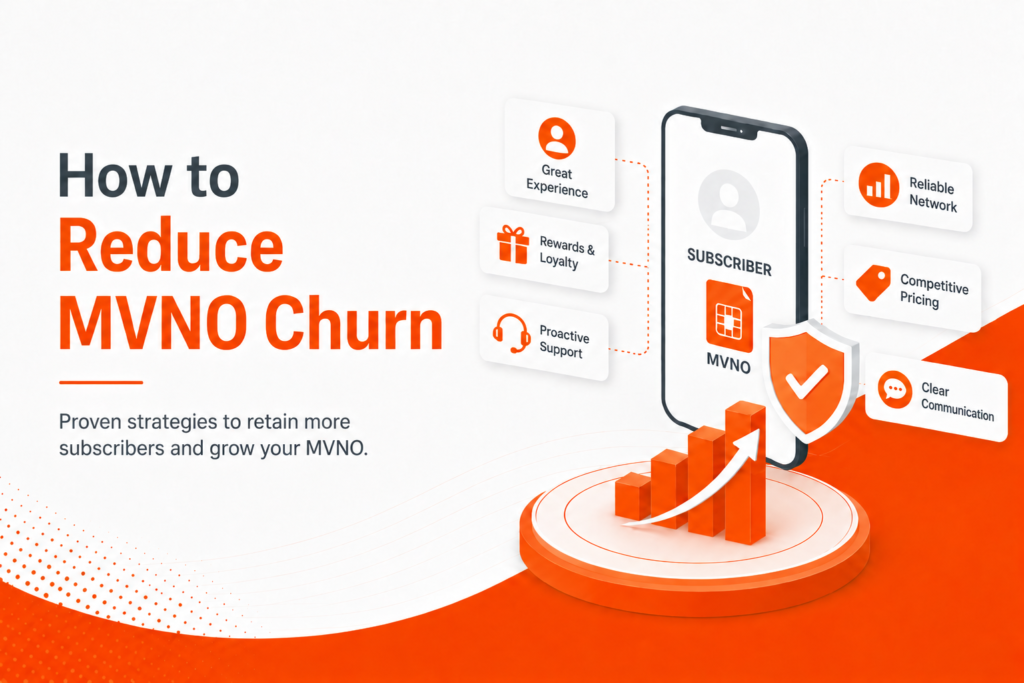
A customer does not have to cancel their plan for an MVNO to lose them. A failed recharge, an inactive eSIM, a service issue, or a customer quietly using less of their plan can all be early signs that churn is coming.
Recent operator data shows how significant the gap can be. In Q2 2025, Rogers reported 3.23% monthly churn for prepaid customers, compared with just 1.00% for postpaid mobile phone customers. In Q1 2026, PLDT reported a stable churn trend for Smart Prepaid, compared with just 1.4% for postpaid customers. These numbers show why retention cannot start at the cancellation screen.
For MVNOs, the goal is not simply to match postpaid churn. It is to keep churn low enough to recover customer acquisition cost (CAC) and generate the lifetime value (LTV) needed for a profitable subscriber relationship.
That means acting across the entire subscriber lifecycle: getting activation right in the first 90 days, spotting declining usage and service problems early, recovering failed payments before they become churn, and reaching at-risk customers before they port out.
The key is simple: spot the warning signs early and give customers a reason to stay.
Strategy Summary
Here’s a brief summary of the 8 retention strategies, the signals to watch, and the key metrics that help MVNOs reduce churn.
| Strategy | Trigger or Signal | Primary Metric |
|---|---|---|
| 1. Improve onboarding activation | eSIM installed but inactive, no usage within 48 hours | Activation rate, day-7 active rate |
| 2. Clarify the first bill or recharge | First invoice or top-up due | First-cycle survival |
| 3. Run early-life check-ins | Usage decline or support contact in weeks 2–8 | Day-90 retention |
| 4. Provide proactive support | Network issue, repeat contacts, falling CSAT | Service-driven churn |
| 5. Use usage nudges and right-sizing | Overage or persistent underuse | Plan fit, ARPU, voluntary churn |
| 6. Build loyalty and VAS | Tenure milestones, no autopay, single-line accounts | Tenure, autopay, lines per account |
| 7. Recover involuntary churn | Failed payment, balance expiry, dormancy | Recovered subscribers |
| 8. Create save and win-back flows | Port-out, cancellation intent, post-churn inactivity | Save and win-back rate |
Why Churn Decides MVNO Profitability
Churn is not simply a customer experience metric. It directly determines how long an MVNO gets to recover its acquisition costs and generate margin from a subscriber.
The basic relationship is straightforward:
Average customer lifetime = 1 ÷ monthly churn rate
At a 5% monthly churn rate, average subscriber lifetime is approximately 20 months. At 3%, it increases to approximately 33 months.
That difference matters because an MVNO may spend significantly less to acquire a customer than a major postpaid operator, but it also generally operates with a shorter customer relationship. The commonly reported CAC ranges from approximately $30 to $80 for MVNO subscribers, compared with $250 to $400 for major postpaid operators, while prepaid ARPU is often cited around $35 to $45 per month.
Consider what happens when churn falls from 8% to 5%.
| Monthly churn | Approx. lifetime | Relative lifetime |
|---|---|---|
| 8% | 12.5 months | 100% |
| 5% | 20 months | 160% |
| 3% | 33.3 months | 267% |
Moving from 8% to 5% monthly churn therefore increases expected customer lifetime by roughly 60%, without increasing price or acquisition volume.
That is why retention should be treated as an economic lever, not simply a CX initiative.
What a Good MVNO Churn Rate Actually Is
There is no universal “good” MVNO churn rate.
The MVNO monthly churn is around 5% to 8%, while other sources report approximately 6% to 10%. Postpaid is commonly reported at around 1% to 2% monthly, while prepaid can sit around 4% to 6%. Overall telecom churn is often cited at approximately 21% to 31% annually.
The important point is not to manufacture a single benchmark from conflicting sources. The ranges differ, and operators should report the source and date whenever they quote a benchmark.
Instead, calculate the churn your economics can support.
If your CAC is low and gross margin is strong, you may tolerate more churn than an operator with high acquisition costs. If you invest heavily in acquisition, customer support, onboarding, or incentives, the required subscriber lifetime becomes higher.
The right question is therefore:
“What churn rate allows us to recover CAC and generate our required LTV?”
That is a more useful operating target than attempting to achieve postpaid-level churn simply because the percentage looks better.
Voluntary vs. Involuntary Churn (and Why Prepaid Churn Is Silent)
Not every subscriber who disappears from your base actively decides to leave.
Voluntary churn occurs when a subscriber chooses to cancel, port out, downgrade, or otherwise stop using the service because of factors such as price, service quality, poor support, lack of value, or a better competing offer.
Involuntary churn occurs when service ends because of a payment failure, expired balance, failed recharge, or another account-state event. The subscriber may not have intended to leave.
The distinction matters because the two types require different interventions.
| Churn type | Typical signal | Retention response |
|---|---|---|
| Voluntary | Port-out, cancellation request, usage decline | Save offer, plan change, support intervention |
| Involuntary | Failed payment, expired balance, failed recharge | Dunning, retries, payment recovery, grace period |
| Prepaid inactivity | No recharge or usage | Defined inactivity window, reminder, win-back |
Involuntary churn is particularly important because published studies estimate that failed payments can account for roughly 20% to 40% of total churn.
For an MVNO, retention is therefore partly a BSS and charging problem.
A payment failure does not have to immediately become a termination. A subscriber can receive a reminder, enter a grace state, receive another payment attempt, or be directed toward a top-up or payment-recovery flow.
The same principle applies to prepaid service. A postpaid subscriber may explicitly cancel. A prepaid subscriber can simply stop recharging.
That makes prepaid churn a definition problem before it becomes a retention problem.
An MVNO needs to define when inactivity becomes churn: 30, 60, or 90 days, for example. Whatever window is chosen should be stated whenever the churn figure is reported because changing the inactivity definition changes the resulting churn rate.
Early Life: Winning the First 90 Days
The first 90 days of a subscriber lifecycle are critical. During this period, customers evaluate network experience, plan value, onboarding experience, and overall service quality. Poor early experiences can increase the likelihood of churn.
That makes the first three months less about sophisticated loyalty programs and more about getting the fundamentals right.
1. Onboarding Activation
An activated subscriber is not the same thing as a subscriber who has completed checkout.
This is particularly important with eSIM. An eSIM makes joining an MVNO easier, but it can also make switching away easier. Activation therefore becomes a retention event rather than merely a fulfilment step.
The most useful early signal can be surprisingly simple:
An eSIM has been installed, but the subscriber has not generated meaningful usage.
Other signals include:
- No usage within 48 hours
- Port-in not completed
- SIM or eSIM installation without service activation
- No app engagement after purchase
These signals should trigger an activation journey rather than waiting for the subscriber to contact support.
The primary metrics are activation rate and day-7 active rate.
2. First-Bill and First-Recharge Clarity
The first payment is another critical retention moment.
A customer who does not understand when their first invoice, recharge, renewal, or balance expiry occurs can interpret a predictable billing event as an unexpected charge or service problem.
Before the first bill or recharge is due, make the following clear:
- What the customer will be charged
- When the charge occurs
- What happens if payment fails
- When prepaid balance expires
- How to add or update a payment method
- What happens when a plan renews
For prepaid customers, reminders before recharge and balance expiry can prevent avoidable service interruptions.
The metric to watch is first-cycle survival, supported by billing-related support tickets.
3. Early-Life Check-Ins and Saves
Do not treat all new subscribers as equally healthy.
Track the retention curve for each acquisition cohort at day 30, day 60, and day 90 instead of relying only on blended monthly churn.
A subscriber whose usage drops sharply during weeks two through eight may be showing an early sign of disengagement. A support interaction during the first month can also indicate friction that will later become churn.
The response should be proportional to the signal. A customer who is still using the service normally does not need a retention campaign. A customer whose usage is falling, who has contacted support repeatedly, or who has failed to complete activation may need a targeted intervention.
The primary metric is day-90 retention.
In-Life: Staying Worth Keeping
Once a subscriber survives the first 90 days, the retention problem changes.
The focus shifts from activation and onboarding to service quality, perceived value, usage behaviour, and relationship depth.
4. Proactive Support
Service problems are among the most important drivers of telecom churn.
Waiting for customers to report every issue is expensive because the cancellation decision may happen before the support team knows there is a problem.
Instead, connect network and subscriber signals.
Examples include:
- A known network issue in the subscriber’s area
- Repeated support contacts
- Falling customer satisfaction
- Recurring service interruptions
- Repeated failed attempts to resolve the same issue
A proactive message acknowledging an outage or providing a resolution path can prevent the customer from interpreting silence as indifference.
For deeper CX and support practices, this strategy should connect with Spenza’s existing content on enhancing UX and support in MVNOs.
5. Usage-Based Nudges and Right-Sizing
Usage is one of the clearest indicators of whether a subscriber still sees value in their plan.
Two opposite patterns deserve attention.
Persistent overuse can create bill shock or make the customer feel that the plan is too expensive.
Persistent underuse can create value doubt. The subscriber may wonder why they are paying for capacity they do not need.
Usage-based nudges can address both.
For example, an MVNO can alert a customer approaching a data threshold, recommend a better-fitting plan, or suggest a lower-cost option when consistent underuse indicates that the current plan is excessive.
A downgrade is not necessarily a retention failure. Keeping a customer on a smaller plan can be more valuable than losing the customer entirely.
Track plan fit, ARPU, usage patterns, and voluntary churn together rather than optimizing ARPU in isolation.
6. Loyalty, VAS and Plan Design
Loyalty works best when it reinforces behaviours that make subscribers more durable.
A documented regional MVNO case found that a loyalty program targeting a high-risk prepaid segment reduced churn by 28% while increasing app engagement. The program rewarded behaviours such as autopay enrollment, referrals, and longer tenure, rather than relying only on discounts.
That distinction matters.
A discount can reduce the immediate price of staying. A well-designed loyalty program can strengthen the relationship itself.
Useful mechanisms include:
- Tenure rewards
- Autopay incentives
- Referral rewards
- Value-added services
- Multi-line benefits
- Annual prepaid plans
- App-based engagement
Autopay deserves particular attention because it can reduce both voluntary and involuntary churn. It removes one source of payment friction while also creating a more predictable renewal behaviour.
The key metrics are tenure, autopay penetration, and lines per account.
At-Risk and Exit
The final lifecycle stage is where intervention needs to become highly specific.
The objective is no longer broad engagement. It is recovering subscribers who are about to disappear or have already disappeared.
7. Fixing Involuntary Churn
Payment failure should not automatically equal customer loss.
A practical recovery sequence can include:
- Pre-dunning reminders before payment or balance expiry
- Smart payment retries
- Card account updater support
- A grace state instead of immediate termination
- Restricted service where appropriate
- A clear payment or top-up recovery path
- Network-level redirection toward top-up when a balance expires
This is where subscriber management and charging architecture directly influence retention.
For example, a prepaid subscriber approaching balance expiry can be given a clear top-up path rather than simply losing service. A failed card payment can trigger a recovery journey rather than an immediate account termination.
The goal is to recover the 20% to 40% potentially recoverable share of churn associated with payment failures, rather than spending acquisition dollars replacing customers who could have been retained.
8. Save Flows and Win-Back
Some customers will still decide to leave.
The objective is to make the final intervention timely and economically rational.
A port-out request, cancellation intent, or sudden change in usage can trigger a save flow.
For MVNOs, save offers do not need to resemble the expensive retention tactics of major postpaid operators. A plan change, temporary credit, additional value, or better-fit package may be enough.
After churn, the 30-to-90-day window can be valuable for win-back. The number, account relationship, and usage habits may still be relatively fresh.
Measure these programs honestly.
Track:
- Save rate
- Win-back rate
- Reactivation
- Post-win-back retention
- Offer cost
- Incremental LTV
A customer who accepts an offer and churns again immediately should not be counted as a successful retention outcome.
How Spenza Powers Proactive Retention
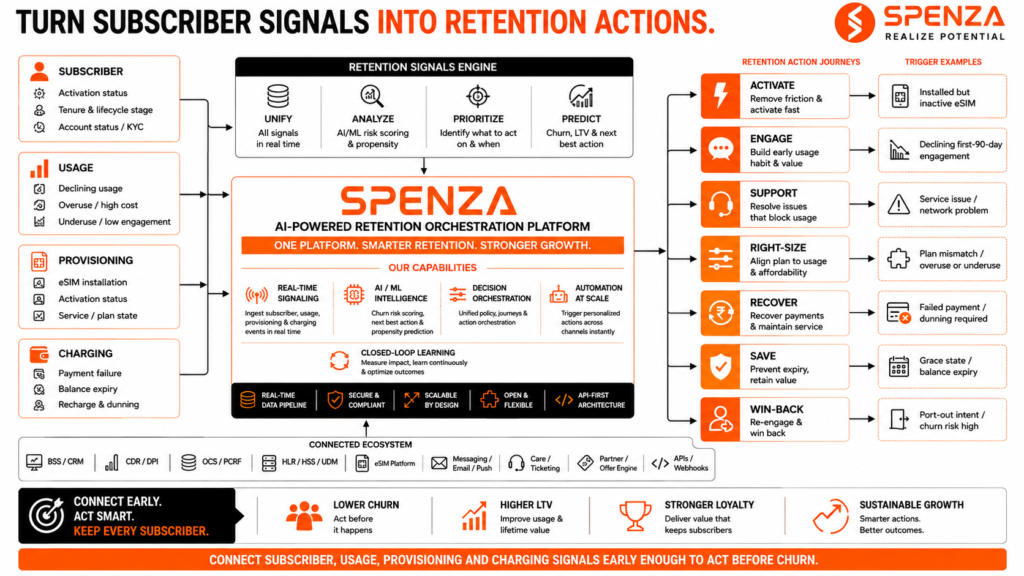
Retention becomes much easier to operationalize when subscriber, usage, provisioning, and service data can be viewed together.
Spenza can support the retention workflow by connecting the operational signals behind several of the strategies above.
For strategies 1 and 3, usage and subscriber data can help identify customers who have completed an eSIM installation but have not become active, as well as subscribers whose engagement is declining during the first 90 days.
For strategy 5, usage visibility can help identify overuse and underuse patterns. That creates an opportunity to recommend a better-fitting plan before the customer reaches bill shock or decides the service is poor value.
For strategy 4 and strategy 6, self-service and engagement capabilities can support proactive communication and ongoing subscriber interaction.
For strategy 7, subscriber-management and charging workflows can support recovery paths around payment failure, grace states, balance expiry, and dunning rather than treating every failure as an immediate termination event.
The broader principle is simple: retention should not depend entirely on a marketing team discovering churn after it happens. The operational platform should expose the signals early enough for the MVNO to act.
Reduce churn with proactive engagement with Spenza.
Conclusion: Turn MVNO Churn Into a Retention Advantage
Reducing MVNO churn is not about finding one perfect retention tactic. It is about building a proactive subscriber lifecycle where every warning signal, from failed activation and declining usage to payment failures and port out intent, creates an opportunity to act before the customer leaves.
The most successful MVNOs look beyond the cancellation event. They improve the first 90 days, proactively resolve service issues, right size plans, recover failed payments, strengthen loyalty, and use targeted save and win back journeys when subscribers become at risk.
The economics make this especially important. Even a modest reduction in monthly churn can significantly extend customer lifetime, improve LTV, and give MVNOs more time to recover CAC and generate sustainable margin.
Ultimately, MVNO churn reduction is a data, customer experience, and operational challenge, not just a marketing problem. When subscriber, usage, billing, provisioning, and engagement signals work together, MVNOs can identify churn risk earlier and turn reactive retention into proactive growth.
With the right connectivity and subscriber management infrastructure, MVNOs can move from asking “Why did this customer leave?” to “What can we do today to keep this customer?”
FAQs
Ready to reduce MVNO churn and build stronger subscriber relationships? Explore how Spenza can help your business turn real time subscriber signals into proactive retention opportunities.