An MVNO billing platform manages how a mobile virtual network operator charges customers and tracks usage. Its scope can include rating, balances, invoicing, account management and wholesale reconciliation. Carrier access, network charging interfaces and operational support may come from separate providers, so the software contract alone does not define the service you can launch.
For a device maker, MSP or software platform, the buying decision starts with the customer relationship: who uses connectivity, who sets the price and who pays the bill. The MVNO operating model determines how much of that workflow you control. This guide compares documented capabilities and shows what to test before accepting a billing system.
What is an MVNO Billing Platform?
An MVNO billing platform connects a commercial offer to the records needed to charge for it. Rating prices usage, charging applies charges or balance changes, billing compiles the bill, and payment collection receives money. A business support system, or BSS, can also manage the catalog, accounts and customer care.
These functions can sit in one product or several integrated systems. Oracle’s BRM concepts documentation distinguishes charging, billing and payment processing, and describes both online and offline charging. That distinction matters when a supplier calls a subscription invoicing product a complete telecom billing platform.
| Function | Purpose |
|---|---|
| Charging | Calculate charges |
| Billing | Compile the bill |
| Payment | Collect money |

Write down the boundary before selecting software. Does the supplier provide the host-network agreement, or only connect to one you arrange? Does the same team operate the rating engine and resolve disputed records? Can your staff change a plan, or must a partner perform the change? The answers should appear in the statement of work.
Discuss your MVNO operating model with Spenza before deciding which billing responsibilities to buy or operate.
How MVNO Billing Works: The End-to-End Flow
MVNO billing connects subscriber activation, usage rating and charging, wholesale reconciliation, invoicing and customer management. Those activities form a continuing cycle, not a single monthly batch. Online charging can make a balance decision during service use; offline charging processes delivered usage records, whose arrival time affects what the platform knows.
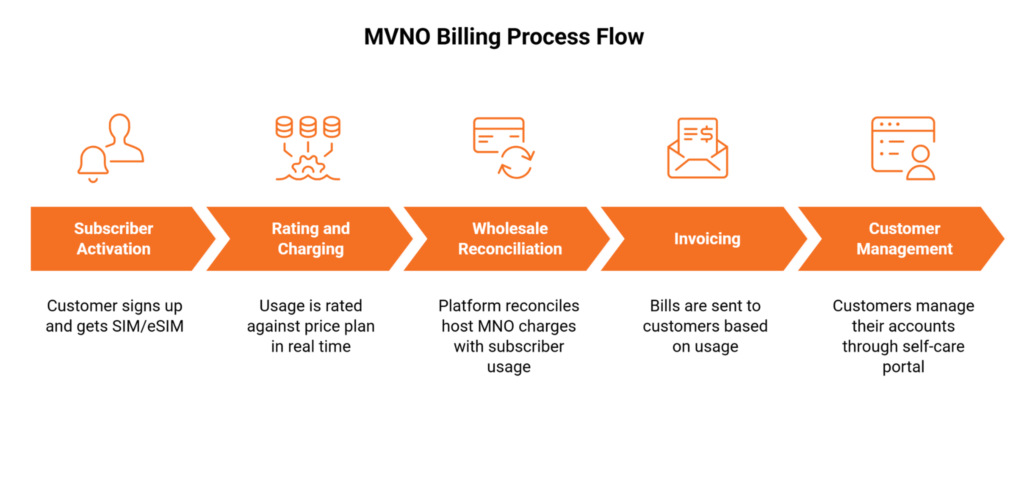
The existing flow illustrates the online-charging path. Its real-time label does not describe every carrier feed or roaming record. A fast rating engine cannot rate an event it has not received. Ask separately about network delivery delay, ingestion delay and the time to make a charging decision.
- Activate: bind the customer, subscription, SIM or eSIM and effective plan to stable identifiers.
- Rate and charge: apply the applicable tariff, allowance and rounding rules to the event or session.
- Reconcile: compare wholesale records and charges with the corresponding retail usage and agreed wholesale terms.
- Invoice: assemble recurring fees, usage, credits and applicable tax outputs into the customer’s bill.
- Manage: process payments, top-ups, changes, disputes and termination without losing the account history.
Different commercial arrangements require different tests, even when the interface looks identical.
| Arrangement | What to test | Evidence to retain |
|---|---|---|
| Prepaid | Allowance exhaustion, top-up and delayed usage | Balance changes and service-control decisions |
| Postpaid | Cycle boundaries, proration and credits | Invoice lines tied to effective plan versions |
| Enterprise or reseller | Separate payer, user and delegated administrator | Account hierarchy and permission audit |
| Device fleet | Pooled usage, dormant lines and SIM replacement | Subscription continuity and fee treatment |
Source: editorial acceptance checklist, not measured platform results. Requirements depend on your contract and product design.
In a reseller hierarchy, the person using a line may differ from the enterprise paying for it. The reseller may administer the account without becoming the payer. Specify those three relationships independently. The subscriber management guide covers lifecycle records; billing adds responsibility for charges and financial adjustments.

Top MVNO Billing Platforms Compared
MVNO billing platforms should be compared against the operating responsibilities each supplier documents and the interfaces your service needs. Software, network enablement and payment collection solve different parts of the problem. The matrix below identifies documented starting points and open verification questions; it does not rank vendors or claim independently tested performance.
Evidence checked on 23 September 2026. A vendor’s documentation establishes its stated product scope, not the configuration, price or service level offered in your contract.
| Option | Documented starting point | Verify for your deployment |
|---|---|---|
| Oracle BRM | Charging, billing, payments and account management | Required components, implementation owner and host-network interfaces |
| PortaBilling | Billing software and technical support; PortaOne says it does not act as an MVNE or MVNA | Your network agreement, activation interface and charging connection |
| OneBill | Vendor describes recurring and usage-based telecom billing | Exact mediation, charging and partner features included in the proposed edition |
| Spenza | RocketPhone case documents enterprise MVNO enablement, billing and reseller capabilities | Carrier scope, billing configuration, operating ownership and acceptance evidence |
Sources: Oracle documentation above; PortaOne’s MVNO FAQs; OneBill’s published product comparison; the RocketPhone case study. Product descriptions are supplier claims, not comparative benchmarks.
PortaOne explicitly distinguishes buying its software from relying on an MVNE’s established network connection and BSS. Apply the same boundary question to every quote. A supplier can be a good software fit while leaving substantial integration work with your team. Compare that responsibility against the MVNO model you intend to run.
MVNO billing platform pricing: compare the same scope
A useful quote exposes which costs vary with lines, events, interfaces and change requests. The old article’s price bands did not have sufficient evidence and should not guide procurement. Request the same assumptions from each bidder so that a small base fee cannot hide a materially different operating commitment.
| Quote input | Clarification to request | Why it matters |
|---|---|---|
| Billable unit | Active line, provisioned SIM, account, event or revenue | Growth and dormant inventory affect costs differently |
| Implementation | Included interfaces, migration and acceptance support | A license does not complete integration |
| Operations | Support hours, incident ownership and release work | Someone must resolve billing exceptions |
| Changes and exit | Catalog updates, exports and termination assistance | Future flexibility needs a defined price and process |
Source: editorial procurement framework. No vendor prices or savings are assumed.
Use the MVNO launch cost guide to place billing alongside other operating costs. The launch cost calculator can organize assumptions; replace illustrative inputs with written quotes before making a financial decision.
Implementation Checklist and Red Flags
MVNO billing acceptance should demonstrate that an operator can reconstruct a charge, correct a mistake and explain the resulting customer balance. A polished invoice alone cannot prove those controls. Test the complete chain from source event to rate version, balance movement, invoice line and adjustment, with an owner for each handoff.
Build an event-to-invoice evidence trace
Select a representative subscription and record its identifiers, product, effective date and expected behavior. Submit a known usage event, then retain the record received by the platform. Trace the applicable tariff version and balance change into the invoice. Add a correction and verify that the adjustment remains explainable rather than overwriting the original history.
The test is an acceptance method, not a claim that every system stores the same fields. Agree the equivalent identifiers and records with the supplier. Billing engineering should be able to reproduce the result, while customer care should be able to explain it without access to unrestricted subscriber data.
Test exceptions before scaling
Replay a duplicate event, introduce delayed usage, change a plan across a billing boundary and simulate a failed payment. For each case, specify whether the platform rejects, queues, corrects or escalates the event. Stripe’s usage-recording documentation describes asynchronous processing and event identifiers for deduplication. Those are integration considerations, not evidence that Stripe supplies a complete mobile charging stack.
Compare customer-facing balances with the authoritative account record after each test. If the portal displays stale information, identify which system owns the delay and what the customer sees. Define notification behavior and escalation thresholds for your service instead of importing an arbitrary latency promise from a comparison article.
Migrate with a reconciliation checkpoint
Inventory accounts, subscriptions, balances, outstanding invoices and effective plan versions before moving them. Map old and new identifiers, agree a cutover boundary and compare a controlled billing run. Decide who investigates mismatches and who can authorize release. Keep an export and recovery procedure appropriate to the systems involved; a generic rollback promise is insufficient.
For wider procurement checks, use the MVNE provider selection guide. A billing pilot should end with signed acceptance evidence and known exceptions, not just credentials to a production portal.
What RocketPhone’s launch shows about billing scope
RocketPhone’s published enterprise MVNO case shows why billing belongs inside a wider product and operating workflow. RocketPhone.ai Limited provides conversation intelligence for Salesforce. The implementation connects mobile service with that application context and describes billing, SIM management and multi-tier reseller capabilities as part of the delivered platform scope.
For an MSP or software business, the useful lesson is to evaluate the whole customer journey. A billing feature list does not show whether account administration, mobile service and the application work together in the required commercial arrangement. Reproduce your intended payer and reseller structure in the acceptance exercise.
Discuss your operating model with Spenza using a concrete account hierarchy, sample plan and billing exception. Keep the case’s qualitative evidence separate from the operational records still needed to validate your own deployment.
MVNO billing platform FAQs
MVNO billing platform selection depends on the charging model, account structure and network responsibilities your business needs. The following answers resolve common procurement questions without assuming a universal price, launch period or integration scope. Use them to define demonstrations and contract questions, then verify the details against the proposed deployment.
Which MVNO billing platform is best?
The best fit is the platform that supports your required charging, account hierarchy and integrations with responsibilities your team can operate. Compare documented scope first, then test representative usage and exceptions. A ranked list cannot establish carrier access, implementation effort or the commercial terms available to your particular business.
Does prepaid billing always operate in real time?
Prepaid service can use online charging to check or reserve balances during usage, but the surrounding billing workflow may still receive delayed records. Confirm which services and networks support live control and how exceptions are handled. A real-time dashboard does not by itself prove that all underlying usage has arrived.
Does buying a BSS include mobile network access?
Buying a BSS does not automatically include a host-network agreement or operational connectivity. Some providers sell software; others bundle enablement and commercial arrangements. Ask who supplies activation interfaces, usage records and charging connections, then put those boundaries into the contract. Treat an integration logo as a prompt for verification.
How much does an MVNO billing platform cost?
MVNO billing cost depends on the commercial unit, minimum commitments, integration scope and operating support. Request a written quote using your expected accounts, active lines, events and interfaces. Include implementation, changes and exit assistance. Without comparable scope, a per-line fee and a software license price cannot support a useful comparison.
Does eSIM support change the billing requirements?
eSIM support adds lifecycle events that must remain correctly associated with the commercial subscription. Test replacement, suspension, reactivation and termination against billing status and fees. Verify the provisioning architecture separately. A supplier saying it supports eSIM does not identify every standard, device type or network integration included in your deployment.
Can an MVNO move to another billing platform?
An MVNO can plan a billing migration when data access, identifiers, balances and contract terms permit it. Define an export format, map the account structure and validate a controlled billing run before cutover. Agree exception ownership and recovery procedures. The feasibility and effort depend on the existing configuration and destination system.
Choose the system you can verify and operate
Start with the customer and payer structure, then define the charging, reconciliation and support work needed to serve it. Shortlist platforms using documented scope, normalize the quotes and run an acceptance exercise that includes failures as well as successful invoices. Preserve the evidence so that billing operations and customer care can explain the same result. Discuss your MVNO operating model with Spenza when you have a sample plan, account hierarchy and integration list. Those inputs make the next conversation specific enough to establish responsibilities and identify the proof still missing.