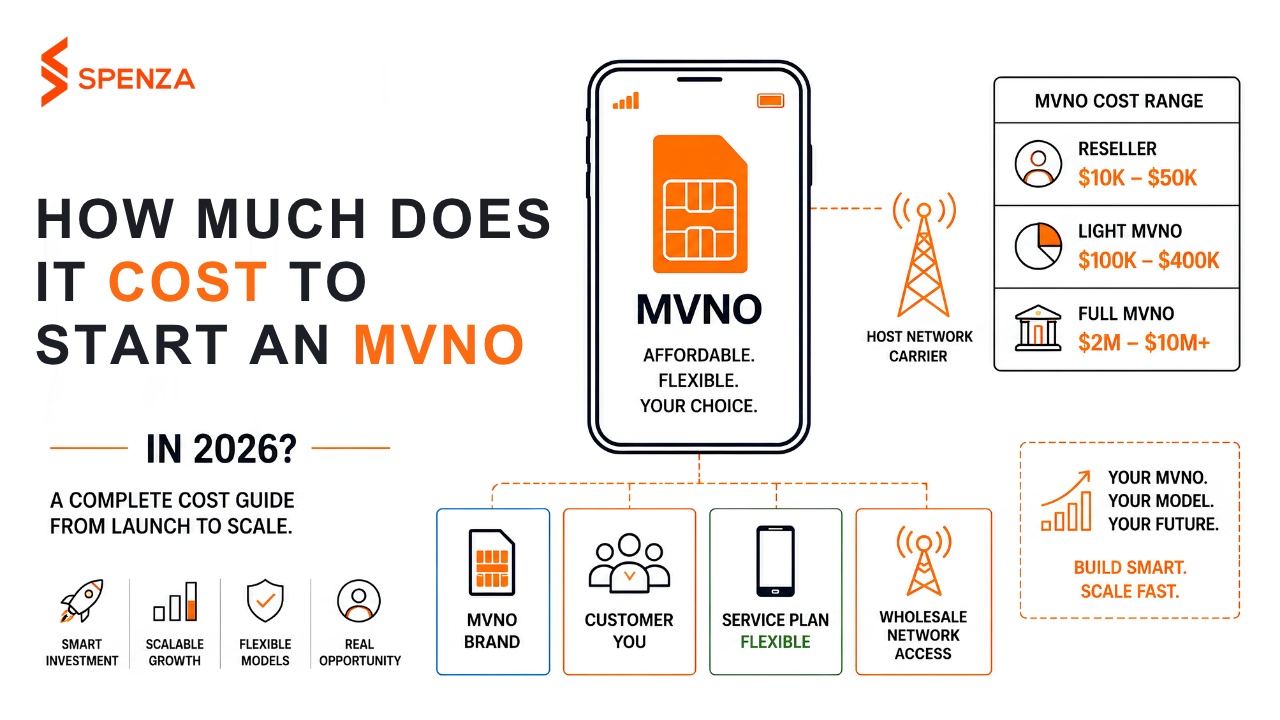
It costs about $10K to $50K to start an MVNO as a branded reseller and go live in weeks, $100K to $400K for a light MVNO through an MVNE, and $2M to $10M or more for a full MVNO with its own core, which typically takes 12 to 18 months.
Quick cost summary by tier
• Branded reseller: $10K to $50K, live in weeks, lowest control, OpEx model.
• Light MVNO via an MVNE: $100K to $400K in the first year, live in weeks to a few months.
• Full MVNO with its own core: $2M to $10M or more, 12 to 18 months, full control.
Why this matters in 2026
The US MVNO market is projected to reach $46.76 billion in 2026 and $64.69 billion by 2031, according to Mordor Intelligence. The global MVNO market sits near $107 billion, per Fortune Business Insights. Lower launch costs are a big reason new brands keep entering.
What Does It Cost to Start an MVNO in 2026?
The cost to start an MVNO depends on two choices: which MVNO model you pick, and whether you build your own network core or buy access through an MVNE. A mobile virtual network operator (MVNO) sells mobile services under its own brand without owning towers or spectrum. It leases network access from a carrier and competes on price, niche, and customer experience.
That single structural choice splits MVNO launch cost into three tiers. A branded reseller runs in the low tens of thousands. A light MVNO on an MVNE runs in the low hundreds of thousands in year one. A full MVNO that builds its own core runs into the millions. Each tier trades money and time for control.
Most brands do not need a full build. They start as a reseller or light MVNO, validate demand, then add control as scale justifies it. Launching as a full MVNO on day one is the most expensive way to learn that your pricing or target market needs work. To compare the models side by side, see MVNO Types Explained (2026) and the broader MVNO hub. The itemized table below shows exactly where the money goes.
MVNO Launch Cost Breakdown: Itemized by Tier
Your MVNO startup costs fall into eight components. Here is what each one runs for the three MVNO models in 2026. Ranges reflect typical US launches and scale with subscriber volume. Resellers pay most costs as usage-based OpEx, which is why their setup is low.
| Cost component | Branded reseller | Light MVNO (via MVNE) | Full MVNO (own core) |
|---|---|---|---|
| Carrier / wholesale access | Included, pay per line or GB | $10K to $50K commit + usage | $500K to several $M / year |
| MVNE platform / BSS | Included in per-line fee | $20K to $150K setup | Build own BSS/OSS: $500K to $2M+ |
| Setup / integration | $0 to $10K (turnkey) | $20K to $100K (APIs) | $1M to $5M+ (core, HLR/HSS) |
| Regulatory / FCC / legal | $2K to $15K | $10K to $50K | $50K to $250K+ |
| Branding / marketing | $5K to $30K | $25K to $150K | $250K to $2M+ |
| Customer support | $0 to $10K (self-serve) | $20K to $100K | $200K+ / year |
| SIM / eSIM | eSIM-first, near zero | $5K to $50K inventory | Own IMSI/SIM: $100K+ |
| Ongoing OpEx | Per line, scales with subs | $5K to $40K / month | About $200K / month at scale |
| Typical first-year total | $10K to $50K | $100K to $400K | $2M to $10M+ |
Each pricing tier is based on the sum of its individual cost components and cross-checked against published industry sources. The Light MVNO estimate of $100K to $400K and the Full MVNO estimate of $2M to $10M+ align with guidance from Cardella Consulting. The Branded Reseller and White-Label MVNO range of $10K to $400K reflects current MVNE platform pricing. Regulatory estimates are based on typical FCC Form 499 registration requirements and legal counsel costs. These figures represent typical U.S. MVNO launches and will vary depending on deployment scale, feature requirements, and business scope.
A few notes on the rows. Carrier access for a reseller is folded into the platform deal, so there is no separate upfront commit. Regulatory cost covers FCC registration and counsel; an MVNE often handles most filings for you. SIM/eSIM drops sharply when you go eSIM-first, since there is no plastic to print and ship. For the platform layer, compare options in our guide to MVNO billing platforms and the OSS/BSS checklist.
The Three MVNO Models and What Each Costs
Branded reseller: $10K to $50K, live in weeks
You sell mobile plans under your brand while your MVNE or host runs the stack. You control pricing, branding, and the customer relationship, and give up deep technical control. This is the fastest, cheapest way to start an MVNO and the right first step for most brands. See Branded Reseller MVNOs for real examples.
Light MVNO via an MVNE: $100K to $400K in year one
You take on more of the product, plan design, and customer data while the MVNE handles provisioning, billing, and carrier integration. You get more control over the experience without the cost of owning a core. Most brands that scale pick this path. Compare it in Light MVNOs: An Overview.
Full MVNO with its own core: $2M to $10M+, 12 to 18 months
You operate your own network core, IMSI range, and BSS, with direct carrier contracts. You get full control and the deepest differentiation, at the highest cost and longest timeline. This fits carriers, large scale players, and operators that need carrier-grade independence. See Decoding Full MVNOs and the White Label MVNO Launch Guide for the build path.
MVNO Wholesale Rates: What You Pay Carriers
MVNO wholesale rates are what you pay the host carrier for network access. You buy capacity per gigabyte or per line, then resell it at a margin. Rates are negotiated and differ by carrier, volume, and contract length, so there is no single public price. What you can plan around are the drivers.
| What drives your rate | Effect on cost |
|---|---|
| Volume committed | Higher commitments lower your per-GB or per-line rate. |
| Contract length | Longer terms earn better pricing but reduce flexibility. |
| Data vs voice vs SMS | Each is priced separately; data dominates most modern plans. |
| Reseller vs direct | Resellers get usage-based rates via the MVNE; full MVNOs negotiate directly with the MNO. |
| Roaming and coverage | Multi-region and roaming traffic carries higher rates. |
Resellers typically pay usage-based wholesale rates that are folded into the platform deal, with no large upfront commitment. Light MVNOs and Full MVNOs usually negotiate volume commitments, so the per-unit rate tends to drop as they scale.
White-Label MVNO Pricing
White-label MVNO pricing is the lowest-cost on-ramp to a branded mobile service. Setup ranges from $10K to $400K depending on how much you customize, with gross margins between 15 and 40 percent once you are live. A branded reseller model sits at the low end. A full white-label build with custom billing and deeper integration sits at the high end.
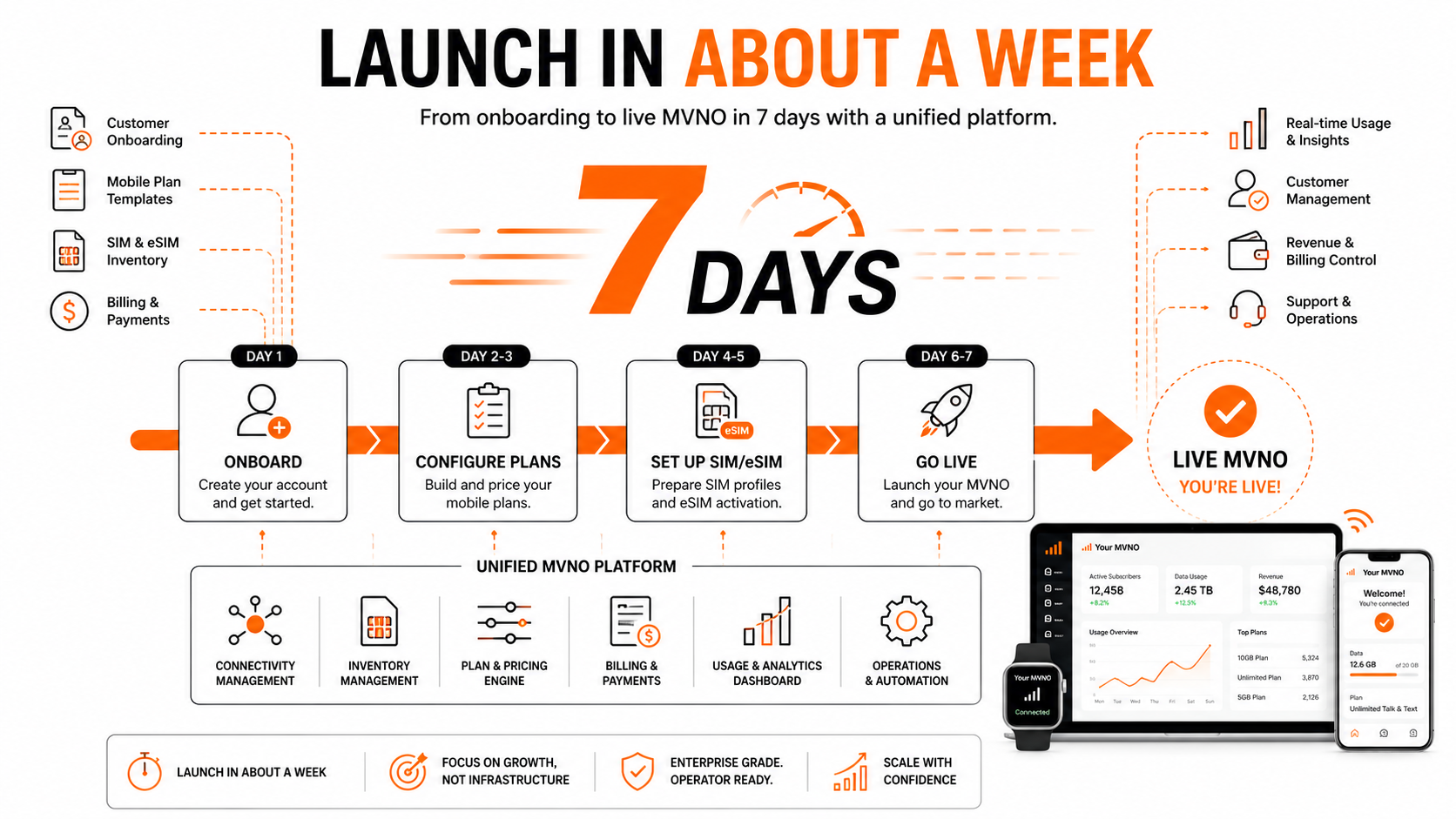
The cost model is OpEx, not CapEx. You pay a platform or per-line fee and the wholesale cost of the capacity you use, rather than building infrastructure. That is why a white-label launch can go live in about a week for a reseller model, or roughly 3 to 6 weeks for a deeper build. For the full path, see the White Label MVNO Launch Guide.
Setup: $10K to $400K, depending on the level of customization.
Margins: 15 to 40 percent gross once live.
Cost model: OpEx, with a platform fee or per-line fee plus wholesale usage.
Timeline: about 7 days for a reseller, or 3 to 6 weeks for a full build.
Build vs Buy: The Real Cost Decision Behind Starting an MVNO
Strip away the tiers and the cost question becomes one decision: build your own MVNO, or buy access through an MVNE or white-label platform. Build means a full MVNO with millions in CapEx and a year or more of work. Buy means an MVNE or white-label model with OpEx that starts in the thousands and a launch measured in days to weeks.
| Factor | Build (full MVNO) | Buy (MVNE / white-label) |
|---|---|---|
| Upfront cost | $2M to $10M+ CapEx | $10K to $400K |
| Time to launch | 12 to 18 months | Days to weeks (7 days for a reseller) |
| Cost model | CapEx heavy, fixed | OpEx, per line, variable |
| Control | Full: own core and IMSI | Shared: platform-managed |
| Network access | Direct MNO contract | Aggregated via the MVNE |
| Best for | Carriers, scale players, and deep differentiation | Brands, startups, and fast validation |
| Break-even | Higher fixed costs to cover | 5K to 25K subscribers for a light MVNO |
Put the two numbers next to each other and the contrast is the point. A full build can cost $2M before you sign a single subscriber. The same brand can launch on an MVNE for the price of a marketing campaign and pay for capacity as it grows. Unless you need your own core, buying is faster, cheaper, and lower risk. For how an enabler compresses the timeline, see How MVNEs Accelerate the MVNO Launch.
One-Time vs Ongoing MVNO Costs
Budget MVNO launch cost in two buckets: one-time setup and recurring OpEx. Most founders underestimate the recurring side, which is where margin lives or dies.
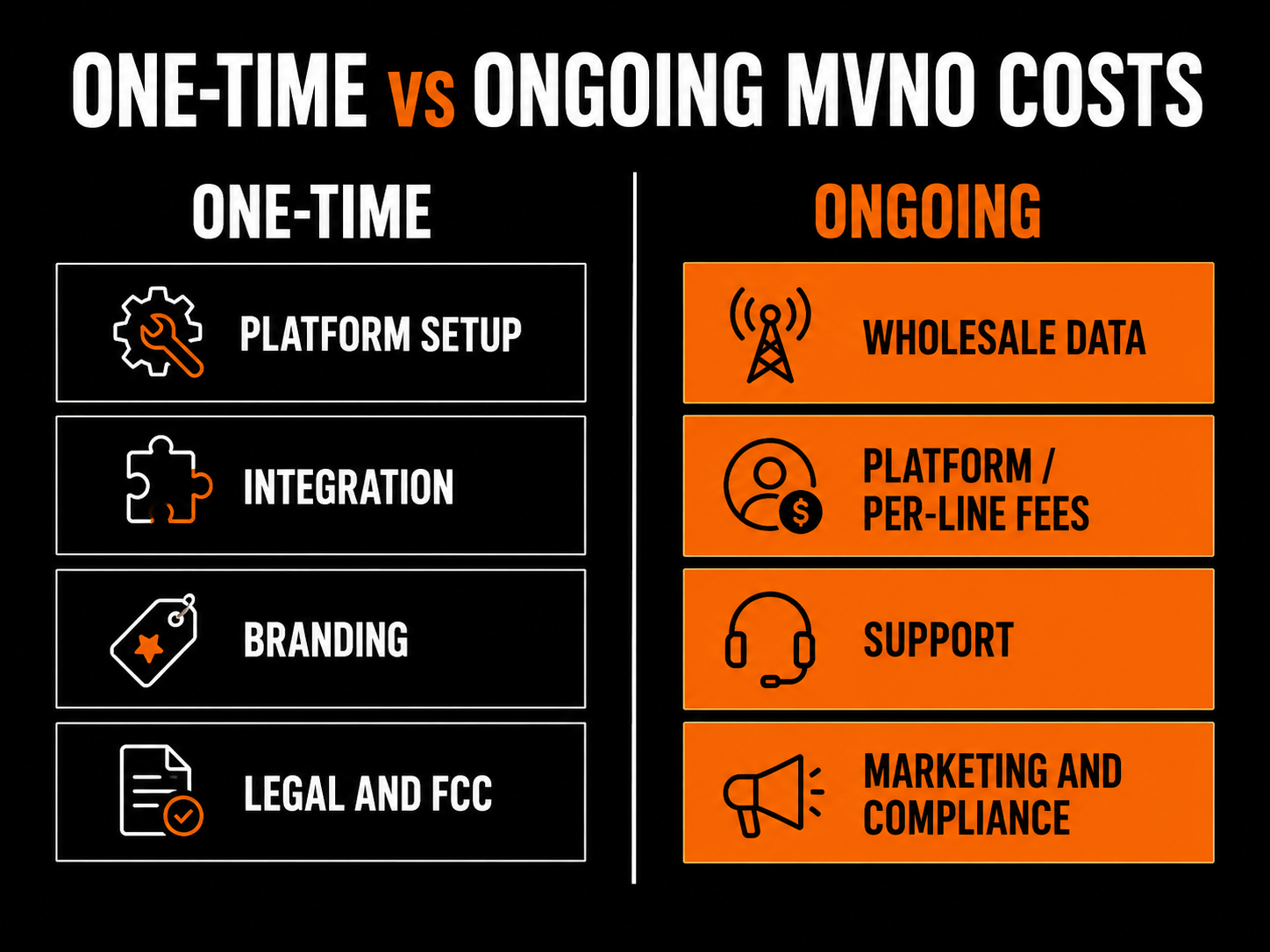
One-time costs
- Platform setup and integration
- Branding, website, and launch marketing
- Legal and FCC registration
- Initial SIM or eSIM provisioning
Ongoing costs
- Wholesale data and voice from the carrier
- Platform or per-line fees
- Customer support and tooling
- Marketing and customer acquisition
- Compliance filings and USF contributions
Scale changes the math. A traditional full MVNO can run about $200K per month in OpEx at scale. A light MVNO on a per-line model pays far less because cost tracks usage, not a fixed buildout. That is the core reason the buy path protects cash flow.
How Much Does an MVNO Make? The MVNO Business Model
The MVNO business model is wholesale arbitrage. You buy network capacity at negotiated wholesale rates and sell retail plans at a margin, typically 30 to 50 percent gross margin on the connectivity itself. Profit then compounds through value-added services: device insurance, international packages, IoT data pools, premium support, and content bundles.
Monthly revenue = subscribers × ARPU. Gross profit = revenue × gross margin. At 10,000 subscribers on a $30 plan, that equals $300,000 per month in revenue and about $120,000 per month in gross profit at a 40 percent margin, or roughly $1.44M per year before fixed costs. Value-added services can add to that.
How much an MVNO makes comes down to ARPU, margin, and churn. A subscriber who churns in month four never repays a $60 acquisition cost, so retention matters as much as growth. This is why niche MVNOs with built-in distribution, a device in the customer’s hand or an existing app, consistently outperform generic discount brands. For a full breakdown of revenue streams and cost centers, see How MVNOs Make Money.
MVNO Unit Economics and Break-Even
Cost only matters next to revenue. Here is a realistic 2026 unit economics snapshot for a light MVNO, drawn from Cardella Consulting and operator data.
| Metric | Typical 2026 range |
|---|---|
| ARPU (example plan) | $30 per subscriber per month |
| COGS (wholesale + delivery) | $9 to $18, or 30 to 60 percent of ARPU |
| Gross margin | 30 to 50 percent |
| Customer acquisition cost (CAC) | $50 to $150 early on |
| Support ticket cost | $2 to $6 if outsourced and well tooled |
| Break-even | 5,000 to 25,000 subscribers for a light MVNO |
Break-even subscribers = fixed monthly cost ÷ gross profit per subscriber. Gross profit per subscriber = ARPU × gross margin. For example, a $30 monthly plan with a 40 percent gross margin generates $12 of gross profit per subscriber each month. If fixed operating costs are $60,000 per month, the business reaches break-even at approximately 5,000 subscribers. Higher fixed costs or lower margins increase the break-even point, which is why many Light MVNOs target a range of roughly 5,000 to 25,000 subscribers before achieving sustainable profitability.
Is an MVNO profitable? It can be. The levers that decide it are ARPU, gross margin, CAC payback, and fixed OpEx. A niche audience with high retention reaches break-even faster than a broad discounter. See MVNO Pros and Cons in 2026 for the trade-offs.
Real MVNO Launch Examples and Case Studies
Ranges are easier to trust next to real launches. The table below maps common brand types to a model, an estimated launch cost, and a realistic timeline. Below it are three documented Spenza launches with their actual results.
| Brand type | MVNO model | Est. launch cost | Time to launch |
|---|---|---|---|
| Kids smartwatch brand | Branded reseller / IoT (eSIM) | $15K to $30K | 2 to 4 weeks |
| Travel eSIM reseller | Branded reseller (eSIM-first) | $20K to $40K | 3 to 4 weeks |
| Regional ISP or hosting brand | White-label MVNO | $30K to $60K | 1 to 4 weeks |
| Fintech app add-on | Light MVNO via MVNE | $100K to $250K | 1 to 3 months |
| Enterprise IoT provider | Light MVNO / managed IoT | $150K to $300K | 2 to 3 months |
The timelines and results presented in the case studies below are based on published Spenza case studies. The launch costs shown in the scenarios table are illustrative estimates derived from the itemized cost ranges outlined in this guide and should not be interpreted as customer-disclosed financial figures. Actual costs vary based on deployment scope, customization, carrier agreements, and operational requirements.
Case study 1: Angel Watch, a kids smartwatch brand (branded reseller)
This model covers eSIM and SIM-based IoT connectivity sold through Shopify Markets across the US, UK, and EU. In one published example, first devices shipped in 3 months from contract, with the custom network ready in 2 months versus a 4 to 6 month industry norm. Results included 500 percent installed-base growth in 6 months, an 80 percent checkout attach rate, and zero activation complaints.
Typical cost band: $10K to $50K (reseller tier).
Angel Watch needed low-data plans that fit a child’s smartwatch, not expensive unlimited carrier plans. Bundling connectivity at checkout turned a one-time hardware sale into recurring revenue and lifted ARPU. Read the full Angel Watch case study.
Case study 2: IMZ, a hosting brand that became an MVNO (white-label)
This deployment used a white-label MVNO model with multi-carrier connectivity across T-Mobile and Verizon, fully integrated into Shopify. The branded wireless service launched in approximately one week, supported 25 reseller partners, and included automated billing and intelligent plan switching that reduced manual finance work by roughly 30 percent.
Typical cost band: $15K to $50K (white-label reseller tier).
IMZ wanted to expand beyond web hosting into nationwide mobile plans without taking on carrier negotiations and billing from scratch. A turnkey white-label portal removed those blockers. For the model, see the White Label MVNO Launch Guide.
Case study 3: Butlr, an enterprise IoT sensor company (light MVNO)
This deployment used a managed IoT connectivity model based on a Light MVNO architecture with a single global SIM SKU across the US, UK, and France. The solution reduced new-market entry time from 60 days to just 7 days, cut billing administration overhead by more than 50 percent, and lowered overall telecom costs by replacing unlimited consumer plans with right-sized IoT connectivity plans.
Typical cost band: $100K to $400K (Light MVNO tier).
Butlr runs privacy-first occupancy sensors that stream real-time data across borders. Consolidating carriers into one platform removed multi-portal overhead and made expansion routine. Read the full Butlr case study.
How to Start an MVNO for Less
If your goal is to start an MVNO cheaply and de-risk the launch, these tactics cut both upfront cost and time to market.
- Start as a branded reseller. Get to market for tens of thousands, learn, then add control.
- Use an MVNE to shift CapEx to OpEx. Pay for capacity as you grow instead of building a core.
- Go eSIM-first. Skip SIM printing and shipping, and activate customers in minutes. See eSIM-Only MVNOs.
- Pick a niche. A clear vertical (IoT, fintech, seniors, travel) lowers CAC and lifts retention.
- Avoid custom builds early. Custom billing and integrations are where budgets and timelines blow up.
- Bundle connectivity into an existing product. Adding mobile to a product you already sell turns connectivity into recurring revenue.
To model your own numbers, use the Spenza MVNO Calculator for a self-serve cost estimate.
The Modern Way to Launch an MVNO (Spenza)
Within the build-vs-buy frame, Spenza is the buy option built for brands, not just telcos. It removes the $2M+ CapEx of a traditional launch and replaces it with a per-line OpEx model, so cost tracks growth.
- Per-line OpEx pricing. Pay for what you use, with no heavy upfront buildout.
- Multi-carrier access. Launch on networks like T-Mobile and Verizon through one platform.
- eSIM and IoT ready. eSIM-first activation plus IoT connectivity under one roof.
- 7-day launch path. Branded reseller and light models can go live in about a week; full white-label builds take roughly 3 to 6 weeks.
This is the model behind launches Spenza has shipped, from a kids smartwatch brand to MSPs reselling global data. For a tailored quote, book a Spenza demo.
Conclusion: The Smartest Way to Launch an MVNO in 2026
Cost to launch an MVNO is a function of model choice and the build-vs-buy decision. Reseller and MVNE paths start in the thousands and go live in weeks. Full builds run into the millions over a year or more. For most brands, buying access through an MVNE is the faster, cheaper, lower-risk way to start, and the case studies above show it working in practice.
Launching an MVNO no longer requires multi-million dollar investment. Costs now range from $10K for a reseller model to $2M+ for a full MVNO, depending on control and complexity.
Most new entrants do better starting with an MVNE or white-label model. It reduces risk, shortens launch time, and lets you scale based on real demand instead of upfront infrastructure spend.
In 2026, the winners are not the ones who build the most infrastructure, but the ones who launch fast, validate early, and scale efficiently.
FAQs
Ready to transform your MVNO strategy? Discover a scalable, cost-efficient way with Spenza. Schedule your personalized demo today!