MVNOs deliver 30 to 50% lower costs than traditional carriers by leasing existing network infrastructure instead of building their own. For consumers, this means flexible, contract-free plans on the same towers used by AT&T, T-Mobile, and Verizon. For businesses, MVNOs offer a path to branded connectivity, vertical-specific offerings, and new revenue streams.
The main tradeoffs are data deprioritization during peak congestion, fewer lifestyle perks, and limited in-store support. In 2026, premium MVNO tiers and multi-carrier platforms are closing these gaps fast. The global MVNO market hit roughly $107 billion in 2026 and is projected to reach $195 billion by 2034 at a 7.8% CAGR.
Source: MVNO Market Report
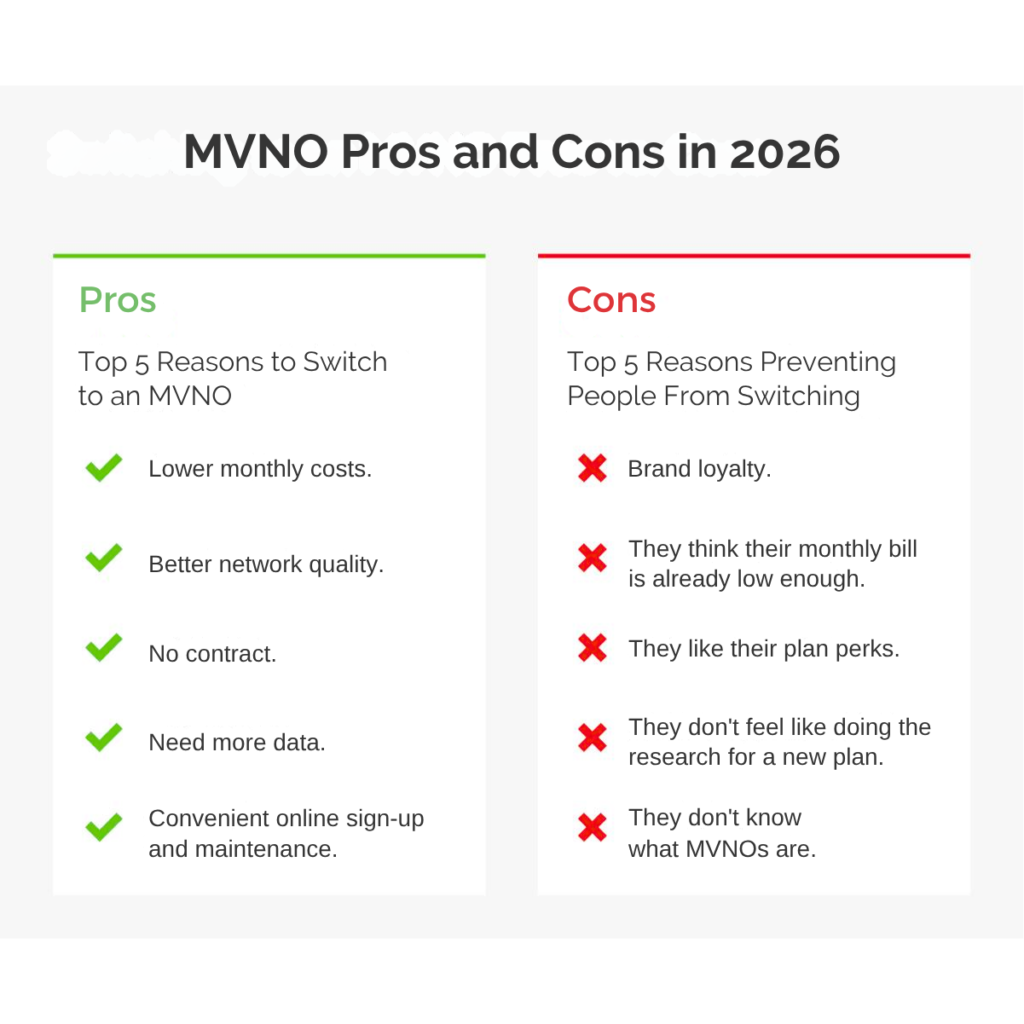
If you already know what an MVNO is, you probably have one question left: is it actually worth it?
The answer depends on who you are. A cost-conscious consumer switching from Verizon postpaid to Visible saves $40 to $65 per month on the same network. A device OEM launching branded IoT connectivity through an MVNO model can turn a one-time hardware sale into recurring subscription revenue. A healthcare company building a compliant remote patient monitoring network needs the kind of vertical specificity that major carriers rarely offer.
The MVNO model has matured well past the “cheap alternative” phase. The U.S. MVNO market alone is on track to reach $46.76 billion in 2026, growing at a 6.71% CAGR. Globally, MVNO subscribers are projected to reach 439 million by 2030 according to Juniper Research. Cable operators, fintech companies, retailers, and IoT startups are all entering the space.
But the model still has real tradeoffs. Here is a grounded look at the advantages and disadvantages of MVNOs, with enough specificity to inform an actual decision.
The Advantages of MVNOs
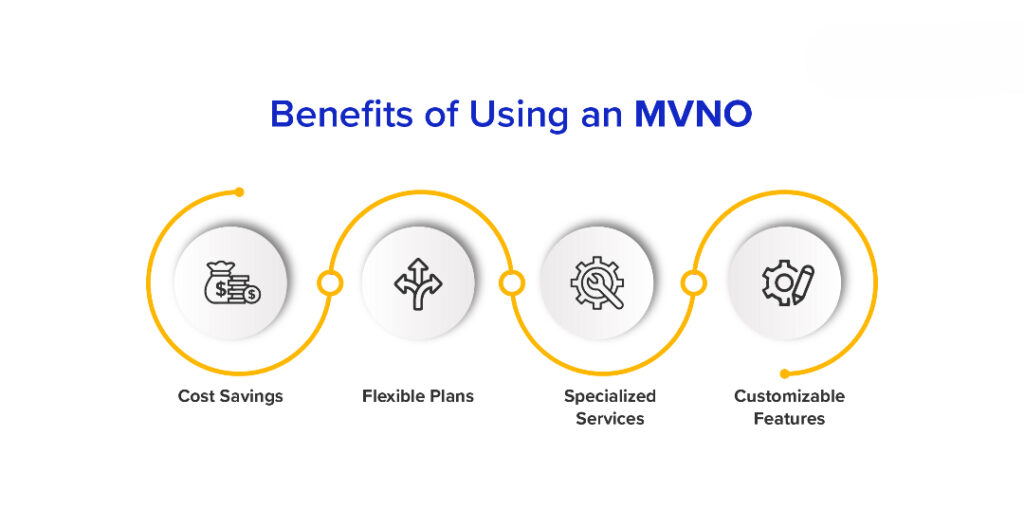
1. Significantly Lower Operating Costs
MVNOs skip the single largest expense in wireless: building and maintaining physical network infrastructure. By purchasing wholesale capacity from MNOs, they pass structural cost savings to customers. The average consumer saves $30 to $50 per line per month. For a family of four, that is $600 to $1,800 per year on functionally identical coverage.
For businesses launching branded connectivity, the economics are even more attractive. Traditional MVNO launches historically required $5 million or more in first-year investment. Modern MVNE platforms have compressed this to a fraction of that amount and shifted the cost model from heavy CapEx to manageable OpEx. Some platforms enable launch timelines of days rather than the 12 to 18 months that were standard.
The cost advantage is not just about price. It is about margin architecture. MVNOs that partner with an MVNE like Spenza get integrated billing, automated plan management, and multi-carrier access bundled into a single operational layer, which keeps ongoing costs predictable.
2. Access to Tier-1 Networks Without the Tier-1 Price
This is the most commonly misunderstood point in any MVNO pros and cons discussion. MVNOs do not operate on inferior networks. They run on the exact same AT&T, T-Mobile, and Verizon towers. Cricket is owned by AT&T. Visible is owned by Verizon. Mint Mobile is owned by T-Mobile.
Coverage maps are identical. 5G access is the same. The only meaningful difference is how data traffic is prioritized during congestion, which is covered in the disadvantages section below.
3. Flexibility That Traditional Carriers Cannot Match
Major carriers optimize for the mass market. MVNOs optimize for the specific.
This shows up in multiple ways. Contract-free, prepaid plans let consumers switch providers or adjust usage monthly with no early termination fees. IoT-focused MVNOs offer data-only plans priced per megabyte for connected devices. Travel-oriented MVNOs build in international roaming that major carriers gate behind premium tiers.
For businesses, the flexibility goes deeper. A Full MVNO model gives operators control over pricing, billing, plan design, and customer experience while still leasing radio access from the host carrier. This is what enables vertical-specific plays that would be economically impossible for a mass-market MNO.
4. Vertical and Niche Specialization
This is where the MVNO model gets genuinely interesting in 2026. The operators winning market share are not the ones competing on price alone. They are the ones building deep vertical expertise.
The Full MVNO segment held 57.83% of global MVNO market share by revenue in 2025, up from a much smaller slice five years earlier. The shift toward full-stack virtual operators reflects a market that rewards differentiation over discounting.
More on industry-specific use cases below.
5. Faster Time-to-Market for New Entrants
Network Function Virtualization (NFV) and cloud-based BSS/OSS platforms have collapsed the barrier to entry. Non-telecom companies (retailers, banks, device makers, utility companies) can now launch “Light MVNO” brands in weeks. The IoT MVNO segment alone grew at an 18.9% CAGR in 2025, reaching an estimated $4.83 billion in 2026.
eSIM technology accelerates this further. Physical SIM cards are quickly becoming legacy infrastructure. Most flagship smartphones support eSIM activation, and several MVNO carriers now offer eSIM-only sign-up processes that let customers activate a new plan in minutes.
The Disadvantages of MVNOs
While MVNOs offer numerous benefits, there are potential downsides to be aware of. These challenges may not apply to all MVNOs, but understanding them will help you make an informed decision.
1. Data Deprioritization During Network Congestion
This is the most substantive tradeoff. When a cell tower gets congested, carriers assign data priority using QCI (Quality of Service Class Identifier) levels. Most MVNO plans sit at QCI 8 or QCI 9, meaning their traffic is served after the host carrier’s postpaid customers during busy periods.
In practical terms, this shows up at stadiums, concerts, airports during peak hours, and dense urban centers at rush hour. Off-peak or in lighter-traffic areas, deprioritized users typically see no difference.
The gap is narrowing. Premium MVNO tiers now offer higher-priority data. US Mobile’s Unlimited Premium plan on Verizon runs at QCI 8, matching many Verizon postpaid plans. Google Fi customers on T-Mobile typically get QCI 6, the same priority as T-Mobile Magenta postpaid.
For businesses, the mitigation strategy is different. Multi-carrier access through an MVNE allows dynamic network switching, reducing dependence on any single congested tower. This is particularly important for mission-critical IoT deployments where a single carrier’s congestion could disrupt service.
2. Limited Lifestyle Perks and Bundling
Major carriers bundle streaming subscriptions (Netflix, Disney+, Apple TV+), sports packages, international roaming, and device financing with 0% interest into their premium plans. Most MVNOs do not.
The logic is straightforward. These perks are subsidized by the higher monthly fees that carrier customers pay. MVNOs keep costs low by stripping away extras and focusing on core connectivity. For users who do not care about free Disney+ but care a lot about a $40 lower phone bill, this is a net positive. For users who value the bundle, it is a real gap.
3. Limited Physical Retail Presence
Most MVNOs are digital-first or digital-only. If you prefer walking into a store to troubleshoot a problem, your options are limited. Consumer Cellular (available at Target stores) and Cricket Wireless (4,500+ retail locations) are exceptions, but the majority of MVNOs handle everything through apps, chat, and phone support.
For B2B and IoT use cases, this is less relevant since enterprise connectivity management is inherently software-driven.
4. Variable Customer Service Quality
MVNO customer service ranges from excellent to frustrating. The variance depends heavily on the provider’s size, focus, and investment in support infrastructure. Niche MVNOs serving specific communities or verticals tend to offer more personalized support because their teams understand the customer’s exact use case. Larger discount-focused MVNOs sometimes underinvest in support.
Before choosing any MVNO, check ACSI (American Customer Satisfaction Index) scores and J.D. Power rankings for the specific provider. Several MVNOs consistently outperform the Big Three carriers in customer satisfaction.
5. Margin Pressure for MVNO Operators
This disadvantage applies to businesses operating as MVNOs, not to consumers. With over 1,000 MVNOs operating globally, competing on price alone is a losing strategy. Wholesale rates, platform costs, customer acquisition costs, and support costs all compress margins.
The MVNOs that sustain profitability are the ones with clear vertical positioning, strong LTV-to-CAC ratios, and operational efficiency enabled by automation. Understanding MVNO revenue models before launch is not optional.
MVNO Pros vs. Cons: Side-by-Side Comparison
| Factor | MVNO Advantage | MVNO Disadvantage |
|---|---|---|
| Cost | 30–50% lower monthly bills | Fewer subsidized device deals |
| Network Quality | Same towers as AT&T / T-Mobile / Verizon | Data deprioritized during peak congestion |
| Flexibility | No contracts, prepaid options, eSIM support | Fewer plan tiers at the premium end |
| Perks | Lower base price offsets lack of bundles | No free streaming or sports packages |
| Customer Support | Often more personalized for niche MVNOs | Limited or no in-store support |
| Business Opportunity | Low barrier to entry, vertical specialization | Tight margins without differentiation |
| IoT / Enterprise | Purpose-built plans, multi-carrier access | Requires MVNE partnership for scale |
MVNO Use Cases by Industry
The “MVNO pros and cons” question looks different depending on the industry context. Here is where vertical MVNOs are gaining traction in 2026.
Healthcare
Remote patient monitoring devices, connected hospital equipment, and telehealth endpoints all need reliable, HIPAA-aware connectivity. Healthcare MVNOs can build compliance into the plan structure itself: data segregation, audit trails, restricted access, and SLA-backed uptime. Major carriers offer generic enterprise plans, but they do not tailor connectivity for specific regulatory requirements like FDA 21 CFR Part 11 or HIPAA transmission standards.
The IoT healthcare segment is seeing strong adoption. Connected medical device deployments continue to grow, with telecare solution users in Europe and North America expanding steadily through 2025 and into 2026.
Retail and Consumer Brands
Retailers launching branded mobile plans create a direct engagement channel with customers. A grocery chain offering a mobile plan builds recurring touchpoints beyond in-store visits. A consumer electronics brand bundling connectivity with devices turns a one-time purchase into an ongoing subscription.
The strategy works best when the MVNO plan reinforces the core brand. Loyalty rewards tied to data usage, exclusive content, or bundled device-and-plan packages all increase customer lifetime value. White-label MVNO platforms allow brands to launch under their own name with full control over pricing and experience.
IoT and Fleet Management
IoT MVNOs serve connected devices at scale: fleet trackers, smart meters, industrial sensors, agricultural monitors, and logistics systems. The requirements are fundamentally different from consumer mobile: low bandwidth per device, massive device counts, multi-region coverage, and centralized management.
IoT connectivity lines are growing at a 16.95% CAGR, with enterprises increasingly outsourcing device connectivity to specialized MVNO providers rather than managing direct carrier relationships. Multi-carrier access is particularly valuable here because device deployments span geographies where no single carrier has universal coverage.
Spenza’s IoT aggregation platform consolidates spend across carriers and automates provisioning, making it practical to manage thousands or millions of connections from a single dashboard.
Fintech and Super-Apps
Fintech companies and super-app platforms are embedding connectivity as a retention and engagement tool. A mobile banking app that also provides the customer’s mobile plan creates deep daily-use stickiness. The LTV math changes dramatically when the customer interacts with your brand every time they make a call or use data.
This model is gaining traction in markets with high mobile-first populations and is expected to grow as eSIM adoption makes plan activation seamless within existing apps.
Why Price-Only MVNOs Fail (and Vertical MVNOs Win)
Here is a contrarian take that the data supports: the cheapest MVNO is rarely the most successful one.
Price-only MVNOs compete in a race to the bottom. When your entire value proposition is “we cost less,” any competitor can undercut you by a dollar. Margins thin out, support gets cut, and churn stays high because there is no switching cost beyond price.
The MVNOs growing fastest in 2026 are vertically focused. They serve a specific audience with specific needs, and they build product, support, and go-to-market around that focus. The Discount segment still holds a 32.5% share of the global market, but Service Provider MVNOs (which offer more differentiation) now command 42.8%.
If you are evaluating whether to launch an MVNO, or choosing one as a consumer, look beyond the monthly price. Ask: what does this operator understand about my specific needs that a generic plan does not?
How Modern MVNOs Overcome Traditional Limitations
The MVNO model’s historic weaknesses (deprioritization, limited network choice, slow launches, fragmented operations) are being addressed by platform-level infrastructure improvements.
- Multi-carrier access lets MVNOs offer coverage across AT&T, T-Mobile, and Verizon from a single platform. If one network is congested in a given area, traffic can shift to another. This directly mitigates the deprioritization problem.
- Cloud-based BSS/OSS eliminates the need for custom-built billing and provisioning systems. Real-time plan creation, usage-based billing, and automated cost optimization become standard features rather than multi-million dollar custom builds.
- eSIM orchestration simplifies activation and enables instant carrier switching. For IoT deployments, this means remote provisioning of thousands of devices without physical SIM logistics.
- API-first architecture allows MVNOs to integrate connectivity into existing products (e-commerce stores, device apps, enterprise dashboards) rather than building standalone telecom operations.
In the broader context of MVNO vs major carriers pros and cons in 2026, these advancements significantly narrow the traditional gap. While major carriers still retain advantages in infrastructure ownership and priority access, modern MVNOs are becoming far more competitive in flexibility, cost efficiency, and speed to market.
Platforms like Spenza bring all of these capabilities together. Their connectivity-as-a-service model lets businesses launch branded MVNOs in days, with integrated billing, multi-carrier access, and white-label apps included.
Understanding MVNO pros and cons from a Consumer Perspective
The world of mobile connectivity today is far more diverse than simply choosing between a handful of major carriers. As consumers become more aware of alternative options, Mobile Virtual Network Operators, commonly known as MVNOs, have stepped into the spotlight. They’re not just a fringe trend; they’re redefining how mobile services are accessed and tailored to individual user needs.
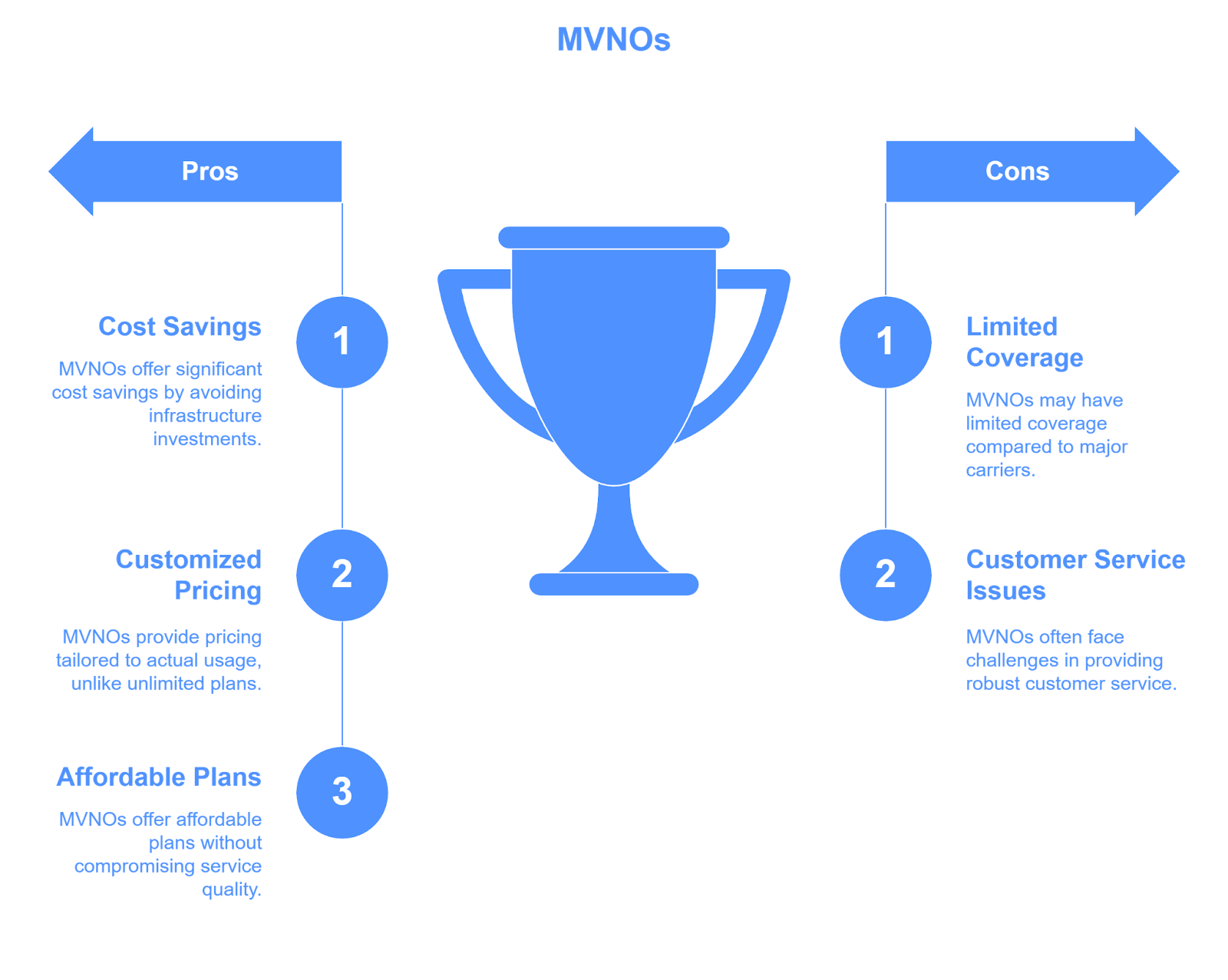
MVNO vs Major Carriers: Pros & Cons (Consumer Perspective, 2026)
| Category | MVNOs (Mobile Virtual Network Operators) | Major Carriers (MNOs) |
|---|---|---|
| Pricing | ✅ Lower-cost plans (often 30–50% cheaper) ✅ Pay only for what you use |
❌ Higher pricing ❌ Often bundled with features you may not need |
| Plan Flexibility | ✅ Highly customizable plans ✅ Prepaid & no-contract options ✅ Easy to switch |
❌ Rigid plans ❌ Long-term contracts common |
| Network Coverage | ✅ Uses same networks (AT&T, Verizon, T-Mobile) ⚠️ Performance may vary by plan |
✅ Full access to owned infrastructure ✅ Consistent performance |
| Data Speeds | ⚠️ Possible deprioritization during congestion | ✅ Priority access to network speeds |
| Customer Support | ✅ Often more personalized & niche-focused ⚠️ Quality varies by provider |
⚠️ Can feel impersonal ✅ More standardized support systems |
| Physical Stores | ❌ Mostly online-only support ❌ Limited or no retail locations |
✅ Extensive retail store presence |
| Perks & Bundles | ⚠️ Fewer extras (streaming, sports, etc.) ✅ Some innovative niche bundles |
✅ Premium perks (Netflix, Disney+, etc.) ✅ Device financing options |
| Innovation & Custom Use Cases | ✅ Strong in niche plans (IoT, travel SIMs, business use) ✅ Faster innovation cycles |
❌ Slower to innovate ❌ Focus on mass-market plans |
| Ease of Setup | ✅ Fast activation (especially with eSIM) ✅ Digital-first experience |
⚠️ Can require store visits or longer setup |
| Problem Resolution | ⚠️ May involve intermediary (MVNO + carrier) in rare cases | ✅ Direct control over network = faster resolution |
Quick Takeaway
Choose major carriers if you want: top-tier performance, perks, and in-person support.
Choose MVNOs if you want: lower costs, flexibility, and customized plans.
Is an MVNO Right for You?
For consumers: If you are paying $65 to $90 per month for a single line on a major carrier and do not rely heavily on bundled streaming perks or device financing, an MVNO is almost certainly the better value. Check the best MVNOs for 2026 to compare plans by network, price, and data priority.
For businesses: If you manufacture connected devices, operate a consumer brand with a loyal customer base, or manage IoT deployments across multiple regions, the MVNO model offers a path to recurring revenue and deeper customer engagement. The MVNO launch cost has dropped dramatically with modern MVNE platforms, making it accessible to companies that would never have considered it five years ago.
For existing MVNOs: If you are a reseller struggling with thin margins, the path forward is vertical specialization, multi-carrier access, and operational automation. Competing on price alone is not a sustainable strategy in a market with over 1,000 global operators.
How Spenza Helps MVNOs Deliver Better Consumer Experiences
Behind the scenes, the MVNO ecosystem is rapidly evolving, thanks in part to companies like Spenza, a Mobile Virtual Network Enabler (MVNE). These platforms help MVNOs compete more effectively by managing operations, billing, and network access.
How Spenza is Transforming the MVNO Experience:
- Operator-Neutral Access: MVNOs using Spenza can tap into multiple major networks, enhancing negotiation power and minimizing network deprioritization
- Custom Mobile Plans: Real-time plan assignment and usage-based billing let MVNOs tailor offerings precisely to consumer needs, down to the megabyte
- Simplified Billing & Operations: Spenza unifies billing, data usage tracking, and network management into a single, streamlined system
- Branded Experiences: MVNOs can build unique branded ecosystems, delivering personalized mobile experiences that stand out in the market
Conclusion: Are MVNOs Worth It in 2026?
The MVNO landscape in 2026 is no longer defined by compromise. What started as a low-cost alternative has evolved into a mature, fast-growing segment of the telecom industry, driven by cloud infrastructure, eSIM adoption, and vertical specialization. With the global MVNO market surpassing $100 billion and projected to approach nearly $195 billion in the coming decade, the shift toward flexible, software-defined connectivity is unmistakable.
For consumers, the decision is increasingly straightforward. If your priority is cost savings, flexibility, and control, MVNOs offer unmatched value with plans that are often 30 to 50 percent cheaper while still running on the same underlying networks. For businesses, the opportunity is even more compelling. MVNOs enable entirely new revenue models, deeper customer relationships, and highly tailored connectivity solutions that traditional carriers are not built to deliver.
At the same time, the tradeoffs have not disappeared entirely. Data prioritization, fewer bundled perks, and limited physical support remain real considerations, especially for users who demand premium, all-inclusive experiences. However, innovations like multi-carrier access, premium data tiers, and API-driven platforms are rapidly closing these gaps, making modern MVNOs far more competitive than their earlier counterparts.
The key takeaway in any MVNO vs major carriers pros and cons 2026 analysis is this: the choice is no longer about better or worse, but about fit.
- Choose an MVNO if you value efficiency, customization, and digital-first experiences
- Choose a major carrier if you prioritize network priority, bundled perks, and in-person service
As the market continues to evolve, the most successful MVNOs will not be the cheapest, but the most focused. Whether you are a consumer switching plans or a business exploring a launch, the real advantage lies in choosing a provider that understands your specific needs better than a one-size-fits-all carrier ever could.
FAQs
Explore Spenza’s innovative MVNO solutions today. Request a free demo now!