An eSIM (embedded SIM) is a SIM that is built into a device as a chip instead of being a card you insert. It does the same job as a plastic SIM: it holds the credentials that let a phone, watch, laptop or connected machine register on a mobile network. The difference is that those credentials are downloaded as a software profile, so you can add, switch or remove a carrier without touching any hardware.
This guide explains how an eSIM works, how it compares with a physical SIM and an iSIM, how people and companies set one up, and where its limits are. It covers phones first, then the business and IoT uses where the largest gains sit. For depth on specific topics it points to our guides on SGP.22 and SGP.32, remote SIM provisioning, eSIM orchestration and eSIM for MVNOs.
Last verified 2 November 2026.
How does an eSIM work?
Three things make an eSIM work: a secure chip, a profile and a way to deliver one to the other.
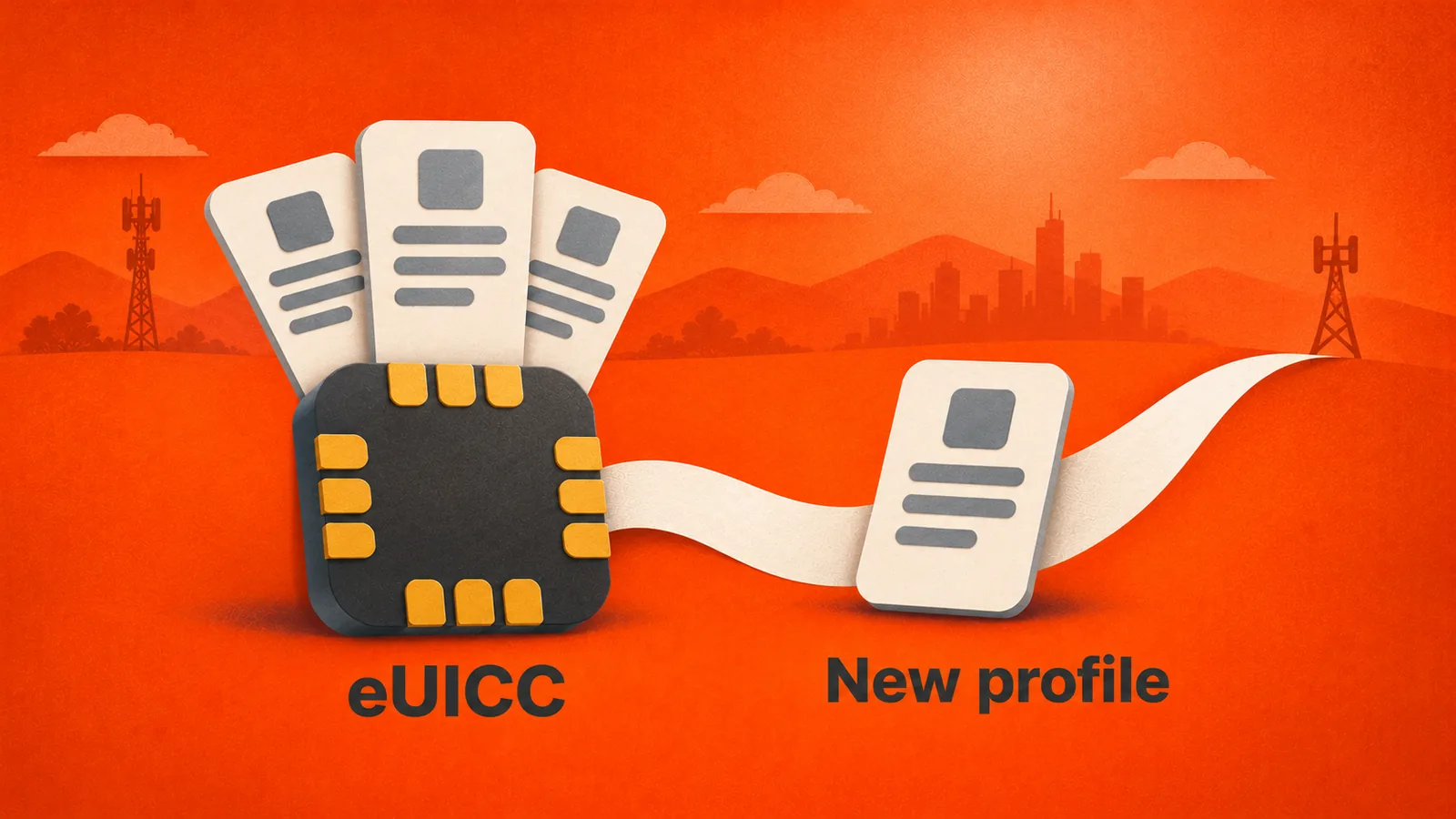
- The chip. The hardware is an embedded Universal Integrated Circuit Card, or eUICC. It is a tamper-resistant secure element, soldered to the board or built into the device’s main chip, that can hold more than one operator profile at a time.
- The profile. A profile is the carrier’s subscription in digital form: the identifiers and keys the network uses to recognize you, plus the operator’s settings. A profile belongs to one carrier. The eUICC stores several and activates the one you pick.
- The delivery path. The carrier (or a reseller or brand acting for it) prepares a profile on a server. In the consumer standard this server is the SM-DP+ (Subscription Manager Data Preparation plus), and software on the phone, the Local Profile Assistant, downloads the profile over the internet and installs it on the chip.
In practice the activation looks like this. You buy a plan and receive an activation code, usually shown as a QR code or delivered inside the carrier’s app. The device reads it, contacts the server, downloads the profile and installs it. You then turn the line on in settings. Apple notes that carriers provide steps to activate an eSIM digitally, for example with a QR code or a carrier app, and that an iPhone needs a Wi-Fi connection or hotspot for the download (some eSIM-only models can activate without Wi-Fi in certain regions). The standards behind this flow are published by the GSMA, the mobile industry body, as the SGP.22 consumer specification.
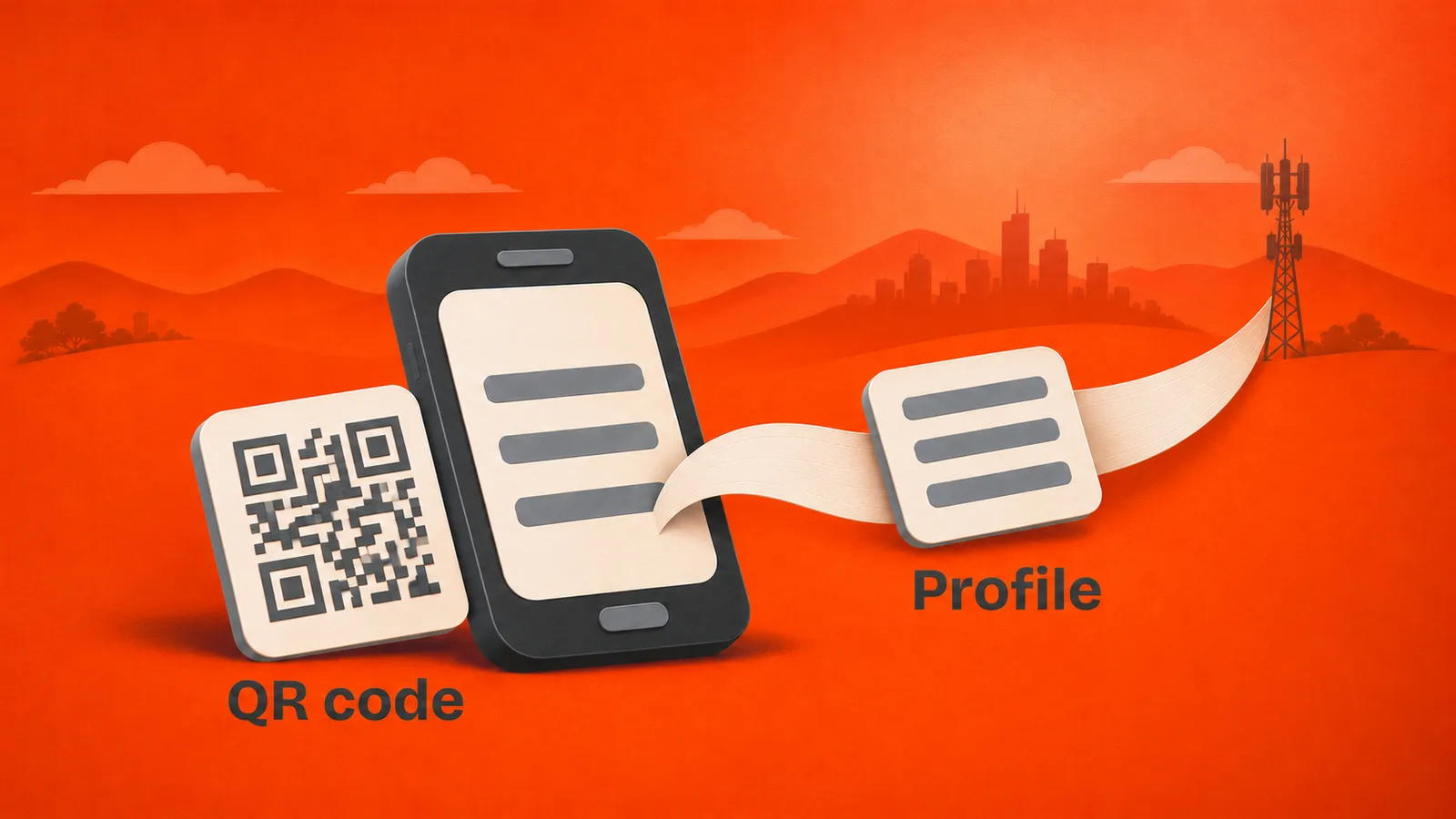
Once the profile is installed, the phone behaves as it would with a plastic SIM: it attaches to the carrier’s network, makes calls and uses data. Nothing about radio coverage changes. An eSIM changes how credentials get onto the device, not how well the network reaches it.
What actually changes for the user
With a physical SIM, the carrier is chosen when you insert the card. With an eSIM, the carrier is a software setting. That has four practical effects:
- You can buy and install a plan without visiting a shop or waiting for a card in the post.
- One device can hold several profiles, such as a home plan and a travel plan, and switch between them in settings.
- Dual SIM works without a second card slot. Apple states that iPhone 13 models and later support Dual SIM with two eSIMs.
- There is no tray to wear out, no card to lose and no tiny part to swap between devices.
eSIM vs physical SIM vs iSIM
Connectivity buyers meet three forms. A physical SIM is a removable card. An eSIM is a chip fixed in the device that accepts downloaded profiles. An iSIM goes a step further and builds the SIM functions into the main system-on-chip, which saves space and parts and suits very small or low-cost devices. iSIM is newer, and the choice of it is usually made by the device maker, not the end customer.
| Physical SIM | eSIM | iSIM | |
|---|---|---|---|
| Form | Removable card | Embedded chip (eUICC) | SIM functions inside the device’s main chip |
| Changing carrier | Replace the card | Download another profile | Download another profile, if the design supports it |
| Remote provisioning | Not possible for a basic card | Supported on compatible devices | Supported on compatible designs |
| Risk of loss or damage | Card can be lost, bent or stolen | No removable part | No separate part |
| Typical fit | Older devices, simple or low-volume use | Phones, wearables, laptops, most new IoT designs | Very compact or cost-sensitive devices |
| Maturity | Long established | Widely deployed | Earlier in adoption |
Two clarifications prevent common mistakes. First, “eSIM” describes capability, not shape. A removable card can also support remote provisioning if it contains an eUICC, so “plastic” does not always mean “fixed”. Second, an embedded SIM does not make a device work on every network. The modem, supported bands and the carrier’s own rules still decide that. Our IoT SIM cards guide compares the physical form factors in detail, and the multi-IMSI vs eUICC guide explains how the two approaches to switching networks differ.
The identifiers you will see
Four identifiers come up when you set up, troubleshoot or inventory eSIM devices. They are easy to confuse.
| Identifier | What it identifies | Where you meet it |
|---|---|---|
| EID | The eSIM chip (eUICC) itself | Provisioning requests; some carriers ask for it to prepare a profile for your device |
| ICCID | A specific SIM or profile | Inventory, billing records and activation lists |
| IMSI | The subscriber on the mobile network | Network and roaming records |
| IMEI | The physical device hardware | Device settings; lost-device and blocklist checks |
A rule of thumb: the EID and IMEI belong to hardware, while the ICCID and IMSI belong to the subscription. Replace the phone and the first two change; swap the profile and the last two change.
Which standards matter
All of this interoperates because the GSMA defines how profiles are prepared, downloaded and managed. Three families are worth knowing by name:
- SGP.22 covers consumer devices. A person with a screen scans a code or opens an app and approves the download. This is the standard behind eSIM in phones, tablets and many wearables.
- SGP.02 is the earlier machine-to-machine specification, which puts control with the operator’s platforms. It is still found in installed IoT fleets.
- SGP.32 is the IoT specification, designed for devices that have no screen and no person present. It replaces the consumer assistant with an on-device IoT Profile Assistant and a cloud-side eSIM IoT Remote Manager. GSMA has published several versions, including v1.2.
You do not need these details to use an eSIM on a phone, but they matter when you buy hardware. Devices are built for one family, and a mismatch can force a redesign later. Our guide to SGP.22 vs SGP.32 sets out which to choose, and what remote SIM provisioning is explains the architecture and acceptance tests.
eSIM for individuals and travelers
For individuals, the benefits are convenience and choice. Before eSIM, landing in a new country meant finding a local SIM vendor and swapping cards. With eSIM you can buy a local data plan before the trip, install it and switch to it on arrival. Apple notes that travelers can buy prepaid plans from a carrier’s website or app before they travel, or at an airport kiosk or carrier store, and that some places ask for identification such as a passport.
Dual SIM is the other everyday use. One phone can carry a personal and a work line, or a home line and a local data plan, with each profile selectable in settings. If you use two lines, check which one is set for data, since an iPhone, for example, uses only one cellular data connection at a time.
Before buying, confirm four things:
- The phone supports eSIM and is unlocked, or is sold by the carrier you are choosing.
- The plan is sold as an eSIM and covers the country and data amount you need.
- You have a way to scan the code or open the carrier app, usually on Wi-Fi.
- You know how to keep your original line active, for example for banking codes, while you use a travel plan.
eSIM for business and enterprise
The strongest business case is operational, not convenience. Physical SIMs need to be bought, shipped, stocked, matched to people and replaced. Each step costs time and creates an opening for error. With eSIM, those steps become requests to a platform.
- Onboarding. Instead of mailing a SIM to a new employee, a company can send an activation code by email with the other starter documents. One scan installs the profile and a corporate line is live. This works equally for remote staff and for people who never visit an office.
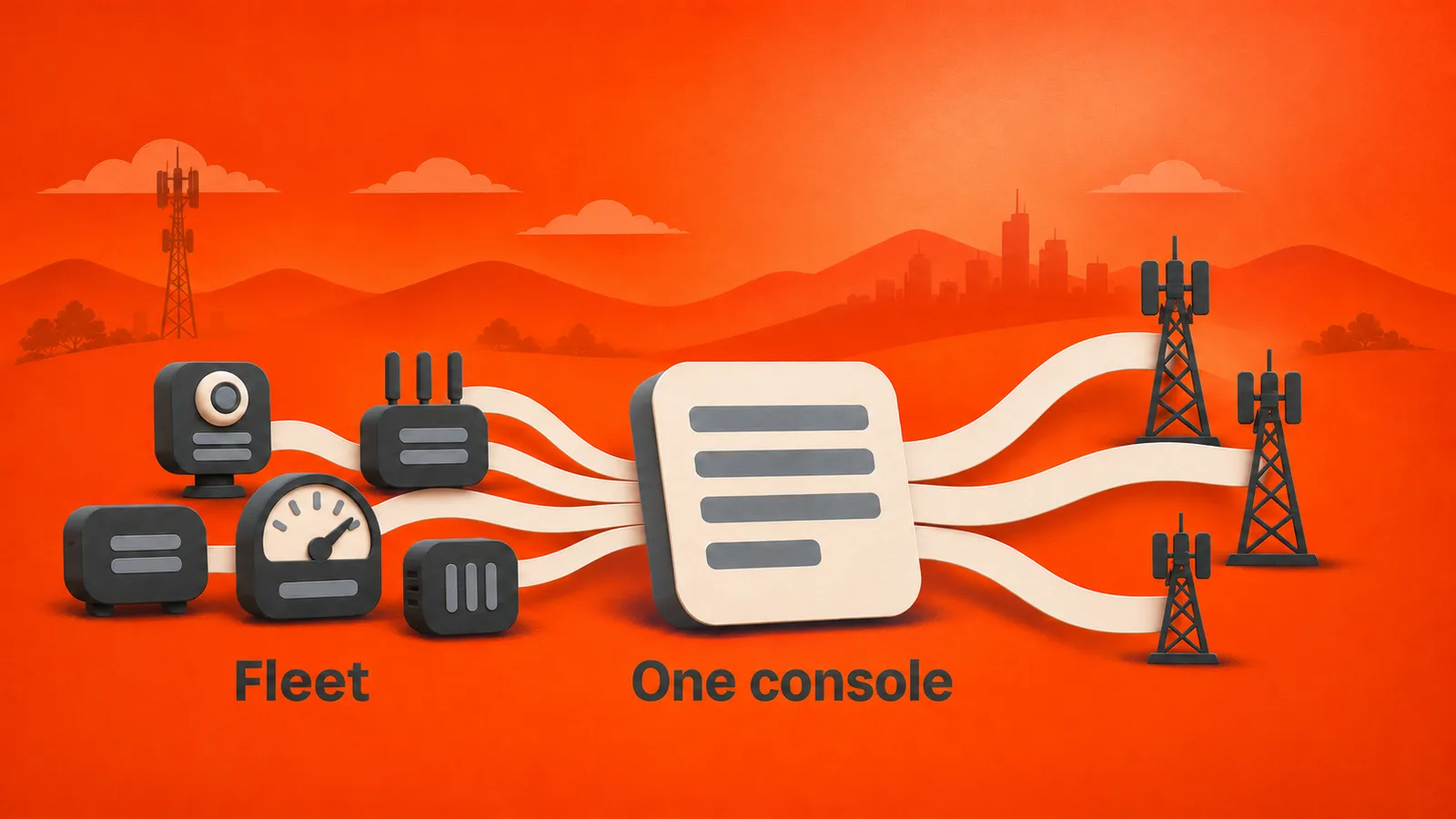
- Control. A single console can assign, suspend and revoke lines across countries. When someone leaves or loses a device, the line can be ended without waiting for a card to come back.
- Bring your own device. Because the SIM is digital and policy-controlled, a company can add a work line to an employee’s own phone without taking the personal one away.
- Travel and roaming. A traveling employee can be given a local data profile in advance instead of relying on roaming charges. Compare the plan terms for each country, because savings vary by carrier and route.
- Several carriers behind one contract. Because profiles can be switched, an enterprise can buy through one provider that sources service from several carriers behind the scenes, and compare cost and quality between them. This is only practical if the provider reports usage and cost in one place.
Security needs a plain statement. An eSIM cannot be pulled from a stolen phone and does not travel through the post, which removes some interception risk. It does not remove fraud that works through the carrier’s support desk, such as persuading an agent to move a number to a new profile. Controls on who can request a profile change are part of the design, whether you run lines yourself or buy them as a service.
eSIM for IoT and connected products
Scale is where eSIM pays back most. Keeping track of a few phones is simple. Managing tens of thousands of meters, trackers or industrial sensors, many of them sealed, outdoors and hard to reach, is not. An embedded SIM lets a manufacturer build one hardware variant, ship it worldwide and load the right connectivity later. If a carrier relationship ends, a network is retired or a country’s rules change, the profile can be changed remotely without a site visit.
Three practical points follow:
- Hardware outlives connectivity contracts. A device may stay in the field for a decade, while a carrier agreement lasts a few years. Choosing a device that can take new profiles keeps your options open.
- Provisioning is only the start. Teams still need to see each device, control data use and move devices between plans. A connectivity management platform provides that operational layer. Our comparison of connectivity management platforms and the IoT eSIM providers guide cover the options.
- Single-carrier dependence is a risk. A fleet tied to one network inherits its outages and its pricing. See the risks of single-carrier IoT and, for a multi-network design, the guide to deploying multi-network eSIM with RSP aggregation.
Network technology matters as much as the SIM. Whether a device uses LTE-M, NB-IoT or 5G RedCap affects battery life, cost and coverage, and an eSIM does not change those trade-offs. Our comparison of NB-IoT, LTE-M and 5G RedCap helps match the radio to the job. For managing profiles across providers at scale, read about eSIM orchestration.
eSIM for brands and MVNOs
eSIM also lowers the cost of becoming a connectivity provider. A mobile virtual network operator (MVNO) sells service over a host network without owning the radio network. If it sells through eSIM, it does not need to print, ship or stock cards, and a customer can be active minutes after payment. That makes it practical for brands with an engaged audience, such as travel apps, device makers and retailers, to offer connectivity as part of their product.
The technology is the simpler part. The business still needs a host-network agreement, a profile-issuing platform, billing, customer support and compliance with local rules. Brands deciding how much to own can start from the types of MVNO, the white-label model, and the technical steps in implementing eSIM for an MVNO. Spenza’s platform is built for this group, covering MVNO launch and operations and the connectivity management side for enterprises and device makers.
What an eSIM does not do
Because eSIM is often described as a simple upgrade, these limits are worth stating plainly.
- It does not add coverage. You still depend on the carrier’s network and on your device’s radio bands.
- It does not unlock a locked phone. Carrier locks and plan rules still apply.
- It does not guarantee every carrier supports it. Some plans and regions are still sold with a physical SIM only.
- It does not remove migration work. Moving a fleet or workforce needs inventory, plan mapping and a rollback path.
- It does not fix a bad contract. Profile switching helps only if your agreements permit it.
How to decide and what to ask
Match the approach to who uses the device:
| If you are… | Start by checking | Then |
|---|---|---|
| A traveler or phone user | Phone is unlocked and supports eSIM; the plan is sold as eSIM | Install the plan before you travel, over Wi-Fi |
| An IT team managing staff phones | Device fleet support; carrier agreements; how profiles will be issued and revoked | Pilot with one team, then extend |
| A device maker | Which standard the hardware must support (SGP.22 or SGP.32) and where devices will operate | Decide on a management platform before locking the design |
| A brand or MVNO | Host-network terms, billing and who supports the customer | Choose how much of the stack to own |
Questions worth putting to any supplier: Which provisioning standard and version do you support? Who holds the profile data and the customer data? What happens to profiles if we leave? Can we see cost and usage in one place? How are profile changes authorized? A supplier that answers these specifically has probably done it before.
Conclusion
An eSIM replaces a plastic card with a chip and a downloadable profile. For individuals that means easier setup, simple travel plans and dual-line phones. For companies it means less logistics, central control of lines and, in IoT, devices that can change carriers without being touched. It does not improve coverage, override carrier locks or remove the need for clear contracts, so the sensible approach is to check device support, the provisioning standard and the commercial terms before committing. For deeper reading, continue with remote SIM provisioning and SGP.22 vs SGP.32.
FAQs
Is an eSIM the same as a digital SIM card?
Yes, in everyday use. An eSIM is a SIM that lives in a chip inside the device and is loaded with a carrier profile by software, so there is no card to insert. The chip itself is called an eUICC, and the profile is the digital copy of the credentials a plastic SIM would hold.
Can I have a physical SIM and an eSIM at the same time?
On many phones, yes. Dual SIM devices can keep one physical SIM and one eSIM active, and some models support two eSIMs. Apple states that iPhone 13 models and later support Dual SIM with two eSIMs. Check your own model’s specification, because support depends on the device and the market it was sold in.
Do I need a carrier’s permission to use an eSIM?
You need a plan that the carrier or reseller offers as an eSIM, and the phone must be unlocked for that carrier or sold by it. A phone locked to one carrier will usually refuse another carrier’s profile. Ask the seller whether the plan is available as an eSIM and whether your device is unlocked before you pay.
Is an eSIM more secure than a physical SIM?
It removes some risks and leaves others. A profile cannot be lost in the post or pulled out of a stolen phone, and the chip is built to protect credentials. But fraudsters can still talk a carrier into moving a number, so protective measures such as account PINs and identity checks on profile changes still matter.
What happens to my eSIM if I lose my phone or buy a new one?
The profile lives on that device’s chip, so you contact the carrier to suspend the line and issue a new activation, usually another QR code or an in-app transfer. Some platforms offer a direct transfer between phones from the same maker. A business managing many lines can revoke and reissue profiles from one console.
What is the difference between SGP.22 and SGP.32?
Both are GSMA remote SIM provisioning specifications. SGP.22 is for consumer devices such as phones, where a person scans a code and approves the download. SGP.32 is for IoT devices that have no screen and no user, and it adds a cloud manager and an on-device assistant so a fleet can be managed remotely.
Is eSIM useful for business fleets and connected products?
Yes, and often more than for individuals. Companies avoid shipping and stocking SIM cards, can change connectivity after a device is deployed, and can add carriers without opening devices. It still depends on compatible hardware, a supported provisioning method and commercial terms that allow profile changes.
Can an MVNO or brand sell eSIM plans?
Yes. A brand or MVNO can offer eSIM plans if it has a host-network arrangement and the platform to issue and manage profiles. eSIM removes the shipping of plastic cards from that model, but not the need for carrier agreements, billing and support.