What Is Phone Number Warm-Up?
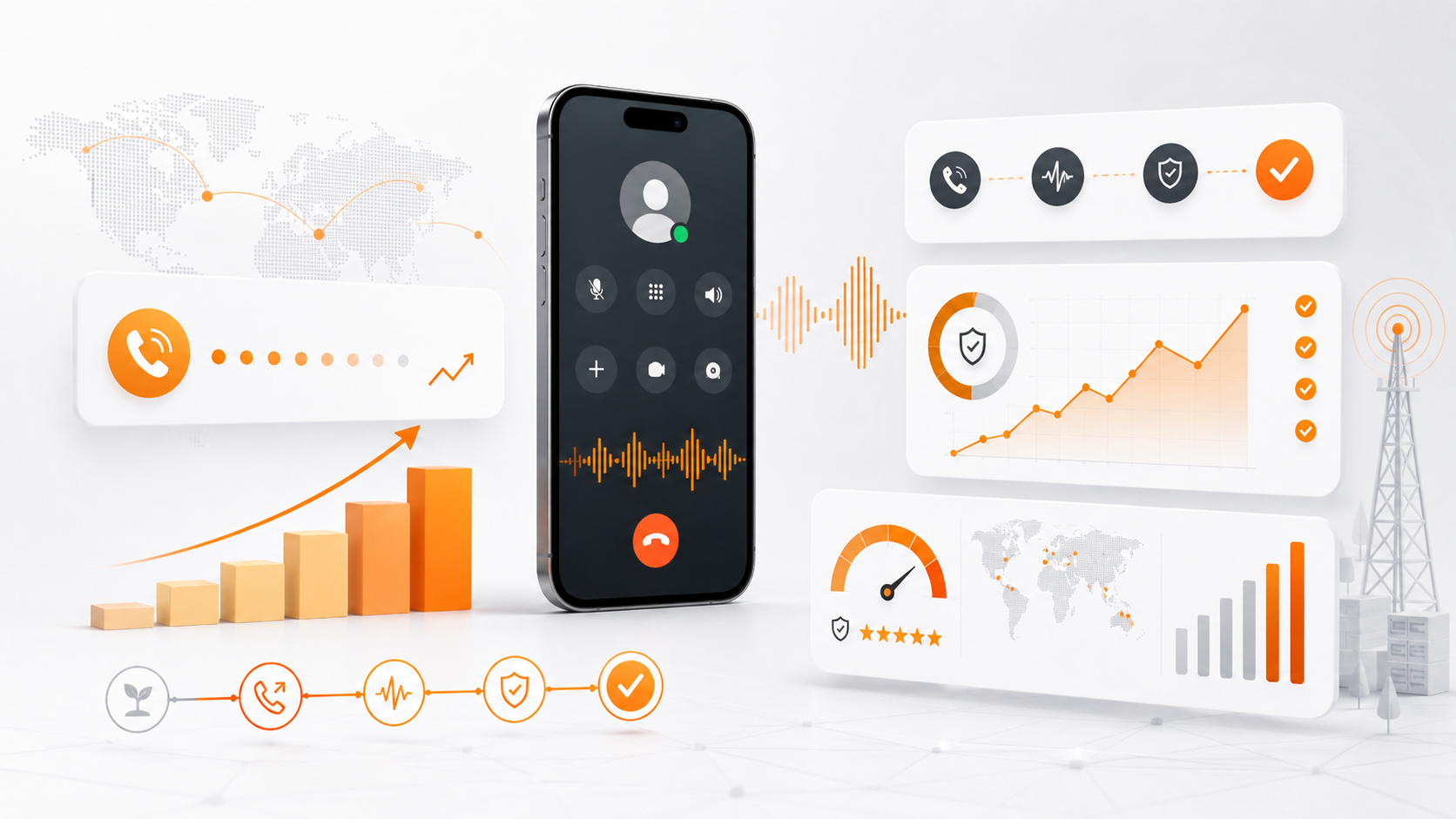
Phone number warm-up is the process of establishing a new business calling number with carriers, analytics engines and recipients before it carries full production volume. It covers ownership verification, registration, a check of the number’s prior history, display testing across networks, and a controlled start with your most responsive audience.
That definition is deliberately wider than the one you will find on most pages, which reduces warm-up to a volume schedule. The schedule is the least important part, and the part most likely to mislead you.
Why the Email Warm-Up Analogy Breaks
The email analogy is useful for intuition and wrong in its specifics. Email warm-up works because mailbox providers publish reputation feedback and because you authenticate a sending domain you control. Neither condition holds in voice. The engines score behaviour continuously, disclose nothing, and grant no starting allowance to a new number.
Here is where the two systems actually diverge.
| Dimension | Email Warm-Up | Phone Number Warm-Up |
|---|---|---|
| What gets scored | Sending domain and IP | The number, the originating provider, and the enterprise’s history across all its numbers |
| Feedback you can query | Postmaster tools, complaint rates, delivery reports | No public score. You infer from answer rates, per-carrier display and engine reports where you hold an account |
| Published ramp | Widely documented curves from major providers | No carrier or analytics engine publishes a warm-up schedule |
| Authentication’s role | SPF, DKIM and DMARC bind the domain to you and feed reputation directly | STIR/SHAKEN attests that you are entitled to use the number. It says nothing about whether recipients want the call |
| Starting position | New domains and IPs start neutral | New numbers can start negative. Reassigned numbers inherit the previous holder’s label |
| What ramping achieves | Builds sending reputation with the provider | Avoids the burst pattern the models are trained to catch |
The practical consequence: you can run a textbook 14-day ramp on a number that was flagged before you ever touched it, and your answer rate will not recover. The ramp was never the variable.
Day Zero: Check What You Just Bought
Before the first dial, find out what the number already is. About 35 million US telephone numbers are disconnected and reassigned each year, and the FCC’s minimum aging period before reassignment is 45 days. A number can therefore reach you six weeks after somebody else finished annoying people with it, carrying their label and their complaint history.
This single check reframes the most common support ticket in outbound calling, which is “my brand new number is already flagged”. That is a provisioning problem, not a behaviour problem, and no amount of ramping will fix it.
Run these four checks before the number touches a campaign.
- Confirm ownership and the origination path. Establish which provider is entitled to use the number and which one will sign your calls. If you cannot name the entity that attests to your traffic, you cannot diagnose an attestation problem later.
- Check the current label on each major network. Place test calls to handsets on AT&T, Verizon and T-Mobile before your first campaign, and record what displays. This is your baseline. Without it you cannot tell later whether your behaviour caused a label or inherited it.
- Check reputation with the engines you have access to. Hiya’s number registration includes a reputation report card with grades across several metrics, and the other engines expose their own reporting to registered callers.
- Ask your provider for the number’s aging status. A number that was recently permanently disconnected and reassigned is a different risk from a number drawn from unused inventory. Providers can usually tell you which one you have.
The FCC’s Reassigned Numbers Database (RND) tells you whether a phone number you intend to dial was permanently disconnected after the date you obtained the recipient’s consent. It does not tell you the history or reputation of the number you are calling from.
The RND is a consent-hygiene tool with a TCPA safe-harbor function, not a reputation lookup service for your own DIDs. Use both types of tools for their respective jobs, and do not confuse one with the other.
If the day-zero check comes back dirty, return the number and request another. Cleaning an inherited label costs weeks. Swapping a number before launch costs minutes.
The Pre-Launch Readiness Checklist
Complete these eight steps in order before the number carries campaign traffic. Steps one through five take days to propagate, so start them well ahead of your launch date.
| # | Step | Why It Matters |
|---|---|---|
| 1 | Verify business identity with your provider | KYC and emerging know-your-upstream-provider requirements determine whether your traffic can be attested at all |
| 2 | Confirm number ownership and origination path | Attestation depends on the originating provider being able to assert your right to use the number |
| 3 | Run the day-zero history and label check | Separates inherited labels from behaviour you have not exhibited yet |
| 4 | Register the number with the analytics engines | Free Caller Registry submits to Hiya, First Orion and TNS in one form, at no cost |
| 5 | Set caller identity separately from registration | Registration data is not used to deliver caller ID name, so CNAM and branded calling are separate jobs |
| 6 | Verify attestation on live calls | Read the SIP Identity header or your CDRs. Do not assume an A because you use a SIP trunk |
| 7 | Baseline test across carriers and devices | Record label, caller ID display and connection result per network, with the date |
| 8 | Confirm consent, calling windows and suppression | Consent records, time-of-day rules and opt-out handling belong in place before the first call |
Free Caller Registry states in its documentation that neither the analytics engines nor their carrier partners use registration data to provide caller ID name (CNAM). Registering your number therefore does not set your CNAM.
If your calls continue to display as a bare phone number after registration, that is expected behavior. CNAM or branded calling is a separate provisioning task and must be handled independently from analytics registration.
Two further notes on registration. It is free, and multiple submissions of the same number add nothing, so resubmitting weekly is wasted effort. Each engine verifies independently and communicates with you separately from that point, which is why you may hear from one within days and another not at all.
How to Test a New Number Across Carriers
Test on physical handsets, one per major US network, and record what the screen actually shows. Lookup tools report a status. The handset reports the experience, and the two disagree often enough that the handset has to be the ground truth.
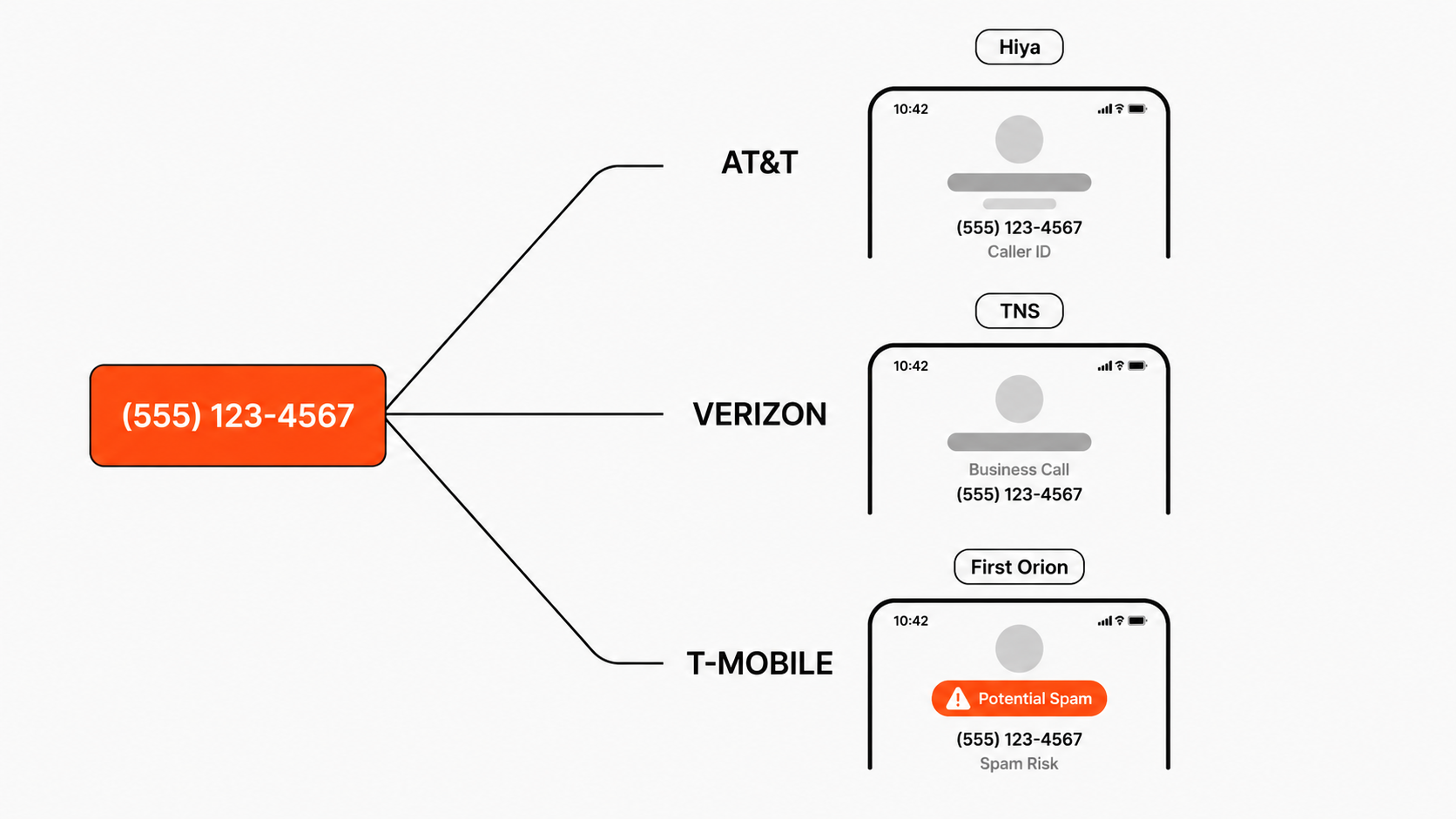
Each carrier uses a different analytics engine, which is why one number can display three different ways on the same afternoon.
| Carrier | Analytics Engine | Where to Register or Dispute |
|---|---|---|
| AT&T | Hiya | Hiya number registration, plus AT&T’s call label review page |
| T-Mobile | First Orion | First Orion free number registration, plus T-Mobile Scam Shield reporting |
| Verizon | TNS | TNS caller registration and reporting |
| All three at once | Not applicable | Free Caller Registry, one form, no charge |
Beyond the carrier layer, handset apps and third-party call blockers maintain their own databases and label independently. This is why the same number can look clean on one Verizon phone and flagged on another. Test with a stock device and with a common blocking app installed, and treat the two results as separate data points.
Ramping: Risk Management, Not a Schedule
Ramping does not build reputation. It keeps you from producing the one pattern every analytics model is tuned to catch, which is a previously silent number generating a burst of calls that nobody answers. Start with the audience most likely to pick up, hold your pacing steady, and expand only while your own numbers hold.
You will see a threshold of 100 calls per day per number quoted across sales blogs and vendor content. No carrier and no analytics engine publishes that figure. It is a heuristic that got repeated until it looked like a rule, and the pages that quote it usually admit two paragraphs later that exact trigger limits are not published. Treat any fixed number you see, including that one, as somebody’s guess.
Here is the shape that works instead of a schedule.
1. Start with the warmest audience you have. Inbound requests, recent opt-ins, customers expecting a callback. Answer rate is the signal the engines can see most clearly, and your first week of traffic sets the tone for the number.
2. Hold your pacing steady within the day. Consistent inter-call spacing across consistent hours looks like a business. Twelve hundred calls compressed into forty minutes looks like a dialer, whatever your intent.
3. Set your ceiling from your own baseline, not from a blog. If your established numbers run at some volume with a known answer rate, your new number’s target for week one is a fraction of that volume at the same answer rate. The metric that matters is not calls per day. It is calls per day relative to the answer rate and complaint rate on that specific number and that specific carrier.
4. Expand only when the previous step held. If answer rate slips on one carrier while the others hold steady, you have a labelling problem on that network, not a list problem. Diagnose before you increase.
Watch these signals, per number and per carrier.
| Signal | What to Watch | What a Change Usually Means |
|---|---|---|
| Answer rate per carrier | Divergence between networks | Labelling on one engine, not a list quality issue |
| Average call duration | A falling average | Recipients recognising and dismissing the call |
| Short-call ratio | Calls ending under six seconds | The clearest unwanted-call pattern in the data |
| Complaint and opt-out signals | Any rise, however small | Behaviour the engines weight heavily and act on quickly |
| Attestation level | Anything below A on traffic you expected to be A | Origination or right-to-use problem, not reputation |
| Label status per network | Any new label | Time to pause and diagnose, not to rotate |
Warm-Up for Voice AI Fleets
Voice AI changes the risk profile in three specific ways. Agents dial faster than humans, never pause, and get hung up on early, which produces exactly the burst-plus-short-duration signature the models flag. A fleet running twenty agents on a shared pool of numbers concentrates that signature instead of spreading it.
Four practices matter more for AI calling than for human teams.
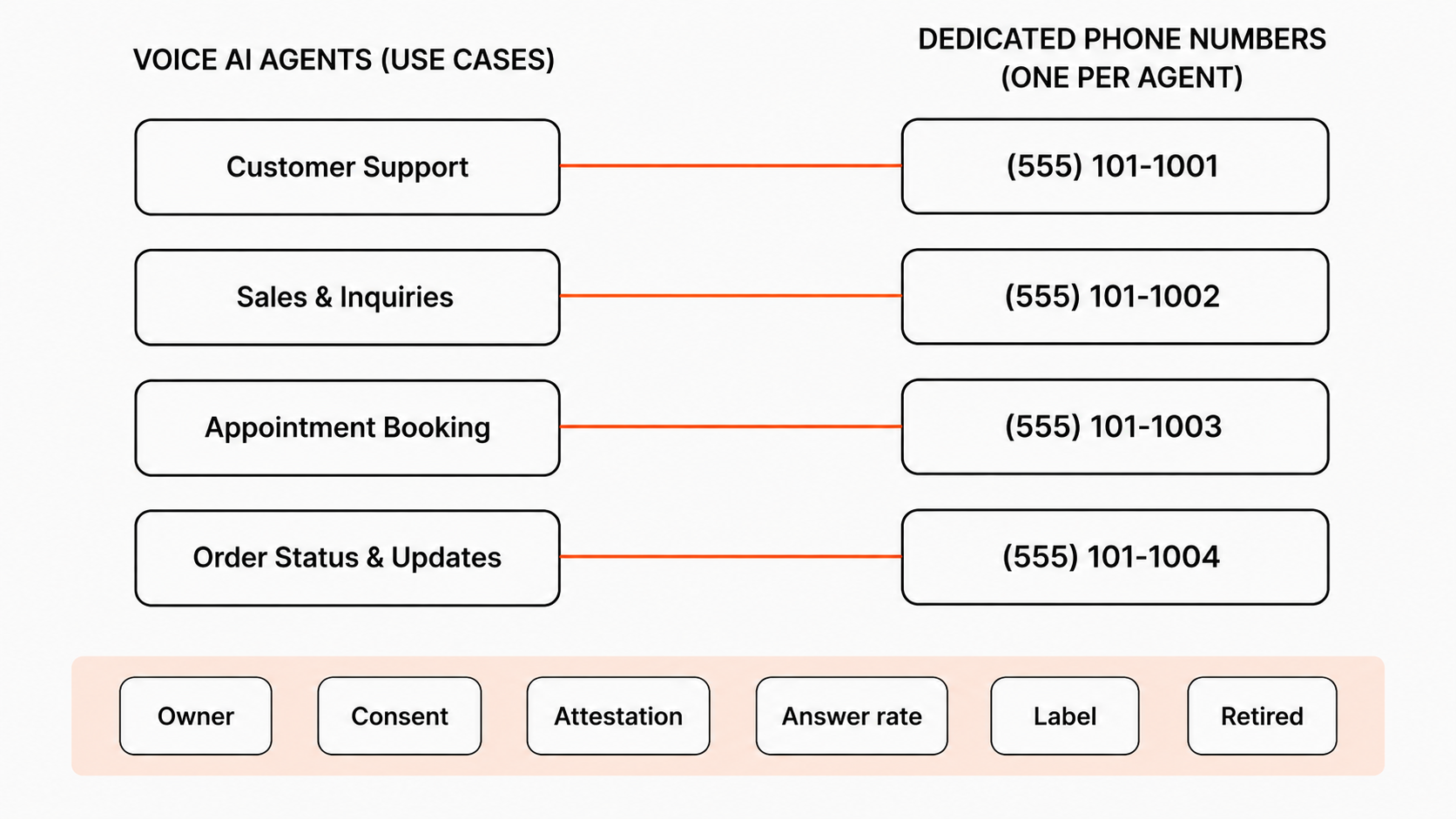
Give each agent and use case its own number. Sales outreach, appointment reminders and support callbacks should never share a DID. One flagged campaign otherwise poisons the other two, and you lose the ability to attribute a label to a cause.
Instrument the first six seconds. Short calls are the strongest unwanted-call signal in the data, and an agent that opens badly generates them at scale. Measure hang-up timing per script version, not just per number.
Keep the number layer separate from the agent platform. If the number is provisioned inside the conversational vendor, you inherit their origination path, their attestation, and their number history, and you cannot move without renumbering. Spenza’s guide on why AI agents need real phone numbers rather than VoIP DIDs covers that trade-off, and the difference between non-VoIP and VoIP numbers explains why line type keeps surfacing in verification and reputation outcomes.
Run a number inventory with real fields. A spreadsheet is fine to start. What is not fine is a pool of numbers with no owner, no consent source and no retirement reason.
| # | Field | Purpose |
|---|---|---|
| 1 | Number | The DID itself |
| 2 | Assigned agent or workflow | Attribution when something is flagged |
| 3 | Use case | Sales, support, reminders, verification |
| 4 | Consent source | Where the recipient’s permission came from |
| 5 | Origination provider | Who signs the call |
| 6 | Launch date | Age of the number in your service |
| 7 | Attestation observed | A, B or C, from CDRs rather than assumption |
| 8 | Answer rate, by carrier | The leading indicator |
| 9 | Complaint rate | The signal that moves fastest |
| 10 | Label status, by carrier | Checked on a cadence, with dates |
| 11 | Last tested | When a human last looked at a handset |
| 12 | Retirement reason | Why it left service, if it did |
If a New Number Is Already Flagged
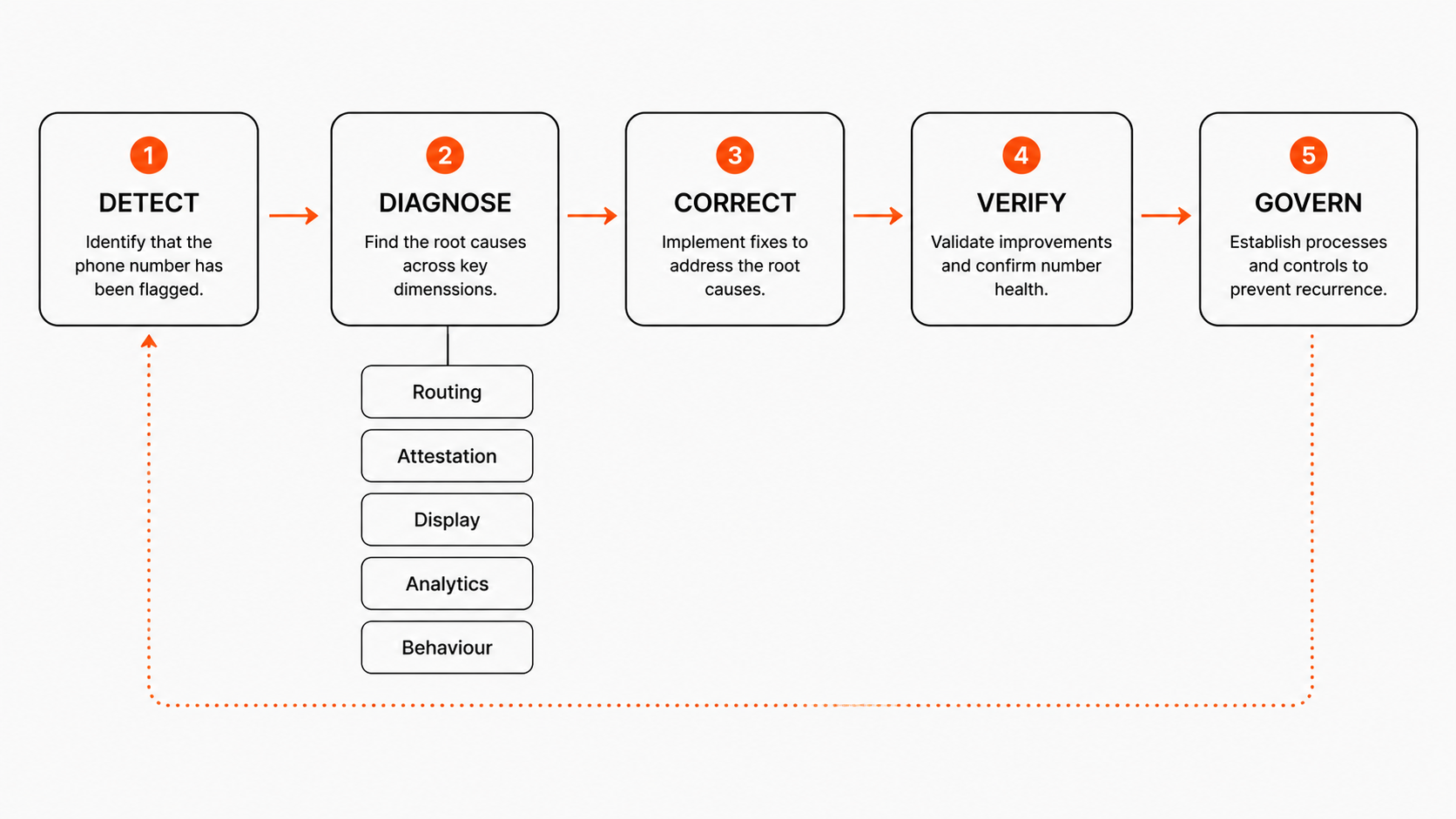
Work the sequence in order. Skipping to registration is the most common mistake, because registration opens a review of a problem you have not diagnosed yet.
- Pause the campaign on that number. Continuing while a label is live reinforces the pattern that produced it.
- Confirm the number is not compromised or spoofed. If someone else is displaying your number, the fix is upstream and nothing you do to your own traffic will help.
- Identify which layer owns the problem. Routing, attestation, identity display, analytics label and calling behaviour are five different systems with five different fixes. Your CDRs, your test log and your answer-rate split by carrier will tell you which one.
- Register and submit a correction request with evidence. Use Free Caller Registry for the shared path, then the individual engine where the label appears. Include what the number is used for, who consented, and what your test log shows.
- Fix the behaviour that triggered it, if behaviour was the trigger. Submitting a dispute without changing the pattern produces a second label.
- Re-test and monitor. Registration acknowledgements are commonly reported within a few business days. Label changes take longer to appear everywhere, each engine decides independently, and no vendor can guarantee removal.
Free Caller Registry‘s own guidance states that registration establishes your numbers as belonging to a legitimate business, but it does not guarantee that your calls will never be blocked or labelled.
Any vendor promising guaranteed label removal is promising an outcome that the calling ecosystem does not offer to anyone.
The Reality of Answer Rates in 2026
Warm-up sits inside a harder problem. In Hiya’s State of the Call 2026 research, drawn from a survey of more than 12,000 consumers, only 14 percent said they answer immediately when an unrecognised number calls. Hiya’s global data puts the average spam rate at roughly one in four calls from numbers outside a recipient’s contacts. One in four Americans reported receiving an AI deepfake voice call in the previous twelve months.
That context matters for expectation setting. A perfectly warmed, correctly registered, fully attested number still calls into an audience that has learned not to pick up. Warm-up protects you from self-inflicted damage. It does not restore the answer rates of 2015, and the sections of this guide that deal with caller identity, branded calling and audience quality carry more weight than the ramp does.
How Spenza Supports the Phone-Number Layer
Spenza operates at the number and carrier layer beneath your calling application. That means sourcing or porting suitable numbers, connecting them to voice workloads through supported carrier and SIP paths, and keeping number ownership, assignment and routing visible in one operating view rather than scattered across vendor consoles.
For teams running Voice AI, the practical value is separation. The number and its business purpose stay under your control while the conversational platform stays swappable. When something breaks, number and call metadata make it possible to tell whether the problem sits in routing, attestation, identity display, analytics labelling or campaign behaviour, which is the diagnosis this entire guide depends on.
To be explicit about the boundary: downstream carriers and analytics providers control labels and display outcomes. Spenza supports number operations and improves operational control. It does not control a carrier’s spam label or a third-party analytics score, and neither does any other vendor.
If you are designing the number layer for an AI calling deployment, start with phone numbers built for AI agents or talk to the team about number and carrier architecture. Teams running at volume across many customers often end up looking at running their own MVNO instead of paying per-minute CPaaS rates.
FAQs
Launch your AI calling fleet with numbers you control, carrier-ready routing, and the visibility to diagnose reputation issues before they become costly.