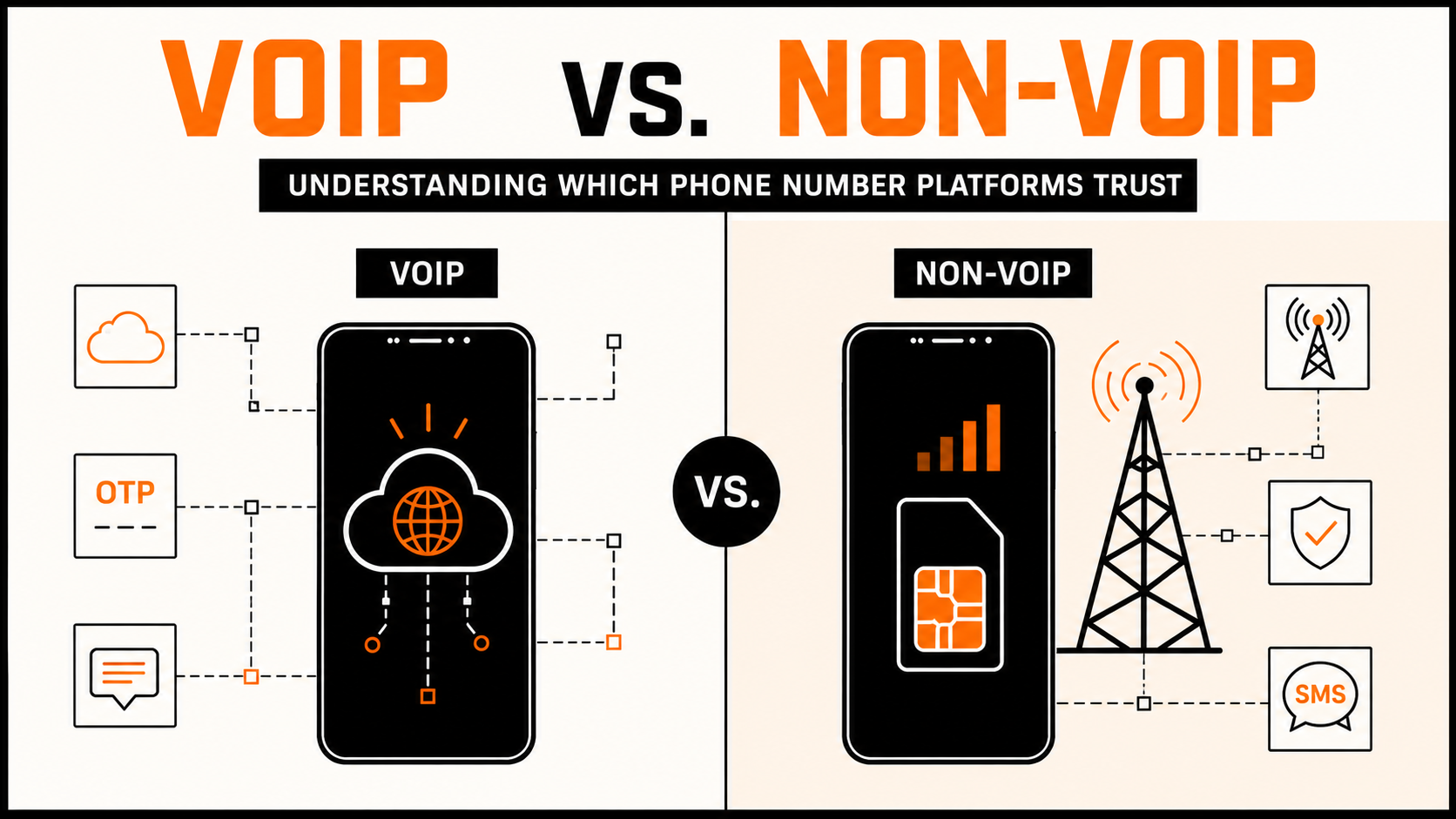
A VoIP number routes voice calls and text messages over the internet, while a non-VoIP number is issued by a mobile carrier or landline provider and operates on traditional telecommunications networks. The biggest difference is not just the underlying technology, but also how online services classify and trust the number. If you need a phone number for business communications, two-factor authentication (2FA), or account verification, understanding this distinction can help you avoid compatibility issues and unnecessary frustration.
To most people, every phone number looks identical. Behind the scenes, however, platforms such as banks, messaging apps, payment services, and cryptocurrency exchanges categorize numbers differently before deciding whether to send a verification code. That classification often determines whether your number is accepted or rejected.
As businesses increasingly rely on SMS verification, customer authentication, and secure communications, understanding the difference between VoIP and non-VoIP numbers has become more important than ever.
This guide explains how each type works, why many platforms prefer carrier-issued numbers, how line-type detection works, and when each option makes the most sense for legitimate business use.
What Is a VoIP Number?
A VoIP (Voice over Internet Protocol) number is a phone number that sends and receives voice calls and text messages over an internet connection rather than a traditional cellular or landline telephone network.
Rather than relying on a SIM card connected to a mobile network, VoIP services operate through cloud infrastructure. Think of a VoIP number like an email address that also rings. It’s software-based, doesn’t require a physical SIM card, and can be used across multiple devices, including smartphones, tablets, and computers, as long as you have an internet connection.
Services such as Google Voice, TextNow, and TextFree offer VoIP numbers that can often be set up in just a few minutes. Many VoIP services are marketed as virtual phone numbers, but not all are treated the same during verification. Acceptance depends on the provider, line type, and platform policies.
VoIP numbers fall into two sub-categories that matter for how platforms treat them:
- Fixed VoIP: Tied to a registered physical address. Think of a business landline that uses internet routing instead of copper wire. Lower risk in fraud systems.
- Non-fixed VoIP: Portable, fully virtual, and not tied to a fixed physical address. Many consumer VoIP services use this type of number, which fraud detection systems often classify as higher risk because there is no accountability anchor.
VoIP numbers are genuinely useful for many things, such as conference calls, softphone systems, international calling at low cost, and business communication features. The problem arises specifically when you try to use them for account verification.
What Is a Non-VoIP Number?
A non-VoIP number is a phone number issued directly by a licensed mobile carrier or traditional landline provider. For mobile service, it is associated with a physical SIM card or eSIM and is classified in carrier databases as a mobile or wireless number.
Most people use non-VoIP numbers every day without realizing they’re a separate category. When you buy a plan from AT&T, Verizon, or T-Mobile, the number you receive is non-VoIP. It is backed by a licensed carrier and associated with a verified subscriber record, making it easier for platforms to establish trust.
A non-VoIP number is linked to a SIM or eSIM profile that authenticates directly with a mobile operator’s network. Whenever a call, SMS, or OTP is sent, it travels through the carrier’s telecom infrastructure rather than internet-based voice servers. That accountability is exactly what makes platforms trust it.
Most carrier-issued phone numbers also follow the E.164 international numbering standard, which ensures they are uniquely identifiable across global telecom networks and can be routed consistently between carriers.
A mobile number is the most common type of non-VoIP number, but traditional landline numbers also qualify as non-VoIP. The key distinction is how the number is issued and routed. If the number is provided by a licensed carrier and operates over the traditional telecommunications network, it is considered non-VoIP, regardless of whether the call ultimately travels over a physical wire or wireless infrastructure.
The distinction between fixed VoIP, non-fixed VoIP, and mobile numbers is not just semantic. Fraud detection systems actively look at these classifications before deciding whether to send you a verification code.
Non-VoIP vs. VoIP: The Key Differences
Here is a side-by-side comparison of how these two number types differ across the dimensions that matter most for businesses and individuals:
| Dimension | VoIP Number | Non-VoIP Number |
|---|---|---|
| Network | Routes calls and texts over the internet. | Routes calls and texts through a cellular carrier or landline network. |
| Issued By | VoIP provider or virtual phone service. | Licensed mobile carrier or landline provider. |
| Requires SIM/eSIM | No. | Yes (physical SIM or eSIM for mobile numbers). |
| Line Type | Fixed VoIP or non-fixed VoIP. | Mobile (wireless) or landline. |
| Setup Time | Usually minutes. | Requires carrier activation. |
| Cost | Often free or low cost. | Carrier plan charges apply. |
| Identity Verification | Usually minimal. | Carrier identity checks are typically required. |
| Verification Acceptance | May be rejected by platforms with strict verification. | Broadly accepted for OTPs and account verification. |
| Fraud Risk | Higher, especially for non-fixed VoIP. | Lower due to carrier-backed identity. |
| Physical Address | Fixed VoIP may have one; non-fixed usually does not. | Associated with carrier subscriber records. |
| Works Across Devices | Yes, on multiple devices simultaneously. | Primarily linked to one SIM/eSIM-enabled device. |
| Best For | Business calling, remote teams, and international communication. | Banking, KYC, business verification, and long-term communications. |
In practice, most online platforms never rely on a single factor. They combine line type, carrier information, number reputation, and platform-specific risk rules before deciding whether to trust a phone number.
VoIP optimizes flexibility. Non-VoIP optimizes trust. Understanding that difference makes choosing the right number much easier. Because VoIP numbers are inexpensive and easy to create in bulk with minimal identity proof, platforms that care about bot prevention and KYC compliance have learned to screen them out.
How Platforms Detect VoIP vs. Non-VoIP Numbers
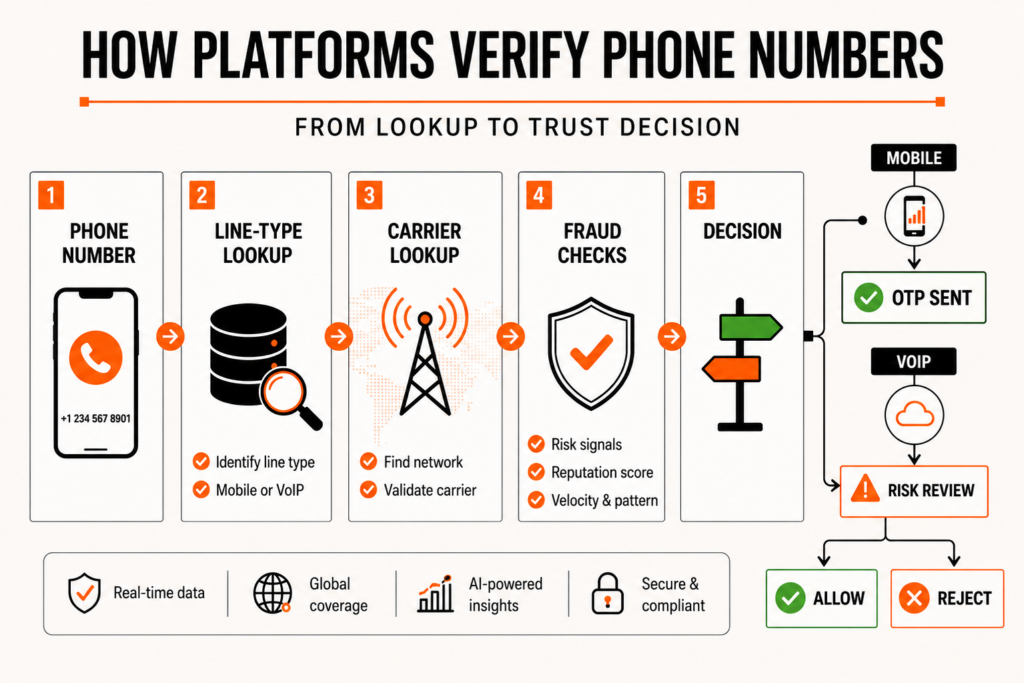
Have you ever entered a phone number for verification only to receive an error like “This number isn’t supported” or “Please use a mobile number”?
In many cases, the SMS hasn’t even been sent yet. That’s because the platform first checks what kind of phone number you’ve entered. If the number doesn’t meet its trust requirements, it may reject it immediately without attempting delivery.
Line-Type Intelligence and Carrier Lookup
Before a platform sends you a one-time password (OTP), it does not just look at your number. It queries a number-intelligence API in real time. Services like Twilio Lookup, Telesign, IPQualityScore, and Ekata can return the line type of any phone number within milliseconds: mobile, landline, fixed VoIP, non-fixed VoIP, or prepaid.
The platform receives that result and makes a decision. If the result comes back as “non-fixed VoIP,” most strict platforms reject the number before any SMS is even sent. That is why you see an error message rather than waiting for a code that never arrives.
When a platform rejects a VoIP number for SMS verification, the rejection typically occurs during the line-type lookup, before any message is sent. The platform identifies the number as VoIP and blocks the request based on its verification policy, so the SMS is never transmitted. This is not a network delivery issue; it is a platform policy decision.
HLR Lookup and Number Reputation
Some platforms go one step further with an HLR (Home Location Register) lookup. This confirms that your number is actually attached to a live mobile subscriber record on a carrier network, not just a virtual endpoint. If the lookup cannot find a real subscriber record, the number gets blocked.
Alongside these checks, many platforms also evaluate Number Reputation. A carrier-issued mobile number that has previously been linked to spam, abuse, or repeated policy violations can still be rejected. Conversely, a clean number with a consistent usage history is generally viewed more favorably.
This is an important distinction because the type of number is only one part of a much broader risk evaluation.
Why Do Platforms Reject VoIP Numbers?
The short answer is fraud prevention.
Imagine running an online ticketing platform. If anyone could create thousands of accounts using disposable phone numbers, bots could grab tickets before genuine customers even had a chance. To reduce this kind of abuse, many online platforms check whether a phone number comes from a trusted mobile carrier before allowing registration or sending a verification code.
According to a study, basic format checks miss up to 30% of high-risk numbers, driving 70% to 80% of consumer platforms to integrate line-type verification into onboarding. Platforms like banks, messaging apps, and crypto exchanges have tightened their policies consistently over the past few years.
For legitimate users who happen to have a VoIP number, this is frustrating. But understanding the reason helps explain why this happens. The platform is not broken; it is doing exactly what it was designed to do.
Which Platforms Require a Non-VoIP Number?
The strictness of phone number verification varies depending on how much risk a platform faces.
A food delivery app and a banking platform don’t have the same security requirements, so it’s natural that they evaluate phone numbers differently.
| Platform Type | Typical Acceptance of VoIP | Why It Matters |
|---|---|---|
| Retail Banks | Low | Strong identity verification and fraud prevention. |
| Payment Platforms (PayPal, Venmo) | Low | Account security and regulatory compliance. |
| Cryptocurrency Exchanges | Low | KYC and AML requirements. |
| Messaging Apps (WhatsApp, Signal) | Mixed | Spam prevention and user trust. |
| Social Media Platforms | Mixed | Bot detection and account integrity. |
| Email Providers (Google, Microsoft) | Mixed | Account recovery and security. |
| Ride-Hailing Apps (Uber, Lyft) | High | Driver and rider verification. |
| Food Delivery Apps | High | User verification and communication. |
| Customer Support Systems | High | Communication is the primary objective. |
| Business Phone Systems | High | Designed for calling and messaging. |
Banks and Financial Apps
Banks and fintech apps are among the strictest. Financial institutions operate under strict Know Your Customer (KYC) and anti-money laundering (AML) regulations. They need to verify that you are a real, accountable person. Because phone numbers are often used as part of customer identity, many banks prefer carrier-issued mobile numbers that provide stronger trust signals.
WhatsApp, Signal, and Messaging Apps
WhatsApp maintains an evolving blocklist and has historically rejected VoIP numbers, toll-free numbers, and landlines for registration. Signal is similar. The reasoning is the same. These platforms aim to associate accounts with actual phone subscribers. If you attempt to register WhatsApp with a Google Voice number, you will likely encounter an issue.
Crypto Exchanges and KYC Platforms
Cryptocurrency exchanges often apply verification standards similar to banks. Since they must comply with identity regulations in many jurisdictions, they commonly require phone numbers that inspire greater confidence during the onboarding process.
For businesses operating in regulated industries, relying on carrier-issued numbers typically reduces unnecessary verification friction.
Verification policies change over time. A platform that accepted VoIP numbers last year may reject them today as part of updated fraud-prevention measures. If you are creating business accounts or services that rely on SMS verification, plan for the strictest scenario by using a carrier-issued non-VoIP number whenever possible.
When Should You Use Each Type?
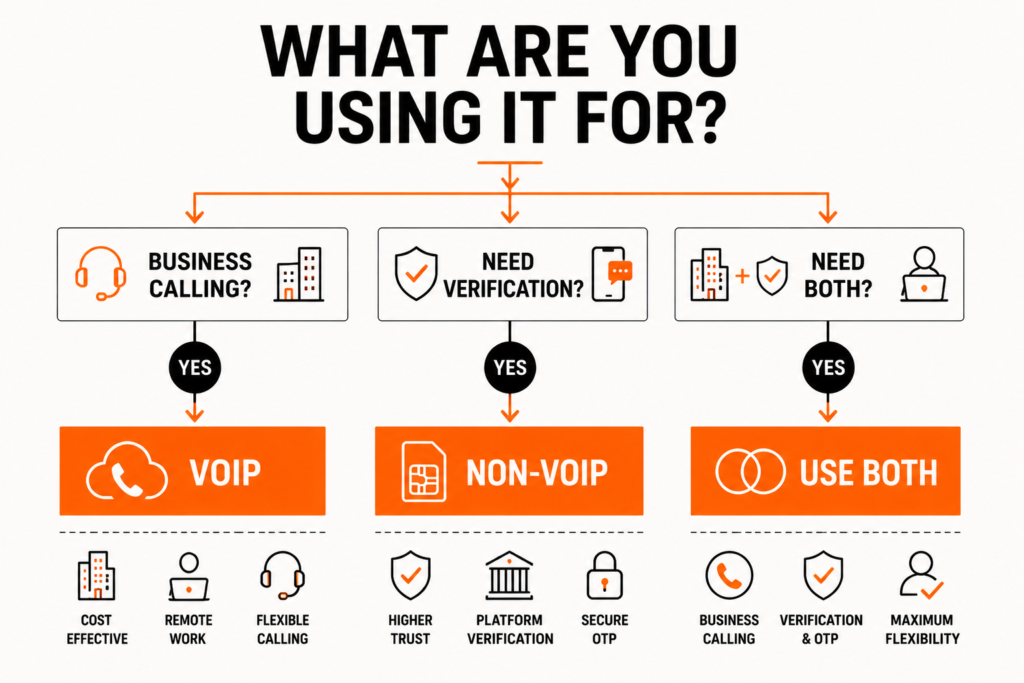
Neither VoIP nor non-VoIP numbers are universally better. The right choice depends on how you plan to use the number.
When a VoIP Number Is Fine
VoIP numbers are genuinely good tools in the right context. If you need a second number for a customer-facing business line, a softphone system for your team, international calling at low cost, or a temporary number for a short-term project where verification is not required, VoIP is perfectly adequate and often more cost-effective.
Example: A growing software startup may use a VoIP platform to route customer support calls to agents in different countries. Customers dial one number, while team members answer from laptops or mobile apps. This flexibility is one of VoIP’s biggest strengths.
When You Need a Non-VoIP Number
You need a non-VoIP number when the platform checks line type, which increasingly means most high-stakes use cases:
- Registering business accounts on WhatsApp, LinkedIn, or similar platforms
- Setting up two-factor authentication for banking or financial services
- Running SMS-based customer communications where deliverability matters
- Any scenario where your number needs to pass a KYC check
If the cost of the number failing verification is significant, use a non-VoIP number.
How to Get a Reliable Non-VoIP Number
A reliable non-VoIP number is one issued directly by a licensed carrier and intended for long-term communication and verification rather than temporary or disposable use.
Four Signs of a Trustworthy Non-VoIP Number
Not all “real” numbers are created equal. When choosing a non-VoIP number for business or verification purposes, the things that matter most:
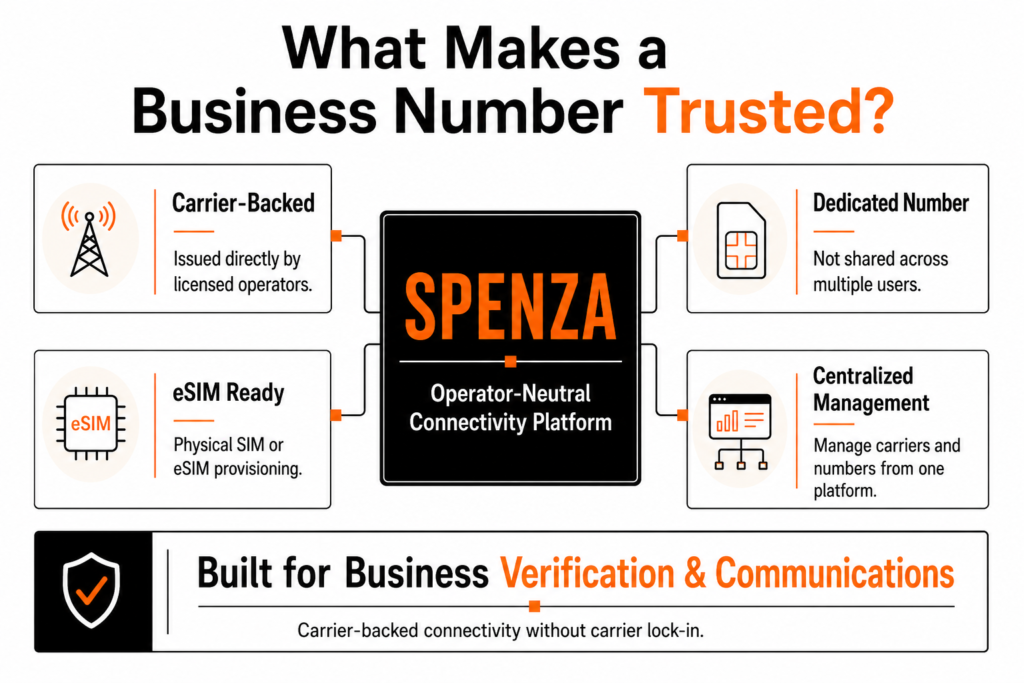
- Carrier-backed provisioning: The number should be issued by or through a licensed carrier, not a virtual number service that reroutes traffic.
- Dedicated number ownership: Assigned exclusively to your business, not shared or recycled across users.
- Clean number history: A number with a good reputation is less likely to face verification issues.
- eSIM support (where available): Enables faster activation and easier management without a physical SIM.
These characteristics help reduce operational complexity while providing a stronger trust signal for business communications.
Many services that advertise “non-VoIP numbers” are actually reselling virtual numbers drawn from shared pools. Even if these numbers are marketed as suitable for verification, they can still be rejected by platforms with strict fraud-detection policies because of their shared usage history or the absence of a clear carrier-issued identity. For business-critical accounts, a number obtained directly from a licensed mobile carrier is generally the most reliable choice.
Spenza Offers Real Carrier-Backed Mobile Numbers
Businesses needing one phone number can usually obtain it directly from a carrier. The challenge arises when managing dozens or hundreds of carrier-backed numbers across employees, devices, or regions. That’s where connectivity management platforms become valuable.
Spenza provides real carrier-backed numbers issued through licensed operators, designed for business communications, verification, and higher-trust use cases.
Unlike shared-number pools or disposable-number services, Spenza operates as a Mobile Virtual Network Enabler (MVNE), giving businesses access to dedicated numbers that are properly anchored in carrier infrastructure. If your business needs reliable SMS deliverability, passing KYC checks, or a communication setup that platforms won’t flag, that kind of real carrier backing matters.
Spenza also supports Dual-SIM with eSIM setups, which means you can run a dedicated business number alongside your personal number on a single device. And if you are currently relying on a virtual number service you want to move away from, Spenza can help you port your existing number to a real carrier line. For businesses exploring the full connectivity picture, the Spenza business communications platform is worth understanding.
An Honest Caveat: Non-VoIP Is Not a Magic Guarantee
A non-VoIP number significantly improves your chances of passing verification. It does not guarantee it. Acceptance still depends on the individual number’s history, the carrier it comes from, the country of origin, and each platform’s specific risk policy. A mobile number that has been recycled through multiple users, or that was previously associated with spam, can still be rejected even though it is technically a “real” number.
Research from GSMA on mobile fraud consistently highlights that number reputation and history are as important as number type in modern fraud detection systems.
Hence, use a dedicated, carrier-backed number with a clean history for anything that matters. That is not a workaround; it is just good practice.
Conclusion
Choosing the right number type comes down to what you need it for. VoIP numbers have a real place in business communications. But for verification, deliverability, and building platform trust, a carrier-backed non-VoIP number is the right foundation. If you are setting up business communications that need to hold up under scrutiny, start with real carrier infrastructure, and make sure the number is dedicated, not shared or recycled.
As verification systems become more sophisticated, choosing the right phone number is no longer just a telecom decision. It’s part of your overall security and identity strategy.
FAQs
Need a trusted, carrier-backed phone number for seamless verification and business communications? Book a demo to see how Spenza in action.