eSIM for OEMs means designing an embedded SIM into a connected product so operator profiles can be loaded, switched and retired remotely, instead of shipping a physical SIM chosen for one carrier. In practice it turns connectivity from a purchasing task at the end of development into a product decision at the start. The decision covers the module, the form factor, the provisioning standard, who operates the service, and how the customer pays for it.
This guide is for hardware makers adding cellular to a wearable, camera, gateway, tracker or other device. It covers what to settle before the board is frozen, where eSIM helps and where it does not, how to test a launch, and how to treat connectivity as part of the business. For the underlying technology, see our eSIM guide.
Last verified 4 November 2026.
Short answer: an eSIM reduces SIM handling and lets you change operators after the device ships. It does not choose your radio bands, certify your product, or run your service. The OEMs that benefit most decide the hardware, the standard and the operating model together.
What eSIM means for an OEM
Cellular used to be an afterthought. The hardware team picked a modem, procurement signed with a carrier, and the product shipped with a SIM that worked in one region. That model strains once a product sells in several countries or has to be activated by a customer who never sees a SIM tray. Customers now expect the device to work when they turn it on, wherever they are.
An embedded eUICC changes where the carrier decision lives. Instead of a SIM that is tied to one operator at manufacture, the device holds a secure element that can store and switch operator profiles over the air. The carrier relationship becomes something you can change after shipment, which matters for pricing, coverage and regulation changes over a product’s life that may run for years.
The terms are often mixed up, so separate them early in the bill of materials.
| Term | What it is | Why it matters to an OEM |
|---|---|---|
| eSIM | The embedded SIM as a product, often a soldered package | A hardware choice that sets board space, assembly and replaceability |
| eUICC | The secure element that stores and manages operator profiles | The capability that makes remote profile changes possible |
| Profile | The operator credentials and configuration loaded onto the eUICC | Not the modem and not the commercial plan |
| Embedded connectivity | Cellular service built into how the customer buys, activates and uses the product | A business model that needs owners for billing, support and service changes |
The chip and the remote-management capability are separate choices. A soldered package that cannot hold multiple profiles will not give you carrier flexibility, and a capable eUICC on a removable card gives you flexibility without the board-space saving. Confirm both in the datasheet.
Choose the form factor and module around the whole product
Form factor is a trade between size, durability, assembly and ecosystem maturity. The smallest option is not automatically the best for a device you will support for years.
| Form factor | Typical fit | Advantage | Watch for |
|---|---|---|---|
| 2FF, 3FF, 4FF removable | Consumer devices with a SIM tray | Easy to replace, broad compatibility | Needs a tray, and a card can be removed or lost |
| MFF2 soldered | Industrial IoT, automotive, trackers | Durable and well established | Not user replaceable |
| Smaller soldered packages | Compact wearables | Smaller footprint than MFF2 | Check supplier availability and supported eUICC software |
| iSIM, integrated in the chipset | Very small, low-power devices | Saves space and power | Ecosystem and operator support vary, so verify for your markets |
| SoftSIM | Specialized designs | No dedicated SIM hardware | Operator support is limited, so verify before committing |
For many enterprise and industrial products, a soldered package remains the safe default because suppliers and test houses know it. Choose a newer option only when size or power is the binding constraint and your suppliers will support it in the markets you sell to.
Remote profiles do not replace the rest of the product design. Use a requirements check before you promise anything about expansion.
| Design decision | What to verify | Why a profile is not enough |
|---|---|---|
| Module and radio | Required technologies, bands and network support | A new profile cannot add a band the modem lacks |
| eUICC and firmware | Supported standard version and profile operations | Physical packaging does not prove interoperability |
| Power and enclosure | Provisioning load, operating environment, maintenance access | Removing a SIM tray does not certify the finished enclosure |
| Markets and approvals | Device certification, authorized plans, intended use | Having a profile available does not waive market or carrier requirements |
Record the tested configuration against the product revision. A later change to the module, eUICC software or firmware can change the provisioning path, so treat it as a revision that needs retesting. Industry certification bodies such as PTCRB publish requirements for devices on North American networks, and your module vendor can tell you which approvals apply to your design.
SGP.22 or SGP.32: match the standard to the device
The GSMA defines two remote provisioning architectures, and they do not suit the same products. SGP.22 is the consumer architecture. A Local Profile Assistant on the device downloads profiles, usually when a person scans a code or uses an app. SGP.32 is the IoT architecture. It was written for devices with no screen and no user, and it adds an IoT Profile Assistant on the device plus an eSIM IoT Remote Manager (eIM) on the server side that issues profile operations. The GSMA eSIM pages hold the specifications.
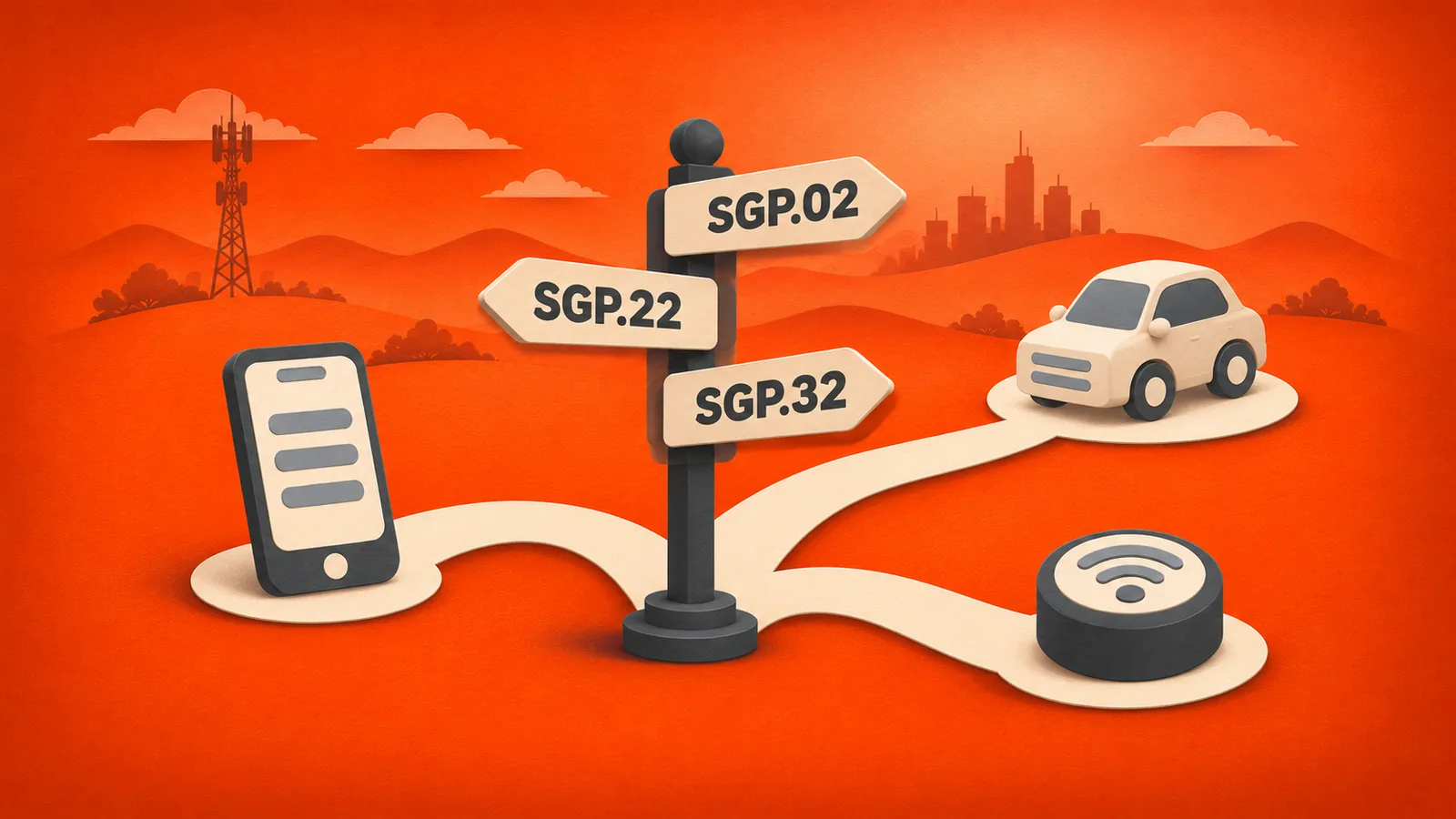
A smartwatch, a laptop and an unattended sensor should not be assumed to accept the same profile delivery workflow just because all three are called eSIM devices. SGP.32 is not a universal upgrade over SGP.22. Check which versions and interfaces your module and eUICC implement, and read the SGP.22 vs SGP.32 comparison for component roles. For the underlying flow, the remote SIM provisioning guide explains what happens between the order and the working connection.
For a product with no camera, no display and no user-controlled profile interface, a generic scan-a-QR-code step does not work. Identify where the profile assistant runs, how the device reaches provisioning infrastructure, and which service provides the very first connection. Then test that path on restrictive networks, after sleep cycles and after power interruptions where those conditions apply.
One global SKU and factory provisioning
The strongest manufacturing argument for eSIM is fewer variants. Every regional SKU adds certification work, inventory planning, packaging and logistics. If the same hardware can be activated on a locally suitable network after it arrives, you carry less stock and can enter a market without a hardware change.
Two limits apply. First, a single SKU is conditional: radio bands, antenna design and approvals can still force variants for some regions. Second, you choose when the operational profile is loaded. In-factory profile provisioning loads it during production, and the supplier’s tooling reports the result for each unit. The alternative is to ship with a bootstrap profile and download the operational profile at first use. Factory loading ties manufacturing controls to credentials you must protect, and later loading ties first use to a working initial connection. Decide how a unit that fails the factory check is handled, and what happens if first use is delayed by months in a warehouse.
Assign ownership from factory to support
An OEM eSIM program fails more often at handoffs than in the technology. Someone must prepare the device, issue the service, run profile operations and resolve exceptions. A platform partner can supply capabilities, but the product team still needs an agreed handoff among manufacturing, software, carrier operations and customer support.
| Function | Primary responsibility to agree | Evidence at handoff |
|---|---|---|
| OEM and manufacturing | Device configuration, identifiers, factory readiness | Serial number to EID association and the recorded production result |
| Platform and provisioning partner | Order handling, profile workflow, status records | Request identifier, profile result, exception state |
| Carrier or service provider | Authorized subscription and network service | Eligibility, service status, applicable terms |
| Brand support and finance | Customer resolution, charges, refunds, closure | Support case linked to the service and financial record |
This is a proposed starting map, not a standard. Replace the function names with your teams and escalation contacts, and keep one shared order record that all four parties can read. The eSIM orchestration guide describes how that record works across carriers.
Single carrier or multi-carrier
A single carrier is simpler. You negotiate once, run one integration and have one party to call. For a product that stays inside one country, that can be the right answer.
Global products meet different conditions. Coverage varies by region, roaming terms differ, and commercial terms change over time. Tying a fleet of devices to one operator makes you dependent on that operator’s pricing and coverage for the life of the product. A multi-carrier design keeps options open: if prices move, a regulation changes or a coverage gap appears, you can change profiles without redesigning hardware.
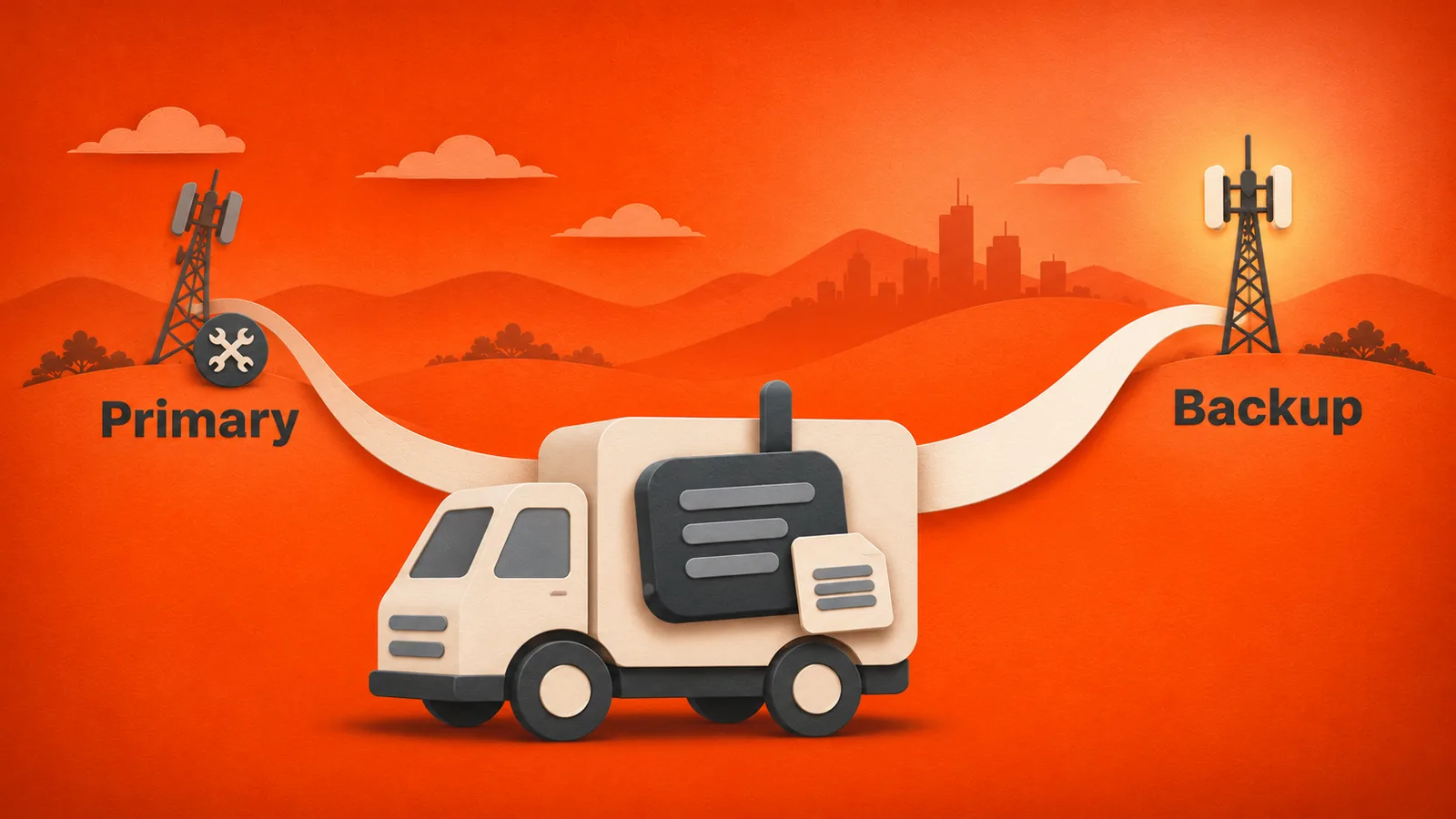
The cost of multi-carrier is operational. Separate portals, invoices and provisioning workflows for each operator multiply support work. Platforms such as Spenza address that by giving access to multiple operators through one management layer, with a single view of the connected estate. Our comparison of IoT connectivity management platforms lists the criteria worth checking, and the IoT SIM cards guide covers the SIM options underneath.
Design activation, then test the whole lifecycle
A connected product is judged when the customer first turns it on. Each extra step, QR code or registration form raises the chance that the customer gives up before seeing the value. Treat activation as part of the product, and test the path from purchase to a working feature, including the unhappy routes.
Define the first meaningful task for the product. A sensor may need to deliver telemetry to its application. A wearable may need supported voice or messaging as well as data. A gateway may need to reach a specific endpoint. Verify that task after network registration rather than relying on a connectivity icon. A practical acceptance sequence:
- Confirm the device and service are eligible before purchase or activation.
- Associate the order with the correct serial number, EID and profile record.
- Observe profile installation, network registration and the required application exchange as separate steps.
- Test a failed download or an interrupted setup, and confirm the permitted recovery route.
- Handle replacement, return and cancellation without leaving an unexplained active line.
Include an unopened return and a replacement unit in acceptance testing. Device ownership, profile state, recurring billing and customer entitlement may each need a separate change, and a warehouse return does not automatically end a carrier subscription. After launch, keep software maintenance in scope: a different profile cannot add radio bands or repair unsupported firmware.
A design example: Wi-Fi first, cellular as backup
Many consumer devices depend on home Wi-Fi, and a router reboot makes the product look broken even though the fault is outside it. A camera or monitor that must stay reachable can treat cellular as a fallback. The device uses Wi-Fi while it is healthy, watches signal quality, and moves to a reduced stream on cellular when Wi-Fi fails. This turns reliability into something the brand controls and can package as a paid tier.
The data budget decides whether this works commercially. Video is expensive over cellular, so the fallback mode should send only what the user needs. Audio at 16 kbps uses about 7.2 MB per hour (16,000 bits per second times 3,600 seconds, divided by eight), so a ten-hour night is around 72 MB. Add a still image on motion or at a set interval and you keep a visual check without streaming video. These figures are arithmetic for planning, not a measured result, and your codec and traffic will change them. Decide the failover rules, the user messaging and the cost per fallback hour before launch.
The same pattern applies to trail cameras, alarms and trackers; our trail camera connectivity guide works through a related case where coverage is the limiting factor.
Turn connectivity into recurring revenue without fooling yourself
Selling hardware once ends the relationship at checkout. Bundling a connectivity plan, remote diagnostics, updates or a fleet dashboard keeps the product earning. Connectivity can be included in a subscription, sold as an optional plan, or bought by an enterprise fleet owner. Say what the allowance, validity, renewal, overage and support responsibilities are before checkout.
Measure it in states, because mixing them makes a weak journey look successful.
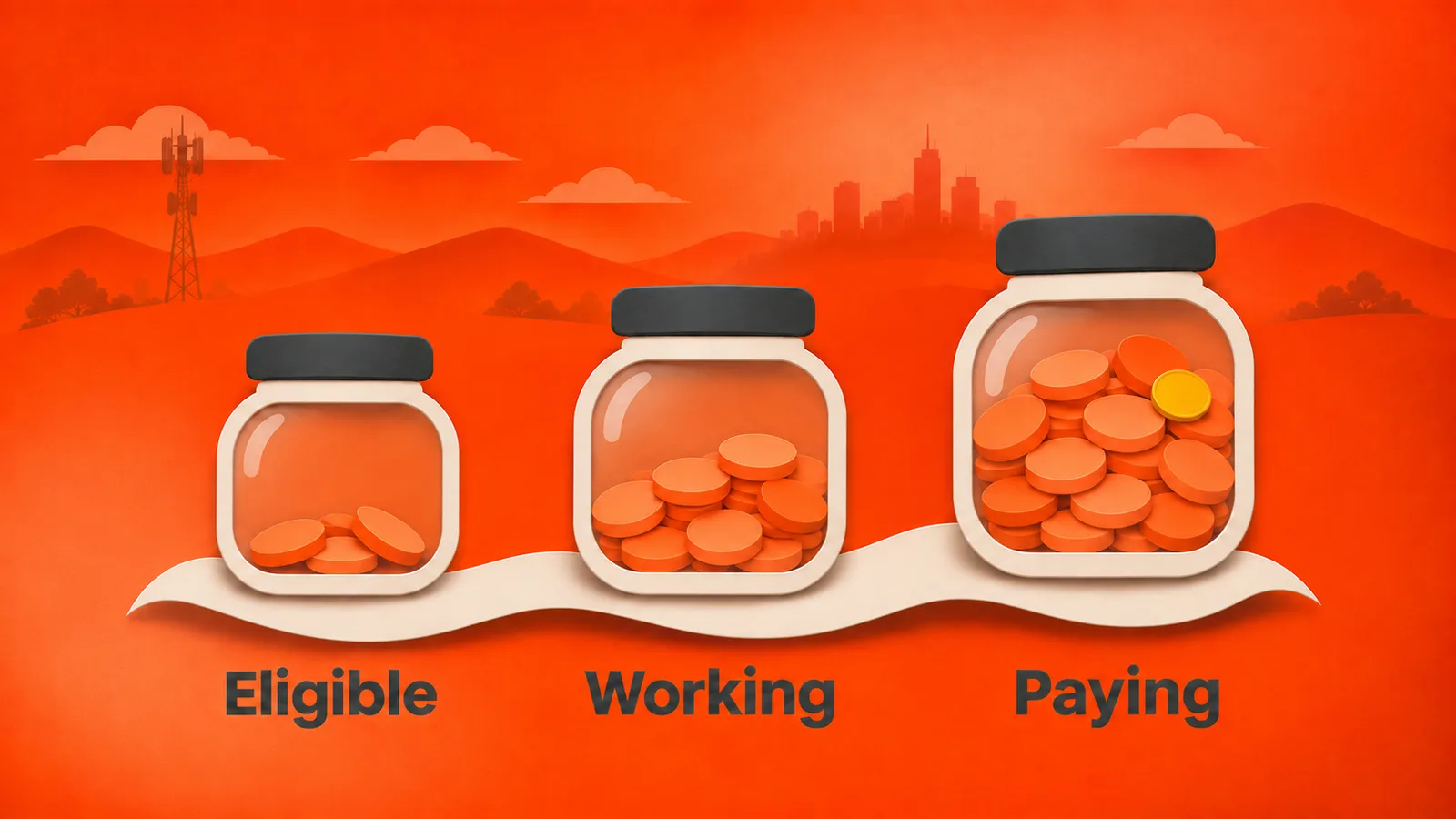
| State | What it means |
|---|---|
| Eligible | Devices that can use the proposed offer |
| Working | Devices where the required connected task is verified |
| Paying | Subscriptions with recurring revenue actually collected |
Attach rate needs a stated numerator and denominator, for example service purchases among an explicitly eligible cohort during a set period. Activation completion measures a different step, and an issued invoice is not collected payment. Judge contribution after carrier charges, platform costs, payment fees, support, refunds and recovery work. Keep the hardware margin separate from recurring service economics unless your analysis includes both on purpose.
Angel Watch, a children’s smartwatch brand, shows how the design and the offer fit together. According to its published case study, standard unlimited phone plans did not suit a watch with low data needs. Region-specific, pay-per-use plans were set up for its markets, plans were bundled and resold through its Shopify store, and usage analytics let the team adjust plans. The case gives no attach rate or revenue figure, so use it as an example of matching plans to a device, not as a benchmark. If you sell through an online store, the guide to selling devices and eSIMs on Shopify covers the storefront side.
Run a scoped pilot before you scale
Start with one device configuration, one or two markets and a small offer, such as a starter plan and an optional upgrade. Agree what the pilot must prove, then size it. Three questions tie engineering to the customer and financial journey.
| Pilot question | Evidence to keep |
|---|---|
| Can the product connect? | Tested configuration and a successful required application task |
| Can the buyer start and recover service? | Observed onboarding, a support exception and its resolution |
| Can the brand operate the offer? | Linked subscription, usage, payment and cancellation records |
When the pilot passes, widen markets and carriers, then segment offers by how customers use the product. If your business is moving toward running a branded service rather than just embedding a SIM, the telematics to MVNO strategy guide and the guide to monetizing devices with travel eSIM show two adjacent routes.
Conclusion
eSIM is most useful to an OEM when it fits the complete product lifecycle. Choose compatible components, pick the standard that matches the device, decide where the operational profile is loaded, and assign ownership before the first activation. Test the customer’s connected task and the less convenient paths of failure, replacement and retirement. Then judge recurring revenue with real cohorts and complete costs.
The point is not the chip. It is whether your product can change networks, enter markets and serve customers without being redesigned. A team that answers those questions early ships a simpler product and keeps the customer relationship long after the sale. For a view of how the industry is moving, see our IoT connectivity trends, and for the independent explainer of the IoT standard, IoT For All is a useful read.
FAQs
What is eSIM for OEMs?
eSIM for OEMs means building a product with an embedded SIM (an eUICC) so operator profiles can be loaded and changed remotely instead of inserting a physical card. It reduces SIM handling in manufacturing and the field. It does not remove the need for the right radio, certification and a service agreement in each market.
Is eSIM the same as eUICC?
Not quite. The eUICC is the secure element that stores and manages operator profiles, and it can be a soldered chip, a removable card or part of the chipset. Teams often say eSIM for the whole package, so confirm in the bill of materials which part you are buying.
Does eSIM give me one global SKU?
It can reduce carrier-specific variants, but it does not guarantee a single SKU for every market. Radio bands, antenna design, certifications and carrier acceptance still differ by region. A new profile cannot add a band the modem lacks.
Should an OEM choose SGP.22 or SGP.32?
Match the standard to the device. SGP.22 is the consumer architecture and relies on a Local Profile Assistant on a device the user operates. SGP.32 is the IoT architecture, built for devices that have no screen or user, and it adds an eSIM IoT Remote Manager (eIM). Confirm which versions your module and eUICC implement before you commit.
Must the operational profile be loaded in the factory?
No. Factory provisioning is one option, and some designs ship with a bootstrap profile and download the operational profile after the device is powered on. The choice depends on your manufacturing controls, target markets and what the first connection looks like. Whichever you pick, test what happens when the first connection fails.
How should we measure connectivity attach rate?
Define three things before you report a number: the cohort of eligible devices, the event you count as attachment, and the time window. Track purchase, successful activation and recurring payment as separate measures. A percentage from another company without those definitions says little about your product.
Can eSIM support a Wi-Fi device with cellular backup?
Yes, this is a common design for products that must stay reachable when home Wi-Fi fails. The device stays on Wi-Fi when it is healthy and moves a reduced stream, such as audio and still images, to cellular when it is not. Plan the data budget and the switching rules during product design, not after launch.
What stays the OEM’s responsibility when a platform runs connectivity?
The contract decides, but the OEM still owns the product design and the customer experience. Write down who maintains firmware, who approves service changes, who resolves activation problems, and who closes billing after a return. A platform can run those functions without removing the need for clear handoffs.