Remote SIM provisioning (RSP) securely downloads and manages mobile operator profiles on a compatible embedded Universal Integrated Circuit Card (eUICC). RSP lets you change a device’s connectivity subscription without replacing its SIM hardware, provided the device, provisioning platform, operator profile and connectivity path support the requested operation.
For a connected-product team, the hard question is what happens after the download. A profile can be installed while the device still cannot reach your application. An unattended sensor also needs a different management arrangement from a phone whose owner can approve setup. Start with the eSIM fundamentals, then use this guide to choose the architecture, allocate responsibilities and define acceptance tests before committing a fleet.
What Is Remote SIM Provisioning (RSP)?
Remote SIM provisioning manages the operator credentials that let a compatible device use cellular service. The downloaded profile lives within an eUICC, a secure component designed for profile management. RSP changes those credentials through supported software operations; it does not replace the modem, create radio coverage or grant a carrier contract.
An eUICC may be soldered into a product or supplied in a removable form factor. That distinction matters when comparing RSP with ordinary SIM replacement: physical packaging and remote provisioning capability are separate choices. A removable card is not automatically incapable of remote profile management.
For an original equipment manufacturer (OEM), the practical benefit is fewer connectivity changes that require physical access. The engineering work moves toward firmware integration, connectivity recovery and operations tooling. A dashboard button cannot remove those dependencies.
Bring your device model, target markets and activation requirements to a connected-device deployment discussion.
Core Components of RSP Architecture
RSP architecture depends on the device’s provisioning family. Consumer devices use a Local Profile Assistant (LPA); the IoT architecture introduces an IoT Profile Assistant (IPA) and eSIM IoT remote Manager (eIM). Legacy machine-to-machine deployments use another arrangement. Components with similar purposes are not interchangeable across these specifications.
The three families separate device-side control and server responsibilities differently.
| Specification family | Device-side role | Server-side roles | Selection question |
|---|---|---|---|
| SGP.22, consumer | LPA coordinates local profile operations | Subscription Manager Data Preparation Plus (SM-DP+) | Does the device support the intended user or managed activation flow? |
| SGP.32, IoT | IPA resides in the device or eUICC | eIM manages remote operations; SM-DP+ supplies profiles | Which IPA capabilities and remote-management paths are supported? |
| SGP.02, legacy M2M | eUICC participates in the M2M architecture | Subscription Manager Data Preparation (SM-DP) and Secure Routing (SM-SR) | Who controls the existing management relationship and migration process? |
Sources: GSMA’s SGP.22 consumer technical specification, SGP.32 IoT technical specification and M2M provisioning documentation. Table summarizes responsibilities, not every interface.

Consumer and IoT paths share some infrastructure
SGP.32 uses SM-DP+ profile infrastructure, but adds the IPA and eIM arrangement for remote IoT management. The IPA can reside on the device or inside the eUICC. Supported capabilities determine whether profile delivery uses a direct or indirect communication path. Do not draw an LPA and eIM as universal companions.
Record versions, not just specification names
The GSMA specification register tracks active versions and related tests. As of September 2026, multiple versions remain relevant. Record the exact versions implemented by each supplier. Our SGP.22 and SGP.32 comparison develops the architecture choice; a procurement label is not an interoperability result.
How Remote SIM Provisioning Works
Remote SIM provisioning starts with an authorized profile request and a usable communication path. The system authenticates the participants, delivers the protected profile and records the installation result. Enabling that profile, obtaining network service and reaching the business application are additional outcomes that your deployment must verify separately.
- Identify the target. Associate the device inventory with its eUICC identifier (EID), intended service and authorized operator profile. Keep customer and device identifiers distinct.
- Establish connectivity. Provide a supported bootstrap profile or another communication path. Confirm that the required provisioning endpoints are reachable.
- Authorize the operation. Check assignment, permissions and profile availability before sending a request. Consumer approval and remote IoT management follow different arrangements.
- Download and install. Record the outcome reported by the supported provisioning stack. Preserve the operation identifier and any error details.
- Enable and confirm service. Check the intended profile state, network registration and required data or voice service. Installation alone is insufficient.
- Reconcile the business record. Match the confirmed service to the correct customer, plan and billing start condition. Investigate unresolved differences.
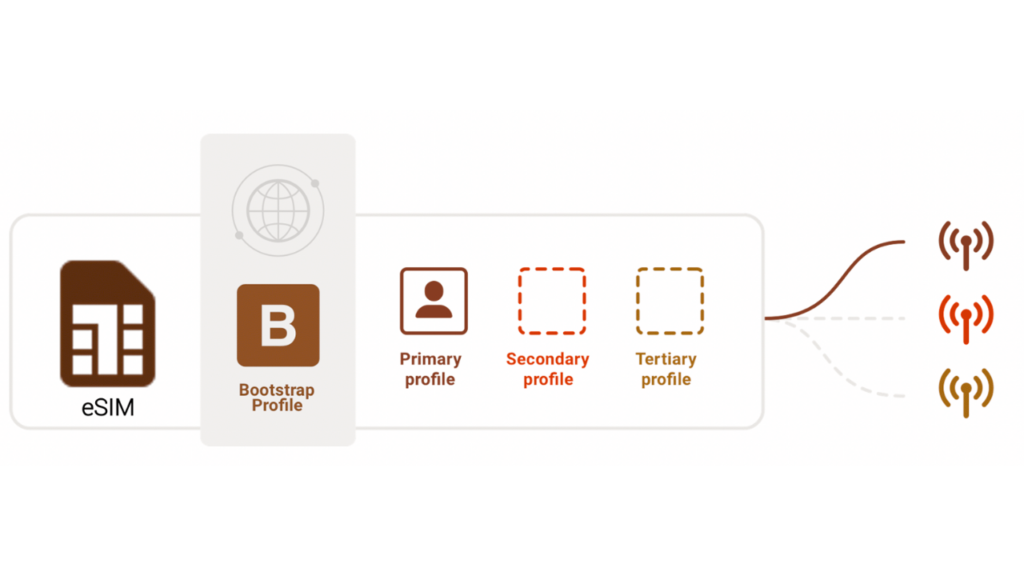
On supported phones, activation may use a carrier assignment, transfer, link, app or QR code. Apple’s eSIM setup instructions describe carrier-dependent methods and connectivity prerequisites. A QR code is therefore one delivery mechanism, not the definition of RSP.
For unattended equipment, record when the device can communicate and how the management system detects a completed operation. A queued request should not appear as a successful activation in customer support or billing. Ask which system supplies authoritative evidence for each transition.
Accept working service only after checking the intended profile, network and application outcomes.
| Check | Required outcome |
|---|---|
| Profile | Installed and enabled as intended |
| Network | Registered with the approved service |
| Application | Data reaches the intended endpoint |
Source: the acceptance checks described above. A successful download proves only one part of readiness.
What changes in deployment cost and effort?
Remote SIM provisioning shifts effort from physical SIM handling toward device integration, platform operations and recovery testing. Savings depend on the number of avoided interventions and the cost of the supported provisioning service. A useful comparison includes implementation work and failed activations, not just the purchase price of a SIM.
Request these inputs before comparing quotes; no universal RSP price applies to every fleet.
| Cost or effort item | Input to collect | Responsible team |
|---|---|---|
| Physical handling | Actual shipping, stocking and site-visit costs avoided | Operations |
| Device integration | Supported module, firmware and provisioning-stack work | Product engineering |
| Platform service | Setup, profile, operation, support and recurring fee units | Procurement and supplier |
| Connectivity | Bootstrap and operational allowances, coverage and restrictions | Connectivity owner |
| Exceptions | Support time, recovery work and replacement procedure | Delivery and support |
Source: editorial procurement worksheet. Inputs must come from your suppliers and operating records; no rates or savings are assumed.
Model total cost as connectivity plus provisioning service, integration, support and any remaining physical intervention. Specify the evaluation period and expected active fleet. A per-profile quote and a per-active-device quote have different denominators, so multiplying both by shipped devices can misstate the comparison.
For a mixed enterprise estate, separate staff phones from unattended equipment. Their setup, replacement and support requirements differ. The enterprise eSIM operating model helps assign those responsibilities before procurement turns them into one blended line item.
Security and Compliance Considerations
RSP security protects profile delivery and management through the controls defined for the chosen architecture. Deployment security also depends on who can request changes, how credentials are handled and how failures are investigated. Technical conformance does not establish permission to operate every service in every country or satisfy every privacy obligation.
Restrict destructive actions such as disabling or deleting a profile. Separate routine support access from bulk administrative privileges. Keep an audit record linking the operator, target, requested change and confirmed outcome, while excluding activation secrets from ordinary support notes.
Design recovery before changing a working connection
A replacement profile may install successfully but fail to provide usable service. Test the supported recovery mechanism before a fleet-wide change. Establish which connection remains available, what triggers recovery and who can intervene when the device is unreachable. Do not assume every device or supplier implements the same rollback behavior.
For an unknown operation outcome, inspect the current state before retrying. A network timeout can hide a completed action. Blind retries or premature deletion of the old profile can make an otherwise recoverable incident harder to resolve.

How Spenza Simplifies RSP Implementation
Spenza, an MVNE platform for connected-product businesses, connects connectivity plans, customer onboarding and ongoing subscription operations. Those commercial workflows surround RSP rather than replace its technical components. A useful deployment review establishes which party supplies each provisioning function and how its outcomes reach support, customer records and billing.
The published Angel Watch customer case describes region-specific plans for children’s smartwatches with low data needs, plan bundling through Shopify and usage visibility. Those details show why device connectivity must fit the product’s sales and support model. They do not establish a measured profile-download time or the customer’s deployed GSMA specification version.
RSP performs profile operations. eSIM orchestration for IoT coordinates the policies and workflows around them. Keep those responsibilities explicit when evaluating the platform: a successful storefront order still needs a confirmed service outcome and an accountable support path.
Use the Angel Watch pattern to scope your own connected-device operating workflow, including fulfillment, activation confirmation and ongoing support.
Deployment Checklist for Enterprise Teams
An enterprise RSP rollout should pass a representative pilot before expanding to the fleet. The pilot must cover the actual hardware, firmware, target networks and failure conditions. Assign an owner to each acceptance result and preserve enough evidence to distinguish provisioning success from network availability and application readiness.
Use a small acceptance matrix to make unresolved dependencies visible.
| Test | Evidence to retain | Acceptance owner |
|---|---|---|
| Supported combination | Device, eUICC, firmware, IPA/LPA and server versions | Engineering |
| Initial provisioning | Bootstrap reachability, requested profile and installation outcome | Delivery |
| Working service | Profile state, registration and application transaction | Network and application teams |
| Interrupted operation | Observed state, safe retry or recovery and escalation record | Support engineering |
| Commercial handoff | Correct customer, plan and billing-start condition | Operations and finance |
Source: proposed editorial acceptance checklist, not a report of completed customer tests.
Choose a consumer provisioning path when the supported product and activation experience fit that architecture. Choose an IoT management arrangement when unattended or constrained equipment requires it and the complete stack is supported. Preserve an existing M2M deployment until its migration and ownership requirements are understood.
Use the eSIM compatibility checker for initial screening, then obtain supplier confirmation for your exact configuration. A model-family match is not a substitute for a tested firmware and profile combination.
Choose the workflow you can verify
Remote provisioning is useful when it removes a physical dependency without creating an invisible operational one. Start with the device and intended service, choose the appropriate architecture, and prove each transition through to the application. Keep failed or uncertain outcomes visible until an owner resolves them. Compare costs using the same fleet, period and service assumptions. The next step is a scoped pilot with agreed evidence and recovery criteria. Bring that plan to a connected-device deployment review before expanding the rollout or promising activation times to customers.
FAQs
Remote SIM provisioning questions often concern device compatibility, connectivity prerequisites and recovery. The answers below separate capabilities defined by a specification from features supported by a particular product. Confirm the device, firmware, carrier and platform combination before treating a general capability as an available production operation.
Does every eSIM activation require a QR code?
No. A QR code is one way to deliver activation information for a supported consumer flow. Carrier assignment, apps, links and supported transfer methods may also be available. IoT provisioning can use remote management without a person scanning a code. The available method depends on the device, carrier and provisioning implementation.
Can a sleeping sensor receive a profile immediately?
A sleeping sensor cannot complete a network-dependent operation while its required communication path is unavailable. The management system may queue the request until the device becomes reachable. Account for wake intervals, power constraints and the supported communication mechanism when defining completion expectations. A queued request should remain distinguishable from an installed profile.
Can a removable SIM support remote provisioning?
A removable eUICC can support remote profile management when the surrounding device and provisioning stack support it. Removable packaging does not determine whether the card has that capability. Check the card’s technical specification, firmware integration and operator-profile support. An ordinary fixed-profile SIM should not be treated as equivalent merely because it fits the same slot.
Does storing several profiles mean they are all active?
No. Stored profiles and simultaneously enabled profiles are different capabilities. The supported number and behavior depend on the eUICC, device and implementation. Establish which profile supplies the intended service, what happens during a change and whether another connection remains usable. Do not infer simultaneous service from a profile inventory screen.
Can an OEM change provisioning providers later?
An OEM may be able to change providers, but portability depends on technical support, management permissions and contractual arrangements. Identify who controls the relevant server relationships and credentials, how devices are reassociated and which profiles remain usable. Require a documented exit process and a representative migration test before treating provider choice as unrestricted.
Does RSP also update device firmware?
RSP manages cellular operator profiles; it is not a general firmware-update service. A device platform may offer both functions, but they use distinct workflows and acceptance criteria. Keep firmware versions in the provisioning compatibility record, and coordinate changes carefully because a firmware update can alter the behavior of the supported provisioning stack.