


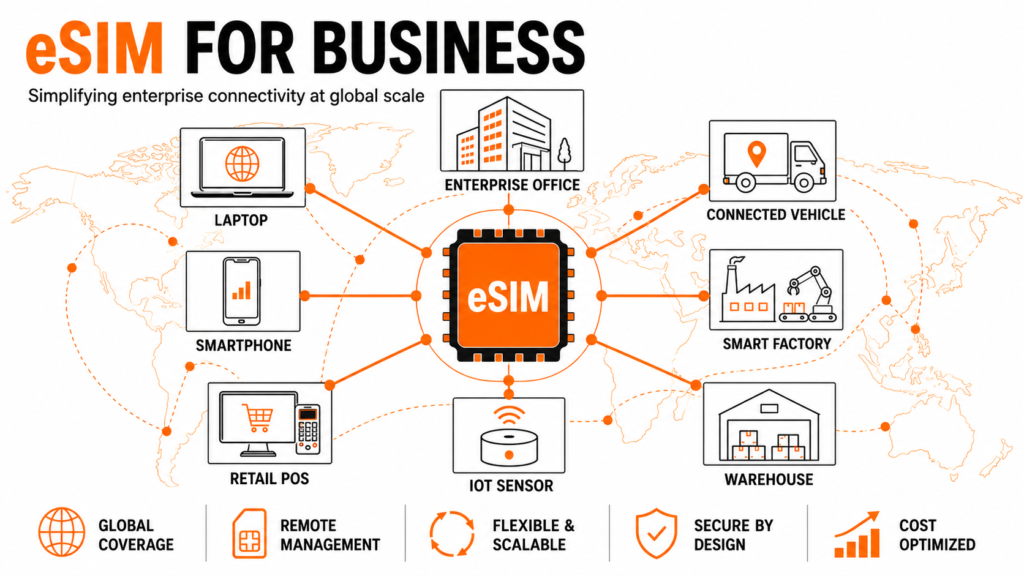
A business eSIM is an embedded SIM that enables organizations to activate, manage, and switch cellular connectivity remotely without replacing physical SIM cards. Enterprises use eSIM technology to support zero-touch device deployment, reduce roaming costs, gain multi-carrier flexibility, simplify global operations, and manage thousands of connected devices from a centralized connectivity platform.
Mobile connectivity now powers almost every part of modern business. Employees work from anywhere, retailers rely on connected point-of-sale systems, logistics companies track fleets in real time, and IoT devices keep factories, hospitals, and smart buildings running. As businesses expand, managing connectivity through physical SIM cards, multiple carrier contracts, and manual provisioning becomes increasingly difficult.
That’s where business eSIMs come in. Instead of treating connectivity as a logistical challenge, organizations can activate devices remotely, switch carriers without replacing SIM cards, and manage deployments across countries with far less effort. This guide explains what an eSIM for business is, how it compares with a traditional SIM, why enterprises are adopting it, and how the right management approach can simplify operations while reducing carrier lock-in.
What Is an eSIM for Business?
A business eSIM (embedded SIM) is a programmable SIM chip built directly into a device that allows companies to remotely assign, switch, or manage cellular profiles without ever touching the hardware.
eSIM for Enterprises: What Is It and How Does It Work?
An enterprise eSIM is a programmable SIM embedded in a device that allows businesses to remotely provision, manage, and change cellular connectivity without physically replacing a SIM card. Enterprises use eSIM to manage employee devices, IoT fleets, vehicles, and connected products across multiple networks and countries.
For enterprise deployments, eSIM is more than a replacement for a physical SIM. Its value comes from remote provisioning, centralized lifecycle management, multi-carrier flexibility, and the ability to manage connectivity across large device fleets without physical intervention.
If you have used a travel eSIM on your own phone, you already understand the basic idea. Instead of buying a plastic SIM card at an airport kiosk, you scan a QR code, and your phone connects within minutes. A business eSIM works the same way, just at a larger scale and for a different purpose. The card itself disappears. What remains is a small, encrypted profile that lives on a chip already built into the device, and that profile can be written, rewritten, or erased entirely over the air.
A consumer might use eSIM to add a second line while traveling. An enterprise uses it to connect hundreds or thousands of laptops, phones, sensors, or vehicles across different countries, all from one central system. For example, a company rolling out 2,000 laptops across North America and Europe can provision connectivity remotely before devices reach employees, eliminating SIM shipments and manual activations.
The difference is not the technology itself; it is the scale and the control behind it. This distinction matters because the term “business eSIM” sometimes gets confused with personal dual-SIM use. This blog, however, is about companies managing connectivity at scale, whether that’s a fleet of tablets for field teams, IoT sensors in warehouses, or laptops for a globally distributed workforce.
According to Juniper Research, global eSIM connections are expected to reach 1.5 billion in 2026 and 4.9 billion by 2030. Much of this growth is expected to come from enterprise IoT and other connected device deployments.
eSIM vs Physical SIM for Business
Think of a physical SIM card as a paper boarding pass. It works, but you have to print it, carry it, and replace it if it gets lost or your plans change. An eSIM is closer to a mobile boarding pass. It lives on the device, updates instantly, and can be swapped without touching anything physical. For a business managing a handful of phones, that difference barely registers. For a business managing thousands of connected devices across borders, it changes how operations run day to day.
The table below breaks this down across the dimensions that matter most to an enterprise buyer. How fast a device can be deployed, what it costs to keep connected, how exposed the business is to a single carrier, and how much manual work falls on IT.
| Dimension | Physical SIM | eSIM for Business |
|---|---|---|
| Deployment | Ship, insert, and activate each SIM manually | Activate devices remotely over the air |
| Global Rollout | Separate SIM per country or carrier | Download new carrier profiles without replacing hardware |
| Carrier Switching | Swap the physical SIM to change networks | Switch carrier profiles remotely |
| Roaming Costs | Often tied to a single carrier’s roaming plans | Choose local or more cost-effective connectivity |
| Carrier Lock-in | Greater dependence on one network provider | Multi-carrier flexibility reduces lock-in |
| IoT Scalability | Manual provisioning becomes difficult at scale | Bulk provisioning for thousands of devices |
| Connectivity Management | Multiple carrier portals and manual tracking | Centralized dashboard for all connections |
| Security | SIMs can be removed, lost, or replaced | Encrypted profiles managed and revoked remotely |
One detail that often surprises people new to this space is that switching an eSIM profile does not mean losing the old one permanently. Most enterprise eSIM platforms let a device hold multiple profiles and toggle between them, so a laptop used in three countries over a quarter can carry three pre-loaded profiles and switch automatically based on location, rather than requesting a brand-new one every time. That single feature is what makes fleet-wide multi-carrier strategies practical instead of theoretical.
Why eSIM Is Becoming a Business Enabler
eSIM is not a future technology. It is the present standard, and the numbers confirm it. The global enterprise eSIM management market is projected to grow from $2.21 billion in 2025 to $2.91 billion in 2026, a jump of nearly 32% in a single year, according to Research and Markets. That same report expects the market to reach $8.63 billion by 2030, which signals this is not a short-lived spike but a sustained shift in how enterprises buy connectivity.
For business leaders, this matters for one core reason: connectivity is now a P&L lever, not just an IT expense. Companies that manage it poorly overpay on roaming, lose time to manual device provisioning, and get locked into carrier contracts that don’t serve their actual needs. Companies that manage it well turn connectivity into a competitive advantage.
Enabler 1: Zero-Touch Global Deployment
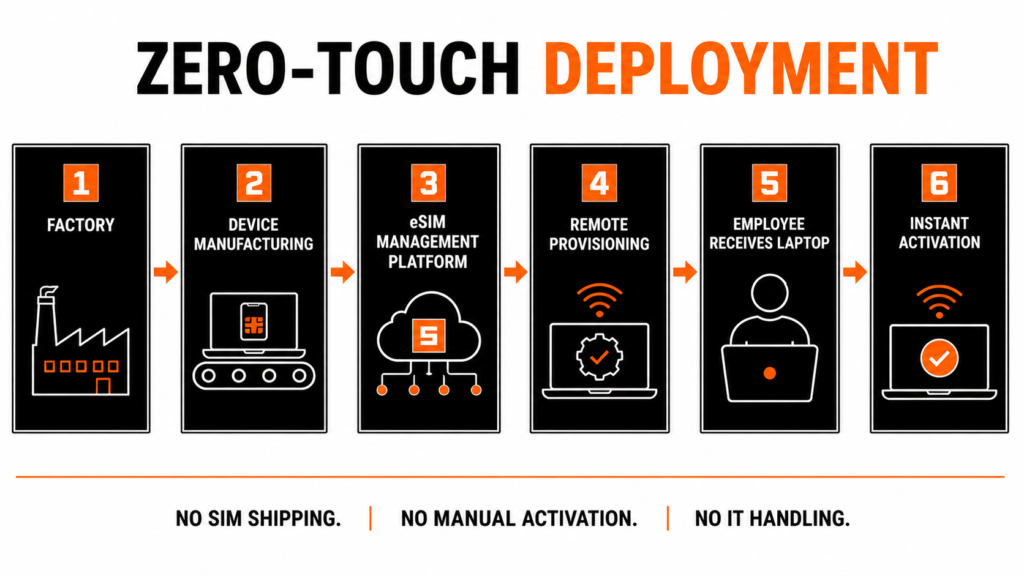
Imagine you are an operations manager at a logistics company. You have just hired 200 new drivers across four countries. Each driver needs a connected device. With physical SIMs, you’re coordinating with multiple carriers, shipping SIM cards, waiting for activations, and troubleshooting mismatches between devices and networks.
With a business eSIM setup, you ship the devices. Through the process called Remote SIM provisioning, the connectivity profile is pushed over the air the moment the device powers on. No SIM cards. No courier delays. No manual configuration.
This is called zero-touch deployment, and it is one of the most immediate, measurable benefits of eSIM for business. Other practical advantages include:
- One global SKU: Manufacturers can ship a single device model worldwide, eliminating the need for region-specific hardware variations.
- Ship-to-employee: Devices can be sent directly to remote staff and activated without IT having to physically handle a SIM.
- Faster onboarding: New devices go live in minutes, not days, without waiting for the IT ticket to be resolved.
For companies scaling internationally, this alone can justify the switch. The cost of physically managing SIM logistics at scale typically runs far higher than the investment in a proper eSIM management platform.
Zero-touch deployment does not mean zero setup. Organizations still need a connectivity management platform to define which carrier profiles are assigned to specific devices, when profiles should switch, and under what conditions. The “zero-touch” experience applies to the end user and field technicians, not to the IT or connectivity administrators who manage the deployment.
Enabler 2: Telecom Cost Reduction
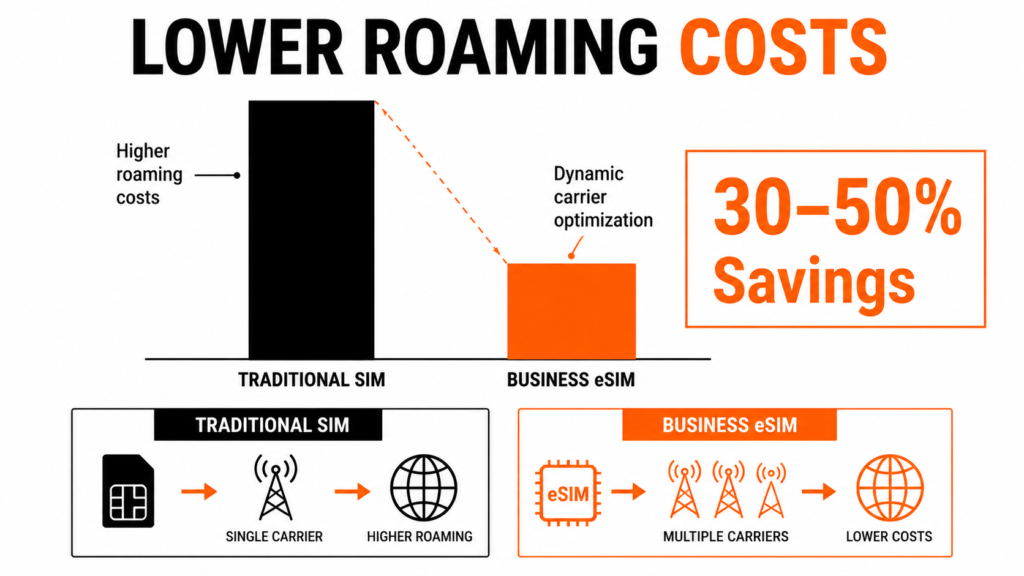
Roaming charges are one of the most common and most avoidable sources of wasted telecom spend. A traditional SIM locks a device to one carrier’s roaming agreements, which are rarely the cheapest option in every country.
A Business eSIM addresses this directly through dynamic carrier optimization. Instead of locking a device to one carrier’s roaming agreement (which is often expensive by design), the platform evaluates available networks and automatically switches to the most suitable option or recommends one for approval.
The result: Companies typically see roaming cost reductions of 30 to 50% after switching to a multi-carrier eSIM setup.
Beyond roaming, eSIM enables:
- Pooled data plans across devices and departments, so unused data from one team offsets overages in another.
- Real-time usage visibility, so IT and finance can spot overages before they hit the invoice.
- Elimination of stranded assets, meaning you stop paying for active SIM plans on devices that are no longer in use.
Spenza’s business roaming plans are built around this idea. Pool usage, compare carriers, and let the platform route to the cheapest viable option automatically. For finance teams, this visibility alone is transformative. Telecom spending is notoriously opaque. eSIM management platforms bring the same budget clarity you’d expect from a SaaS tool or cloud service.
Multi-Carrier eSIM and SGP.32: The 2026 Shift
SGP.32 was first published in 2023, and the specification continues to evolve. In May 2026, GSMA published SGP.32 v1.3, the active specification for eSIM IoT remote provisioning and management. For most of eSIM’s history, the standard used for enterprise and IoT deployments (called SGP.02 for M2M) required a human-readable server to push profile changes. It worked, but it was slow, complex, and hard to scale.
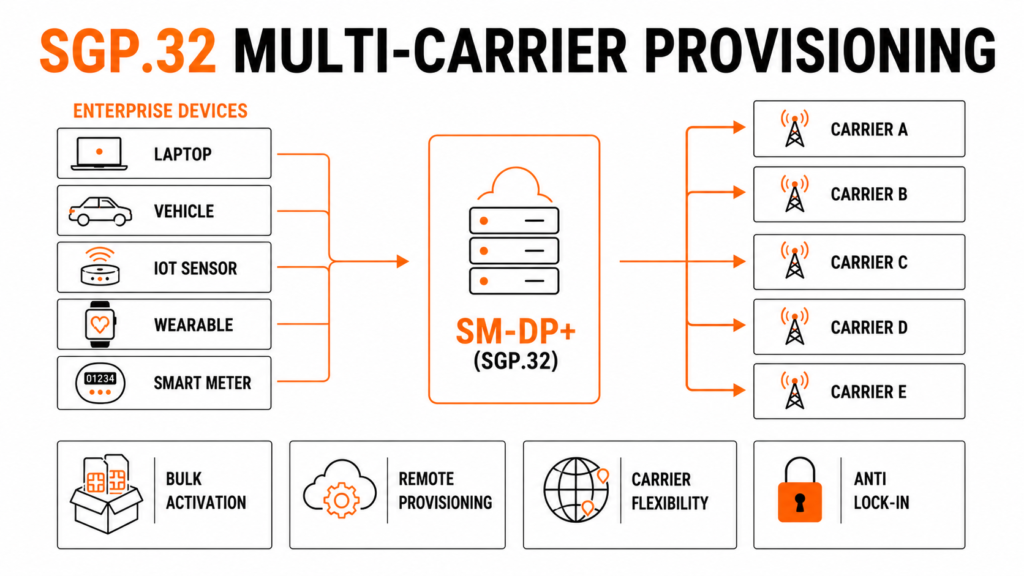
In 2026, SGP.32 is the defining shift. It is the new GSMA standard for IoT eSIM that enables fully server-driven, remote SIM provisioning, meaning profiles can be pushed, swapped, or deactivated at scale without any manual intervention or device-side initiation.
Think of SGP.32 like the difference between manually updating software on each computer versus pushing an update to every device in your organization simultaneously from a central server. Same idea, applied to SIM profiles.
Why does this matter for enterprises?
- Bulk activation: Thousands of IoT devices can be provisioned simultaneously.
- Carrier-agnostic: Devices are not tied to any single operator.
- Anti-lock-in: You can switch carriers across your entire fleet by updating a profile, not renegotiating a contract.
For enterprises, the practical benefit is straightforward. Less dependence on any single carrier, and more room to switch if service quality, pricing, or coverage changes. According to Juniper Research, logistics, energy, and smart infrastructure sectors are expected to add a combined 75 million new eSIM connections in 2026, largely driven by this server-driven, carrier-agnostic approach. You can read more in Spenza’s SGP.22 vs SGP.32 standards guide.
SGP.32 is specifically designed for IoT and machine-to-machine (M2M) devices. If your organization manages consumer devices such as smartphones, tablets, or laptops, those typically use the SGP.22 (Consumer eSIM) standard instead. Many enterprises operate both device types today and manage them through a unified connectivity platform.
eSIM for IoT at Scale
If zero-touch deployment is eSIM’s headline feature for workforce devices, IoT is where the technology’s full potential becomes visible.
Consider a smart building company deploying thousands of occupancy sensors across office buildings in twelve countries. Each sensor needs a reliable data connection. Physically managing SIM cards across that infrastructure is not just expensive, it is operationally impossible at any meaningful scale.
With eSIM for IoT, the company can:
- Activate all devices in bulk from a central platform.
- Set automatic failover so devices switch to a backup carrier if the primary signal drops.
- Deploy temporary connectivity for pop-up sites or seasonal locations without new contracts.
- Scale from dozens to thousands of devices without changing the underlying management setup.
A children’s smartwatch only needs a small GPS ping every few minutes, so its connectivity profile should be cheap and lightweight. A spatial intelligence sensor monitoring foot traffic needs steady, higher-bandwidth data across multiple countries. A connected vehicle fleet needs reliability and the ability to switch networks mid-route. One eSIM platform, configured correctly, can serve all three without forcing the company to negotiate separate carrier contracts for each. Spenza’s IoT eSIM solutions are designed around exactly this kind of scale.
For businesses building connected products, eSIM is not a feature add-on. It is the foundational connectivity layer.
Butlr.io, a spatial intelligence company, used Spenza’s connectivity platform to manage high-bandwidth IoT sensor deployments across multiple countries. Rather than managing separate carrier agreements and invoices in each region, the company consolidated connectivity onto a single management platform with one unified bill, significantly reducing operational complexity.
Managing Business eSIMs: Platform and Security
Here is where many businesses get stuck. The concept of eSIM is clear. The question is, how do you actually manage it at scale? This is where an eSIM connectivity management platform becomes essential. Think of it as your central control room for all things connectivity.
A good platform gives IT and finance teams one dashboard to see every connected device, set role-based access so only the right people can make changes, remotely lock or wipe a profile in seconds rather than days, and provide Cost-per-device analytics so you know exactly what each device or department is spending. It also integrates into the MDM, ITSM, and ERP systems/tools that a business already uses, like Salesforce, Okta, or Slack, so connectivity data does not sit in a silo.
Security matters here, too. Because the profile lives in encrypted, tamper-resistant hardware rather than a removable card, it cannot simply be pulled out of a stolen device and reused elsewhere. If a device is lost, an administrator can disable its connectivity remotely within minutes.
Choosing an eSIM Platform: What to Look For
Not all eSIM platforms are built for enterprise scale. Before choosing one, businesses should look beyond pricing and ask a few key questions. Does it support multiple carriers? Can it manage thousands of devices? Does it integrate with existing systems and allow businesses to keep their current carrier relationships? These capabilities determine whether a platform can support long-term growth or become another operational bottleneck.
The most successful organizations treat their eSIM management platform as core infrastructure rather than just another connectivity vendor.
| Capability | What Enterprises Should Evaluate |
|---|---|
| Multi-carrier support | Coverage, carrier choice, and network switching |
| eSIM management | Remote provisioning, profile lifecycle, and bulk activation |
| IoT support | SGP.32 compatibility and large-scale device management |
| Security | Role-based access, profile protection, and remote deactivation |
| Integrations | APIs, webhooks, MDM, ITSM, and ERP compatibility |
| Cost management | Usage visibility, billing controls, and cost analytics |
| Scalability | Ability to manage devices from pilot to large fleet |
| Network flexibility | Support for existing carrier relationships and multi-network deployments |
How Spenza Powers eSIM for Business
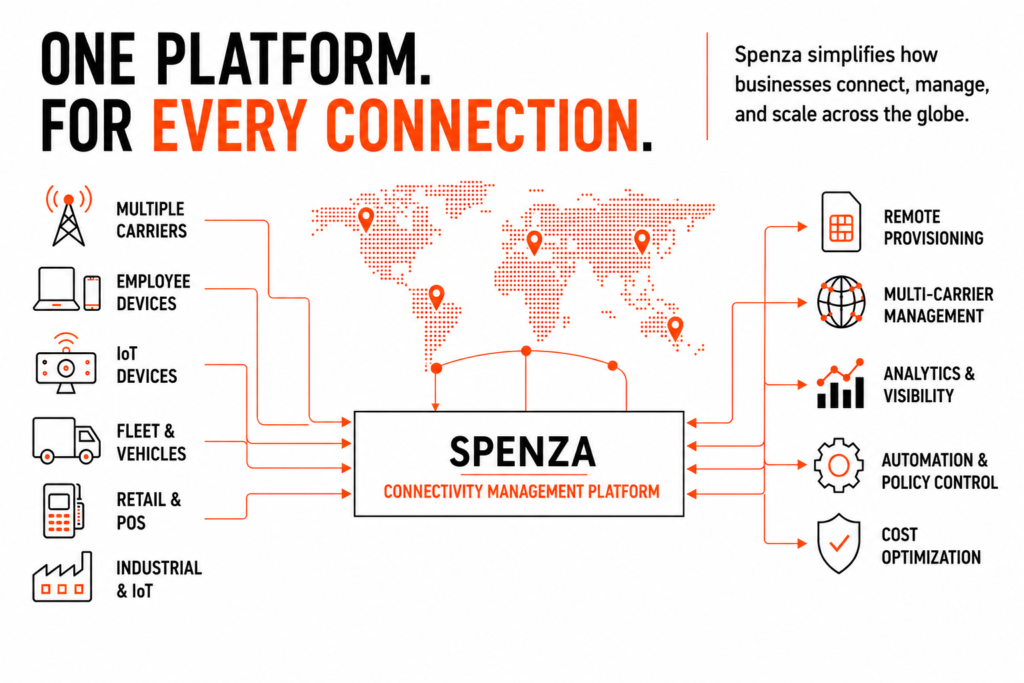
Spenza is an all-in-one Connectivity Management Platform built specifically for enterprises and businesses that need to manage connectivity at scale without the overhead of negotiating directly with dozens of carriers. A platform that handles the complicated backend of telecom, carrier contracts, billing, and provisioning, so businesses do not have to.
Here is what makes Spenza different from a standard carrier portal or a single-operator eSIM solution:
- 190+ country coverage through a single platform agreement, with no need for separate regional contracts.
- Multi-carrier marketplace where you can mix and match plans based on cost, coverage, and performance.
- API-first architecture that integrates with the tools your team already uses, from Salesforce to Shopify to Okta.
- MVNE capability, meaning businesses can even launch their own branded mobile service if they choose.
- SGP.32-ready IoT management for enterprises deploying connected devices at scale.
For companies wary of carrier lock-in, Spenza’s Bring Your Own Network feature lets businesses keep existing MNO contracts while still managing everything through one dashboard. Combined with SGP.32 readiness for IoT, this gives enterprises a connectivity strategy that can grow with them, from a single device pilot to a fleet of thousands.
For IoT device makers, Spenza’s platform handles the entire lifecycle. From eSIM provisioning for connected devices and bulk activation to ongoing profile management and cost analytics.
Spenza also supports Telecom Expense Management as a foundational layer, so a company evaluating eSIM for cost control today has a natural path to adding IoT connectivity or even launching its own branded mobile service later, without switching providers as its needs evolve.
Angel Watch, a children’s smartwatch maker, used Spenza to create custom mobile plans tailored for low-data IoT devices, bundle connectivity directly into their product, and expand into the US and UK markets without negotiating separate carrier deals in each country. The result was faster growth, simpler operations, and a better customer experience.
Conclusion
In 2026, eSIM for business is no longer an emerging trend; it is becoming core infrastructure. It cuts deployment time from weeks to minutes, reduces avoidable roaming costs, and gives enterprises the flexibility to avoid being boxed in by a single carrier. Companies that treat connectivity as a managed, software-driven resource rather than a fixed cost are the ones best positioned to scale, whether that means onboarding new employees, expanding an IoT fleet, or launching an entirely new connected product.
The companies getting this right are not just saving money. They are building more resilient, more scalable operations. As enterprise connectivity becomes increasingly software-defined, choosing the right eSIM management platform will matter just as much as choosing the right network.
FAQs
So the question for CIOs, CTOs, and CFOs is simple: Are you ready to treat connectivity as a business strategy? If yes, contact Spenza today for a personalized consultation.


