The best IoT connectivity management platforms fit the networks, workflows and commercial model your fleet actually needs. Compare documented provider scope, supported carrier relationships, lifecycle APIs, cost visibility and exit terms. Then test representative devices and failure cases. A feature list or universal ranking cannot establish that fit for your deployment.
This comparison is for product, engineering and operations teams buying a platform for connected devices. It separates published capabilities from the evidence needed to accept a service. Start with the IoT connectivity selection guide if your underlying network choice is unresolved. A CMP can help operate supported connections; it cannot supply missing radio coverage or repair an incompatible device by changing a dashboard setting.
How Should This CMP Comparison Be Used?
The IoT CMP comparison uses public provider documentation checked on September 24, 2026. The table identifies documented scope, likely buyer fit and questions requiring confirmation. It is an editorial shortlist aid, not a hands-on performance test, complete market ranking or guarantee that a listed capability is available under every contract.
An IoT connectivity management platform centralizes supported subscription operations, usage visibility and connectivity workflows. Depending on the offer, it may be bundled with network access, a core network, billing or managed services. Device firmware and application management remain separate capabilities unless the product explicitly includes them.
Evaluate each candidate against the same fleet: countries, operators, radio technologies, device revisions, traffic patterns and operating tasks. A platform suited to selling connectivity to downstream customers may be more than an enterprise needs for its own subscriptions. Conversely, basic subscription visibility may be insufficient for a provider that needs customer accounts and invoicing.
| Record | What to retain |
|---|---|
| Published documentation | Product scope; available interfaces; stated service conditions. |
| Acceptance evidence | Actual carrier estate; device and API traces; reconciled commercial terms. |
| API request | Authorized actor; stable request ID. |
| API response | Accepted or rejected; retry behavior. |
| Observed state | Confirmed change; observation time. |
| Reconciliation | Application result; correct charge. |

Which IoT Connectivity Platforms Fit Different Needs?
IoT connectivity platforms differ in the software, network and commercial responsibilities they include. Shortlist providers whose documented scope matches the service you need to operate, then confirm the actual implementation. The options below retain distinct categories so a network control function is not mistaken for a complete subscription management replacement.
Use these documented differences to decide which provider discussions are worth pursuing.
| Provider or product | Published scope | Consider when | Confirm in evaluation |
|---|---|---|---|
| Cisco IoT Control Center | Connectivity visibility, lifecycle control and automation | Your carrier offer includes Control Center and its operating model fits | Carrier-specific APIs, features, commercial terms and supported actions |
| Aeris IoT Accelerator | IoT connectivity management through its operator ecosystem | Operator-delivered connectivity and fleet management match the requirement | Selected operator’s service scope, integration and support responsibilities |
| floLIVE | CMP with core-network and BSS capabilities | You need a broader connectivity and commercial operating stack | Actual routing, deployment scope, licensing and operational ownership |
| KORE ConnectivityPro | Connectivity management within KORE’s IoT service offering | Managed connectivity and supplier support fit your operating model | Plans, lifecycle controls, integrations and any legacy API transition |
| Soracom | Cellular connectivity with documented SIM controls and platform services | Developers need programmatic connectivity and service integration | Plan geography, additional service charges and required device support |
| 6D Technologies Infinity | IoT connectivity management with accounts, products, billing and multitenancy | A service provider needs commercial operations alongside connectivity | Current deployment architecture, integration work and supported eSIM workflow |
| Enea IoT CCS | Connectivity control function working alongside existing CMPs | A service provider needs additional policy, VPN and connectivity controls | Which CMP remains responsible for subscription and profile lifecycle |
| Spenza | Enterprise connectivity operations, spend management and connectivity commercialization | Supported carrier relationships and commercial workflows need coordination | BYON eligibility, action coverage, integration scope and complete charges |
Sources: linked provider documentation and Spenza’s IoT offering, checked September 24, 2026. Fit statements are editorial inferences from published scope. No numerical ranking or comparable performance benchmark is claimed.
Aeris completed its acquisition of Ericsson’s IoT Accelerator business in March 2023; the platform should not be presented as an Ericsson-owned offer. Enea describes IoT CCS as complementary to CMPs. These distinctions affect who supplies the service and which functions still need a separate system.
Choose Cisco or Aeris when a participating operator’s specific offer meets your requirements. Consider floLIVE or 6D when the broader network or commercial stack is part of the purchase. Consider KORE for its managed connectivity offer and Soracom for documented developer workflows. Evaluate Spenza when coordinating supported carrier operations and commercial management is central. Confirm each fit through the same acceptance process.
Bring your shortlist and carrier estate to a connectivity requirements discussion.
Which Architecture and Contract Boundaries Matter?
IoT CMP architecture should be evaluated separately from the connectivity contract and device-management system. Determine who supplies network access, owns the subscriber relationship, controls profiles and routes application traffic. Operator neutrality describes a business or integration approach; it does not establish unrestricted carrier choice, automatic compliance or a hardware-independent migration.
BYON can preserve existing carrier relationships where account permissions, commercial terms and integrations support it. Ask whether an integration offers inventory reporting, usage data, lifecycle control or all three. A shared interface should show unsupported actions and stale observations rather than pretending every underlying carrier behaves identically.
For eSIM, name the actual provisioning architecture. SGP.02 covers M2M, SGP.22 consumer and SGP.32 IoT remote provisioning. Confirm compatible eUICC, device software, profile services and management components. A roadmap label is different from a demonstrated production workflow on your hardware.
SGP.32 support is relevant where the deployment requires that architecture; it is not a universal reason to reject every other operating model. Remote provisioning also needs a usable delivery and recovery path. See the remote SIM provisioning guide for the component responsibilities.
Treat satellite, private networking and automated carrier selection as scoped requirements. Confirm the device and service support before including them in the business case. Local breakout concerns data routing; it does not by itself establish local subscription eligibility or satisfy every data-handling requirement. The global IoT operations guide separates those checks.
How Should Lifecycle APIs and Automation Be Tested?
IoT CMP acceptance tests should follow authorized requests through confirmed subscription state, application behavior and billing. Exercise normal actions, failed requests and partial batch completion on representative services. An API acknowledgment proves that a request was received or accepted; it does not necessarily prove that the intended network change has finished.
Start with required operations rather than a score for having an API. Define who may activate, suspend, change or terminate a subscription. Record the identifier, requested state, observation time and final result. Use the CMP architecture guide to distinguish subscription control from the device’s application state.
- Validate inventory. Import representative records and map device, SIM, profile, carrier and account identifiers. Preserve source identifiers for troubleshooting.
- Exercise a lifecycle action. Observe the accepted request, eventual state and expected application effect. Record any carrier-specific conditions.
- Test retries and partial failure. Confirm how repeated requests, duplicated events, timeouts and partially completed batches are identified and recovered.
- Check telemetry age. Compare device activity with displayed usage and event timestamps. Define what an alert can do when source data arrives late.
- Reconcile commercial results. Verify how the tested action appears in the rate plan, usage record and invoice. Export the supporting evidence.

Test automation with an explicit action boundary. A usage alert may notify an operator, change a plan or suspend service, depending on configuration and supported capability. Those outcomes have different risks. Define authorization, rollback or recovery, exception handling and the person responsible for reviewing unexpected results.
Use actual device requirements, not just a portal demonstration. The sensor connectivity guide helps identify installation and power conditions that can affect observations. A responsive dashboard cannot establish the energy cost of repeated registration attempts on a battery-powered sensor.
How Do You Compare CMP Costs and Exit Terms?
IoT CMP costs should be compared for an equivalent fleet, service boundary and operating period. Separate software charges from network access, data, integration and support. Include subscription lifecycle states and exit obligations, because a quoted per-device fee does not explain the cost of deploying, operating and eventually moving the service.
Normalize these components before comparing quotes.
| Component | Question for each provider | Record to compare |
|---|---|---|
| Software and access | Which platform, carrier and minimum charges apply? | Itemized quote for the same eligible fleet |
| Usage and pooling | How are traffic, rounding and pool membership defined? | Representative distribution and metering rules |
| Integration and support | Which implementation tasks and incident services are included? | Responsibilities, exclusions and support terms |
| Lifecycle and exit | What do suspension, termination and data export require? | State charges, notice periods and export sample |
Spenza evaluation worksheet, September 2026. This is a comparison method, not a provider price list or savings benchmark.
Retain the distinction between a consolidated financial view and a single legal invoice. BYON may preserve multiple carrier contracts and billing relationships. Confirm which records the platform imports, which charges it creates and who resolves discrepancies. The IoT connectivity cost guide explains the wider fleet economics.
For exit, request a sample export before signing. It should preserve identifiers and the history needed to operate or migrate the fleet. Check profile rights, support during transition, retention limits and commercial notice requirements. Open APIs reduce some integration work, but they do not remove every contractual dependency.
Where Does Spenza Fit in the Shortlist?
Spenza, an MVNE platform for enterprise connectivity operations, fits evaluations that combine supported carrier management with spend control and commercial workflows. The published Butlr case provides a concrete regional sensor-rollout example. Use that scope to inform a shortlist, then require the same technical, commercial and recovery evidence requested from competing providers.
The Butlr case study reports a multi-country sensor rollout reduced from 60 days to seven. That result supports regional deployment coordination. It does not establish that Spenza outperforms every CMP, that a new fleet will see the same timeline or that all requested integrations are already available.
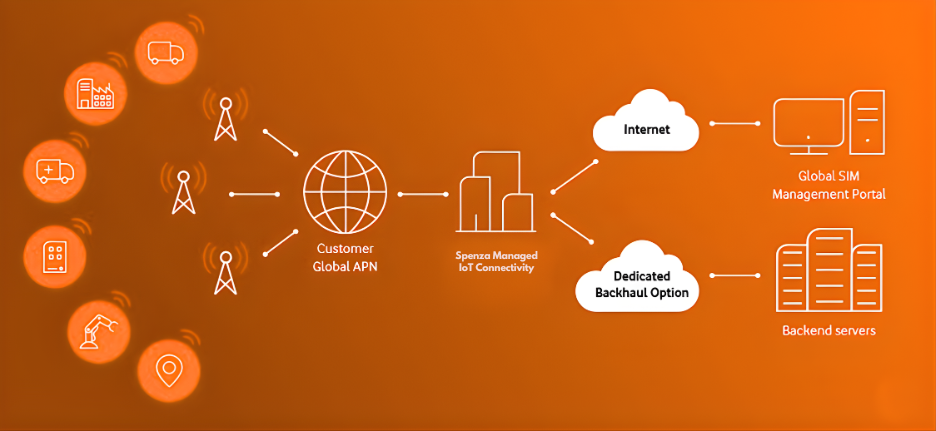
Ask Spenza to identify the carrier accounts, actions and commercial modules included in the proposed scope. If your requirement is limited to an existing carrier’s basic portal, compare that option fairly. If you need broader supported operations and commercialization, include those responsibilities and costs in the evaluation rather than treating them as free additions.
Bring your required workflows and evidence checklist to a Spenza platform review.
Choose an IoT CMP by the work it can demonstrably perform for your fleet. Keep published scope, contractual availability and tested behavior distinct. Confirm the carrier estate, architecture, lifecycle APIs and complete commercial boundary before comparing cost. Then run representative acceptance tests, including failure recovery and invoice reconciliation, with named owners on both sides. The next step is a shortlist supported by records, not a universal vendor score. Use those records to scope a deployment discussion and retain a workable exit path before committing the wider estate.
IoT CMP Comparison FAQs
IoT CMP comparison questions often concern promises that cannot be settled by a marketing checklist. The answers below distinguish software scope, commercial availability and test evidence. Use them to identify unresolved conditions in a proposal, then request the relevant documentation or demonstration before assigning a capability to the production design.
Does every fleet need SGP.32?
Every fleet does not need SGP.32. The requirement depends on the chosen provisioning architecture, device capabilities and operating needs. SGP.32 can support IoT remote profile workflows, but existing services may use other supported arrangements. Evaluate the actual change and recovery requirements rather than treating a standards label as a universal purchasing rule.
Does a public API mean every carrier action is supported?
A public API does not mean every carrier action is supported. Capabilities can vary by integration, subscription type, account permission and commercial arrangement. Request a dated action matrix for the carriers you intend to use. Test the required operations, including errors and partial failures, before assuming one interface makes every underlying service equivalent.
Can missing website documentation be treated as a missing feature?
Missing website documentation should not automatically be treated as a missing feature. It leaves a capability unverified. Ask the provider for current documentation and a demonstration under the proposed service terms. Keep that status distinct from a confirmed absence, and avoid comparing a competitor’s unverified feature with an untested claim from another vendor.
Is unified billing always one invoice?
Unified billing is not always one invoice. A platform may consolidate usage and costs while separate carrier contracts continue to produce separate invoices. Confirm the contractual supplier, rating responsibility and reconciliation process. Compare the financial visibility you receive with the legal billing arrangement rather than assuming the same phrase describes both.
Does private routing prove end-to-end device security?
Private routing does not prove end-to-end device security. Device credentials, firmware support, application authorization and data handling remain part of the design. Confirm which controls the connectivity service supplies and which belong elsewhere. Test the relevant handoffs and retain clear responsibility for incidents instead of assigning every security task to the CMP.
How should roadmap features affect the decision?
Roadmap features should remain separate from accepted production capabilities. Record the promised scope, dependencies and delivery conditions, and decide whether the deployment can proceed without them. If a feature is essential, require evidence before relying on it. A forecast date does not replace a working implementation or agreed contractual protection.