Last verified 2 November 2026.
Global IoT connectivity is the ability to keep connected devices working in every country a product ships to, which takes more than a SIM with a long coverage list. It means the device can attach to a network, the service is allowed for how long and where the device will actually stay, and the data reaches your application. Roaming is one way to get there quickly. Local profiles, multi-IMSI SIMs and remote eSIM provisioning are the others, and most fleets end up using more than one.
The short answer to the planning question: use roaming to launch and to cover devices that really move across borders, and plan a local arrangement for devices that sit in one country for months or years. Which countries restrict long-term roaming is a legal question for each regulator and operator, not something a vendor map can settle. This guide explains how roaming works, how the alternatives differ, how to record country constraints, how to prove recovery between carriers, and how to run a rollout. If the radio technology is still undecided, start with the NB-IoT, LTE-M and 5G RedCap comparison.
What Is Global IoT Connectivity?
Global IoT connectivity is the combination of network access and operating processes that lets devices run across the countries and operators a product needs. The scope covers subscriptions, device compatibility, data routing, support and lifecycle changes. Global does not mean every country or every operator, and a device that attaches to a network has not shown that the intended deployment is permitted there.
Define the footprint as a set of country, device and use-case combinations. Record how long devices stay, whether they move, which radio features they need and where their data has to go. Then ask suppliers for evidence for that combination instead of accepting a headline network count. Three questions keep the design concrete:
- Can the device connect? This is engineering: bands, modem, antenna, SIM and APN settings.
- May the service be used for the intended duration in that country? This is the supplier, the operator agreement and the relevant regulator.
- Does the application get its data and recover when something fails? This is the product team.
Those questions have different owners, which is why a “global SIM” purchase tends to go wrong when one team answers all three. Our IoT SIM card guide covers the SIM formats behind these choices.
Key takeaway. A global offer is a collection of supported regional conditions. Keep those conditions in the inventory and the operating process, not only in the sales deck.
How Does IoT Roaming Work?
IoT roaming lets a device with a SIM from a home operator attach to a visited operator in another country through the agreement between the two. It works much as it does for a traveling phone, but the device is a machine, often with small, regular data bursts and no human to fix a setting.
- The device ships with a SIM or eSIM profile from a home operator.
- In a new country it scans for networks it is allowed to use.
- The visited network contacts the home network to authenticate the subscriber identity (the IMSI).
- Once authenticated, the device registers on the visited network under the roaming agreement.
- Data is then routed. In the common home-routed model, traffic travels back to the home operator’s packet gateway before it reaches the internet or your servers.
- Usage is billed by the visited operator to the home operator, who bills the account holder.
A connectivity management platform (CMP) sits on top of this to show usage, set limits and alert on charges. See the connectivity management platform comparison for what to expect from one.
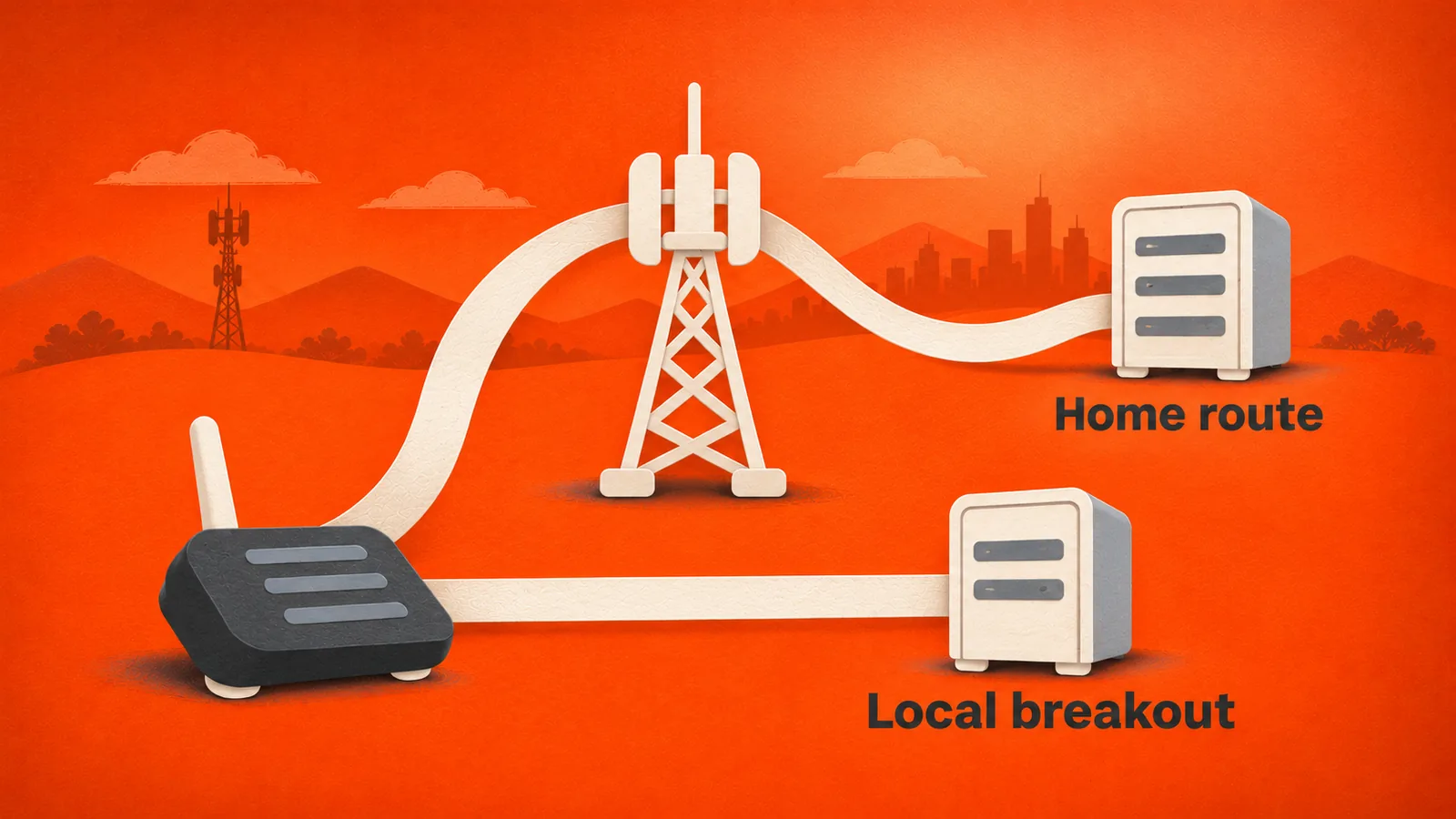
Home-routed traffic versus local breakout
With home routing, data crosses an international link twice: out to the home gateway and back to wherever the application lives. That longer path can add latency and a failure point, and it can put data in a different country from the device. With local breakout, traffic leaves the mobile network in the visited country, or at a nearby point of presence. 1GLOBAL’s network documentation, for example, describes routing traffic to the nearest point of presence instead of one fixed home gateway. Breakout changes where traffic exits the network. It does not change where your application, logs and backups are stored.
What roaming does well, and where it strains
Roaming reduces launch friction. One SIM type can ship in every unit, which simplifies manufacturing and inventory, and you do not have to negotiate with an operator in every country before the first device goes out. It suits devices that really cross borders, such as shipping containers, vehicles and portable equipment, and it works as a fallback when a local profile drops.
The strain shows up with scale and time. Roaming wholesale rates and billing layers can make cost harder to predict. Network selection follows the roaming agreements rather than the best signal for your device. Home routing affects latency and data location. Most importantly, a device that stays in one country for a long time is a different case from a traveler, which is where permanent roaming comes in.
Roaming, Local Profiles or Multi-IMSI: Which Should You Use?
Roaming serves devices through a home subscription and visited networks. A local operator profile gives the device a subscription in the country where it operates. Neither is universally cheaper or more compliant, and a fleet may use both under different regional conditions. Telenor’s IoT team treats them as complementary and states that SGP.32 does not replace global roaming; remote provisioning adds a way to change profiles later without replacing operator agreements.
Separate the decisions that get bundled into one “global SIM” claim:
| Mechanism | What it changes | What it does not establish |
|---|---|---|
| Roaming | Access through a visited network under an eligible service | Unlimited duration, or every operator feature |
| Local operator profile | The subscription identity and the service arrangement in a market | The full data route, or where the application is hosted |
| Multi-IMSI SIM | Selection among several subscriber identities stored on the SIM | An independent radio, or automatic legal approval |
| Remote eSIM provisioning (SGP.32) | Supported profile download and lifecycle operations | Modem band support, or a new service contract |
| Local breakout | Where traffic leaves the mobile network | Where applications, logs and backups are stored |
Architecture distinctions informed by Telenor, 1GLOBAL network documentation and GSMA SGP.32 v1.2. Check the actual provider implementation.
Keep SGP.32 and multi-IMSI distinct
GSMA’s SGP.32 v1.2 specifies remote provisioning for constrained IoT devices, using an eSIM IoT Remote Manager and an IoT Profile Assistant. Multi-IMSI is something else: a SIM that holds more than one international mobile subscriber identity. The two can coexist in one implementation, but they are not names for the same thing, and consumer SGP.22 has a different architecture again. The SGP.22 versus SGP.32 guide sets out the difference.
1GLOBAL’s documentation shows how a supplier can separate the layers: identity selection (which IMSI the SIM uses in a country), service profiles (what services are allowed), SIM profiles and routing. Use the same separation when you question any supplier. A local identity does not by itself prove local application hosting, or that data stays inside a country.
A rule of thumb that holds up
Use roaming to launch, and for devices that genuinely move. For stationary, long-lived or large deployments, ask each supplier how the device will be served locally from the start, and get the answer in writing for each country. This is a planning rule, not a legal one. It tells you where to look for risk, not which countries are fine.
What Is Permanent Roaming, and How Do You Check Country Constraints?
Permanent roaming is a device using a foreign operator’s subscription for a long time, often for its whole life, in one country. Roaming agreements were built for travelers who go home. A smart meter or a sensor installed in a building does not. Regulators and operators treat that difference in different ways, and some restrict or limit it.
The European regulators’ body BEREC studied the subject in its report on M2M and permanent roaming (BoR (24) 165, December 2024). It notes that permanent roaming is particularly relevant for services such as automotive and shipping, and that many access seekers, especially MVNOs, find permanent roaming agreements hard to negotiate. That is a useful picture of the commercial side. It is not an approval for any one deployment, and it covers Europe only.
Watch out. Treat any list of “banned countries” or any universal number of days as unverified until you hold the national rule or the operator contract that applies to your service. Thresholds differ by country, by operator and by contract, and they change. Do not copy a figure from a blog post, including this one, into a deployment decision.
Long-term use of a foreign subscription can raise different questions from temporary cross-border movement. The requirement in play may concern service authorization, subscriber registration, equipment approval, data handling or the operator agreement. Work out which applies and who confirmed it. Do not infer permission from a successful pilot connection: a device that attaches today can still be restricted later.
Build one record per country and service
| Record field | Evidence to retain | Review trigger |
|---|---|---|
| Country, use and duration | Deployment scope; stationary or mobile behavior | New market, location or operating period |
| Provider and subscription | Named service, profile and eligible operators | Plan or agreement change |
| Applicable requirements | Dated primary rule and written supplier confirmation | Rule change or approval expiry |
| Device eligibility | Module, bands, firmware and required approvals | Hardware or software revision |
| Data path | Breakout, tunnels, application and storage locations | Routing or cloud change |
| Owner and fallback | Escalation contact and an approved alternative | Service loss or supplier change |
This table is a template, not a statement that a particular country permits or prohibits a particular service. Date every entry and keep the source with it, so an old approval is never silently extended to a new service. Ask your supplier to state in writing, per country, whether your SIM type and deployment pattern are supported, and keep that statement with the record.
Which Connectivity Options Fit Which Devices?
Roaming and local profiles are not the only options. Match the option to the device and its environment.
| Option | Typical fit | Main trade-off |
|---|---|---|
| Roaming SIM | Pilots and genuinely mobile assets | Duration and routing limits; you depend on agreements you do not hold |
| Multi-IMSI SIM | Fleets that need several identities in one SIM | Operator agreements must be in place beforehand, and the SIM carries them |
| eUICC with remote provisioning | Long-lived devices whose market or terms may change | Needs compatible module and firmware, plus a service contract for each profile |
| LPWAN or LoRaWAN | Stationary or low-data devices | Separate network, gateways and coverage planning |
| Private cellular | Sites such as factories and campuses | You operate or contract the network; local spectrum rules apply |
| Satellite | Remote areas and mobile assets outside cellular coverage | Different hardware, antenna needs and cost model |
For a side-by-side look at cellular, LPWAN and satellite from a buyer’s angle, read the IoT connectivity comparison. For how orchestration of several carriers and profiles works day to day, see eSIM orchestration for global IoT.
How Do You Prove Multi-Carrier Recovery?
Prove it with an application outcome after a defined failure, not by counting how many networks are available. Identify the failed component, the alternative path and anything the two paths share. Two operators can still depend on the same device, power supply, antenna, subscription platform or upstream service, and a second profile is not a second modem. The single-carrier risks guide explains why a single dependency matters.
Test it in a representative environment. Remove the intended path or reproduce an agreed failure, record detection time, watch the network or profile change, then confirm session establishment and application delivery. Keep rejected actions and failed recoveries in the record. They explain limitations that a clean demonstration can hide.
| Stage | Evidence to capture |
|---|---|
| Failure | The defined fault and the dependencies the two paths share |
| Alternative | An eligible network and the supported action that selects it |
| Connection | Restored session and measured interruption |
| Application | Expected receipt, loss and duplicates at the destination |
Soracom’s connectivity troubleshooting documentation shows why this needs more than a coverage plan. A connection can fail because the SIM is not in an active state, because the modem does not support the local bands, because the APN is wrong, or because data roaming is switched off on the device. Check subscription permission, radio compatibility and APN configuration before assuming a broader plan would fix a failure.
Agree what happens to data during an interruption. A device may need local buffering, retry limits and duplicate detection after reconnection. The application owner decides whether delayed delivery is still useful or whether a missed event needs a human. A connectivity supplier cannot decide that from a SIM status alone.
Buyer checklist. Record the failure, the detection time, the selected alternative, the restored session and the application result. Include shared dependencies and a named owner for any recovery that remains unresolved.
What Belongs in a Global Rollout Plan?
A rollout plan should connect inventory, approved regional services, provisioning and application acceptance in one process. Start with representative devices and countries, then expand in controlled groups. Keep the original and target subscription records, recovery instructions and billing effects available, so a regional change does not leave unidentified devices or unexplained charges.
- Define the deployment matrix. List device revisions, countries, operators, application endpoints and the expected operating duration.
- Complete eligibility checks. Confirm the device, the subscription, the service terms and the country record.
- Map inventory. Link the business asset, SIM identifier, eUICC identifier where used, active profile and responsible account.
- Test provisioning and recovery. Include offline devices, interrupted changes and a workable recovery route.
- Accept application delivery. Confirm the intended message flow, not only network registration.
- Reconcile and expand. Compare usage and charges, resolve exceptions and approve the next regional group.

Compare regional costs on the same basis
A cheaper data rate can hide extra profile, platform or support work. One combined service can simplify operations while including costs that a local rate card leaves out. Compare the same device workload and service requirements, and keep these boundaries visible in the worksheet:
| Cost category | Unit or scope | Comparison requirement |
|---|---|---|
| Access and usage | Subscriptions and billable data per country | Same traffic distribution and eligible networks |
| Profile operations | Downloads, lifecycle events and retries | Same migration and recovery scenario |
| Inventory | Testing, stored and deployed units | Same billing start conditions |
| Operations | Integration and support effort | Same responsibility and escalation scope |
| Commitments | Minimum spend and termination terms | Same planning period and exit assumptions |
This is a comparison frame, not a price estimate. Fill it with current supplier terms, usage records and invoices. The IoT connectivity cost guide goes further on pooling and metering. For the operating layer, single-pane-of-glass management separates subscription changes from device software and application health.
Where the MVNO Model and Spenza Fit
An IoT MVNO or MVNE sells connectivity built on carrier networks it does not own, and often aggregates several carriers behind one contract and platform. For a company with devices in many countries, that can mean one commercial relationship in place of one per operator. It is not automatically better than a traditional carrier, and the same checks apply to it: ask for country-level service scope, routing and exit terms in writing. Our IoT MVNO versus traditional carrier guide compares the two.
Spenza is an MVNE platform that works with IoT device companies. Its site lists local-operator eSIMs for devices in each country and multi-carrier SIMs with automatic routing, with access to more than 180 operators. The published Butlr case study reports that Butlr, a smart-building sensor company, cut regional launch time from 60 days to 7 using Spenza. That is one customer’s result. It does not show that every country is eligible, that every profile change is immediate, or that your application will recover without interruption, so take your own country record and pilot results into any discussion with a supplier, Spenza included.
Conclusion
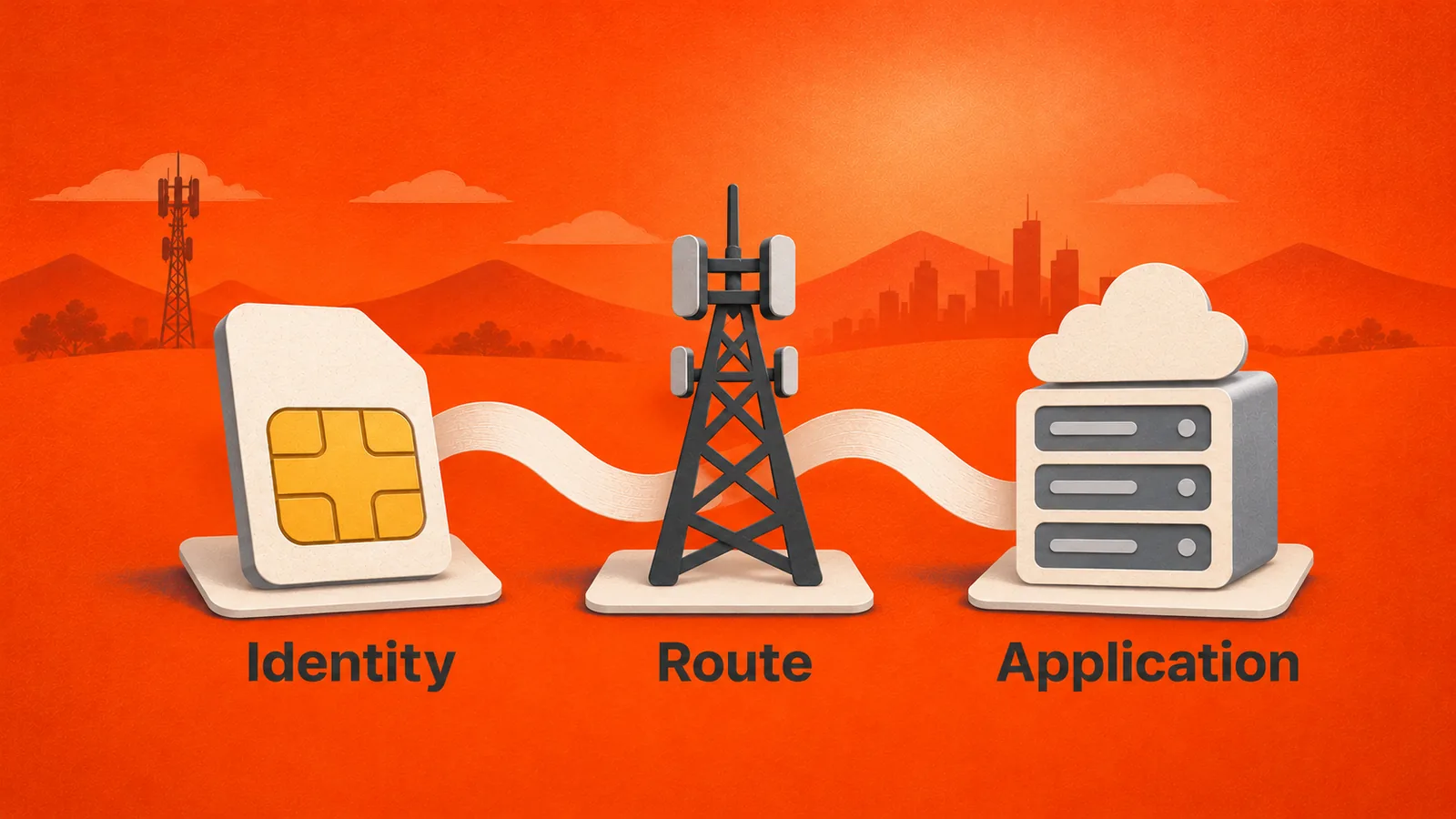
Treat global IoT connectivity as an operating design with a defined service path for each region. Keep roaming and local profiles available where each fits. Separate three things that vendors often merge: the subscriber identity, the traffic route and the application location. Keep dated country records, test failures on the real device, and compare complete costs for the same cohort.
The next step is a regional pilot with written acceptance conditions and named owners. Use the results to decide which groups can expand and which need a different architecture before you commit the wider fleet. For related planning, the asset tracking connectivity guide covers devices that cross borders by design.
Global IoT Connectivity FAQs
What is IoT roaming, and how is it different from phone roaming?
IoT roaming lets a device use a home operator’s subscription on a visited network under the agreement between the two, as a phone does abroad. The difference is the use: a phone returns home, while a meter or sensor may stay in one country for years. That is why the terms of long-term roaming matter far more for IoT.
How long can an IoT device roam before it is restricted?
It depends on the country, the operator and the contract, so no single figure applies. Some operators and regulators limit long-term roaming; others do not. Ask your supplier for the limit in writing for each country and service, and check it against the national rule. A pilot that connects tells you nothing about the limit.
Does a local profile keep all data inside the country?
Not by itself. A local profile changes the subscriber identity, while traffic routing is a separate part of the design. Check breakout, tunnels, application hosting, logs and backups against your actual requirement, and keep the supplier’s documented data path with the approval for that deployment.
What is the difference between multi-IMSI and eUICC?
Multi-IMSI stores several operator identities on the SIM, which allows switching among those prearranged identities. eUICC lets supported profiles be downloaded and changed remotely, which suits devices whose market or terms may change. They can be combined, but they are separate mechanisms with different dependencies.
Does SGP.32 resolve roaming restrictions?
No. SGP.32 enables supported remote profile operations for IoT devices, but service eligibility still depends on the active subscription, the agreements and the applicable rules. A local-profile strategy needs a compatible module, the right entitlement and an approved operating model, as well as a successful technical download.
Can one hardware model serve every market?
Only when its radio bands, components and approvals fit each of those deployments. Remote profile changes cannot add unsupported frequency bands. Validate the exact hardware and firmware revision on the intended networks before treating a single inventory unit as globally interchangeable.
Can data allowances be pooled across countries?
Only where the provider’s terms say so. Countries, operators, plans and subscription states can have different eligibility or rating rules. Compare the actual pool membership and usage distribution, including bursts, instead of assuming every SIM on one account shares one allowance.
How often should the country record be reviewed?
Whenever a relevant rule, operator agreement, device revision, routing arrangement or deployment scope changes, and on a routine schedule with a named owner. Each record should show its source date and open conditions, so an old approval is not carried over to a new service.