IoT connectivity cost includes subscription access, billable data, platform services and operating work. Compare plans against the same device cohort, countries, billing period and workload. Add hardware, cloud processing and lifecycle changes for total ownership cost. The lowest per-megabyte rate is not necessarily the lowest complete bill.
Product, engineering and finance teams need the same cost boundary before comparing suppliers. A sensor payload, a carrier usage record and a cloud message are different billing inputs. The IoT connectivity selection guide helps establish the network requirement first. This article covers the commercial decision: which charges apply, how plan structures behave, and how to prove that a proposed change reduces cost without weakening the service.
What is the full spectrum of IoT connectivity costs?
IoT connectivity costs span one-time purchases, recurring access, usage and operational work. A SIM price or data rate describes only part of that total. Establish which services are included, which are separately metered and which remain your responsibility. Keep the same scope when comparing a direct operator contract with a managed platform.
The component list below prevents a low data rate from obscuring other charges.
| Component | Billing unit to confirm | Common boundary question |
|---|---|---|
| SIM and setup | Per card, profile or activation | Are testing, shipping and replacement included? |
| Subscription access | Per line, day or month | Which inactive states still incur fees? |
| Data and messaging | Billable bytes, allowance or message | What rounding, minimums and overages apply? |
| Platform and support | Per account, line or service tier | What support and integrations are included? |
| Ownership expenses | Per project, device or intervention | Who pays for hardware, cloud, labor and migration? |
Source: procurement worksheet derived from the billing categories discussed below. It contains no assumed market prices.
Separate installed devices from billable subscriptions. A gateway may serve several sensors, while a vehicle may contain several cellular modules. The sensor connectivity architecture guide helps identify that relationship before you multiply a rate by the wrong device count.
Which IoT data plan fits the usage distribution?
An IoT data plan should fit the distribution of device usage and the contract’s billing rules. Pay-as-you-go, individual allowances, shared pools and prepaid lifetime packages expose different costs. Model ordinary operation and correlated bursts, such as fleet-wide updates. Device count alone does not tell you which structure will cost less.

The comparison distinguishes a pricing method from the boundary around its allowance.
| Plan structure | Useful when | Check before choosing |
|---|---|---|
| Pay-as-you-go | Usage is low or variable and the rate fits | Access fee, rounding, minimum charge and spikes |
| Per-device allowance | Individual usage is predictable | Unused allowance, overage and rollover rules |
| Shared pool | Eligible devices have complementary usage | Pool membership, minimums and shared burst exposure |
| Prepaid lifetime allowance | Total lifetime demand fits the package | Expiry, replenishment, eligible service and change terms |
Source: plan-structure comparison. Actual eligibility, rates and limits come from each supplier’s agreement.
Use a distribution, not only an average
Group devices by application, country, firmware and lifecycle state. Inspect the low-use population and the high-use tail. A stable fleet average can hide a few expensive devices. Pooling can absorb differences between devices, but it cannot absorb a fleet-wide burst without sufficient allowance or overage exposure.
For a concrete prepaid example, the 1NCE US plan page, checked in September 2026, lists $14 for ten years with 500 MB and 250 SMS, plus replenishment options. The data allowance is for the package lifetime, not each month. Check the service scope and purchase terms before treating that headline as deployment cost.
Choose an individual bucket when its allowance fits the device and limits shared exposure. Choose a pool when actual combined usage and membership rules justify it. Choose pay-as-you-go when the complete rated bill beats the alternatives. None is automatically best because a fleet crosses a particular size.
Bring your usage distribution and contract terms to an IoT cost requirements review.
What does IoT platform pricing add to the data bill?
IoT platform pricing can add account fees, device fees, cloud message charges and support costs to cellular service. The word connectivity may refer to a device’s cloud session rather than its mobile subscription. Identify each meter and its provider before combining figures, then check whether a bundled quote already includes a component.
AWS IoT Core pricing meters cloud connection time and messages separately. Its published messaging rules use 5 KB increments, so an 8 KB message counts as two metered messages in the stated example. That cloud charge does not purchase cellular data transport or a SIM subscription.
Payload bytes are not always billable bytes
Protocol headers, acknowledgements, retries and downlink traffic can increase network usage beyond the application payload. Billing may then round that usage again. Soracom’s usage calculation documentation describes per-SIM rounding and a US plan01s example where 127 KB becomes 200 KB under a 100 KB minimum billing unit.
For very small messages, test the actual packet and billing records rather than estimating from payload size alone. A compression change can reduce payload bytes while leaving a minimum charge unchanged. Cloud and carrier meters can also use different units or periods, so their totals need not match byte for byte.
How can a fleet cost worksheet be reproduced?
A reproducible IoT cost worksheet states the cohort, usage, rate source, period and exclusions before showing a total. Use quoted or published rates, and label hypothetical device counts as assumptions. Separate recurring charges from setup costs. A worked example demonstrates arithmetic; it does not establish a customer result or a market benchmark.
Illustrative assumptions: 100 subscriptions, each using 10 MB per month, all eligible for the displayed low-data rate. The Telenor IoT Complete rate page, checked in September 2026, lists €0.76 monthly access, €0.024 per MB, €2.52 setup and a €95 monthly Basic service plan. Country and configuration can change pricing.
The steady-state example includes the service plan and excludes any introductory free period.
| Example component | Calculation | Amount, EUR |
|---|---|---|
| Monthly access | 100 × €0.76 | €76 |
| Monthly data | 100 × 10 MB × €0.024 | €24 |
| Monthly Basic service | 1 × €95 | €95 |
| Recurring subtotal | €76 + €24 + €95 | €195 per month |
| One-time setup | 100 × €2.52 | €252 |
Source: linked Telenor public rates, September 2026. Hypothetical cohort, not a Spenza quote. Excludes hardware, installation, taxes, cloud, optional services and support outside the selected scope.
Replace every input with your approved quote and measured cohort. Add separate normal, update and adverse-usage scenarios. Keep one-time costs visible, then choose a documented ownership period if you amortize them. For moving assets, the fleet cost and recovery guide adds route and vehicle-specific requirements.
How do multi-country deployments change IoT cost?
Multi-country IoT cost depends on the eligible networks, regional rates, device support and operating arrangements in each market. A global plan name does not establish identical service or pricing everywhere. Model the intended countries and duration of use, then compare supported alternatives including the effort and risk of changing service.
Keep country-level quantities in the worksheet even if the invoice has one total. Check whether allowances cross regional boundaries and whether a device moving between zones changes its rate. For long deployments, confirm the provider’s permitted service arrangement instead of relying on a generic permanent-roaming cutoff.
Remote eSIM provisioning can support subscription changes on compatible equipment. It does not automatically remove local obligations, import charges, hardware costs or field work. A cheaper profile has no value if the device cannot use the required bands or reach the provisioning service.
Use the global IoT service planning guide for regional deployment questions. Keep this cost analysis separate from network selection and the IoT connectivity migration guide. Migration has its own acceptance and recovery work, which belongs in the business case.
Which six controls can reduce avoidable IoT spend?
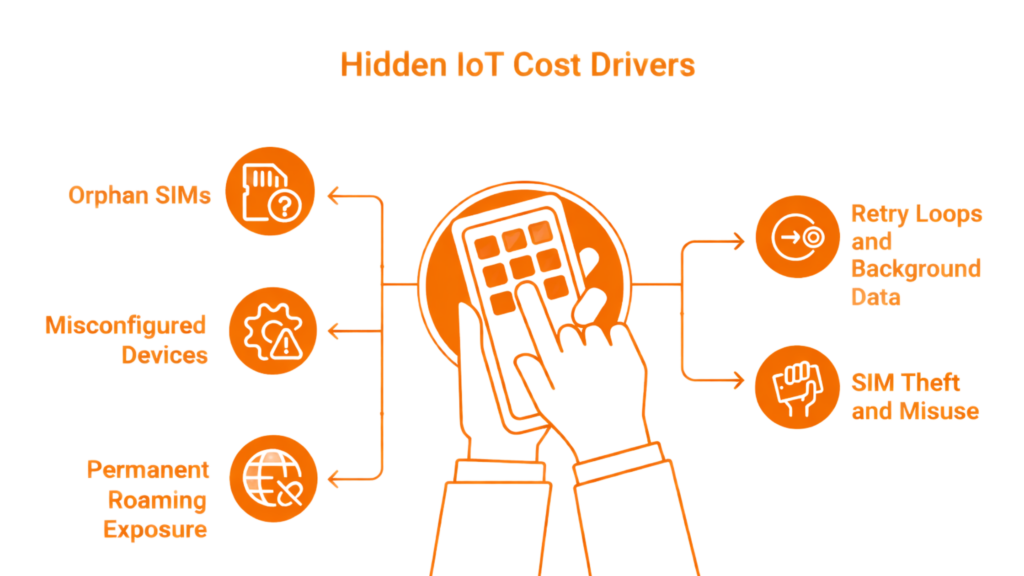
IoT cost controls work when they target a measured source of waste and preserve the required service. Start with inventory and usage evidence, then test changes to payloads, plans, lifecycle states and alerts. Track the complete before-and-after bill under comparable conditions. Do not assign a standard savings percentage to a control.
1. Segment the inventory
Join each subscription to its device, application, country and owner. Use the cellular identifier reference to avoid confusing the SIM, subscriber and equipment records. Investigate subscriptions with no accountable owner before changing their service.
2. Reduce unnecessary transmission
Review sampling, reporting intervals, debug logs and retries with the application owner. Measure the traffic change at the carrier boundary. Do not remove acknowledgements or diagnostic evidence simply to shrink a payload. The application must still deliver its required outcome under poor coverage and recovery conditions.
3. Resize plans from observed demand
Replay historical usage through each proposed rate structure. Include update periods, seasonal changes and high-use devices. Check the cost of unused capacity against the cost of overage. Test pool membership rules before assuming that all subscriptions can share the same allowance.
4. Verify lifecycle billing
Offline, inactive, suspended and terminated are not interchangeable billing states. Soracom’s subscriber-state documentation shows that inactive subscriptions can retain basic fees, while other states can have renewal or reactivation conditions. Confirm the selected plan’s rules and the effect of an action before scheduling it across the fleet.
5. Test alerts and enforcement
Measure how quickly usage reaches the platform and how long the requested action takes. An alert is not a guaranteed spending cap. Give critical services a reviewed response policy, and retain failed actions in an exception queue. Test notification delivery and the operator’s escalation path.
6. Reconcile and renegotiate
Compare the rated forecast with invoices and credits. Investigate unexplained differences before accepting a claimed saving. Review the contract when usage, countries or service requirements change, then include implementation effort and exit terms in the decision to switch.
How should operations prove that a cost change worked?
IoT cost optimization should be proven through linked usage, contract, invoice and service records. A dashboard estimate alone cannot establish a saving. Compare equivalent cohorts and billing periods, explain changes in device activity, and verify that delivery and support requirements still hold. Assign finance and operations joint responsibility for the result.
| Record | Meaning |
|---|---|
| Usage | Metered traffic |
| Rating | Contract rules |
| Invoice | Billed charges |
| Review | Explain differences |

Soracom’s billing record documentation illustrates the useful fields: identifiers, quantities, unit prices and periods, with tax treatment recorded separately. Your provider’s export can differ, but the reconciliation still needs a traceable path from service use to billed amount.
Spenza, an MVNE platform for connected-product operations, documents regional sensor connectivity in the published Butlr rollout case. The case supports coordinated activation and operating oversight across regions. It does not establish a percentage saving for the worksheet above.
Review the records needed for a cost baseline with Spenza’s deployment team.
Choose an IoT cost model that makes the service boundary and billing assumptions visible. Compare the same workload under each contract, include platform and operational expenses, and test controls before applying them widely. The next step is to complete the worksheet with an approved rate sheet and a measured usage cohort. Reconcile the forecast with the resulting invoice, then verify that the application still meets its requirements. Keep unexplained differences open until the responsible team can account for them. That creates a defensible decision without relying on generic savings promises.
Use the fleet cost worksheet to prepare the next supplier review.
Frequently asked questions
IoT connectivity cost questions often turn on the fine print around units, timing and service scope. The answers below address common purchasing assumptions that a headline rate cannot resolve. Check the current agreement and measured device behavior before applying any plan rule or operating control across your deployment.
Does a lifetime plan provide a fresh allowance every month?
A lifetime plan does not necessarily renew its allowance monthly. The package may provide a fixed quantity for the entire service period, with paid replenishment when it runs out. Read the allowance and expiry terms separately. Model firmware updates and maintenance traffic before assuming that a small lifetime package covers the product.
Are unlimited plans free from usage restrictions?
An unlimited label does not establish unrestricted speed, use or network access. Review fair-use policies, throttling, permitted applications and regional conditions in the agreement. Compare the service delivered after any threshold with your application requirement. A fixed invoice can still be a poor fit if the resulting performance fails the product.
Can a usage alert guarantee the final invoice amount?
A usage alert cannot by itself guarantee the final invoice amount. Reporting delay, open sessions, action timing and separate charges can create differences. Confirm how the provider meters usage and enforces limits. Test the full notification and response path, then reconcile the result with a bill before depending on the control.
Is a private local network free after installation?
A private local network can avoid some cellular subscription charges, but it still has operating costs. Include gateways, backhaul, power, maintenance, security updates and support. Compare the same coverage and availability requirement against cellular alternatives. Removing one recurring line item does not remove the work needed to keep the network operating.
Should every device in a company share one pool?
Every device should not automatically share one pool. Country eligibility, application requirements, usage patterns and contract terms can justify separate groups. A shared update campaign can also create a correlated burst across many devices. Model those conditions before combining allowances, and retain device-level visibility after the pool is established.
Can lower data use increase another cost?
Lower data use can increase another cost if the change requires more device processing, support or field maintenance. It can also leave a minimum charge unchanged. Compare the complete ownership model and application outcome, not only transmitted bytes. Measure the new behavior under normal operation and failure recovery before approving the change.