


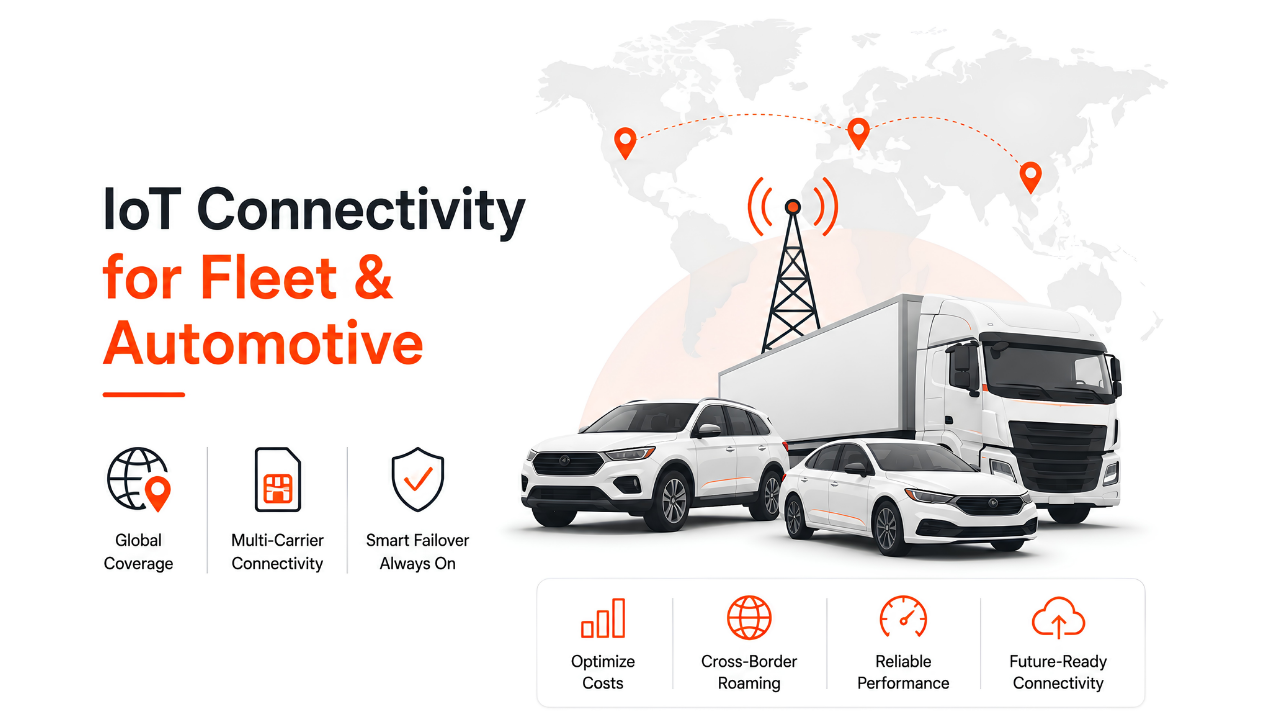
Modern fleets depend on reliable connectivity to keep vehicles visible, connected, and operational wherever they travel. From real-time GPS tracking and vehicle diagnostics to navigation, over-the-air updates, and emergency services, cellular connectivity is the foundation behind today’s telematics and connected-vehicle solutions.
But connecting vehicles is different from connecting a typical IoT device. Fleet and automotive devices are constantly moving between coverage areas, networks, and sometimes countries. They may also support multiple services simultaneously and remain deployed for years, making network availability, roaming, carrier flexibility, and long-term connectivity essential considerations.
For telematics service providers, fleet technology companies, and automotive businesses, choosing the right IoT connectivity strategy can directly affect reliability, operating costs, and the customer experience. Technologies such as LTE-M, LTE Cat-1bis, and eSIM are helping businesses build more flexible and scalable connected-vehicle solutions, while multi-operator connectivity can help maintain service as vehicles move across regions.
In this guide, we’ll explore IoT connectivity for fleet and automotive applications, what makes vehicle connectivity different from traditional IoT, the key connectivity challenges fleets need to solve, and how technologies such as eSIM, multi-carrier connectivity, and smart network switching can support reliable connected-vehicle operations.
In short: Fleet and automotive IoT connectivity is the cellular service layer that keeps vehicles, telematics devices, and connected-vehicle systems online as they move across networks and borders. Unlike conventional IoT deployments, automotive connectivity must account for mobility, cross-border coverage, multiple concurrent services, and long device lifecycles.
What Fleet and Vehicle Connectivity Has to Handle
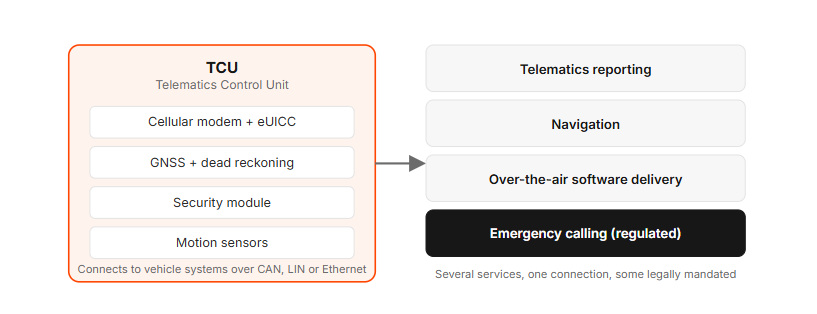
A vehicle is not one connected device. It runs several services in parallel, each with different requirements: telematics reporting, navigation, over-the-air software delivery, in-vehicle services, and, in regulated markets, emergency calling such as eCall. Some of these are legally mandated and cannot simply degrade.
Why a Vehicle Is Not a Single Connected Device
A phone roaming event affects one user and one app. A vehicle roaming event has to keep a portfolio of services alive at once, and critical services such as emergency calling and OTA delivery need fallback routing that survives the loss of the preferred network. That is the design constraint everything else on this page follows from.
What Connectivity Costs Per Vehicle Per Year
Kore, Cubic3, and 1oT all explain the architecture well. None of them publishes what it costs, and that is a commercial choice, not an oversight: published pricing constrains negotiated quoting. Industry-wide, aggregated telematics hardware, connectivity, and software licensing run in the range of roughly $50 to $150 per vehicle per year for a standard fleet deployment, with the connectivity share depending heavily on data behavior rather than device count.
The figure above represents an industry-wide cost range for the bundled hardware, connectivity, and software stack. It is not a Spenza-specific quote or pricing benchmark. Spenza’s own cost-per-vehicle benchmark, broken down by data profile and region, is being published separately.
What Drives the Cost (OTA, Video, Roaming)
Cost per vehicle differs from cost per SIM, because a vehicle can carry more than one connected module: a trailer, a dashcam, or an aftermarket tracker each adds a SIM to the same asset. Three drivers routinely surprise buyers who scope on data plan price alone (see the full fleet cost management guide for the complete list):
- Over-the-air update delivery is bursty. A single firmware push can dominate a month’s data bill in a way a flat per-device estimate never anticipates.
- Video telematics multiplies data volume well beyond GPS pings and diagnostic codes, and it is increasingly standard rather than optional.
- Roaming premiums apply to any cross-border route, and they compound with the permanent-roaming exposure covered below.
Pooled vs Per-Device Plans for Fleets
Fleets have highly variable per-vehicle consumption: a long-haul truck and a depot-based van do not use data the same way. Pooled data usually beats per-device plans for this reason, but pooling only helps if the platform gives visibility into which vehicles are actually consuming the pool. Pooling without visibility just moves the bill shock from the SIM level to the account level.
Crossing Borders: Roaming and Permanent-Roaming Limits
Several markets restrict how long a foreign SIM may operate before it is classified as permanently roaming and blocked. Cut-offs commonly fall in the 90 to 180 day range, and Brazil, India, China, Turkey, and Saudi Arabia are among the markets most frequently cited for enforcement, alongside licensing-based restrictions in the UAE and Singapore. Regulations shift, so any specific deployment plan needs a current check per market. See Spenza’s global IoT connectivity and roaming guide for the current market-by-market picture.
The failure mode is what makes this dangerous: a truck that crosses a border and stays does not fail immediately. It fails months later, in the field, at scale, which is the worst possible way to discover a compliance gap, after the vehicles are already deployed and generating support tickets instead of during procurement review.
How Local Profiles Solve It
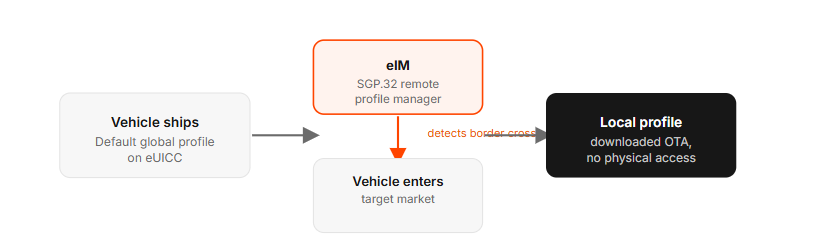
The fix is a design decision, not a rescue operation: local carrier profiles provisioned over the air, decided before deployment. As one industry source puts it, compliance here is an architecture problem, not a legal afterthought. The operationally sound pattern is to ship with a default global profile for initial connectivity, then download local carrier profiles over the air as vehicles enter target markets, so the vehicle never has to be touched physically to stay compliant.
Surviving Network Sunsets
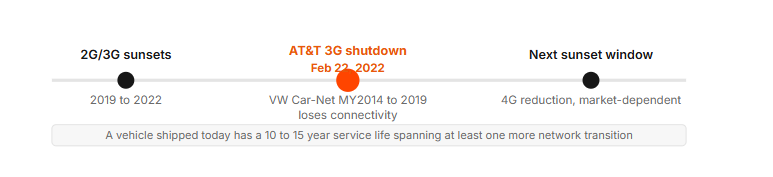
Vehicle lifecycles run well beyond network lifecycles. Any vehicle shipping today will outlive at least one network generation, and the industry has a documented case showing exactly what that costs when the connectivity is not replaceable over the air.
What the 3G Shutdown Cost Connected Vehicles
When AT&T shut down its 3G network on 22 February 2022, Volkswagen notified dealers that Car-Net-equipped vehicles from model years 2014 to 2019 would lose connectivity, while model year 2020 and newer vehicles were unaffected. Remedies varied by model year: some qualified for a dealer-installed third-party dongle, and older vehicles had no remedy at all beyond losing the feature. This is a documented case of connected-vehicle features going dark across an entire installed base because the connectivity was not replaceable over the air.
The practical guidance that follows: avoid 2G and 3G module selections entirely at this point, choose eUICC so the carrier and even the network generation can be changed without touching the vehicle, and treat sunset exposure as a line item in the business case rather than a surprise discovered by a support queue.
Coverage and Failover for Moving Assets
Multi-network access with automatic selection on signal quality is what keeps vehicles connected through coverage gaps and regional outages. For a fleet operator, single-carrier dependency is an operational risk, not merely a commercial one, because a single network incident becomes a fleet-wide visibility blackout rather than a contained inconvenience.
Steered vs Non-Steered Multi-Network
Steered SIMs are pre-assigned to a preferred network by the connectivity provider, which creates a single point of failure: if that network degrades in a given area, the SIM does not automatically move. Non-steered multi-network access, where the device selects on live signal quality across available networks, is the reliability baseline fleet SLAs require. In practice, failover means the profile or network selection changes and reconnection happens, on a timescale that matters most for an in-flight OTA update: an update interrupted mid-transfer by a network change needs to resume cleanly rather than restart or corrupt.
Uptime figures like “99.99 percent” circulate widely in this space. Treat any such number, from any vendor, as a claim to verify against the provider’s own measured performance rather than an industry constant. For the trend context behind multi-network auto-transport connectivity, see eSIM for auto transport.
Choosing the Right Technology (LTE-M, Cat-1bis, NB-IoT, RedCap)
NB-IoT does not support cell handover. A vehicle moving across a coverage boundary drops its connection rather than handing off to the next cell, which makes NB-IoT unsuitable for any moving asset regardless of how attractive its power profile looks. LTE-M (Cat-M1) handles mobility correctly through proper handover support and is the right default for vehicles, with Cat-1bis a reasonable alternative where LTE-M coverage is inconsistent.
| Technology | Verdict | Why |
|---|---|---|
| LTE-M (Cat-M1) | Default choice | Full handover support, VoLTE capable, correct for any moving vehicle. |
| Cat-1bis | Alternative | Mobility support without a full LTE-M rollout requirement; useful where LTE-M coverage is patchy. |
| NB-IoT | Not for vehicles | No cell handover. Suited to static assets, not moving ones, regardless of power efficiency. |
| 5G RedCap | Forward guidance | Emerging cost-effective middle path hedging against future LTE sunsets. One sentence, not a section. |
For the same technology trade-offs applied to non-vehicle assets such as containers and cold-chain shipments, see the IoT asset tracking connectivity guide.
Managing SIMs Across a Vehicle Fleet
MFF2 soldered SIM is the appropriate form factor for vehicles. Commercial vehicles generate sustained vibration across a long service life, and plug-in SIM trays suffer contact degradation that soldered installations do not.
On the eSIM side, precision in the standards matters because it is where credibility is won or lost with a technical buyer. eUICC lets a vehicle hold multiple carrier profiles and switch between them over the air with no physical access to the vehicle. SGP.02 is the legacy M2M remote provisioning model, built around an SM-SR component that created operator lock-in. SGP.22 is the consumer model, built for a person tapping through a QR code, which does not fit a headless device. SGP.32 (see Spenza’s standards comparison guide) is the current IoT model: its eIM architecture removes the SM-SR lock-in that made M2M provisioning vendor-dependent, replacing it with a server-driven manager built for fleet-scale, headless operation.
Steered SIMs create a single point of failure, described above; the same non-steered, signal-quality-based selection that governs failover applies to fleet-scale SIM management as a whole.
How Spenza Supports Fleet and Automotive Deployments
Spenza is an operator-neutral connectivity management platform: multi-carrier eSIM, remote profile switching, usage controls, and cost analytics across a vehicle estate. Neutrality is the substantive contrast with a full-stack vendor that bundles hardware, telematics software, and connectivity together, since a bundled vendor’s connectivity recommendation is also a lock-in decision.
To be clear about what that contrast is and is not: the connectivity-layer technical depth described on this page, eUICC, SGP.32, LTE-M handover, is not proprietary knowledge, and competitors in this space understand it well. The difference is commercial. A bundled vendor sells hardware, software, and connectivity as one package and quotes pricing privately. Spenza sells the connectivity layer on its own, works across carriers rather than one preferred network, and publishes its pricing methodology rather than gating it behind a sales call.
Conclusion: Build Fleet Connectivity for Reliability, Not Just Coverage
Reliable fleet and automotive IoT connectivity is about more than choosing the cheapest SIM or the network with the widest coverage. Connected vehicles need a connectivity strategy that can handle cross-border travel, changing data demands, carrier outages, regulatory requirements, and network sunsets throughout the vehicle’s lifecycle.
For most moving-asset deployments, LTE-M and Cat-1bis, combined with multi-carrier eSIM connectivity, provide a strong foundation. Non-steered network selection and over-the-air profile switching can help fleets maintain connectivity when vehicles move between coverage areas, countries, or carriers, while eUICC and SGP.32 help make connectivity replaceable without physically accessing deployed vehicles.
Cost also needs to be evaluated at the total cost per vehicle, not simply the price of an individual data plan. OTA updates, video telematics, roaming, multiple connected modules, and variable usage can all materially change the annual connectivity cost. Pooled data, usage analytics, and automated controls can help fleets manage those variables at scale.
Ultimately, the best automotive IoT connectivity architecture is one designed to fail over, adapt, and remain serviceable for the full life of the vehicle. By combining multi-network coverage, flexible eSIM technology, compliant roaming strategies, and long-term network planning, fleet operators and automotive businesses can reduce connectivity risk while keeping vehicles reliably connected wherever they operate.
FAQs
Ready to make your fleet connectivity more reliable and cost-efficient? Explore Spenza’s multi-carrier IoT connectivity platform and book a demo today.


