IoT connectivity in 2026 spans four major layers: cellular connectivity (LTE-M, NB-IoT, Cat-1bis, RedCap, 5G), LPWAN technologies (LoRaWAN, Sigfox, Wi-Fi HaLow), short-range protocols (BLE, Zigbee, Matter, Wi-Fi), and satellite NTN. The optimal connectivity stack depends on factors such as coverage requirements, data consumption, power constraints, and expected device lifespan.
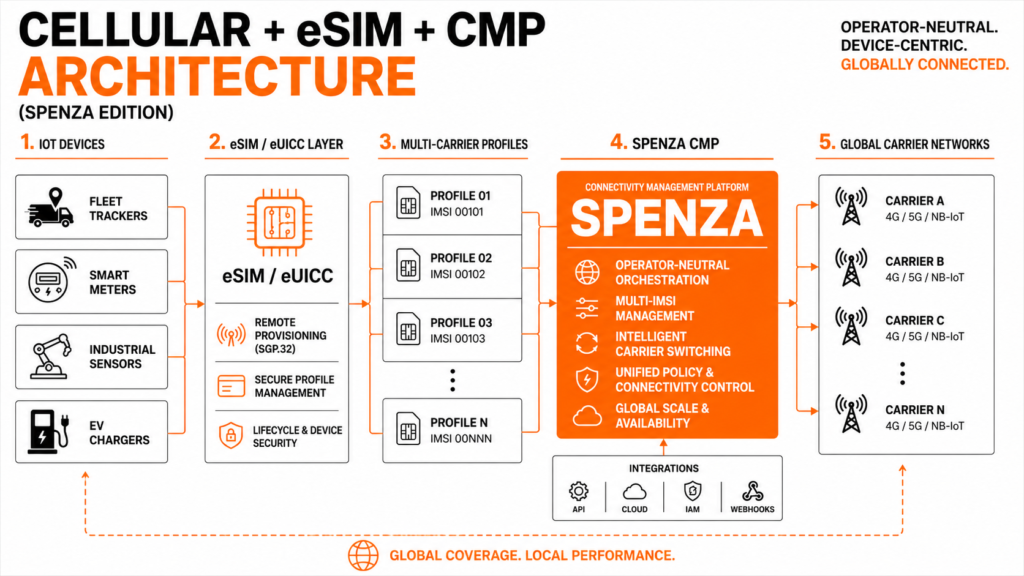
Modern IoT deployments increasingly combine multiple connectivity technologies, eSIM orchestration, and satellite fallback to improve reliability and global reach. At scale, global IoT connectivity increasingly depends on centralized IoT Connectivity Management Platforms (CMPs) such as Spenza, which orchestrate carrier integrations, eSIM provisioning, usage policies, and network switching across thousands of connected devices.
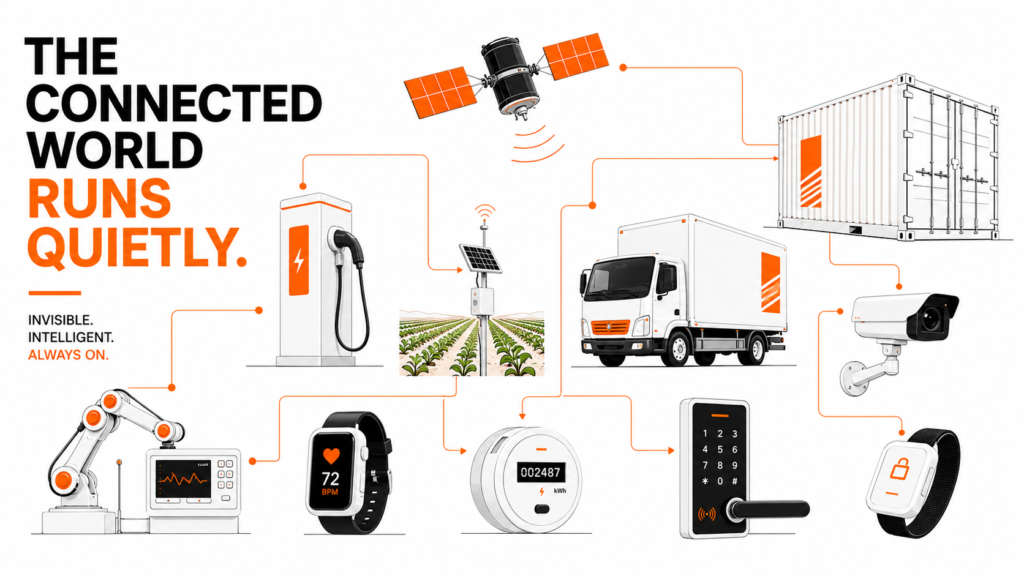
The 2026 IoT Connectivity Stack in Numbers
The IoT market has moved well beyond the “pilot project” phase. According to IoT Analytics, there are now over 21.1 billion connected IoT devices globally, and that number continues to climb rapidly.
Legacy networks are shutting down faster than many device manufacturers planned. Newer, purpose-built technologies like 5G RedCap and satellite NTN are moving from standards documents into practical commercial deployments. And the eSIM specification SGP.32, finalized in 2024, is now seeing accelerated adoption across industrial IoT programs.
This means the connectivity decision made today will shape device performance for the next 5 to 10 years. Connectivity planning is now a lifecycle decision, not just a procurement decision.
The Four Layers of IoT Connectivity
Think of IoT connectivity like a toolbox. No single tool handles every job. The right choice depends on the environment, the task, and the constraints of the device doing the work.
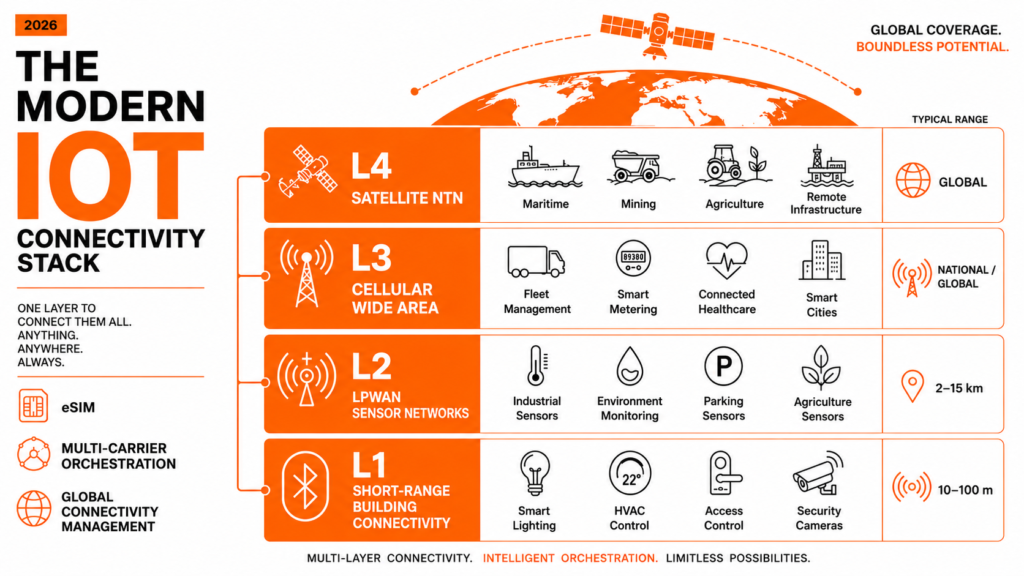
1. Cellular Wide-Area Networks
Cellular IoT technologies use licensed spectrum, which means they operate on the same regulated, interference-free bands as your mobile phone. This makes them reliable for devices operating across cities or countries. Technologies like LTE-M, NB-IoT, Cat-1bis, RedCap, and 5G NR all sit within this category, although each serves different points on the speed, power, and cost spectrum.
2. LPWAN Unlicensed Networks
LoRaWAN, Sigfox, and Wi-Fi HaLow operate on unlicensed bands, which keeps costs low but introduces range and interference trade-offs. These are best suited for low-data, battery-powered sensors in environments where cellular coverage is either absent or economically impractical.
3. Short-Range Connectivity
BLE, Zigbee, Thread, Matter, and Wi-Fi 6/7 are proximity technologies. They typically connect devices within buildings or campuses rather than directly to the internet. A smart building, for example, may use Zigbee sensors connected to a cellular gateway that handles the backhaul connection.
4. Satellite NTN
Non-terrestrial network (NTN) connectivity uses LEO, MEO, or GEO satellites to reach devices in locations where ground-based infrastructure simply does not exist. Standardized through 3GPP Release 17, NTN is becoming part of mainstream IoT architecture rather than a niche solution.
The table below compares the most widely used IoT connectivity technologies based on coverage, power consumption, mobility, and deployment fit.
| Technology | Layer | Data Rate | Range | Power Draw | Mobility | Best For |
|---|---|---|---|---|---|---|
| LTE-M | Cellular | Up to 1 Mbps | National / Global | Medium | High | Asset tracking, remote patient monitoring, and fleet management |
| NB-IoT | Cellular | Up to 250 Kbps | National / Global | Very Low | Low | Smart metering and stationary sensor deployments |
| Cat-1bis | Cellular | Up to 10 Mbps | National / Global | Medium | Medium | 2G/3G replacement and general-purpose IoT connectivity |
| 5G RedCap | Cellular | Up to 150 Mbps | National / Global | Medium | High | Industrial cameras, smart factories, and EV charging systems |
| LoRaWAN | LPWAN | Up to 50 Kbps | 2–15 km | Very Low | Low | Private sensor networks, agriculture, and rural monitoring |
| Wi-Fi 6/7 | Short-Range | Up to 9.6 Gbps | 30–100 m | Medium–High | Low | Indoor gateways and high-bandwidth local networking |
| BLE / Zigbee | Short-Range | Up to 2 Mbps | 10–100 m | Very Low | Low | Proximity sensors and smart-building mesh systems |
| LEO NTN | Satellite | Up to 1 Mbps | Global | Medium | High | Remote assets, maritime operations, and agriculture |
The sections below break down where each connectivity technology performs best, where its limitations appear, and how it fits into modern IoT deployments.
Cellular IoT Technologies Explained: LTE-M vs NB-IoT vs RedCap
Cellular IoT is not a single technology. It is a family of standards, each optimized for a different operational profile. For a technical deep dive, please read Spenza’s NB-IoT vs LTE-M vs 5G RedCap breakdown.
LTE-M
LTE-M supports mobility and even voice, which makes it the standard of choice for anything that moves. A connected medical wearable, for example, may travel across cities while continuously transmitting telemetry. LTE-M handles that mobility without losing connectivity.
Typical use cases: Asset tracking, Connected medical wearables, Fleet management, Healthcare RPM
NB-IoT
NB-IoT is built for stationary, low-data devices that need years of battery life. Think of a smart water meter sending one small reading every hour. It does not need high bandwidth, but it does need low power consumption and deep indoor coverage.
Typical use cases: Smart metering, Parking sensors, Agriculture sensors, Utility infrastructure
Cat-1bis
Cat-1bis is the practical 2G and 3G replacement for devices that need a reliable data connection without LTE-M’s complexity. Unlike older LTE categories, Cat-1bis uses a single antenna design, reducing hardware complexity and lowering certification costs for manufacturers migrating legacy devices.
Many OEMs underestimate migration timelines. Module recertification alone can take 6–12 months, depending on the target region, carrier requirements, and device category. Planning migrations early is critical to avoid deployment delays and supply chain disruptions.
5G RedCap and eRedCap
5G RedCap (Reduced Capability), introduced in 3GPP Release 17, fills the gap between LPWAN and high-end 5G NR. It is designed for devices that need more bandwidth than LTE-M or NB-IoT, but do not require the cost or power profile of full 5G.
Common examples include: EV charging stations, Industrial cameras, Mid-tier industrial automation, Smart retail systems
eRedCap, introduced through Release 18, pushes 5G further into constrained IoT deployments with lower power and module costs.
LPWAN and Short-Range Technologies Still Matter
Not every IoT problem needs a cellular subscription. Sometimes the most practical solution is a private network or a local mesh.
When LoRaWAN Makes Sense
LoRaWAN shines in environments where a company can deploy its own gateways. A large agricultural operation, an industrial campus, or a smart city pilot can build a private LoRaWAN network and connect thousands of sensors without paying per-device cellular fees. The trade-off is infrastructure ownership and limited bandwidth.
The Decline of Sigfox
Sigfox has faced significant market contraction following financial difficulties and ownership changes. While some regional networks persist, designing new products around Sigfox introduces long-term continuity risk that most product teams are no longer willing to accept.
Where BLE, Zigbee, and Matter Fit
Short-range protocols are not competitors to cellular. They are complementary. A smart building might use Zigbee sensors throughout each floor, feeding data to a cellular-connected gateway at each entry point.
Matter is emerging as the unifying standard for smart home and commercial building devices, simplifying interoperability across vendors.
Understanding how different IoT sensor types connect helps clarify which gateway architecture makes sense for your deployment.
- Isolated campuses or warehouse deployments with private gateway infrastructure
- Sensors transmitting small payloads only a few times per day
- Battery-first device designs targeting 5–10 year operational lifespans
- Deployments where per-device cellular connectivity cost exceeds the economic value of the transmitted data
| Connectivity Model | Best For | Main Advantage | Main Trade-off |
|---|---|---|---|
| Public cellular | Fleets, vehicles, distributed IoT | Wide-area coverage and mobility | Recurring connectivity cost |
| LPWAN | Smart meters, agriculture, low-data sensors | Low power and long device life | Limited bandwidth |
| Private cellular | Factories, ports, campuses, critical industrial sites | Dedicated control, coverage, and QoS | Infrastructure and operational complexity |
| Hybrid cellular + NTN | Remote and cross-border assets | Terrestrial coverage with satellite fallback | Higher architecture complexity |
Satellite NTN Is Reshaping Global IoT Coverage
If cellular IoT is the highway network, satellite NTN (Non-Terrestrial Network) is the off-road capability that reaches everywhere the highway does not.
What 3GPP Rel-17 and Rel-18 Changed
Before 3GPP Release 17, satellite connectivity often relied on proprietary systems that were difficult to integrate into standard cellular deployments.
That changed when NTN became part of the standardized cellular ecosystem.
Release 17 introduced standardized NTN support for LTE-M and NB-IoT. Release 18 improved support for constrained devices and low-power satellite communication.
This means IoT devices can increasingly move between terrestrial and satellite connectivity without requiring entirely separate architectures. GSMA Intelligence reports that NTN-capable chipsets are already entering commercial supply chains in 2026.
Hybrid Cellular + Satellite Architectures
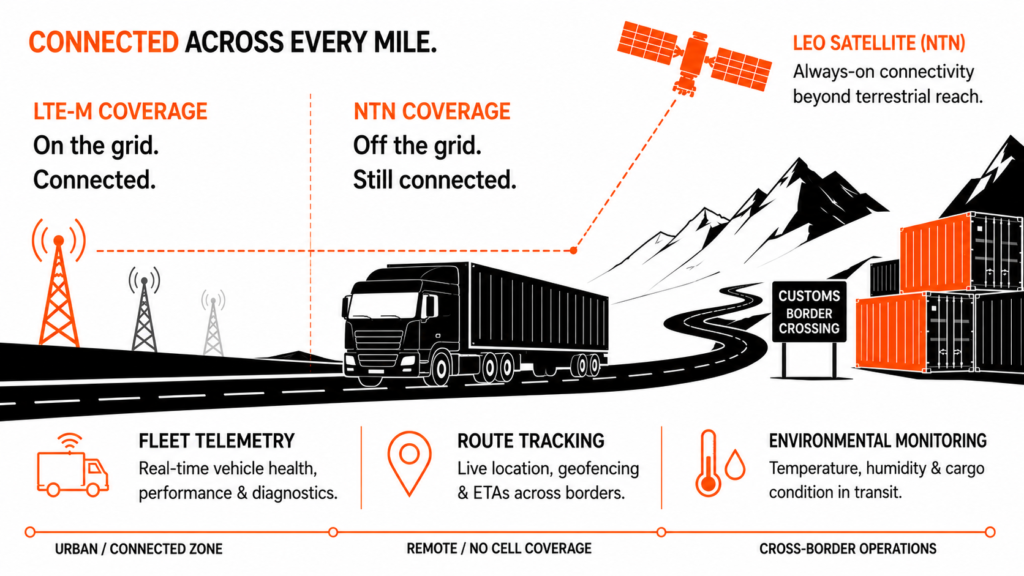
The most resilient architecture combines cellular as the primary connection with satellite as an automatic fallback.
A logistics tracker traveling through remote regions may use LTE-M for most of its route, then automatically switch to LEO NTN in coverage gaps.
Here’s LEO vs GEO vs MEO at a Glance:
| Orbit | Altitude | Latency | Example |
|---|---|---|---|
| LEO (Low Earth Orbit) | 200–2,000 km | 20–40 ms | Starlink, Skylo |
| MEO (Medium Earth Orbit) | 2,000–35,000 km | 100–600 ms | O3b (SES) |
| GEO (Geostationary Earth Orbit) | 35,786 km | 600+ ms | Traditional satellite systems |
For additional context on evolving connectivity architectures and IoT connectivity platforms, explore Spenza’s IoT connectivity solutions.
Non-Terrestrial Networks (NTN) are currently most valuable in agriculture, offshore maritime operations, mining, and cross-border logistics. These environments are difficult or economically unviable for traditional cellular infrastructure, yet still require reliable connectivity to support tracking, monitoring, and operational control.
eSIM, SGP.32, and Multi-IMSI: The IoT Connectivity Control Layer
Hardware decides what a device can connect to. Software decides how it actually connects, when it switches, and what it costs to operate at scale. That software layer runs on eSIM.
Why eSIM Matters for IoT
An embedded SIM (eUICC) allows cellular profiles to be provisioned, switched, and managed remotely without physical access to the device. For a deployment of 100,000 connected devices across multiple countries, that flexibility is not just a convenience. It is a fundamental operational requirement.
At scale, this typically requires a centralized Connectivity Management Platform (CMP) capable of orchestrating provisioning, policy management, and usage visibility across thousands of endpoints. Choosing the right eSIM IoT provider is the first decision that determines how well your CMP layer scales.
What SGP.32 Standardizes
SGP.32 is the GSMA standard designed specifically to enable eSIM functionality on resource-constrained IoT devices. Earlier eSIM standards assumed devices had screens, user interfaces, and reliable power. SGP.32 removes those assumptions and simplifies remote provisioning for battery-powered and headless devices, making large-scale eSIM orchestration practical for industrial deployments. With adoption accelerating through 2026, it is becoming the foundation for scalable IoT connectivity solutions.
Why Multi-IMSI Matters
A multi-IMSI SIM carries multiple network identities within a single physical or embedded SIM. When a device crosses a border or loses signal from its primary carrier, the multi-IMSI logic selects the next best available network automatically.
This reduces dependency on a single operator’s roaming agreements and maintains coverage resilience across regions.
Important Reminder: Single-carrier lock-in may reduce short-term complexity, but it can create major operational risk at scale.
| Buyer Type | Key Focus Area |
|---|---|
| OEMs | Module certification, eSIM/iSIM selection, device lifecycle management, embedded provisioning |
| MSPs | Multi-tenant CMP, billing orchestration, white-label eSIM, carrier switching logic |
Platforms like Spenza operate at this orchestration layer, helping businesses with IoT connectivity management across carriers, eSIM profiles, and global deployments through a unified control plane.
Which IoT Connectivity Technology Should You Choose?
The best IoT connectivity technology depends on device mobility, data volume, power constraints, coverage requirements, deployment duration, and cost. NB-IoT and LoRaWAN suit low-data, low-power deployments; LTE-M suits mobile devices; Cat-1bis supports reliable mid-tier connectivity; RedCap targets higher-bandwidth IoT; and NTN extends connectivity into areas without reliable terrestrial coverage.
For large deployments, the decision should also account for the connectivity lifecycle: module availability, network sunset timelines, eSIM flexibility, roaming requirements, certification, and the ability to change connectivity providers without replacing deployed hardware
How to Choose the Right IoT Connectivity Stack
Choosing IoT connectivity is really about understanding the deployment context. The best technology depends on five practical questions.
1. Where Will Devices Operate?
- Urban environments may work well with NB-IoT or Wi-Fi.
- Cross-border deployments often require LTE-M with multi-IMSI.
- Remote infrastructure with no cellular coverage needs NTN or LoRaWAN for fallback.
2. How Much Data Will Devices Send?
- NB-IoT handles a few bytes per hour.
- LTE-M handles kilobytes per minute.
- RedCap handles video streams.
Mismatching data volume to technology is one of the most common and costly design errors in IoT programs.
3. What Are the Power Constraints?
- Battery-powered devices running for 10 years need NB-IoT or LoRaWAN’s power profiles.
- Line-powered devices can use Cat-1bis, LTE-M, or RedCap.
Solar adds an interesting middle ground where burst transmission windows become the design variable.
4. How Long Will Devices Stay Deployed?
A temporary campaign deployment has different requirements than a smart meter expected to operate for 10 years. The 2G and 3G sunset timelines make this concrete: any device designed around 2G connectivity today will face forced migration before most product teams expect.
For deployment planning guidance, see Spenza’s IoT devices buyer’s guide
5. Which Pricing Model Fits Best?
Three models dominate IoT data pricing.
- Per-device flat fees ($1–5/device/month) work well for predictable, consistent usage.
- Pooled plans distribute a shared data bucket across a fleet, which suits fleets with variable individual consumption.
- Per-MB metered pricing ($0.10–$2/MB) suits very low-volume devices where a flat fee would be wasteful.
For a deeper breakdown of how to structure and optimize these models, see Spenza’s guide to IoT data plan cost optimization.
Here’s the recommended stack for each question:
| Question | Answer | Recommended Stack |
|---|---|---|
| Moves across borders? | Yes | LTE-M + multi-IMSI eSIM |
| Stationary, low data? | Yes | NB-IoT + per-device plan |
| No cellular coverage? | Yes | LoRaWAN or NTN hybrid |
| Video or high bandwidth? | Yes | RedCap + pooled plan |
| Replacing 2G hardware? | Yes | Cat-1bis + LTE-M fallback |
Recommended IoT Connectivity Stacks by Vertical
The table below maps common IoT deployment scenarios to the connectivity stacks that best balance coverage, power efficiency, mobility, and long-term operational reliability.
| Vertical | Recommended Stack | Why It Works |
|---|---|---|
| Fleet Management | LTE-M or Cat-1bis + multi-carrier eSIM + pooled data plan | Mobility and roaming resilience |
| Smart Metering | NB-IoT + per-device pricing | Low power and predictable usage |
| EV Charging | Cat-1bis or 5G RedCap + hybrid pooled plan with burst allowance | Variable bandwidth patterns |
| Healthcare RPM | LTE-M + voice fallback + per-device plan | Reliable alerts and mobility |
| Connected Vehicles | 5G NR + LTE-M fallback + pooled plan | OTA updates and infotainment |
| Agriculture and Remote Infrastructure | NB-IoT + satellite NTN hybrid + per-device plan | Rural coverage resilience |
How to Future-Proof IoT Connectivity Deployments Beyond 2026
The biggest IoT connectivity mistake is designing around today’s network availability instead of tomorrow’s infrastructure roadmap.
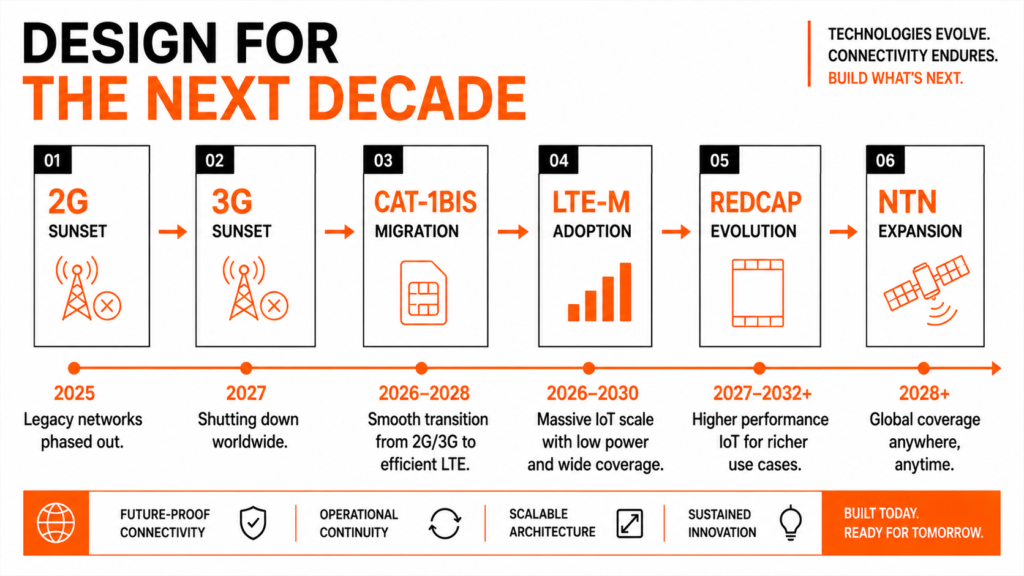
The 2G and 3G Sunset Migration Window
As discussed earlier, GSMA data confirms 37 operators have retired or are actively retiring 2G, with 39 doing the same for 3G through 2025 and 2026. North America is furthest along. Europe and Asia are following on staggered timelines.
The migration path for most devices runs toward Cat-1bis for simple data applications, LTE-M for mobile applications, and RedCap for higher-bandwidth use cases.
The 3GPP Roadmap
Release 17 (2022) introduced RedCap and standardized NTN. Release 18 (2024) brought eRedCap and improved NTN for constrained devices. Release 19, expected to finalize in 2026 and beyond, begins laying the groundwork for 6G and advances NTN further.
For IoT devices with 7–10 year lifespans, the Release 18 and 19 roadmap determines whether today’s module selection remains viable through the device’s end of life.
Certification Timelines and Deployment Risk
Module certification for new cellular technologies typically takes 6–12 months. Teams that delay migration planning until network sunset notices arrive often face compressed timelines and limited module availability. In practice, evaluations should begin 18–24 months before migration.
- Locking into a single carrier without eSIM flexibility
- Ignoring FOTA bandwidth requirements during stack selection
- Missing 2G/3G sunset deadlines by starting migration too late
- Skipping field coverage testing before finalizing module selection
- Choosing technology before defining use case constraints
Conclusion
The future of IoT connectivity is not about choosing one network. It is about building a stack flexible enough to survive changing coverage, changing standards, and changing business models over the next decade.
IoT connectivity in 2026 is no longer a single-technology decision. The right deployment combines layers: a primary cellular or LPWAN connection, eSIM-based carrier flexibility, satellite fallback where coverage demands it, and a management platform that unifies the entire stack.
Spenza’s platform connects this full picture. As an IoT connectivity management platform, it provides multi-carrier orchestration, eSIM lifecycle management through SGP.32-compatible architecture, and an operator-neutral control layer that adapts as your deployment scales. Whether you are designing your first connected product or managing an existing fleet through a 2G migration, explore Spenza’s IoT connectivity solutions to see how unified management changes the cost and complexity equation.
FAQs
Ready to simplify your IoT connectivity stack? Explore Spenza’s IoT connectivity platform