


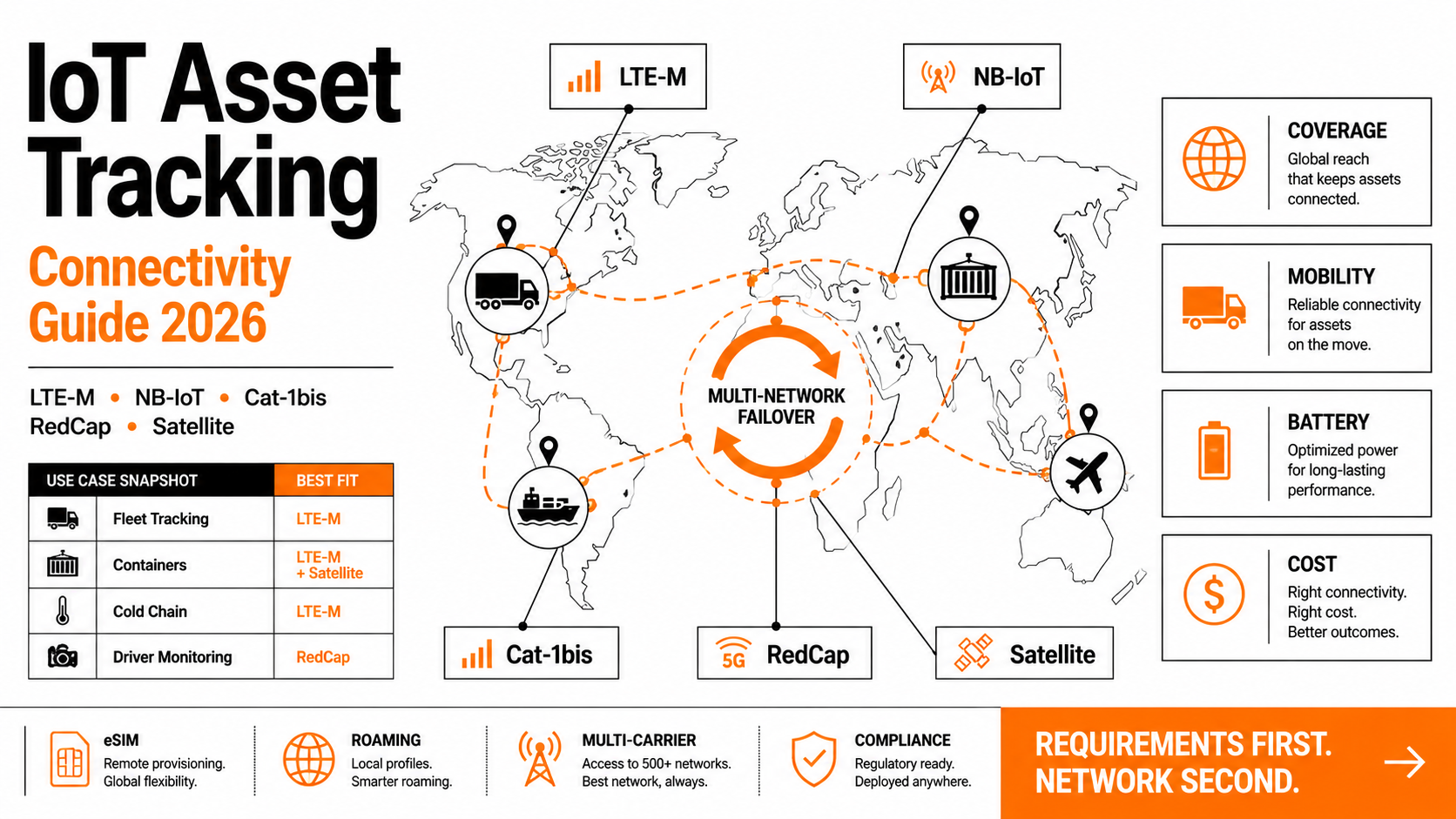
What Connectivity Does an Asset Tracker Need?
At its core, an IoT asset tracker needs three things:
- A way to determine location (typically GNSS technologies such as GPS).
- A method for sending that data, such as LTE-M, NB-IoT, Cat-1bis, RedCap, satellite connectivity, or a hybrid of these options.
- A platform to manage connectivity, monitor devices, and control lifecycle operations.
The challenge is that there is no universal answer to the question of which connectivity technology is best.
A shipping container, scooter, and video-enabled fleet system all have different connectivity requirements.Many organizations choose SIM providers before defining their connectivity requirements. Instead, the network should be selected based on the use case. The network should be selected based on the use case.
That’s why this guide takes a requirements-driven, practical framework approach rather than pushing a single network or SIM strategy.
Most failed asset-tracking deployments are not caused by GPS hardware. They are more often the result of coverage gaps, roaming restrictions, battery drain, or network selection decisions made too early in the project without considering long-term deployment conditions.
The Asset Tracking Market in 2026
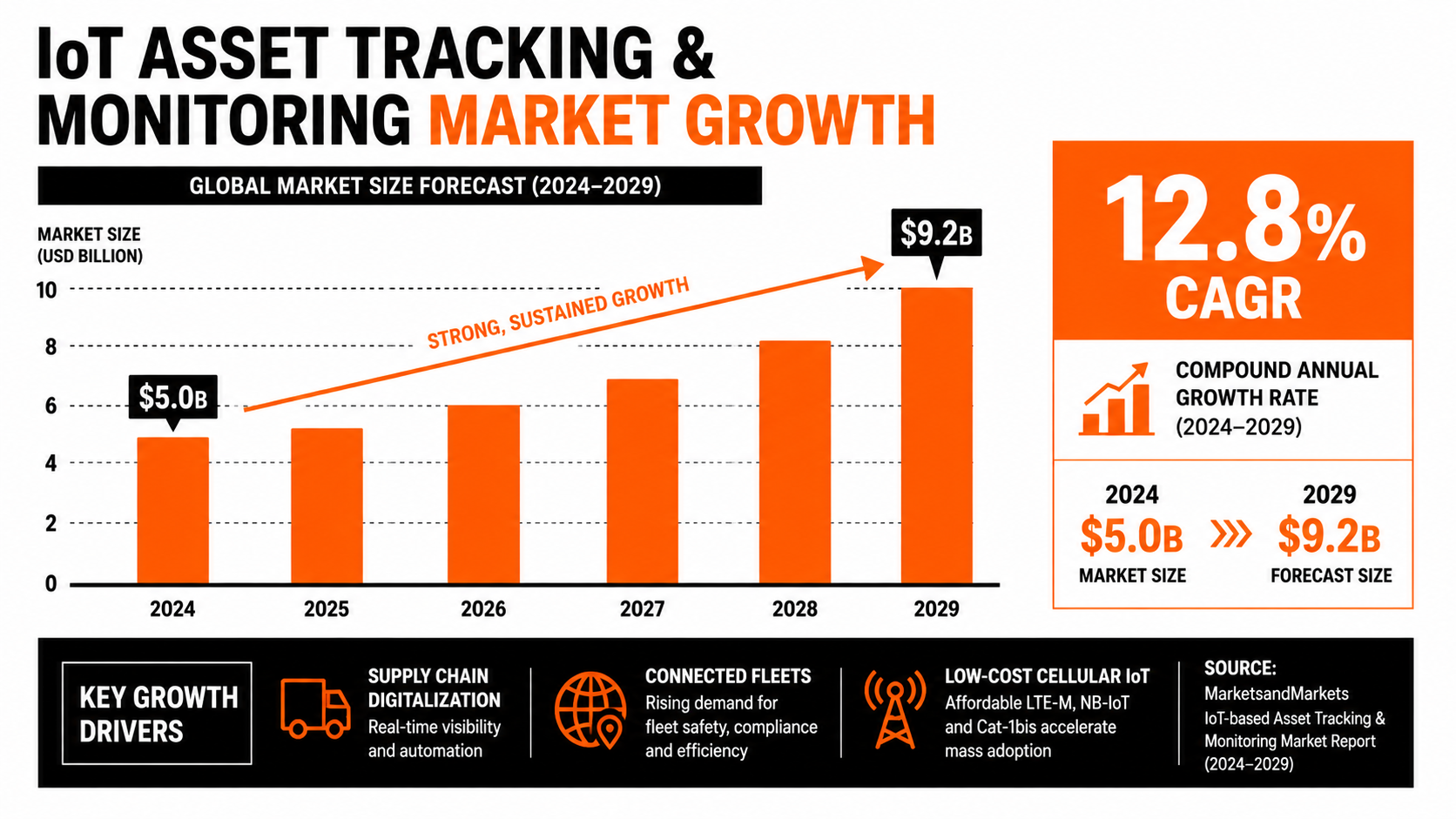
Asset tracking has become one of the most important segments within the broader IoT ecosystem.
Analysts estimate that the global asset-tracking market was worth approximately $5 billion in 2024 and is projected to reach $9.2 billion by 2029, representing a compound annual growth rate of roughly 12.8%. Transportation and logistics account for nearly 40% of industry revenue, making connectivity a critical component of supply-chain visibility and operational efficiency.
Several technology shifts are accelerating adoption.
Cellular IoT modules have become more affordable, with many LTE-M and NB-IoT modules available for less than $5 at scale.
At the same time, power-saving technologies such as PSM (Power Saving Mode) and eDRX (Extended Discontinuous Reception) allow some trackers to operate for ten years or more on a single battery under optimized conditions.
The connectivity landscape is also changing rapidly. LTE-M and NB-IoT now account for roughly 54% of cellular IoT connections worldwide, while Cat-1bis, 5G RedCap, and satellite-based NTN (Non-Terrestrial Networks) are expanding the range of deployment options available to tracker manufacturers.
As deployments scale, organizations must balance coverage, power consumption, compliance, and costs.
Asset tracking is no longer primarily a hardware problem. As deployments scale, success increasingly depends on connectivity management, including network selection, carrier flexibility, roaming strategy, power efficiency, and centralized fleet management.
Connectivity Options for Trackers
The best network for asset tracking depends on how often an asset moves, how much data it sends, how long the battery must last, and where it operates.
The following comparison provides a practical starting point.
Network Comparison Table
| Technology | Data Rate | Power Usage | Mobility Support | Best Fit |
|---|---|---|---|---|
| LTE-M | Up to 1 Mbps | Low | Excellent | Fleet tracking, logistics, and cold chain monitoring |
| NB-IoT | Up to 250 Kbps | Very Low | Limited | Static assets, parking systems, and metering |
| Cat-1bis | Up to 10 Mbps | Moderate | Excellent | Vehicles and industrial equipment |
| 5G RedCap | Higher bandwidth | Moderate | Excellent | Video applications and driver monitoring |
| Satellite / NTN | Variable | Higher | Global | Maritime, mining, and remote assets |
GNSS: How Trackers Know Where They Are
Connectivity and location are often discussed together, but they perform different functions within an asset-tracking solution.
GNSS (Global Navigation Satellite System) technologies such as GPS, Galileo, GLONASS, and BeiDou determine the location of an asset. Cellular or satellite networks then transmit that location data back to applications, operators, and fleet management platforms.
Most modern trackers combine GNSS positioning with cellular connectivity. The GNSS module calculates where the asset is, while LTE-M, NB-IoT, Cat-1bis, RedCap, or satellite connectivity ensures that information reaches the cloud.
For most deployments, the question is not whether to use GNSS, it is how to combine location technology with the right connectivity architecture to balance coverage, battery life, and cost.
LTE-M
LTE-M has emerged as one of the most popular connectivity technologies for mobile asset tracking.
It was purpose-built for IoT use cases that need low power operation while still supporting mobility. Unlike certain LPWAN technologies, LTE-M is capable of maintaining reliable connectivity for moving devices, making it well-suited for trucks, trailers, fleet vehicles, and mobile cargo applications.
Another advantage is support for firmware-over-the-air updates. For most mobile tracking applications, LTE-M represents the best balance between battery life, coverage, and performance.
NB-IoT
NB-IoT focuses on power efficiency above all else.
It performs exceptionally well for devices that send small amounts of data infrequently and remain relatively stationary.
NB-IoT is well suited for smart parking, utility infrastructure, and other stationary assets due to its low power consumption and strong coverage.
However, mobility support can be inconsistent depending on operator implementation.
For that reason, NB-IoT is often less attractive for assets that regularly cross regions or countries.
Cat-1bis
Cat-1bis is increasingly becoming the default option for general-purpose cellular IoT deployments.
Many organizations choose Cat-1bis because it offers broad carrier support and avoids some of the regional availability challenges associated with LTE-M.
While power consumption is somewhat higher than NB-IoT or LTE-M, the technology supports higher throughput and works well for connected vehicles, industrial equipment, and mobile assets requiring frequent communication.
5G RedCap
5G Reduced Capability, commonly known as RedCap, fills an important gap between traditional IoT connectivity and full-scale broadband.
The technology is particularly relevant for applications involving:
- Driver monitoring
- Dashcams
- Video analytics
Traditional trackers transmit coordinates and sensor data.
Modern fleet platforms increasingly transmit images, diagnostics, and video.
These applications require significantly more bandwidth than LTE-M or NB-IoT can efficiently provide.
RedCap is designed specifically for this next generation of connected assets.
Satellite and NTN Connectivity
No cellular network covers every location.
Shipping lanes, remote mines, offshore energy infrastructure, and wilderness environments frequently operate beyond the reach of terrestrial networks.
This is where satellite connectivity becomes valuable.
Many modern deployments use a hybrid architecture that combines cellular and satellite connectivity.
When cellular coverage is available, devices use LTE-M or Cat-1bis.
When coverage disappears, trackers automatically switch to satellite communications.
The key question is not whether satellite connectivity is better than cellular connectivity. The real decision is whether the business impact of losing asset visibility outweighs the additional cost of maintaining satellite coverage. For many remote, mission-critical, or cross-border deployments, the cost of downtime can far exceed the premium paid for resilient connectivity.
Connectivity Requirements by Use Case
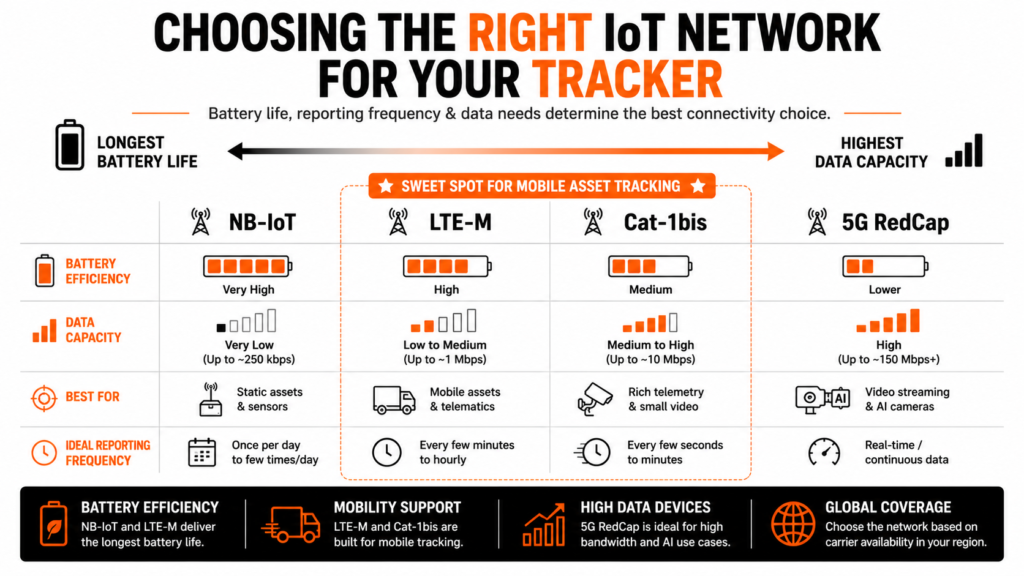
This is the most important section of the guide.
Most buyers are not searching for “the best IoT network.”
They are trying to determine which connectivity architecture matches their specific tracking requirements.
The following matrix offers a practical framework for decision-making.
Connectivity Requirements Matrix
| Use Case | Recommended Network | Data Volume | Power Priority | Coverage Need | Primary Cost Driver |
|---|---|---|---|---|---|
| Container Tracking | LTE-M + Satellite | Low-Medium | High | Global | Roaming and satellite usage |
| Fleet Tracking | Cat-1bis / LTE-M | Medium | Medium | Regional and national | SIM volume |
| High-Value Cargo | Multi-network LTE-M | Medium | Medium | Maximum reliability | Redundancy |
| Micro-Mobility | NB-IoT | Low | Very High | Urban | Device volume |
| Cold Chain | LTE-M | Medium | High | Consistent coverage | Sensor reporting |
| Driver Monitoring | RedCap / Cat-4 | High | Lower Priority | Continuous | Data consumption |
The ideal connectivity solution varies based on how an asset operates, the amount of data it generates, its location, and its power requirements.
- Container tracking often requires a combination of cellular and satellite connectivity to maintain visibility across international routes, ports, and remote locations.
- Fleet and vehicle tracking typically depend on LTE-M or Cat-1bis to support continuous movement, reliable handovers between networks, and regular data transmission.
- High-value asset monitoring benefits from resilient connectivity strategies, including multi-network access and failover mechanisms, to minimize the risk of losing critical tracking information.
- Micro-mobility and smart infrastructure applications such as scooters, bicycles, and parking systems are well suited for NB-IoT due to their low data requirements and focus on extending battery life.
- Cold-chain logistics require dependable connectivity to consistently transmit both location and environmental conditions such as temperature or humidity, making LTE-M a common choice.
- Video-enabled tracking and driver safety systems demand higher bandwidth to support cameras, AI processing, and advanced analytics, making technologies like RedCap more suitable.
Ultimately, the most effective connectivity option is not necessarily the lowest-cost one—it is the solution that best aligns with the operational, coverage, and performance needs of the deployment.
The best network is not necessarily the cheapest network. It is the one that best aligns with the operational requirements of the asset being tracked, including coverage, reliability, latency, power consumption, mobility, and total cost of ownership over the device’s lifecycle.
Multi-Network Failover and SIM Steering
One of the most overlooked causes of tracking failures is network dependence.
Many organizations assume that broad coverage claims automatically translate into reliable performance.
In practice, coverage and performance are not the same thing.
A device may technically have access to multiple networks in a region but remain attached to a single preferred carrier due to roaming policies or SIM steering configurations.
This creates hidden reliability risks.
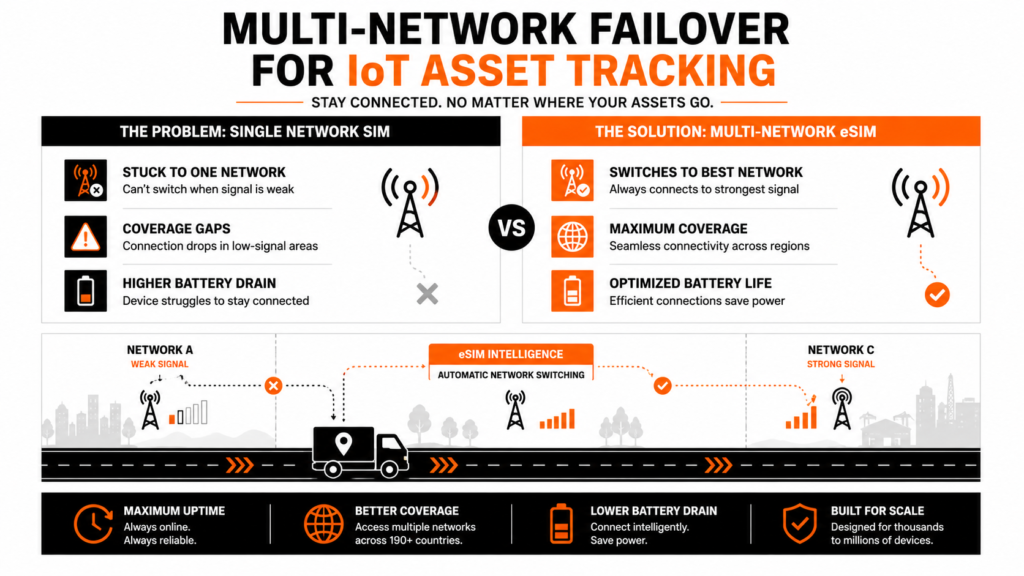
What Is SIM Steering?
SIM steering is the practice of directing devices toward preferred partner networks.
From the connectivity provider’s perspective, this may reduce wholesale costs.
From the customer’s perspective, it can create problems.
A steered SIM may continue attempting to connect to the preferred network rather than switching immediately to the better option.
The consequences can include:
- Delayed transmissions
- Packet loss
- Failed registrations
- Increased battery consumption
- Reduced tracking accuracy
These issues can be difficult to diagnose.
FPLMN Lock-In and Hidden Connectivity Issues
Some roaming implementations use FPLMN (Forbidden Public Land Mobile Network) lists to prevent devices from reconnecting to networks that previously failed registration attempts. While intended to improve network behavior, these restrictions can sometimes prevent trackers from attaching to stronger available networks.
For moving assets, this can create a frustrating scenario. A stronger network may be available, but the device continues attempting to reconnect to a previously preferred carrier. The result can be delayed reporting, packet loss, higher latency, and unnecessary battery drain.
For fleets operating across multiple regions, these hidden restrictions can quietly reduce tracking reliability without triggering obvious alerts.
Myth: If a SIM operates across 200 countries, it effectively eliminates coverage issues.
Reality: Coverage availability does not guarantee network quality. The ability to connect to the best available network often matters more than the total number of countries listed on a coverage map, especially for mission-critical or high-availability deployments.
Why Multi-Network Failover Matters
Moving assets rarely remain inside a single network footprint.
A fleet vehicle may travel through multiple carrier territories in a single day. A shipping container may cross dozens of countries over its lifetime.
Multi-network architectures improve resilience by allowing devices to switch between carriers when conditions change.
Modern implementations typically use:
- Multi-IMSI technology
- eUICC-enabled eSIMs
- Dynamic profile switching
- Multi-carrier agreements
The result is greater uptime, improved performance, and reduced operational risk. For asset-tracking deployments, failover should be viewed as a business continuity feature rather than a connectivity enhancement.
Global Coverage, Roaming, and Regulation
Global asset tracking introduces challenges that go beyond coverage.
Historically, many IoT deployments relied on permanent roaming arrangements to provide international connectivity.
While effective in some situations, regulators in several countries have increased scrutiny of long-term roaming models.
Countries such as Brazil and Turkey have implemented restrictions that affect how foreign SIMs can operate over extended periods.
For organizations deploying trackers globally, this creates a new requirement: connectivity must be compliant as well as functional.
The Shift Toward Local Profiles
This is one reason eSIM technology has become increasingly important.
Rather than relying on a single roaming profile indefinitely, eSIM-enabled devices can download and activate local operator profiles when required.
This approach offers several advantages:
- Better compliance
- Improved coverage
- Lower roaming costs
- Reduced operational risk
Leading global IoT connectivity providers may offer access to 500–680+ operator networks worldwide. While broad coverage is important, organizations should also evaluate failover capabilities, local profile support, and network quality across deployment regions.
For device manufacturers building global products, local-profile capability is rapidly becoming a strategic requirement rather than a nice-to-have feature.
Global connectivity is no longer just about reaching more countries. Long-term success depends on maintaining regulatory compliance, network performance, and operational flexibility across every market where devices are deployed.
Battery Life vs Connectivity
Battery life is one of the most important design constraints in asset tracking.
A tracker that requires frequent battery replacement can quickly become expensive to maintain, especially when devices are deployed across large fleets or remote locations.
The good news is that modern connectivity technologies provide multiple tools for optimizing power consumption.
The challenge is understanding the trade-offs.
How Network Choice Affects Battery Life
NB-IoT generally offers the longest battery life because it is optimized for infrequent, low-volume transmissions.
LTE-M delivers strong efficiency while maintaining support for mobile assets.
Cat-1bis and RedCap consume more power but provide additional bandwidth and flexibility.
The right choice depends on the use case.
A parking sensor transmitting once per day has different requirements than a vehicle tracker transmitting every five minutes.
PSM (Power Saving Mode) allows a device to remain asleep for extended periods while staying registered with the network, minimizing energy consumption without requiring a full network reattachment.
eDRX (Extended Discontinuous Reception) reduces how frequently the device wakes up to listen for incoming network messages, further extending battery life while maintaining periodic reachability.
Together, these technologies enable LTE-M and NB-IoT trackers to achieve battery lifespans exceeding 10 years in some low-power, low-data deployments.
Why Signal Quality Matters
Battery consumption is not determined solely by the network technology.
Signal quality plays a major role.
When coverage is weak, devices must transmit at higher power levels and may attempt repeated network registrations.
This increases energy consumption dramatically.
Poor network selection strategies, including aggressive steering, can therefore reduce battery life even when the underlying hardware is optimized.
Reporting Frequency Trade-Offs
Reporting frequency often has a larger impact on battery life than network selection.
Consider two identical trackers:
- Tracker A reports every 5 minutes
- Tracker B reports every 4 hours
Tracker B may operate for years longer on the same battery.
Organizations should balance visibility requirements against power constraints.
More data is not always better data.
The longest battery life comes from optimizing the entire system, not just choosing a larger battery. Network technology, signal quality, reporting intervals, and power-saving features such as PSM and eDRX all work together to maximize device lifespan.
What Tracker Connectivity Costs
Connectivity pricing is often less transparent than hardware pricing.
Most providers advertise monthly SIM costs while giving limited visibility into the broader economics of operating a tracking fleet.
The reality is that connectivity costs extend beyond the SIM itself.
Major Cost Drivers
Several factors influence the total cost of IoT connectivity:
- Data usage: Low-data GPS trackers cost significantly less than video-enabled applications that transmit large volumes of data.
- Coverage requirements: Global deployments often involve higher costs due to roaming and multi-region connectivity needs.
- Redundancy: Multi-network connectivity improves reliability but may increase overall connectivity expenses.
- Lifecycle management: Provisioning, monitoring, diagnostics, and support contribute to the total cost of ownership.
Per-SIM vs Pooled Data Pricing
| Pricing Model | Best For | Advantages | Considerations |
|---|---|---|---|
| Per-SIM Plans | Small fleets | Predictable costs | Less efficient utilization |
| Pooled Data Plans | Large fleets | Better usage optimization | Requires active monitoring |
Large deployments often benefit from pooled data plans because unused capacity from one device can offset higher usage from another. As fleets scale into the thousands of trackers, pooled models can improve cost efficiency while simplifying billing.
A Practical Cost Perspective
Connectivity costs should be evaluated beyond monthly SIM pricing. Factors such as coverage reliability, roaming, network management, and operational efficiency all contribute to the total cost of ownership. The most affordable SIM may not be the most cost-effective choice if poor connectivity leads to disruptions.
Building and Scaling Asset Tracking Deployments
As asset-tracking deployments grow, manual connectivity management becomes impractical. Scaling from hundreds to thousands of devices requires automation, centralized visibility, and lifecycle management.
Connectivity decisions should start during device design, as module selection impacts network compatibility, power efficiency, certification, and future scalability.
For device manufacturers, eSIM provisioning enables flexible global deployments and simplifies manufacturing and compliance. For fleet operators, a centralized platform is essential for managing activations, usage, troubleshooting, and device operations at scale.
Most connectivity challenges emerge after deployment, not during the initial rollout. As fleets grow, the ability to provision, monitor, troubleshoot, and optimize thousands of connected devices from a single management platform often becomes a significant operational and competitive advantage.
Spenza helps fleets and connected-device manufacturers manage multi-carrier connectivity through a single platform. Rather than locking organizations into a single network, the platform provides centralized visibility, lifecycle management, eSIM orchestration, and flexible carrier options that support scaling deployments across regions and use cases.
Conclusion
The most important lesson in asset tracking connectivity is simple: choose the network based on the use case, not the other way around.
LTE-M, NB-IoT, Cat-1bis, RedCap, and satellite connectivity all have legitimate roles within modern tracking deployments. The right choice depends on how assets move, how much data they transmit, how long batteries must last, and where those assets operate.
Organizations that plan for multi-network failover, global coverage requirements, roaming compliance, and long-term fleet economics are better positioned to scale successfully.Most importantly, they avoid the hidden costs associated with coverage gaps, steering-related performance issues, and connectivity lock-in.
Going forward connectivity architecture will play a major role in successful asset-tracking deployments.
FAQs
Simplify global IoT connectivity for trackers and fleets. Book a demo with Spenza to explore multi-carrier eSIMs, failover, and centralized device management.


