



OSS stands for Operations Support System. In telecommunications, an OSS is the software layer used to operate, manage, provision, monitor, and maintain a telecom network. It helps operators activate services, manage network and service inventory, monitor performance, detect faults, and keep connectivity services running reliably.
But what does OSS mean in telecom, exactly? And how is it different from BSS, Open Source Software, or the OSS used in classic GSM architecture?
In modern telecom, OSS is no longer just a collection of network-management tools. As networks become more cloud-native, API-driven, multi-vendor, and automated, OSS is evolving into an intelligent operational layer that connects services, network resources, automation, and real-time network data.
The simplest way to remember the difference is:
OSS makes the network deliver it.
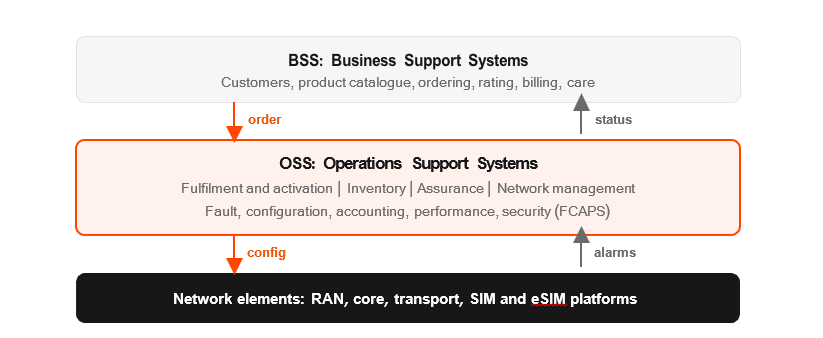
While BSS (Business Support Systems) handles customer-facing and commercial processes such as products, orders, charging, and billing, OSS handles the network-facing side, from provisioning and activation to inventory, fault management, and performance monitoring. Together, OSS and BSS support the end-to-end delivery of telecom services.
In this guide, we’ll explain the OSS full form in telecom, what an Operations Support System does, its core functions, the FCAPS model, OSS vs BSS, OSS in GSM, and how modern OSS architecture is changing in 2026. We’ll also look at why MVNOs and other connectivity providers increasingly use integrated platforms rather than building an entire OSS stack from scratch.
What Does OSS Stand For?
In telecommunications, OSS expands to the Operations Support System. You will also see it written as Operational Support System and, in older GSM documentation, as Operation and Support Subsystem. These are the same idea with different labels: the software layer that keeps the network running, as distinct from the software layer that keeps the business running.
Which OSS Function Do You Need?
People search for OSS for very different reasons. Pick the option that best matches what you’re trying to do and we’ll point you to the part of the telecom operations stack you need.
What does OSS stand for?
In telecom, OSS stands for Operations Support System. It refers to the software used to operate and manage a network, including service provisioning, inventory, fault management, and performance monitoring.
Read Spenza’s OSS & BSS guideProvisioning and activation
OSS fulfilment turns an order into a working telecom service. It can coordinate SIM and eSIM provisioning, subscriber activation, network configuration, and service enablement across multiple network systems.
See provisioning in an MVNO stackFaults, alarms and performance
OSS assurance helps operators understand whether network services are working correctly. It covers fault detection, alarm handling, performance monitoring, event correlation, and operational visibility.
Explore OSS service assuranceLaunching an MVNO?
You may not need to build a complete OSS stack yourself. An MVNE or connectivity platform can provide capabilities such as SIM/eSIM provisioning, activation, inventory, and usage monitoring alongside BSS functions.
Read Spenza’s MVNE launch guideComparing OSS and BSS vendors?
Start with the boundary between the two. BSS manages customers, products, orders, charging and billing. OSS manages the network side: provisioning, inventory, assurance, and network operations.
Compare OSS vs BSS with Spenza
What an Operations Support System Actually Does
An OSS is not one product. It is a group of systems that between them answer four questions an operator has to answer every day: what did we promise the customer, what do we own, is it working, and who is touching the equipment. Most vendors package these as separate modules, and most operators run several vendors at once.
Service Fulfilment: Provisioning and Activation
Fulfilment turns a sold product into a working service. When BSS accepts an order for a mobile line, the OSS decides what has to change in the network, sends the configuration to the right elements, and confirms the result. For a mobile operator that means writing the subscriber profile to the HSS or UDM, associating the SIM or eSIM profile, enabling the correct APN and data allowances, and returning an activation status the BSS can bill against. Fulfilment is where most operators delay lives, because a single order can touch a dozen systems that were never designed to talk to each other.
Network and Service Inventory
Inventory is the record of what exists and how it is connected: physical assets, logical resources such as IP addresses, IMSI and ICCID ranges, and the services built on top of them. It is the least glamorous OSS function and the one that breaks the others when it is wrong. Fulfilment cannot allocate a resource it does not know about, and assurance cannot tell you which customers an alarm affects without an inventory link from element to service to subscriber.
Service Assurance: Faults and Performance
Assurance covers everything that happens after activation. Fault management collects alarms, filters duplicates, correlates them into a probable root cause, and raises a trouble ticket. Performance management collects counters and KPIs on a schedule For a connectivity fleet, that same assurance function shows up as real-time usage and status monitoring , compares them against thresholds, and feeds capacity planning. Together they answer the two questions an operations centre exists to answer: what is broken, and is the service still meeting the level we promised.
Network Management (NMS and EMS)
Underneath sit two layers that are easy to mix up. An Element Management System (EMS) manages one vendor’s equipment and speaks that vendor’s interface. A Network Management System (NMS) sits above several EMSs and gives a single cross vendor view of the network. In the ITU-T model these are formally separate layers, and the distinction still matters commercially: an operator running four radio vendors has four EMSs and needs an NMS or OSS layer to see one network instead of four.
The FCAPS Model Explained
FCAPS is the standard shorthand for what network management systems do. It comes from ITU-T Recommendation M.3400, which split management functionality into five functional areas. Almost every OSS product description maps to at least one of them.
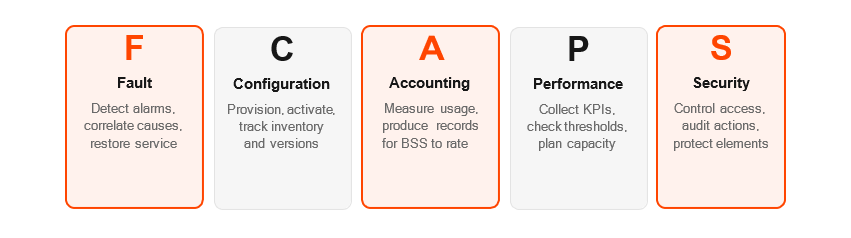
Two points are worth keeping straight. First, accounting is not billing. Accounting in FCAPS means measuring resource usage and producing the records; turning those records into an invoice is a BSS job. Second, FCAPS describes categories of function, not product architecture. A single OSS platform usually covers several areas, and portions of each area are performed at different layers of the management hierarchy.
OSS vs BSS: The Short Answer
The cleanest way to hold the distinction: BSS takes the order, OSS makes the network deliver it. BSS faces the customer and the money. OSS faces the network and the equipment. They meet at the order, and again when usage records flow back for rating.
| OSS | BSS | |
|---|---|---|
| Faces | The network | The customer |
| Core Question | Is the service working? | Who bought what, and did they pay? |
| Typical Systems | Inventory, activation, fault and performance management, NMS, and EMS | Product catalogue, CRM, order management, rating and charging, billing, and care |
| Owned By | Network and engineering operations | Commercial, finance, and customer operations |
| Failure Looks Like | Outages, failed activations, unmanaged capacity | Wrong invoices, stalled orders, revenue leakage |
In modern architecture the boundary is deliberately blurring, which is the point of the frameworks below.
The Frameworks Behind OSS (TMN, FCAPS, eTOM, ODA)
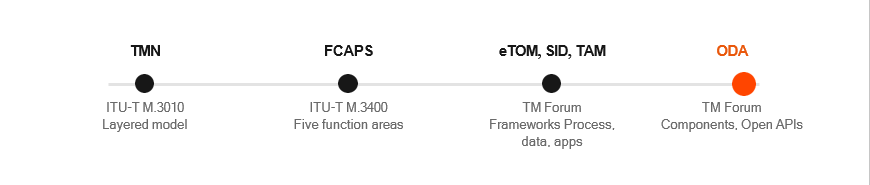
TMN (Telecommunications Management Network) is the ITU-T framework, defined in Recommendation M.3010, that first partitioned management into layers: business, service, network, element, and the network elements themselves. That layering is why the NMS and EMS distinction exists at all, and it still shapes how vendors scope their products.
eTOM, the Business Process Framework, is TM Forum’s process blueprint for the industry, giving operators a shared vocabulary for the processes an OSS and BSS have to support. SID, the Information Framework, does the same for data. TAM, the Telecom Application Map, mapped those processes onto application footprints; it has since evolved into the Functional Framework.
ODA (Open Digital Architecture) is the current direction of travel. It defines a taxonomy of software components that expose their capabilities through TM Forum Open APIs, plus a standardised execution environment called the ODA Canvas, with conformance test kits intended to make components from different suppliers interoperate without bespoke integration. The commercial goal is a market of interchangeable OSS and BSS building blocks rather than monolithic suites, and TM Forum reports that most operator RFPs now require Open API support.
How OSS Has Changed by 2026
Three shifts have changed what the term means in practice.
Cloud native and API first. The monolithic OSS suite installed in an operator data centre is being unbundled into containerised components with REST interfaces. This is the ODA agenda arriving in procurement documents, and it is why an operator today can buy activation from one supplier and assurance from another without a two year integration project.
AI moved from analytics to action. Anomaly detection and alarm correlation were the first credible machine learning use cases in assurance. The 2026 conversation has moved to closed loop automation and agentic operations, where a system diagnoses and applies a fix rather than raising a ticket for a human.
Autonomy is now measured, and the scores are honest. TM Forum’s autonomous networks model runs from Level 0 to Level 5, and validated Level 4 results in production have started to appear across the industry. That is the headline. The caveat is that most operators are still assessed somewhere around Levels 2 to 3, and the most commonly cited blocker is exactly the legacy OSS and BSS estate: siloed vendor element managers, inconsistent data schemas, and inventory that does not match reality. The practical lesson for anyone specifying an OSS in 2026 is that the first project on the road to automation is usually a unified data layer, not a model.
Does Every Operator Need to Build an OSS?
No. A national operator running its own radio and core network needs OSS capability because it owns the elements that have to be configured and monitored. But a large share of the companies selling MVNO-style connectivity today do not own a network at all, and for them the question is not how to build an OSS but how to get the OSS functions without building anything.
The MVNO Case: Build vs Platform
An MVNO buys wholesale access from a host operator. Depending on the model it may run some of its own core elements, or none. What it still needs is the functional output of an OSS: the ability to provision and activate SIMs and eSIM profiles, hold an accurate inventory of IMSIs, ICCIDs, and subscribers, see usage and diagnose why a device is not connecting, and control policy per line.
Almost no MVNO builds those systems. They come from the host operator’s interfaces, from an MVNE (Mobile Virtual Network Enabler), or from a connectivity management platform that packages the OSS functions together with the BSS ones: catalogue, ordering, rating, billing, and self service. That bundle is the practical answer for most launches, because the integration work between OSS and BSS is the part that consumes the timeline.
How Spenza Provides OSS for MVNOs
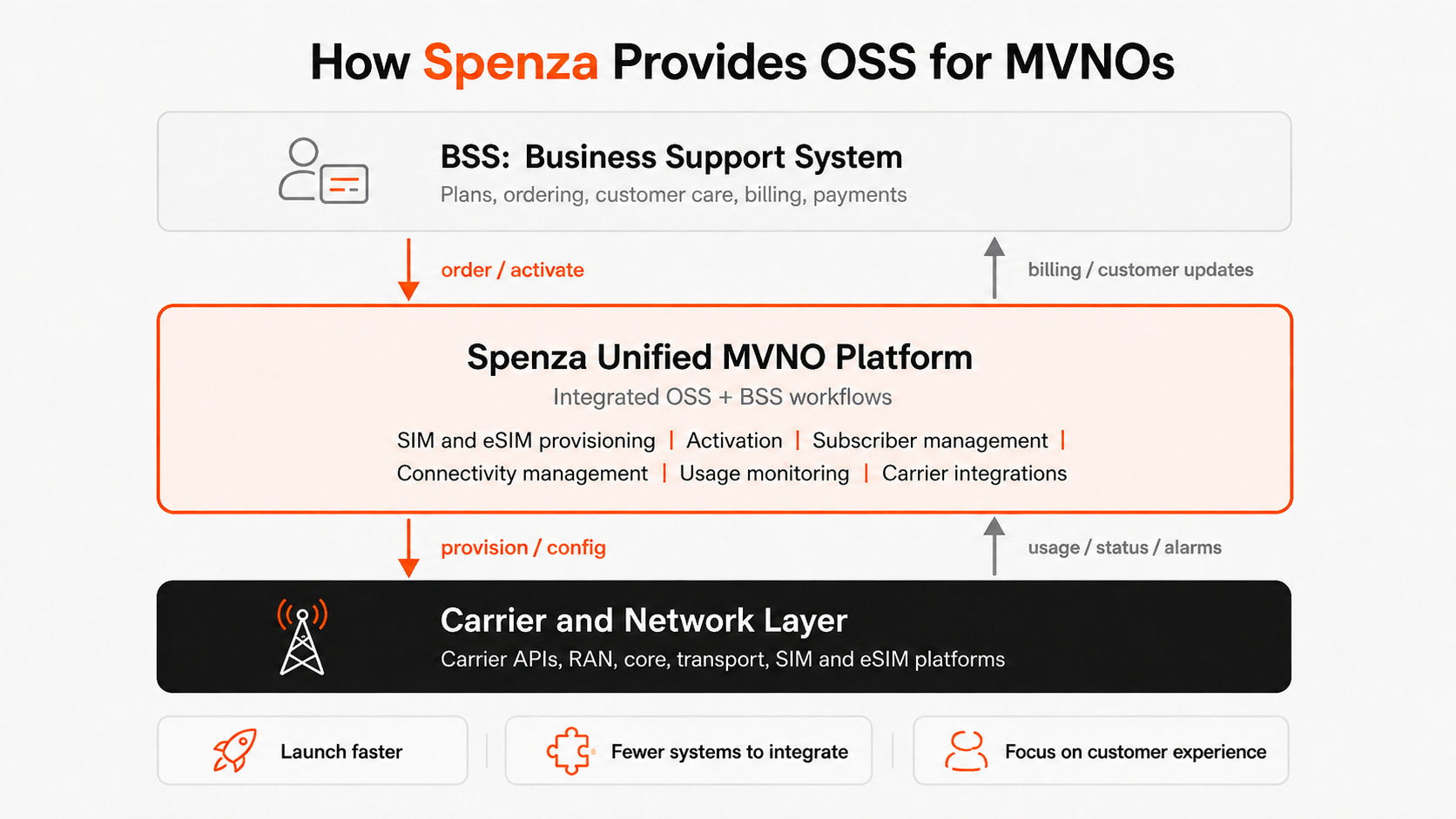
For an MVNO, getting the benefits of an Operations Support System does not necessarily mean building one from scratch. An MVNE platform can provide the core OSS capabilities needed to provision services, activate SIMs and eSIMs, manage subscriber and connectivity data, and monitor usage.
Spenza combines these operational capabilities with the BSS functions an MVNO needs to run its commercial operations. Its platform supports SIM and eSIM provisioning, activation, connectivity management, usage monitoring, billing, and carrier integrations through a unified platform.
This matters because OSS and BSS workflows are closely connected. A customer selects a plan, places an order, receives a SIM or eSIM, and activates the service. The OSS side provisions the connectivity and manages the service, while the BSS side handles plans, billing, and the customer relationship. Keeping these workflows connected reduces the number of separate systems an MVNO has to integrate and maintain.
The main advantage is speed. Instead of developing an OSS stack, connecting it to carrier systems, and maintaining those integrations as the business grows, an MVNO can use an existing platform and focus its engineering resources on the customer experience and product.
There is still a trade-off. Building an OSS provides greater control over architecture and operational processes, while using an MVNE provides a more standardized platform with less infrastructure to manage. For most MVNOs, the decision comes down to whether network operations are a core source of differentiation or simply a capability the business needs to deliver its service.
For brands, IoT businesses, resellers, and other companies launching connectivity, the platform approach can remove much of the technical complexity behind an MVNO launch. Spenza provides the OSS and BSS capabilities through an integrated connectivity platform, allowing businesses to manage connectivity operations without building the entire telecom stack themselves.
The practical question for an MVNO is therefore not whether it needs OSS. It does. The question is whether it should build those capabilities internally or use an MVNE platform that already provides them.
Conclusion: OSS Is the Operational Layer of Telecom
OSS stands for Operations Support System, but the acronym only tells part of the story. In telecom, OSS is the operational layer that turns a service order into a working connection and keeps that connection running. Provisioning, activation, inventory, fault management, performance monitoring, and network management all depend on OSS capabilities.
The easiest way to remember the difference between OSS and BSS is simple: BSS manages the business, while OSS manages the network operations that deliver the service. BSS handles products, customers, orders, rating, and billing. OSS handles the network resources, service activation, and operational health behind those products.
For traditional network operators, OSS remains a critical part of managing increasingly complex infrastructure. For MVNOs, however, the question is often different. An MVNO may need the same operational capabilities without owning or operating an entire telecom network. Building those capabilities internally can add significant integration and maintenance work, which is why many MVNOs choose an MVNE or connectivity platform instead.
Modern telecom architecture is also moving away from rigid, monolithic OSS and BSS stacks. Cloud-native components, APIs, automation, and frameworks such as TM Forum’s Open Digital Architecture are changing how these capabilities are built and integrated.
So, if you were looking for the OSS full form in telecom, the answer is Operations Support System. If you are launching a connectivity business, the more important question is what OSS capabilities you need and how you want to operate them.
For MVNOs and connectivity businesses, Spenza provides an integrated platform for the operational and commercial workflows required to launch and manage connectivity. Explore the OSS/BSS launch checklist to see which provisioning, activation, inventory, monitoring, and commercial capabilities you should evaluate before choosing an MVNE or connectivity platform.
FAQs
Ready to simplify your telecom operations? Book a demo with Spenza and see how you can launch and scale connectivity faster.


