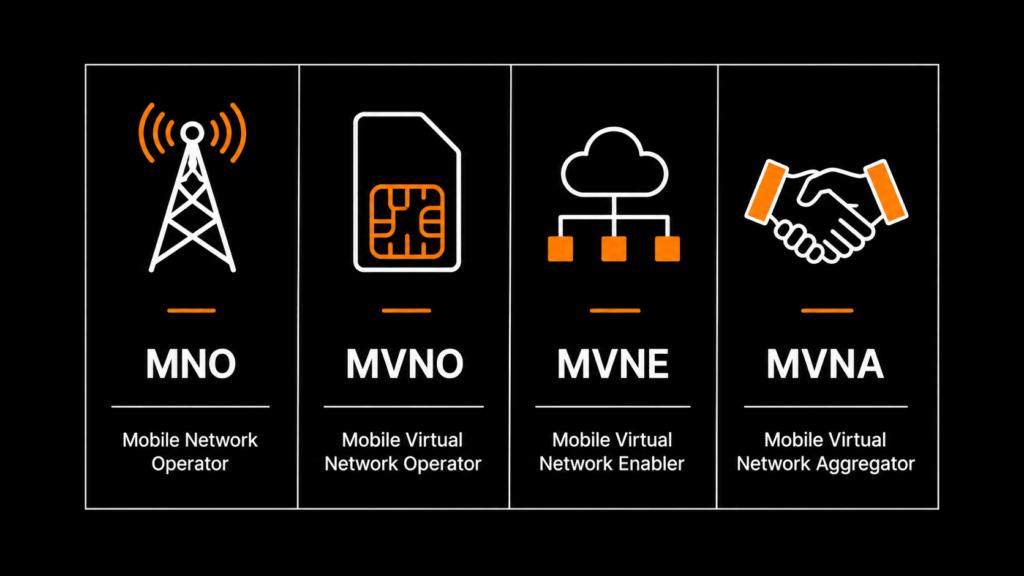
An MNO operates the mobile radio network, an MVNO sells a mobile service using host-network access, an MVNE supplies enabling systems and operations, and an MVNA aggregates wholesale access for other providers. These are roles, not four mandatory companies in a fixed chain. One supplier can perform several of them.
For a device maker, managed service provider or software business, the useful question is which responsibilities your product needs to retain. Start with the MVNO business model, then separate the customer offer, network agreement and operating platform. This guide compares each pair, explains the ownership limits and provides a decision framework for choosing partners without assuming a standard launch price or timeline.
At a Glance: The Four Roles
The four mobile roles describe different contributions to a service: radio access, the retail offer, technical enablement and wholesale aggregation. An MNO and an MVNO can both sell to end customers. MVNE and MVNA describe supplier functions, but the same corporate group may also operate a separate retail business.
The comparison identifies the primary role, not every function a company is allowed to perform.
| Role | Primary contribution | Buyer question |
|---|---|---|
| MNO: Mobile Network Operator | Operates the radio network and supplies network access | Which services and network interfaces are contracted? |
| MVNO: Mobile Virtual Network Operator | Builds the customer-facing mobile offer using host access | Which systems and customer tasks will we retain? |
| MVNE: Mobile Virtual Network Enabler | Supplies enabling technology and operational services | Who runs provisioning, billing and support handoffs? |
| MVNA: Mobile Virtual Network Aggregator | Aggregates wholesale access or demand for multiple providers | Who holds the wholesale agreement and its commitments? |
Sources: CRTC’s MVNO explanation and the MVNO value-chain discussion in the ITU economic-policy report. Contract questions are editorial guidance; national terminology and requirements vary.
Discuss your MVNO operating model with Spenza using these four responsibilities as the starting point.
MNO vs MVNO: who owns the network?
An MNO operates the radio access network that connects devices over the air. An MVNO uses a host’s radio access while packaging service for its customers. An MVNO can still operate core network functions, billing and customer systems. The distinction is therefore not that an MVNO owns no infrastructure.
What an MNO actually operates
An MNO’s service depends on radio access, spectrum rights and the systems behind them. Physical tower sites, transport links and other assets may be owned, leased or shared. Treat “owns the network” as shorthand for the operating role, not a statement that every physical component belongs to the same company.
Buying wholesale service does not give the buyer unrestricted control over the host’s radio network. The agreement defines available coverage, services, interfaces and operating conditions. A direct relationship can remove an intermediary without transferring the host’s engineering decisions to the MVNO.
Different types of MVNO
An MVNO sells mobile service under its own brand using network capacity from another operator. A reseller arrangement may source most systems, while a fuller model retains selected core and operating functions. The CRTC’s explanation explicitly distinguishes host radio access from the other facilities an MVNO may operate.
Use the MVNO model comparison to decide how much control you need. Branding a customer portal does not require the same architecture as controlling subscriber identities or a voice-routing integration. Buy the control your product needs and assign staff to the work it creates.
MVNO vs MVNE: who runs the service?
An MVNO is the customer-facing mobile provider; an MVNE supplies technology and operating capabilities that help that provider deliver service. The MVNO defines its offer and customer relationship. The MVNE may supply provisioning, billing, SIM management and network integration. The contract determines which tasks the parties perform and support.
What a traditional MVNE provides
An MVNE can supply business support systems, provisioning workflows, subscriber records and customer-care tools. Some arrangements include hosted core functions; others concentrate on platform services. Check each capability against the actual network and device configuration. “Full platform” does not identify the interfaces included in the proposed implementation.
A software vendor is not automatically an MVNE. PortaOne’s MVNO FAQ explicitly distinguishes its billing software and technical support from acting as an enabler or aggregator. A buyer of software may still need to arrange the network agreement and integration work.
Do you need an MVNE?
An MVNO can operate without a separate MVNE when it has suitable systems, partners and staff to perform the required work. Outsourcing can reduce the scope your team operates, but it does not make the remaining work disappear. Define who configures plans, investigates usage disputes, communicates incidents and approves changes.
For example, a failed activation can cross your checkout, the provisioning platform and the host network. The customer needs one accountable support route even when several teams investigate. Use the billing platform acceptance checks to connect subscriber changes with the invoice that follows.
MVNE vs MVNA: technology and wholesale access
An MVNE provides technical and operational enablement, while an MVNA primarily aggregates wholesale network access and commercial arrangements. The distinction is useful when a business has one capability but lacks the other. A combined supplier can provide both, so evaluate the included responsibilities instead of treating the labels as mutually exclusive.

How MVNAs work
An MVNA purchases or arranges wholesale access and supplies it to multiple MVNOs or resellers. Aggregating demand can make a commercial relationship practical for smaller buyers. Whether the resulting price, minimum commitment or service scope is attractive depends on the actual agreement; aggregation is not proof of a better deal.
The supplier may also provide billing, provisioning or hosted network functions. Ask which company is the wholesale counterparty, which operates the systems and which issues your invoice. Separate agreements may sit behind one branded product, and a technical integration may depend on another party’s commercial authorization.
Why definitions need context
Telecom terminology can become more specific in a regulatory discussion. Ofcom’s Global Titles statement distinguishes MVNE and MVNA roles in its UK mobile-security context. Its section 2 discussion is useful evidence that the contracting relationship matters; those contextual definitions should not be treated as a universal product taxonomy.
If you already have network access but need operating systems, investigate enablement. If you have the systems but lack an appropriate wholesale route, investigate aggregation or direct host access. If both are missing, compare a combined proposal with separate suppliers, including the coordination work each arrangement leaves with you.
How to Choose: The 5-Question Decision Framework
Choosing MNO, MVNE and MVNA partners starts with your existing capabilities and the customer promise you need to deliver. Work through the five questions below to identify missing access, systems and operating ownership. The result is a shortlist of responsibilities to source, not a recommendation based on an arbitrary budget or subscriber threshold.
Five questions to define the partner scope
- Who is the customer? Selling branded mobile service points toward the MVNO role. Supplying systems or wholesale access to other operators points toward enablement or aggregation.
- Which decisions must remain yours? Identify required control over plans, accounts, subscriber data and application integrations with a trusted Salesforce integration partner before choosing a fuller infrastructure model.
- Do you already have suitable network access? If yes, verify interfaces and permitted services. If no, compare direct host access with an aggregated route.
- Who can operate the service? Match provisioning, billing, customer care and incident work to named internal or partner teams.
- What must remain portable? Specify data export, integration documentation and transition assistance before choosing a long-term arrangement.
For an OEM, the deciding requirement may be device activation and lifecycle control. An MSP may need delegated administration and enterprise billing. A software platform may need mobile events inside an application. These are starting requirements, not automatic reasons to become a full MVNO.
Turn role labels into an operating agreement
The same responsibility worksheet works whether one supplier or several deliver the service.
| Task | Name the performing team | Agree escalation and proof |
|---|---|---|
| Network access | Host or contracted access provider | Eligible services, devices and access terms |
| Activation | Provisioning and host integration teams | Failed-order route and final service status |
| Billing | Rating, invoicing and finance teams | Usage reconciliation and correction history |
| Customer incident | Retail and partner support teams | Customer contact owner and escalation record |
| Service obligations | Responsible entity and specialist advisers | Jurisdiction-specific scope and assigned work |
| Exit | Platform and account owners | Usable export and transition procedure |
Source: editorial responsibility worksheet. Proposed buyer checks, not reported customer test results or a transfer of legal duties.
Use the MVNE provider selection guide for the deeper evaluation. Assign a decision owner to each unresolved item; “the partner handles it” is not an operational answer when two suppliers depend on each other.
Compare costs using quoted units
Price the responsibilities left in each proposal using the same assumptions.
| Cost area | Request | Compare |
|---|---|---|
| Wholesale access | Usage units, minimums and deposits | Payable floor and included service scope |
| Platform | Account, line or event-based charges | Inactive lines, changes and operating support |
| Implementation | Interfaces, configuration and acceptance work | Included delivery and retained engineering |
| Transition | Export and migration assistance | Contract restrictions and remaining work |
Source: editorial quote framework. No prices, margins or launch durations are asserted.
The launch cost guide explains the broader budget. Use the MVNO calculator to organize assumptions, then replace them with supplier quotes. Set readiness against completed dependencies and accepted tests, not a role label’s supposed standard launch time.
Real Launches: How Each Role Plays Out
RocketPhone’s published enterprise MVNO launch shows how a specific application requirement shapes partner responsibilities. RocketPhone needed native cellular calls to reach its conversation-intelligence workflow for Salesforce. Spenza supplied the mobile capabilities and integration described in the case, including SIP routing, subscriber operations and a portal supporting enterprise and reseller administration.
| Published capability | Scope |
|---|---|
| Native calls | Cellular voice |
| SIP routing | Call integration |
| Reseller portal | Enterprise and reseller administration |

The RocketPhone case study describes why a separate calling app, reliance on a carrier recording product and handset-native capture did not satisfy the requirement. The chosen implementation connected the cellular voice leg with RocketPhone’s application workflow. That requirement is more informative than a generic preference for one acronym.
The case supports an enterprise MVNO implementation, not an independently measured duration, cohort size or universal carrier configuration. Additional markets and some self-service capabilities were future scope in the published account. Preserve that boundary when using the case to frame your own partner discussion.
Discuss your operating model with Spenza around the application journey and account structure that your service must support.
MNO, MVNO, MVNE and MVNA FAQs
MNO, MVNO, MVNE and MVNA questions often confuse a company’s label with the scope of a particular service. The answers below separate infrastructure, customer ownership, supplier responsibilities and commercial terms. Use them to identify what needs verification in the proposal rather than assuming every company using an acronym offers the same arrangement.
Can one company be both an MVNE and an MVNA?
One company can provide technical enablement and wholesale aggregation, combining MVNE and MVNA functions. Verify the contracted services separately even when they appear in one product. Ask who holds the network agreement, operates the platform and resolves incidents, and whether another supplier performs any of that work behind the scenes.
Can an MVNO operate without an MVNE?
An MVNO can operate without a separate MVNE if it has the systems, integrations and operational capacity required by its service. The work may be performed internally or through other specialist suppliers. Removing an enabler does not remove provisioning, billing, customer care or the need to coordinate with the host network.
Does an MVNO own any network infrastructure?
An MVNO can operate core network functions and other infrastructure while relying on a host for radio access. The retained scope varies by model and contract. A full MVNO arrangement therefore differs from a branded reseller, even though both use host-network access. Check the architecture instead of assuming no infrastructure ownership.
Are MVNO plans always cheaper or slower?
MVNO status alone establishes neither price nor performance. Retail pricing, traffic priority, roaming, coverage eligibility and device support depend on the specific offer and host arrangement. Compare the actual plan terms and test the intended use case. A shared host network does not mean two brands sell identical service conditions.
Does an MVNE handle every compliance responsibility?
An MVNE may supply tools or services that support compliance work, but its label does not establish which obligations transfer or who remains responsible. Identify the service, jurisdiction and contracting entities, then obtain scope-specific specialist review. Record each party’s work and evidence rather than relying on a blanket compliance claim.
Is an MVNA automatically the cheapest launch route?
An MVNA can aggregate demand and provide a wholesale route, but the cheapest suitable arrangement depends on the quoted scope. Compare minimum commitments, usage, platform services, implementation and support, including work your team retains. A lower access rate can coexist with other costs, restrictions or missing capabilities that change the decision.
Choose responsibilities before choosing labels
Use the four roles to organize the decision, then replace each acronym with a named responsibility, contract and acceptance test. Define the customer journey, required control and existing network access before comparing partners. Document incident handoffs and exit requirements alongside the commercial offer. The most useful proposal is one your team can operate and verify. Discuss your MVNO operating model with Spenza using a service brief and responsibility worksheet. Keep missing evidence visible until the relevant owners supply it, and set the launch plan against completed work rather than unsupported price or speed assumptions.