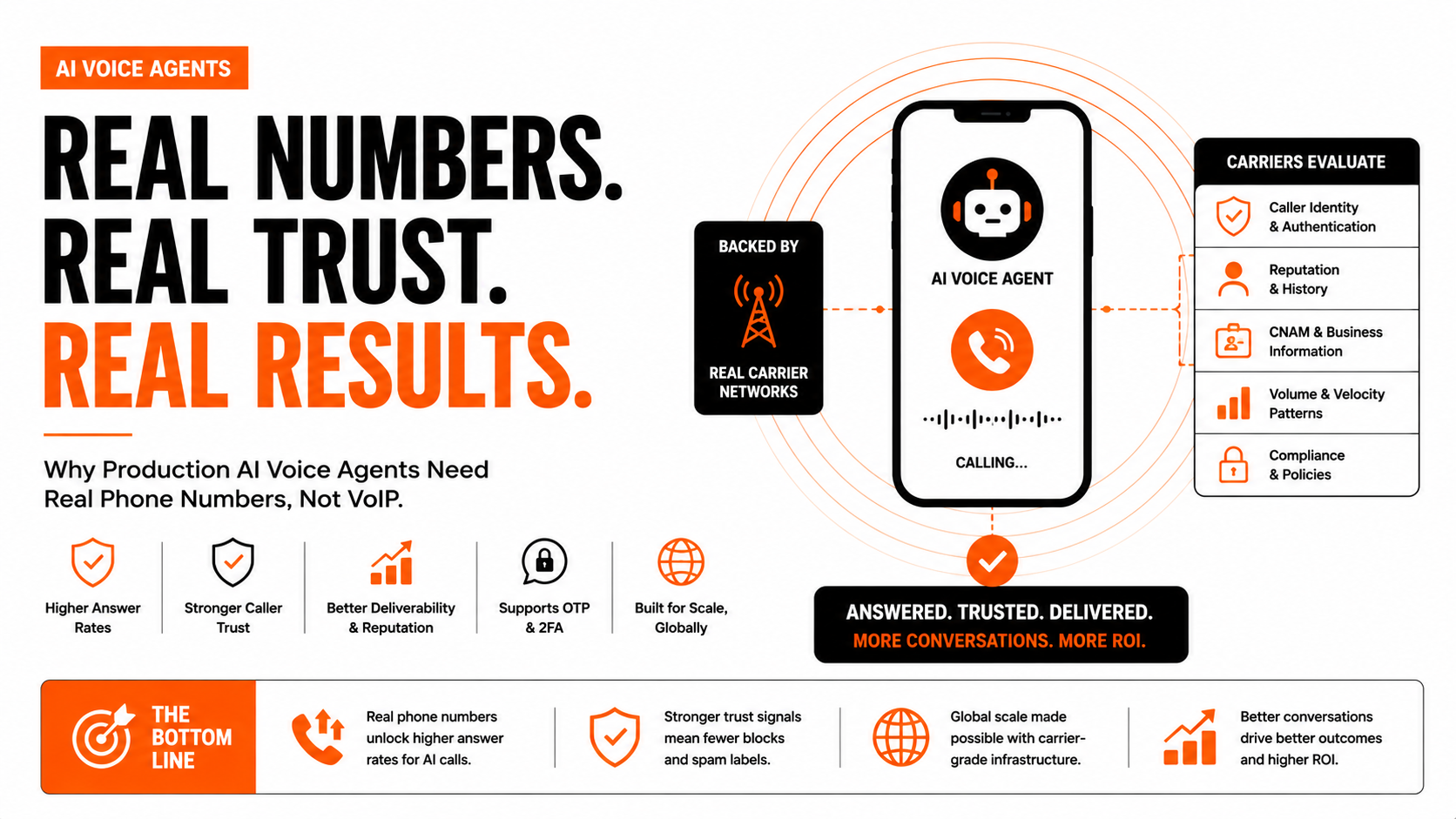
The Hidden Problem With AI Voice Agents on VoIP
AI voice agents have reached an inflection point.
What began as experimental chatbots has rapidly evolved into AI-powered sales representatives, customer support assistants, appointment schedulers, debt collection agents, healthcare coordinators, and recruiting assistants capable of handling thousands of conversations every day.
Platforms like Retell, Vapi, Bland AI, and Synthflow have dramatically lowered the barrier to deploying conversational AI. Today, startups can launch sophisticated AI calling workflows in hours rather than months.
The opportunity is only getting bigger. Gartner predicts that by 2029, agentic AI will autonomously resolve 80% of common customer service issues, reducing operational costs by up to 30%. As AI voice becomes a core customer engagement channel, businesses are shifting their focus from experimentation to production-scale deployments.
Yet while the industry has obsessed over models, prompts, latency, and voice realism, one critical piece of infrastructure has remained largely invisible: the phone number itself.
That’s becoming a production problem.
Many AI platforms default to inexpensive VoIP numbers because they’re easy to provision and work well during development. Early testing often looks promising. Calls connect, conversations flow naturally, and the system appears ready for production.
Then the scale arrives.
Outbound campaigns begin seeing lower answer rates. Customers report calls being labeled “Spam Likely.” Verification messages fail to reach users. Even perfectly legitimate business calls start disappearing into voicemail.
At first glance, these look like problems with AI quality, call scripts, or campaign targeting.
In reality, the issue often begins much earlier in the call journey.
Long before an AI agent says “Hello,” the telecommunications ecosystem has already evaluated the call. Mobile carriers, spam analytics providers, and reputation systems assess whether the calling number appears trustworthy. If that foundation is weak, even the most sophisticated conversational AI may never reach its intended audience.
The challenge is becoming more significant as consumers grow increasingly wary of unknown callers. According to Hiya’s 2025 Global Call Threat Report, nearly one in four consumers worldwide reported receiving an AI-generated scam call. As AI-powered fraud increases, carriers are strengthening spam detection systems, making caller reputation and number authenticity more important than ever for legitimate businesses.
This is why the conversation around AI voice infrastructure is beginning to shift.
The competitive advantage is no longer just building a smarter AI agent. It’s about building one that carriers trust, customers recognize, and people are willing to answer.
How Carriers Decide Whether Your AI Call Gets Through
A successful AI conversation depends on more than speech recognition or large language models.
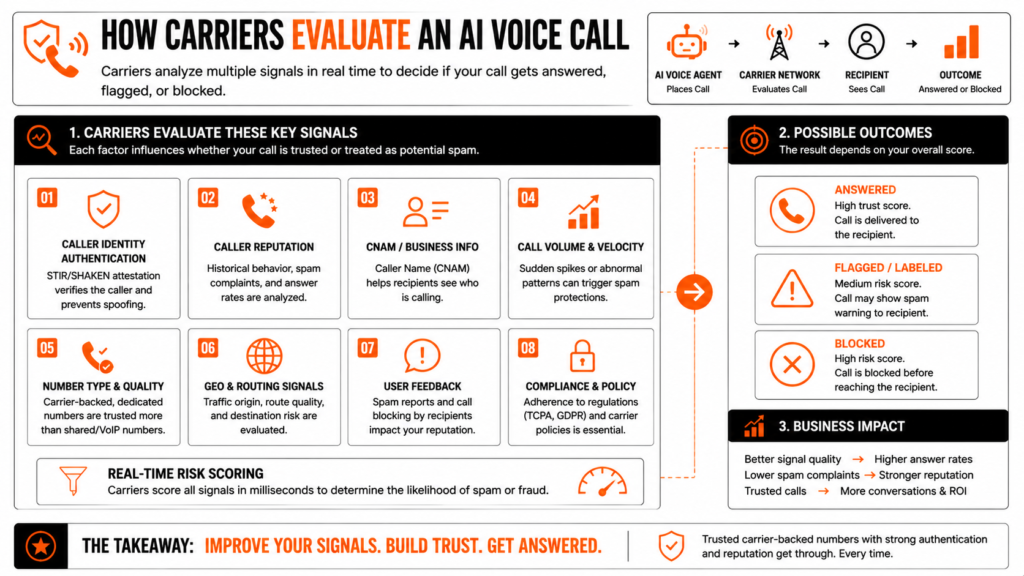
Before a phone rings, carriers perform several trust checks to determine whether a call deserves to reach the recipient. These checks influence whether the call is authenticated, labeled as suspicious, or ignored altogether.
Understanding these mechanisms explains why two AI agents using identical software can experience dramatically different answer rates.
STIR/SHAKEN and Attestation (A, B, C)
One of the most important developments in combating robocalls is STIR/SHAKEN, the caller authentication framework mandated by the U.S. Federal Communications Commission (FCC).
Rather than treating every outbound call equally, STIR/SHAKEN digitally signs each call using a PASSporT token that indicates how confidently the originating provider can verify the caller’s identity.
For production AI deployments, this distinction matters.
Calls originating from long reseller chains, shared VoIP pools, or poorly provisioned numbers often receive weaker attestation because the carrier cannot confidently verify the caller’s relationship to the phone number.
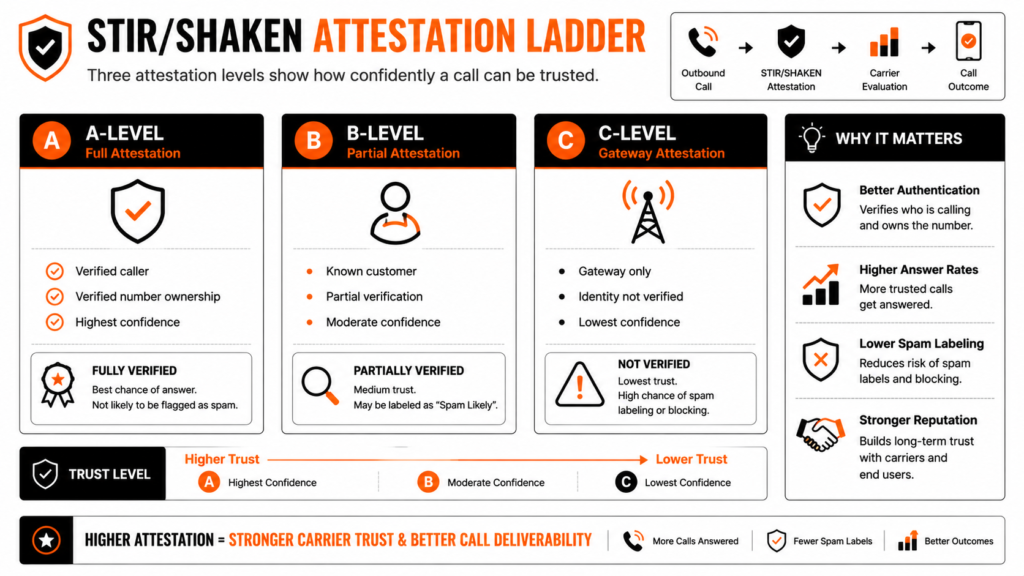
Conversely, real carrier-provisioned numbers combined with proper Know Your Customer (KYC) verification and correct provisioning are significantly better positioned to achieve stronger authentication.
It’s important to note that using a real carrier number alone does not automatically guarantee A-level attestation. Proper provisioning, ownership verification, and carrier relationships remain essential.
Spam Labeling (A Separate System)
Authentication is only one part of the equation.
Many businesses mistakenly assume that STIR/SHAKEN determines whether a call will appear as “Spam Likely.”
It doesn’t.
Spam labeling is a separate analytics-driven process.
Carrier applications such as Verizon Call Filter, AT&T ActiveArmor, and T-Mobile Scam Shield, together with analytics providers like Hiya, First Orion, and TNS, continuously evaluate calling behavior using signals that include:
- Call velocity and calling patterns
- Consumer complaints
- Historical reputation of the number
- Area code consistency
- CNAM (Caller Name) information
- STIR/SHAKEN attestation level
- Previous spam reports
Because these systems continuously update reputation scores, a number’s history becomes increasingly important.
Shared or recycled VoIP numbers may inherit the reputation of previous users. If those numbers were previously associated with aggressive calling campaigns or spam complaints, new businesses may begin with a trust deficit before making their first legitimate call.
Dedicated carrier numbers, by contrast, allow organizations to establish and maintain their own reputation over time.
Why VoIP Numbers Score Worse on Both
VoIP technology itself is not inherently untrustworthy.
In fact, VoIP remains an excellent choice for internal communications, development environments, and low-volume testing.
The challenge emerges when AI calling moves into production.
Standard VoIP services often rely on shared number pools, multiple intermediaries, and indirect carrier relationships. These factors can make it harder to establish strong caller identity and maintain a consistent reputation across carrier ecosystems.
As outbound AI calling volumes increase, these structural disadvantages become more visible.
This doesn’t mean every VoIP number performs poorly, nor does every real carrier number perform perfectly.
Instead, real carrier numbers provide a stronger operational foundation for achieving:
- Higher-quality caller authentication
- Dedicated caller reputation
- Cleaner carrier relationships
- Better long-term deliverability
- Greater acceptance for business-critical messaging services
For organizations deploying AI agents at scale, the phone number becomes infrastructure not just an identifier.
The Business Impact: Answer Rates and Deliverability
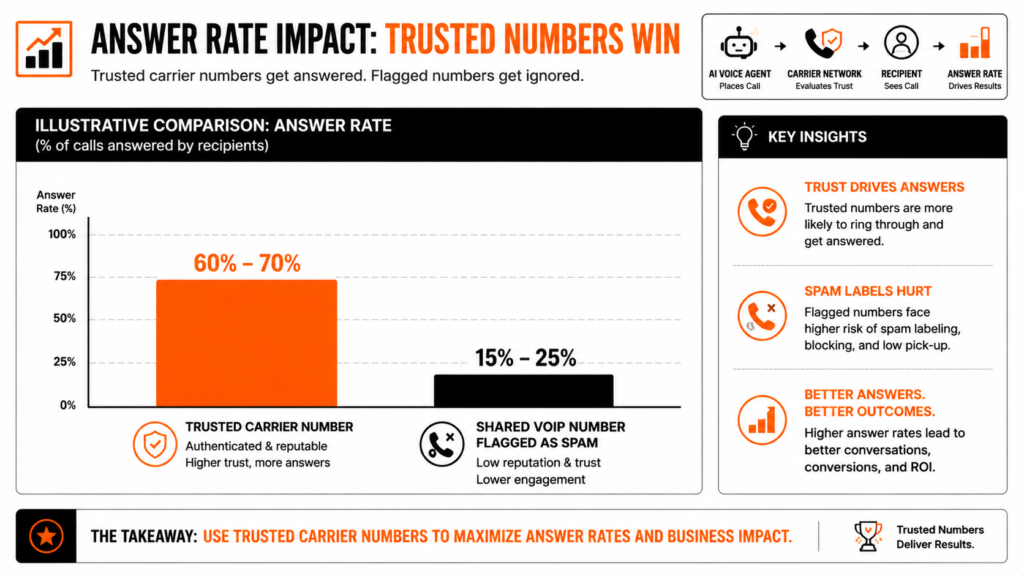
For AI voice agents, every unanswered call represents more than a missed conversation. It represents wasted infrastructure, higher customer acquisition costs, and lower returns on every outbound campaign.
Consumer behavior has made this challenge increasingly difficult. Roughly 80% of Americans don’t answer calls from unknown numbers, a trend identified by Pew Research Center that highlights how difficult it has become for businesses to establish trust before a conversation even begins.
The broader telecom landscape reinforces this challenge. Americans received more than 58 billion robocalls in 2024, based on YouMail’s robocall index, prompting carriers and analytics providers to continuously strengthen spam detection and caller reputation systems. As these safeguards become more aggressive, legitimate businesses using low-trust calling numbers face greater scrutiny before their calls ever reach a customer.
Healthy outbound programs often expect connection rates in the 15–25% range, depending on audience quality, consent, and campaign design. When answer rates suddenly decline beyond expected benchmarks, the issue is frequently rooted in caller identity and reputation rather than the AI conversation itself.
This distinction is critical.
Organizations often spend weeks refining prompts, retraining models, or replacing AI voice providers when the real bottleneck lies in the telecom layer supporting those conversations.
Improving caller trust won’t compensate for poor sales messaging or weak customer targeting.
However, without trusted number infrastructure, even exceptional AI agents may never reach the people they’re designed to help
VoIP vs. Real Numbers for AI Agents
Choosing the right phone number is less about cost and more about production readiness.
The table below summarizes where each option fits.
| Capability | VoIP Numbers | Real Carrier Numbers |
|---|---|---|
| STIR/SHAKEN Authentication | Often receive lower attestation depending on provisioning. | Better positioned for stronger carrier authentication. |
| Caller Reputation | Frequently shared or recycled. | Dedicated business reputation. |
| Spam Label Risk | Higher due to shared history and weaker trust signals. | Lower when combined with responsible calling practices. |
| Answer Rate Potential | Can decline as campaigns scale. | Better foundation for consistent answer rates. |
| OTP & 2FA Compatibility | Frequently rejected by verification systems. | Broadly accepted for verification workflows. |
| KYC & Regulatory Readiness | Depends on the provider. | Better aligned with carrier verification processes. |
| Best Use Case | Development, testing, and internal workflows. | Production AI agents, customer engagement, and business communications. |
The takeaway isn’t that VoIP should be abandoned altogether.
VoIP remains a practical choice during prototyping, proof-of-concept deployments, and internal testing.
But once AI voice agents become customer-facing and business-critical, organizations need infrastructure that carriers recognize, verification systems accept, and customers are more likely to trust.
That’s where real carrier numbers become a strategic advantage rather than simply another telecom purchase.
Why Real Numbers Also Matter for OTP and 2FA
Voice is only one side of the equation.
Many organizations deploying AI agents also rely on SMS for customer authentication, appointment confirmations, account recovery, password resets, and one-time passwords (OTPs). As AI-driven customer interactions become more sophisticated, voice and messaging increasingly work together as part of a unified customer journey.
This is where the limitations of VoIP numbers become even more apparent.
Many verification platforms distinguish between mobile, landline, and VoIP numbers through line-type intelligence. For security reasons, numerous banking platforms, fintech applications, identity providers, and enterprise services either restrict or completely reject VoIP numbers during account verification.
The rationale is straightforward.
VoIP numbers are generally easier to obtain anonymously than carrier-issued numbers, making them more susceptible to abuse in fraud, fake account creation, and automated verification attacks. As a result, many authentication providers apply stricter rules when evaluating whether a number can receive verification messages.
For businesses, this creates an operational challenge.
An AI agent may successfully complete a customer conversation, but if the follow-up verification code never reaches the user—or is rejected because of the underlying number type the customer experience breaks down.
Real carrier numbers solve a broader infrastructure problem than voice alone.
They provide organizations with a trusted identity for outbound calling while also supporting business-critical messaging workflows such as:
- OTP delivery
- Two-factor authentication (2FA)
- Customer verification
- Appointment confirmations
- Transaction alerts
- Secure account recovery
Rather than managing separate infrastructure for calling and messaging, businesses can build both on a trusted carrier-backed foundation.
The 2026 Rules You Can’t Ignore (TRACED Act, KYUP, 10DLC)
The AI calling landscape is changing for another reason: regulation.
Over the past several years, regulators and carriers have introduced increasingly stringent measures to reduce robocalls, caller spoofing, and messaging abuse. As AI-generated voice becomes more accessible, these safeguards are becoming even more important.
Three frameworks deserve particular attention.
- TRACED Act
The TRACED Act strengthened the FCC’s ability to combat illegal robocalls by requiring implementation of STIR/SHAKEN across U.S. voice networks and giving carriers greater authority to block suspicious traffic.
This means authentication is no longer optional, it is becoming part of the expected baseline for legitimate business communications.
- Know Your Upstream Provider (KYUP)
Emerging Know Your Upstream Provider (KYUP) requirements push providers to verify the identity of businesses sending traffic through their networks.
The objective is straightforward: reduce anonymous or poorly verified traffic before it reaches consumers.
For organizations relying on obscure routing chains or low-cost international VoIP providers, these verification requirements introduce additional operational risk.
Businesses that can clearly establish ownership of their phone numbers and maintain verified carrier relationships are better positioned as these standards continue to evolve.
- A2P 10DLC
On the messaging side, Application-to-Person 10DLC (A2P 10DLC) has become the standard for business SMS in the United States.
Registration, brand verification, and campaign approval help carriers distinguish legitimate business messaging from spam.
For AI-powered businesses, this means voice and messaging compliance are becoming closely connected.
Organizations that treat telecom infrastructure as a strategic asset not simply a utility are better prepared for future regulatory changes.
What Production AI Agents Actually Need
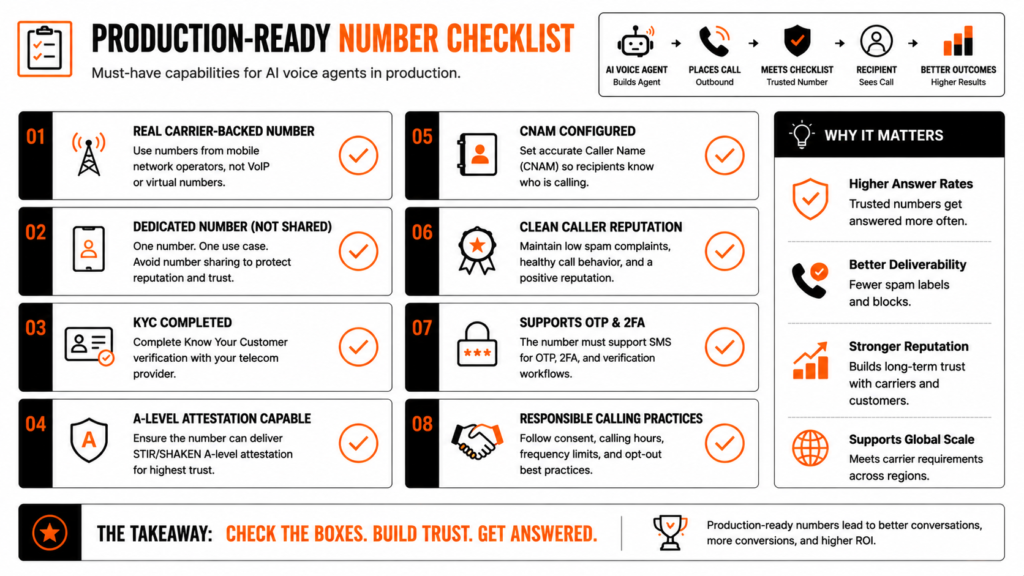
Building an AI voice agent that works in production requires far more than selecting the right language model or speech engine.
It requires trusted communications infrastructure that supports identity, reputation, compliance, and long-term scalability.
A Real, Dedicated Carrier Number
The first requirement is ownership.
Dedicated carrier-backed numbers allow organizations to establish their own identity rather than inheriting the reputation of shared number pools.
As calling volumes increase, maintaining that dedicated reputation becomes increasingly valuable.
Instead of continuously replacing flagged numbers, businesses can invest in building long-term caller trust.
A-Level Attestation and Clean Reputation
Authentication and reputation should work together.
Strong STIR/SHAKEN attestation demonstrates that a caller has been properly verified, while responsible calling behavior helps establish a positive reputation with carrier analytics systems over time.
Neither replaces the other.
Organizations should focus on:
- Proper KYC verification
- Correct number provisioning
- Consented customer outreach
- Accurate CNAM registration
- Responsible calling frequency
- Ongoing reputation monitoring
Together, these practices create the conditions for sustainable outbound performance.
How Spenza Fits
For organizations deploying AI voice agents at scale, managing telecom infrastructure can quickly become as complex as managing the AI itself.
Spenza simplifies that complexity by providing businesses with real carrier-backed phone numbers supported by trusted carrier relationships rather than relying solely on traditional VoIP infrastructure. This gives organizations a stronger foundation for production AI deployments, while also supporting adjacent messaging use cases such as OTP, 2FA, and customer verification.
Beyond phone numbers, Spenza’s Connectivity-as-a-Service platform enables enterprises to manage telecom infrastructure through a single API-first platform. Businesses can provision and manage connectivity, work across multiple carrier relationships, and scale communications without becoming locked into a single provider. This aligns with Spenza’s broader mission of abstracting telecom complexity in the same way modern cloud platforms abstract infrastructure for developers.
Rather than replacing AI platforms, Spenza complements them by providing the telecom foundation they depend on.
An Honest Caveat: Numbers Are the Foundation, Not the Whole Fix
Real carrier numbers improve the foundation of AI communications, but they are not a guarantee of success.
A business can still receive spam labels if it ignores customer consent, generates excessive complaint rates, places high-volume calls without proper registration, or fails to maintain accurate caller identity.
Likewise, A-level attestation depends on proper provisioning and carrier verification not simply on purchasing a carrier-backed number.
In other words, trustworthy infrastructure and trustworthy behavior go hand in hand.
The strongest AI calling programs combine verified numbers with responsible outreach, transparent identity, compliant messaging practices, and customer-first engagement strategies.
That distinction matters because it reflects how carrier trust systems actually work and it’s what separates sustainable AI communications from short-term workarounds.
Conclusion
The next generation of AI voice agents won’t succeed solely because they’re smarter.
They’ll succeed because they’re trusted.
As enterprises move from experimentation to production, telecom infrastructure becomes a competitive advantage rather than an implementation detail. Caller authentication, reputation, verification, and regulatory readiness all influence whether an AI conversation ever reaches a customer.
That’s why choosing the right phone number is no longer a procurement decision, it’s an architectural one.
For organizations building AI voice agents, customer verification platforms, or intelligent communications products, investing in real carrier-backed numbers establishes the trust layer that modern AI communications increasingly depend on.
Spenza helps businesses build that foundation by combining real carrier-backed phone numbers with an API-first connectivity platform that simplifies telecom operations, supports AI voice deployments, and enables reliable voice and messaging at scale without adding unnecessary operational complexity.
FAQs
Power your AI voice agents with real carrier-backed numbers. Book a personalized demo with the Spenza