


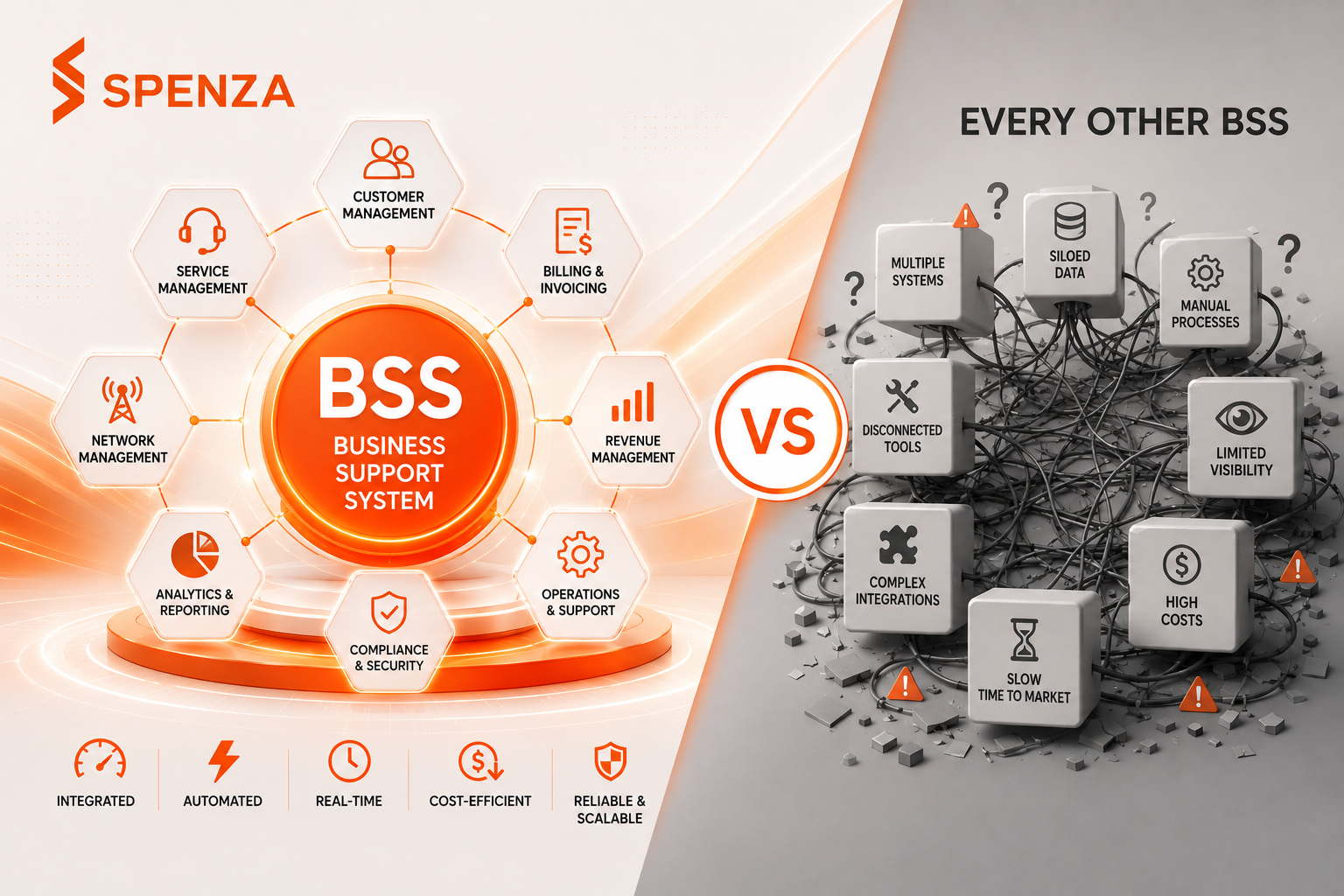
Telecommunications has evolved far beyond voice calls and text messaging. Today’s operators deliver 5G, IoT, enterprise connectivity, and digital services while managing increasingly complex customer experiences. Behind these offerings is a sophisticated software ecosystem that enables providers to launch services, onboard subscribers, process orders, generate bills, and manage revenue at scale.
At the heart of this ecosystem is the Business Support System (BSS). Although the acronym has several meanings across industries including GSM networks, Wi-Fi, and programming it most commonly refers to the software that manages the commercial side of telecom operations. As operators modernize their technology stacks and MVNOs accelerate digital service launches, understanding BSS is essential for navigating today’s telecom landscape.
All BSS Meanings at a Glance
| BSS Meaning | Industry | Used For |
|---|---|---|
| Business Support System (BSS) | Telecommunications | Manages customer-facing operations such as CRM, product catalog, order management, billing, and revenue management. |
| Base Station Subsystem (BSS) | GSM Mobile Networks | Handles the radio access portion of a GSM network through Base Transceiver Stations (BTS) and Base Station Controllers (BSC). |
| Basic Service Set (BSS) | Wi-Fi Networking (IEEE 802.11) | Refers to a wireless network consisting of an access point and its connected client devices, identified by a BSSID. |
| .bss (Block Started by Symbol) | Programming | Stores uninitialized global and static variables that are zero-initialized when a program loads. |
| Boeing Satellite Systems (BSS) | Aerospace | A satellite manufacturer. Included for completeness only, as it is unrelated to the telecom, Wi-Fi, and programming meanings of BSS. |
What Does BSS Stand For?
Search for “BSS full form”, and you’ll quickly discover that there isn’t a single answer.
The acronym appears across multiple industries, each using it to describe something entirely different. A telecom architect discussing subscriber billing isn’t referring to the same BSS as a Wi-Fi engineer configuring access points or a software developer working with memory segments.
For most telecom professionals, however, BSS means Business Support System. It is one half of the OSS/BSS architecture and manages the commercial operations that keep a telecom business running.
The challenge is that telecom itself introduces another layer of confusion.
In GSM network architecture, BSS can also stand for Base Station Subsystem, a completely different concept focused on radio infrastructure rather than customer operations. This overlap is one of the main reasons the term is frequently misunderstood.
The easiest way to identify the correct meaning is to look at the surrounding terminology.
If the discussion involves customers, plans, subscriptions, products, invoices, or revenue, the topic is almost certainly Business Support System.
If it mentions BTS, BSC, handovers, radio coverage, or GSM architecture, then BSS refers to the Base Station Subsystem.
The remaining meanings, Basic Service Set and the .bss memory segment, belong to Wi-Fi networking and programming respectively. We’ll cover those later in this guide, but first let’s explore the definition that matters most to telecom operators and MVNOs.
BSS in Telecom: Business Support System
Among all the meanings of BSS, Business Support System is by far the most important within the telecommunications industry.
Every telecom provider has two fundamental responsibilities.
First, it must deliver reliable connectivity through its network.
Second, it must sell, activate, bill, and support the services customers actually buy.
The first responsibility belongs largely to the Operational Support System (OSS). The second belongs to the Business Support System (BSS).
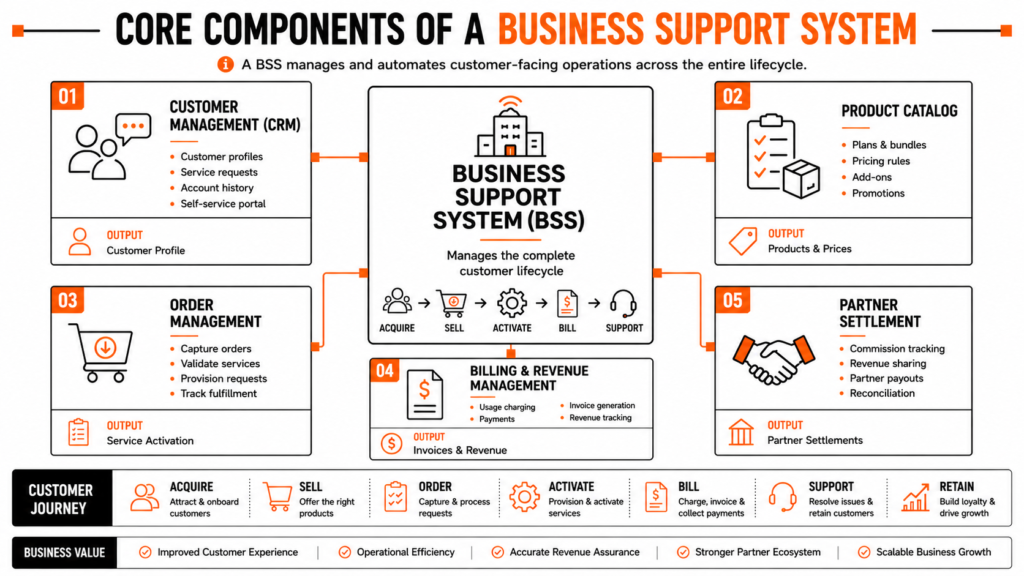
A Business Support System is a collection of integrated software applications that manages the commercial side of telecom operations. It supports the complete customer lifecycle, beginning with product creation and continuing through subscriber onboarding, service activation, billing, payments, customer care, and ongoing account management.
Without a BSS, operators could still run a network, but they would struggle to launch products, manage subscribers, process payments, or generate sustainable revenue.
This is why every mobile network operator, internet service provider, and MVNO relies on BSS capabilities, regardless of their size.
Customer Management and CRM
For telecom providers, customer relationships begin long before the first invoice. They start with capturing accurate customer information, understanding service requirements, and maintaining a complete view of every interaction throughout the subscriber lifecycle.
The Customer Relationship Management (CRM) component of a Business Support System serves as the central repository for customer profiles, account details, active services, interaction history, support tickets, and communication preferences. By giving every department access to the same customer data, CRM enables sales, support, and digital channels to deliver a more consistent experience.
Modern telecom CRM platforms also support customer segmentation, personalized promotions, automated campaigns, and omnichannel engagement. As operators expand into enterprise connectivity, IoT, and digital services, these capabilities help strengthen customer relationships while improving operational efficiency.
Product Catalog and Offer Management
Telecom operators manage a constantly evolving portfolio of prepaid and postpaid plans, roaming packages, enterprise services, IoT connectivity, bundled offers, and promotions. A centralized product catalog ensures every commercial offering is defined consistently across websites, mobile apps, retail stores, and partner channels.
The catalog stores pricing, eligibility rules, service bundles, discounts, and regional availability, allowing operators to launch new offers quickly without updating multiple systems. This reduces time-to-market while maintaining pricing accuracy and consistency across sales channels.
Order Management
Once a customer purchases a service, the Business Support System manages the entire order lifecycle. It validates the request, confirms product eligibility, initiates fulfilment workflows, and exchanges information with the Operational Support System (OSS) responsible for provisioning services.
For example, when a customer purchases an eSIM-enabled mobile plan, the BSS records the order, verifies the selected package, creates the account if required, and sends the activation request to the OSS. After successful provisioning, the BSS updates the customer account and completes the order. Efficient order management reduces activation delays, minimizes provisioning errors, and improves the overall customer experience.
Billing and Revenue Management
Billing and revenue management ensures telecom services generate sustainable revenue. Beyond generating invoices, modern billing systems calculate subscription and usage charges, apply promotions and discounts, process payments, support collections, and help prevent revenue leakage.
Today’s operators often manage prepaid, postpaid, pay-as-you-go, enterprise contracts, roaming, and IoT usage-based pricing within a single platform. As 5G introduces flexible consumption models and premium service tiers, accurate billing becomes even more important. Reliable billing improves revenue protection while giving customers greater transparency and reducing billing disputes.
Partner Settlement and Digital BSS
Telecom operators work with roaming partners, wholesale carriers, MVNOs, enterprise customers, and digital service providers. Business Support Systems automate partner settlement by tracking usage, applying commercial agreements, and calculating revenue shares, reducing manual reconciliation and improving financial accuracy.
Modern digital BSS platforms have evolved beyond traditional on-premises systems. Built as cloud-native, API-first, and modular platforms, they integrate easily with external partners and digital channels. Industry standards such as TM Forum’s Open APIs, eTOM, and Open Digital Architecture (ODA) further improve interoperability and accelerate service innovation.
This modern approach enables operators and MVNOs to launch new products faster, support 5G, IoT, and enterprise services, and scale without rebuilding core business systems.
BSS vs OSS: The Short Answer
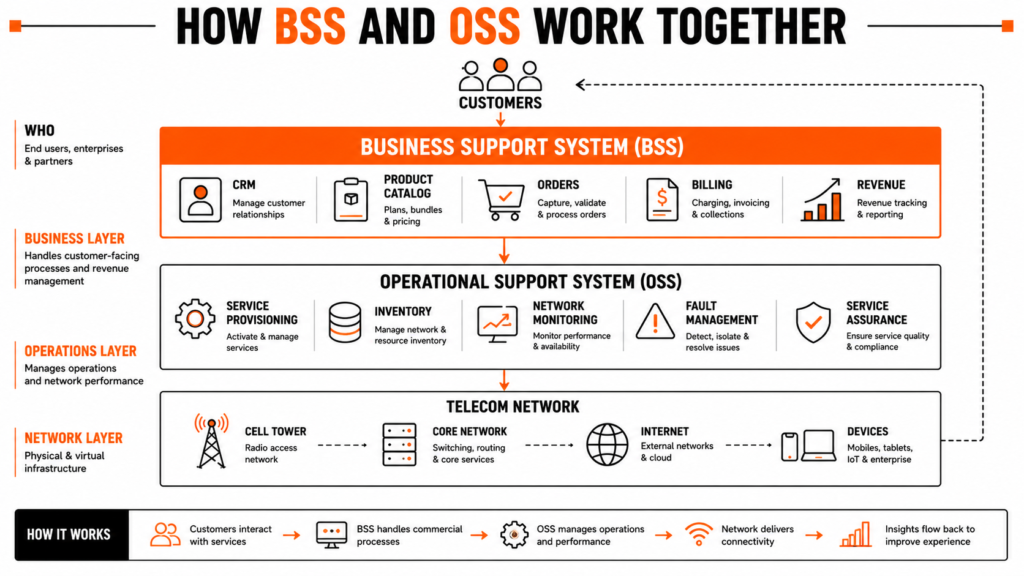
Business Support Systems (BSS) and Operational Support Systems (OSS) are often discussed together because they represent the two foundational layers of telecom operations.
A simple way to remember the difference is:
OSS manages the network.
Learn more about how the two systems work together in telecom: Spenza’s OSS vs. BSS guide .
The BSS focuses on customer-facing operations. It manages products, customer accounts, orders, billing, payments, and revenue. The OSS, by contrast, is responsible for provisioning services, monitoring network performance, managing faults, maintaining inventory, and ensuring the network operates reliably.
Although their responsibilities differ, the two systems work together continuously.
Imagine a customer purchasing a new mobile plan. The BSS captures the order, creates the subscriber account, applies the selected pricing plan, and generates the billing record. The OSS then provides the service on the network, allocates the required resources, and monitors service quality after activation.
Neither system can deliver a complete telecom service on its own. The BSS ensures the service can be sold and monetised, while the OSS ensures it can be delivered reliably.
The Other Telecom BSS: Base Station Subsystem
If you’ve worked in telecommunications long enough, you’ve probably seen BSS used in two completely different ways. One refers to the Business Support System, while the other refers to the Base Station Subsystem.
Although they share the same acronym, they serve entirely different purposes.
A Business Support System manages the commercial side of a telecom business, including customers, products, billing, and revenue. A Base Station Subsystem, on the other hand, is a component of a GSM mobile network responsible for providing radio communication between mobile devices and the core network.
The Base Station Subsystem consists primarily of two components:
- Base Transceiver Station (BTS): Handles radio communication with mobile devices.
- Base Station Controller (BSC): Manages multiple BTSs, allocates radio resources, and coordinates functions such as handovers and frequency management.
Together, these components enable mobile devices to connect to the network, move between coverage areas, and maintain reliable communication.
While the Base Station Subsystem remains a fundamental concept in GSM architecture, modern LTE and 5G networks use different radio access network architectures. As a result, today’s telecom professionals are more likely to encounter Business Support System in discussions around digital transformation, OSS/BSS modernization, and MVNO operations.
How to Tell the Two Telecom BSSs Apart
Because both meanings appear in telecom documentation, distinguishing them quickly can save considerable confusion.
| Feature | Business Support System (BSS) | Base Station Subsystem (BSS) |
|---|---|---|
| Purpose | Manages customer-facing business operations | Manages the GSM radio access network |
| Primary Focus | Customers, products, billing, and revenue | Radio communication between mobile devices and the core network |
| Key Components | CRM, product catalog, order management, billing, and partner settlement | Base Transceiver Station (BTS) and Base Station Controller (BSC) |
| Used By | Customer service, sales, finance, and operations teams | Network engineers and radio network planners |
| Role in Telecom | Enables telecom services to be sold, managed, and monetized | Enables mobile devices to connect and communicate over GSM networks |
A useful way to remember the difference is:
Cell towers and radio networks = Base Station Subsystem (BSS)
BSS in Wi-Fi: Basic Service Set (and BSSID)
Outside telecommunications, BSS takes on another meaning in wireless networking.
In the IEEE 802.11 Wi-Fi standard, BSS stands for Basic Service Set. It refers to the fundamental building block of a wireless LAN: a single access point and all the client devices connected to it.
Every Basic Service Set is identified by a Basic Service Set Identifier (BSSID), which is typically the MAC address of the wireless access point. While users usually recognize a network by its SSID (Service Set Identifier), network equipment uses the BSSID to uniquely identify individual access points.
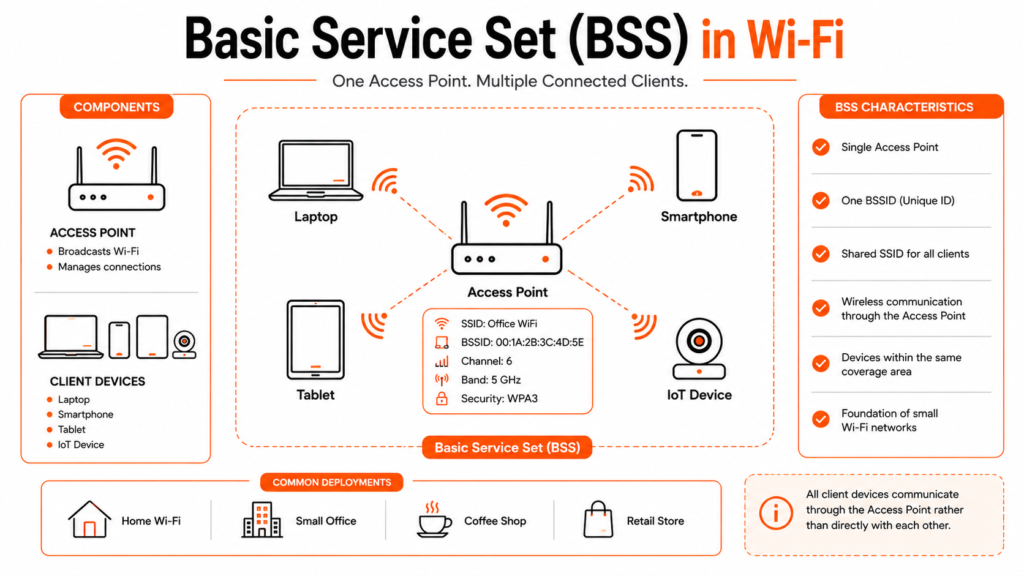
This distinction becomes particularly important in enterprise environments, where multiple access points may broadcast the same SSID to provide seamless coverage. Although users see one network name, each access point has its own unique BSSID, allowing devices to roam between access points while maintaining connectivity
The three terms describe different parts of a Wi-Fi network:
- SSID is the network name users select.
- BSSID uniquely identifies the access point providing that connection.
- Basic Service Set (BSS) refers to the access point and the wireless devices associated with it.
For networking professionals, this is the most common interpretation of BSS.
.bss in Programming: Block Started by Symbol
In software development, .bss has a completely different meaning.
The .bss section, short for Block Started by Symbol, is a memory segment used by compiled programs to store uninitialized global and static variables.
Unlike initialized variables, which are stored in the program’s data segment, variables placed in the .bss section do not occupy space within the executable itself. Instead, the operating system allocates and initializes this memory to zero when the program starts.
For example:
int counter;
static int total;
Both variables above are uninitialized and are typically stored in the .bss section.
Although this definition is unrelated to telecommunications, it frequently appears in programming documentation, compiler discussions, and embedded systems development. Understanding the context ensures it isn’t confused with the telecom or networking meanings of BSS.
Does Your Business Need a BSS?
For telecom operators, internet service providers, and MVNOs, the answer is straightforward: yes.
Every telecom business needs a way to manage subscribers, create products, process orders, generate invoices, and support customers. These capabilities are provided by a Business Support System.
The question is rarely whether a business needs BSS capabilities. Instead, it’s how those capabilities should be delivered.
Why BSS Matters More Than OSS for an MVNO
Unlike traditional mobile network operators, most MVNOs do not own radio infrastructure.
Network provisioning, spectrum management, and much of the operational infrastructure are handled by the host Mobile Network Operator (MNO). As a result, the MVNO’s primary differentiator lies in the customer experience rather than the network itself.
That makes Business Support Systems especially important.
A modern BSS enables MVNOs to:
- Launch branded mobile plans quickly.
- Manage subscribers across multiple channels.
- Configure pricing and promotions without lengthy development cycles.
- Automate billing and payment processing.
- Deliver self-service customer experiences.
- Scale operations without increasing administrative complexity.
In many cases, the BSS becomes the primary platform through which an MVNO competes in the market..
Simplify Telecom BSS Operations With Spenza
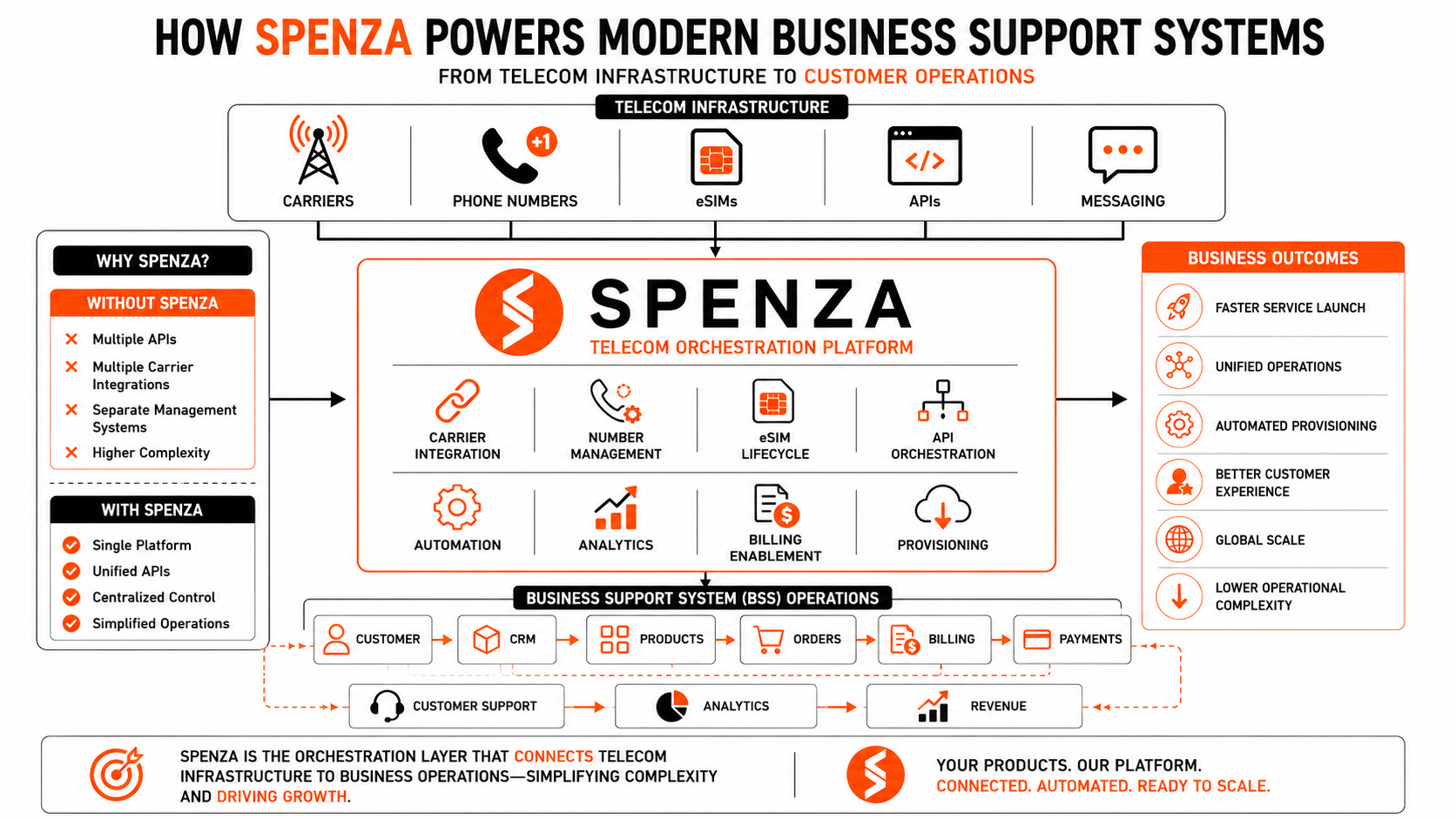
For telecom businesses, having BSS capabilities is essential. But building, integrating, and maintaining a complete BSS environment can introduce significant technical and operational complexity, especially for MVNOs, IoT providers, device manufacturers, and brands entering the connectivity market.
This is where a modern connectivity platform can make a difference.
Spenza brings key telecom capabilities together in a unified platform, helping businesses manage connectivity, billing, customer experiences, and telecom operations without having to assemble and maintain a fragmented technology stack. Its platform combines multi-operator connectivity management, billing, analytics, and branded customer experiences to support businesses from launch through scale.
What Spenza Brings to a Modern BSS
Instead of treating connectivity, customer management, and billing as separate systems, Spenza connects these functions through a single platform.
With Spenza, businesses can:
- Launch connectivity services faster with an MVNO/MVNE platform designed to handle the technology behind mobile services.
- Manage subscribers and plans through centralized connectivity and customer-management capabilities.
- Automate billing and payments for mobile, IoT, and other connectivity offerings.
- Manage multiple operators through a unified platform rather than maintaining separate carrier workflows.
- Support SIM and eSIM deployments across different connectivity use cases.
- Monitor usage and costs through centralized analytics and operational visibility.
- Create branded customer experiences through digital sales channels and customer portals.
- Integrate with existing systems using APIs, webhooks, and other integrations.
This approach is particularly useful for MVNOs and businesses that want to monetize connectivity without building every telecom business function from scratch. Spenza positions its platform for MVNOs, device OEMs, MSPs, connectivity providers, consumer brands, and IoT businesses.
From BSS Complexity to a Connected Business Platform
Traditional BSS environments can involve multiple vendors, integrations, databases, and operational processes. As connectivity businesses expand into eSIM, IoT, multi-carrier deployments, and digital sales, that complexity can grow quickly.
A modern platform takes a different approach: centralize the critical workflows, automate repetitive operations, and expose the capabilities businesses need through a unified interface and APIs.
For companies launching or scaling connectivity services, the goal isn’t simply to have a BSS. It’s to have the right BSS capabilities without taking on unnecessary infrastructure and integration complexity.
That is the role Spenza aims to fill: providing a modern technology foundation for businesses that want to launch, manage, and scale connectivity services while focusing their resources on customers, products, and growth.
Ready to simplify your telecom operations? Explore how Spenza can help you launch and scale connectivity with a modern MVNO/MVNE platform.
Conclusion
BSS can mean different things depending on the context. In telecommunications, the most common meaning is Business Support System, the collection of systems that manages the commercial side of connectivity, from customers and products to orders, billing, payments, and revenue.
In GSM network architecture, BSS can instead mean Base Station Subsystem, which handles radio connectivity through components such as the BTS and BSC. In Wi-Fi, BSS means Basic Service Set, while .bss in programming refers to a memory section used for uninitialized global and static variables.
For telecom operators, MVNOs, and connectivity businesses, however, the Business Support System is the definition that matters most. A capable BSS provides the foundation for selling services, managing subscribers, automating billing, and delivering a consistent customer experience.
As telecom becomes increasingly digital, businesses also need BSS capabilities that can support multi-carrier connectivity, eSIM, IoT, flexible billing models, digital sales channels, and rapid service launches. That makes modern, API-driven platforms increasingly valuable for organizations that want to scale without adding unnecessary operational complexity.
Whether you’re launching an MVNO, building an IoT connectivity offering, or expanding an existing telecom business, the right BSS strategy can help you move faster and operate more efficiently. Platforms such as Spenza bring connectivity management, billing, analytics, and customer-facing capabilities together to provide a modern foundation for launching and scaling connectivity services.
In short: BSS manages the business behind connectivity. The right modern BSS helps that business grow.
FAQs
Ready to simplify your telecom operations? Book a demo with Spenza and see how you can launch and scale connectivity faster.


