NB-IoT vs LTE-M vs 5G RedCap is a choice between different cellular capabilities, device designs and commercial services. NB-IoT often fits small, infrequent reports. LTE-M is a useful starting point for connected mobility. RedCap brings reduced-complexity 5G New Radio. Actual power, delivery and availability require testing.
For connected-product teams, the decision starts with the application: what must arrive, when, where and for how long? The IoT connectivity selection guide places these cellular options alongside other networks. This comparison narrows the cellular shortlist, separates standards from deployed services and gives engineering and operations teams a shared acceptance record. Avoid choosing a radio from a battery-life headline or a coverage map alone.
Head-to-head comparison: NB-IoT vs LTE-M vs 5G RedCap
NB-IoT, LTE-M and 5G RedCap address different cellular workloads. NB-IoT and LTE-M began in 3GPP Release 13; RedCap arrived in Release 17. Compare the named device category, supported network features and application behavior. A standards capability does not establish that a particular module, subscription or operator provides it.
Narrowband Internet of Things (NB-IoT) and Long Term Evolution for Machines (LTE-M) are cellular low-power wide-area technologies. Reduced Capability (RedCap) is a 5G New Radio device class. Channel bandwidth describes radio resources, not the number of application bytes delivered each second.
The table uses specific categories and releases so unlike measurements do not appear interchangeable.
| Criterion | NB-IoT | LTE-M | 5G RedCap |
|---|---|---|---|
| Starting specification | Release 13, Cat-NB1 | Release 13, Cat-M1 | Release 17, reduced-capability NR |
| Bandwidth scope | 180 kHz radio allocation | Cat-M1 operates within a 1.4 MHz channel | Maximum supported UE bandwidth: 20 MHz in FR1, 100 MHz in FR2 |
| Initial shortlist | Small reports, tolerant delivery deadlines | Connected mobility and richer transfers | Applications needing NR service with reduced device complexity |
| Power decision | Measure reporting cycle and retries | Measure transfer duration and network timers | Measure the actual module and NR service |
| Commercial check | NB-IoT service, bands and roaming | LTE-M service, bands and mobility features | RedCap support, bands and approved devices |
Sources: 3GPP TS 36.300 Release 13 and TS 38.300 Release 17. Initial categories are shown, not every later enhancement.
The 3GPP Release 13 radio specification establishes the NB-IoT and Cat-M1 distinctions. The Release 17 RedCap specification defines the FR1 and FR2 bandwidth limits. Neither supplies a universal battery lifetime or application latency.
Bring your payload, countries and delivery deadline to a connectivity requirements discussion before committing the hardware design.
How do data rate, mobility and latency affect the choice?
Data rate, mobility and latency matter only in relation to the application’s delivery requirement. A moving tracker may need session continuity, while a meter can reconnect between reports. Measure the time from a device event to a usable application record, including wake-up, network access, retries and backend processing.
For a quick NB-IoT versus LTE-M decision, shortlist NB-IoT for small, infrequent reports where delayed delivery is acceptable. Shortlist LTE-M when movement during active communication, larger transfers or more frequent interaction matter. These are starting hypotheses, not guarantees that one radio will pass your acceptance test.
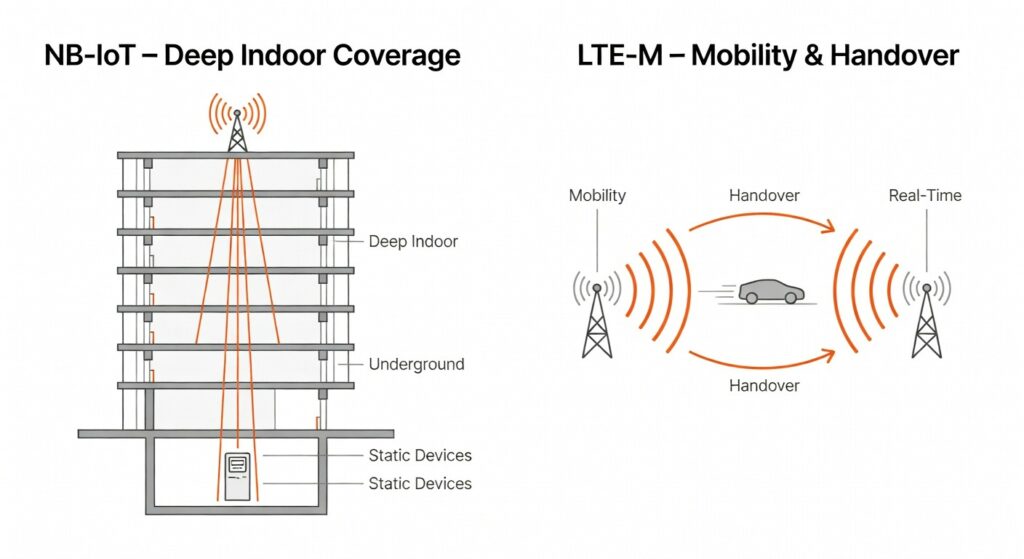
Separate movement from connected-session continuity
A device can move between reporting locations without maintaining an active session throughout the journey. That differs from handing an ongoing connection between cells. Release 13 NB-IoT did not support handover. Later NB-IoT mobility enhancements exist, but implementation and adoption matter; the GSMA’s 2026 guidance cautions against assuming widespread support.
LTE-M is the stronger starting point when connected mobility is required. Test the actual route, cell changes and recovery behavior. Do not use a vehicle-speed threshold copied from a generic comparison as an acceptance criterion.
Test application deadlines, not advertised peaks
Record message size, acknowledgement policy and acceptable delivery time. Include command delivery when a device is sleeping. For periodic updates, measure the complete transfer and recovery after interruption. Peak radio rates omit protocol overhead, signal conditions and scheduling. RedCap deserves evaluation when NR capabilities fit the workload, not simply because the product roadmap says 5G.
How should NB-IoT vs LTE-M battery life be compared?
NB-IoT vs LTE-M battery life depends on the complete reporting cycle, not the technology name. Payload size, coverage, retries, sleep current and network timers all affect energy use. Compare equivalent application outcomes on the same device configuration where possible, and document differences when hardware or service conditions cannot be matched.
Power Saving Mode (PSM) reduces reachability while a device sleeps. Extended discontinuous reception (eDRX) changes paging and sleep intervals. The GSMA Mobile IoT deployment guide explains these mechanisms and their network dependencies. Requested settings and granted settings can differ, so log both.
| Measurement | Record | Include |
|---|---|---|
| Reporting cycle | Connect | Search and attach |
| Reporting cycle | Transfer | Send and receive |
| Reporting cycle | Wait | Paging and timers |
| Reporting cycle | Sleep | Device baseline |
| Mobility | Radio record | Cell changes, signal conditions and reconnection events |
| Mobility | Application record | Message delivery, command delay and session recovery |

A Nordic LTE-M and NB-IoT field experiment illustrates why a fixed power ranking fails. Its results varied with radio conditions and network configuration. The experiment used particular hardware, static measurements and operator settings. Its lesson is to measure those variables, not transfer its results into an unrelated fleet forecast.
Build an energy budget you can reproduce
Measure charge across connection establishment, transfer, waiting and sleep. Add unsuccessful attempts, recovery and firmware maintenance. Include the sensor, processor and power supply; modem consumption alone is not device consumption. State usable battery capacity, operating temperature and service-life assumptions before estimating replacement intervals.
For a connected sensor deployment, align battery measurements with the actual sampling and reporting schedule. Separate expected operation from outage behavior. A long coverage loss can dominate an otherwise efficient reporting cycle, so test the retry limit and the recovery path explicitly.
What determines coverage, roaming and global availability?
Coverage, roaming and availability depend on the exact radio service, supported bands, device approval and subscription agreement. An operator’s LTE or 5G footprint does not prove that NB-IoT, LTE-M or RedCap is available to your device. Confirm eligibility by country and operator, then validate representative deployment locations.
The GSMA Mobile IoT deployment map helps identify networks for further investigation. It does not promise indoor reception, roaming access or every optional feature. Ask the provider to identify the serving networks and service restrictions for your contracted scope.
RedCap also needs a commercial check. T-Mobile’s RedCap service update describes a named commercial device and network context. That is useful evidence of deployment, but not evidence that all 5G subscriptions or modules support RedCap.
Write down the supported combination
Record module model, firmware, antenna design, bands, operator, subscription and enabled features. Request approval requirements and any restrictions on long-term roaming. Keep this matrix versioned alongside the bill of materials. A modem firmware change or service migration can invalidate an earlier test.
Use weak-signal locations, installation enclosures and real travel routes in the pilot. Record failures as carefully as successes. For an international product, a single successful attach in one country is insufficient evidence for the launch territory list.
How do module cost and total cost of ownership compare?
Module cost is only one part of cellular IoT ownership cost. Certification, integration, service charges, battery replacement, support and eventual migration can outweigh a purchase-price difference. Compare quotes against the same countries, volumes, application traffic and support scope. Fixed price bands without those assumptions are not a reliable budget.
The cost worksheet separates what you can quote from what the pilot must measure.
| Cost input | Unit to record | Evidence to obtain |
|---|---|---|
| Hardware and integration | Per device and one-time project cost | Module, antenna, engineering and certification quote |
| Connectivity service | Per active line, period and traffic unit | Contracted countries, minimums and usage terms |
| Field maintenance | Per intervention | Measured failure rate and service process |
| Migration | Per affected device and project | Hardware limits, service notice and replacement plan |
Source: proposed procurement worksheet. No prices or failure-rate assumptions are supplied.
The IoT connectivity cost guide develops the commercial model separately. Keep selection and cost decisions linked without treating the cheapest data allowance as the lowest lifecycle cost. Ask what happens to billing when devices are suspended, replaced or stored before activation.
Obtain separate quotes for the configurations that pass technical screening. Record exclusions and support ownership. A lower module price is useful only if the resulting product still meets delivery, coverage and maintenance requirements.
What changes with eRedCap, network evolution and eSIM?
Network evolution can expand the options for a future hardware design, but it does not remove existing radio limits. Enhanced RedCap belongs to Release 18, while eSIM manages subscription profiles. Neither should be treated as a universal software upgrade that turns an LTE-M device into a 5G NR device.
The Release 18 eRedCap specification defines a reduced 10 Mbps peak data-rate capability and an optional reduced baseband bandwidth configuration. The 5 MHz baseband option is not a claim that every eRedCap radio uses a 5 MHz channel. Verify the category supported by the proposed module.
The IoT eSIM architecture guide explains provisioning separately from the radio layer. An eSIM migration still needs compatible hardware, supported profiles and a working recovery path. Do not promise that remote provisioning eliminates all truck rolls.
For network longevity, obtain the operator’s current support position and contractual notice terms. Avoid a universal sunset year for NB-IoT or LTE-M. Keep the application and backend migration plan separate from any assumption about how long a specific radio service will remain available.
How should you choose and validate a cellular IoT radio?
A cellular IoT radio should pass a documented application acceptance test before fleet rollout. Define delivery, power, mobility and recovery requirements first. Test the supported device and service combination under representative conditions. Keep radio logs and application records together so a successful network attachment cannot hide failed business data delivery.

The acceptance record makes the selection review concrete without inventing benchmark thresholds.
| Test | Record | Acceptance owner |
|---|---|---|
| Normal reporting | Payload, delivery time, retries and energy | Product and device engineering |
| Movement or weak coverage | Cell changes, losses and application recovery | Radio engineering and operations |
| Remote commands | Sleep settings and command completion | Application engineering |
| Maintenance and outage | Update interruption, rollback and service restoration | Delivery and support |
Source: proposed field acceptance checklist. Set numerical thresholds from your product requirements before testing.
- Define the reporting and command workload, including maintenance.
- Confirm the approved module, firmware, bands and service.
- Run comparable tests across normal and adverse conditions.
- Reconcile device logs with received application records.
- Approve rollout only after assigning failure and recovery ownership.
Spenza, an MVNE platform for connected-product operations, describes multi-country sensor connectivity in its published Butlr rollout case. That case supports an operational lesson about coordinating regional deployment. It does not establish an NB-IoT, LTE-M or RedCap performance ranking.
Review the deployment scope with Spenza IoT operations, including service eligibility and responsibility for failed activations.
Choose NB-IoT, LTE-M or RedCap from the application requirement and the supported commercial combination. Use standards to understand capability, operator evidence to establish availability and field measurements to approve the product. Keep power, delivery and recovery records comparable. A radio that looks attractive on a specification sheet can still fail the installation or operating model. The next step is a bounded pilot with named owners, documented conditions and acceptance thresholds agreed before the results arrive. Keep an alternative configuration available until those results justify the rollout decision.
Bring the acceptance record to a fleet deployment review.
Frequently asked questions
Cellular IoT selection questions often mix radio capabilities with device, subscription and application behavior. The answers below separate those layers. Use them to identify what a supplier must demonstrate, then check the supported configuration and field results before treating a feature as available across your deployment.
Can these radios support voice calls?
Voice support depends on the radio, device implementation and operator service. NB-IoT is not a substitute for a conventional cellular voice service. For LTE-M or RedCap, require a supported voice configuration and test call behavior on the intended network. Do not infer voice availability from the technology label alone.
Can NB-IoT handle firmware updates?
NB-IoT can carry downlink data, so it is not inherently a one-way technology. Practical firmware updating depends on image size, throughput, energy and interruption recovery. Test the complete update under weak coverage, including verification and rollback. A successful small telemetry message does not establish that a large update is operationally acceptable.
Does NB-IoT always last longer on a battery?
NB-IoT does not always provide longer battery life than LTE-M. Network timers, transfer duration, retries and device sleep behavior can change the result. Compare equivalent reporting and command workloads, including failed attempts. State battery and environmental assumptions before turning measured consumption into an estimated maintenance interval for the product.
Can an eSIM upgrade an LTE-M modem to RedCap?
An eSIM cannot add RedCap radio capability to an LTE-M-only modem. Profile management changes subscription credentials on supported hardware. RedCap requires an appropriate NR modem, bands, antenna design and service. Check the hardware bill of materials and operator approval before presenting a subscription change as a radio migration path.
Does Release 17 make existing devices satellite-ready?
Release 17 support does not make every existing cellular IoT device satellite-ready. Non-terrestrial service requires compatible device capabilities, firmware, bands and a supported commercial arrangement. Ask for the exact module and service combination. Validate antenna installation, operating conditions and application behavior instead of assuming a software update will be sufficient.
Can one module serve every launch country?
One module may cover several markets, but a universal launch-country claim needs evidence. Supported bands, certification, operator approvals and subscription access must all align. Keep a country-by-country matrix for the exact firmware and hardware version. Where a configuration is unsupported, plan a separate variant or revise the launch scope.