A connectivity management platform (CMP) centralizes SIM subscriptions, usage records and supported carrier actions for connected devices. A CMP helps teams operate cellular connectivity across integrated networks, but it does not automatically manage device firmware, application performance or every network policy. Those responsibilities need separate capabilities and clear ownership.
For an enterprise running devices across several operators, the practical question is what the platform can confirm after an action. A dashboard may show a requested suspension before the carrier applies it. An active SIM may belong to a powered-off device. This guide helps product, operations and engineering teams separate those states, define a workable scope and test the complete workflow. Start with the IoT connectivity selection guide if the underlying network choice is still open.
What Is a Connectivity Management Platform (CMP)?
A connectivity management platform is a control and reporting layer for cellular subscriptions. Typical functions include SIM inventory, activation requests, usage visibility, alerts and billing records. A multi-carrier CMP brings supported operator services into a common interface while retaining the differences in each provider’s permissions, states and commercial terms.
The Cisco IoT Control Center service description illustrates this scope through account, SIM lifecycle, rate plan, billing and diagnostic functions. Scope still depends on the specific service and integration. A feature appearing in one platform does not establish that every CMP provides it.
Separate the responsibilities before evaluating a combined product.
| Layer | Primary responsibility | Evidence to request |
|---|---|---|
| CMP | Subscription inventory, permitted carrier actions, usage and commercial records | Carrier API mapping and completed SIM workflow |
| eSIM provisioning | Supported profile download and lifecycle operations | Compatible components and recovery demonstration |
| Device management | Firmware, configuration and device software state | Device agent, signed update and rollback record |
| Mobile device management | Enrolled endpoint settings, policies and applications | Supported operating system and enrollment method |
| Application platform | Messages, business logic and application data | Authenticated message receipt and processing record |
Scope comparison: Cisco service description, Microsoft MDM overview and AWS IoT Jobs documentation, checked September 2026. Bundled products may cover several rows.
Microsoft’s mobile device management overview describes an enrollment and management system with a device client. That is different from changing a cellular subscription. Likewise, AWS IoT Jobs describes remote device operations, including firmware updates. A CMP can coordinate connectivity around an update without being the system that installs it.
Map those boundaries against your deployment in an IoT connectivity requirements review before comparing feature lists.
How Connectivity Management Platforms Work
Connectivity management platforms connect an enterprise inventory and workflow layer to supported carrier interfaces. The platform translates requests, retrieves observations and records outcomes. Carrier services enforce the available subscription actions. Application traffic may follow a separate network path, so the management console is not necessarily in the device’s data path.

Normalize identity without hiding provider differences
Map the integrated circuit card identifier (ICCID) to the provider account, commercial plan and business asset. Where applicable, record the eUICC identifier (EID) separately from individual profile identifiers. A device serial number, SIM identifier and customer account are related records, not interchangeable keys.
Keep both the provider’s raw status and your normalized label. If one carrier’s suspended state permits reactivation and another service uses different conditions, a shared dashboard label must not erase that difference. Record supported transitions, fees, approval requirements and the source timestamp alongside the display value.
Separate subscription, session and application health
A SIM can be authorized to connect without currently carrying traffic. Soracom’s subscriber-status reference explicitly distinguishes subscription status from session status: an active subscription can be online or offline. Provider labels and fees are service-specific. Your application needs its own health observation rather than treating either state as proof of successful business delivery.
Three observations answer different operational questions.
| Observation | Question answered | What remains unknown |
|---|---|---|
| Subscription state | Is the service authorized under this plan? | Whether the device has power or coverage |
| Data session | Does the network report a current connection? | Whether the application completed its task |
| Application receipt | Did the expected message arrive and pass validation? | Whether every later message will succeed |
Operational interpretation based on Soracom’s subscription/session distinction. The application check is a proposed acceptance requirement, not a vendor benchmark.
Benefits of Using a Connectivity Management Platform
A connectivity management platform can reduce repeated portal work by bringing supported subscriptions, actions and reports into one operating process. The benefit depends on integration depth and reliable records. Measure completed work, unresolved exceptions and reconciled charges; a consolidated dashboard alone does not demonstrate savings, faster recovery or better service.
A single pane of glass should let operations, support and finance work from the same identified subscription. Support needs the last observed session; finance needs the applicable charge; operations needs an authorized action. Each team should see the appropriate records without receiving unnecessary privileges.
Compare a carrier portal when one provider covers the required workflow, an aggregator when a combined connectivity service fits the deployment, and an orchestration layer when existing provider relationships must be coordinated. None is automatically best. Check the exact operators, account types and actions supported rather than comparing carrier counts.
Use measurable acceptance criteria instead of promising a percentage improvement.
| Cost or effort item | Baseline unit | Acceptance evidence |
|---|---|---|
| Integration work | Engineering hours per interface | Required functions tested with production-like accounts |
| Routine operations | Staff minutes per completed task | Same workflow and cohort before and after |
| Exception handling | Unresolved requests per batch | Failure owner, retry decision and final state |
| Billing reconciliation | Unexplained charges per billing period | Usage, contract terms and invoice matched |
| Exit work | Records and interfaces to transfer | Usable export and documented handover |
Proposed evaluation worksheet. No measured savings, prices or time benchmarks are asserted. Use the same workload and service requirements for each comparison.
Include platform charges, API integration, support and continuing exception work in the business case. The IoT connectivity cost guide covers the broader subscription and data model. The CMP should help explain those charges, but its presence does not make dormant inventory free or eliminate delayed usage reporting.
The eSIM Advantage in CMPs
eSIM provisioning can extend a CMP workflow to compatible profile operations without physically replacing a SIM. The provisioning architecture, device components and operator agreements determine what is possible. A management interface does not turn a conventional SIM into an eUICC or make an unsupported radio work on a new network.
GSMA SGP.32 v1.2 specifies remote provisioning for constrained IoT devices. Its architecture includes the eSIM IoT remote Manager (eIM) and IoT Profile Assistant (IPA), with profile preparation through SM-DP+. Consumer SGP.22 uses a different architecture centered on the Local Profile Assistant. A supplier saying “eSIM support” has not identified which implementation it supports.
For a proposed change, establish the existing profile, target profile, compatible components, service eligibility and a recovery path. Test what happens when connectivity disappears during the operation. A completed profile operation and a restored application connection are separate outcomes that both need evidence.
Mixed fleets may need several provisioning paths. Keep physical SIM inventory and different eSIM implementations visible without presenting them as one interchangeable protocol. The remote SIM provisioning guide explains those architecture boundaries in more detail.
How Spenza Supports Multi-Carrier IoT Operations
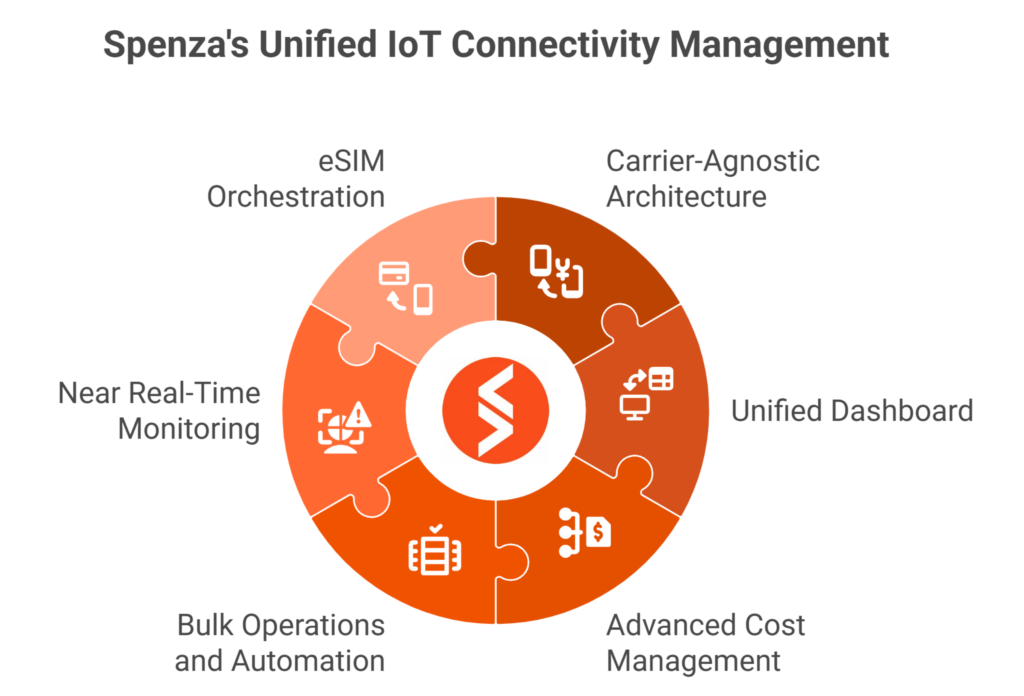
Spenza, an MVNE platform for enterprise IoT connectivity operations, brings carrier services and connectivity workflows into a shared operating layer. Its published Butlr case provides a concrete regional sensor-rollout example. Use that evidence to discuss deployment coordination, while validating each required integration and action against the proposed customer scope.
The Butlr case study describes multi-country sensor connectivity and a rollout reduced from 60 days to seven. That is a reported regional implementation outcome. It is not evidence that every CMP deployment takes seven days, that a firmware fleet was managed, or that all operators exposed identical controls.
The useful buying lesson is to connect commercial availability with the actual deployment workflow. A sensor product still needs compatible hardware, an appropriate data path and application validation. The IoT sensor connectivity guide helps connect those device requirements to network selection.
Bring your device types, countries and existing carrier accounts to a connectivity workflow review. Ask to see the specific operation your team must complete.
How Should You Implement and Verify a CMP?
CMP implementation should begin with a small, representative workflow that can be verified from request through final service outcome. Establish identity, permissions, provider mappings and recovery before expanding automation. Keep failures visible and assign an owner, because a bulk request can contain successful, pending and failed operations at the same time.
- Define the inventory. Reconcile business assets, subscriptions, accounts and the systems that own each identifier.
- Map the carrier actions. Document allowed transitions, billing effects, asynchronous behavior and irreversible operations.
- Set access boundaries. Separate viewing, routine changes and destructive permissions. Require appropriate approval for broad changes.
- Run a representative cohort. Include the actual provider and plan combinations, plus offline devices and rejected requests.
- Verify the outcome. Record provider confirmation and application evidence, not just the initiating response.
- Expand with an exit plan. Define stopping conditions, recovery ownership, exports and the handover procedure before adding more devices.
| Stage | Record |
|---|---|
| Request | Identity and permission |
| Provider | Accepted, pending or failed |
| Confirm | Final state and source timestamp |
| Validate | Service outcome and exception owner |

Consider a proposed suspension workflow, not a customer result. An operator identifies an unexpected usage pattern, checks its age and business context, then submits an authorized action. The integration stores a correlation identifier. If the provider response is pending, the task remains open. If the action is rejected, the operator sees the reason and a recovery choice.
Do not automatically retry an irreversible action merely because a request timed out. Read the current provider state and use the documented duplicate-request handling. Likewise, a delayed webhook should not silently overwrite a newer observation. Record timestamps, ordering rules and the original event so an engineer can reconstruct the sequence.
Choose the CMP that proves the operations your team needs across the providers it will actually use. Preserve the distinction between subscriptions, device software and application health, and price the continuing work around those boundaries. Keep the first rollout small enough to inspect each exception. Then expand only when the records, responsibilities and recovery process are clear. A useful next step is to write one acceptance scenario with your operations and engineering owners, attach the relevant service terms, and use it consistently in each Spenza requirements discussion.
Connectivity Management Platform FAQs
Connectivity management platform evaluation often turns on operational edge cases rather than dashboard features. The answers below cover missing application data, existing contracts, device updates, export requirements and delayed observations. Each question should become a specific acceptance check where it applies to your fleet, with the responsible supplier identified in advance.
Why can an active SIM stop sending application data?
An active SIM can stop delivering application data because subscription permission is only one part of the connection. Power, coverage, session setup, routing, credentials or the application itself may fail. Compare provider observations with device logs and message receipts before changing the subscription or concluding that the carrier caused the incident.
Can a CMP keep our existing carrier contracts?
A CMP can retain existing carrier relationships when its integrations and commercial arrangements support those accounts. Ask which actions, usage records and billing details remain available under your contracts. A provider logo in a marketplace does not prove that your account type or negotiated service can be managed through that interface.
Does a firmware update require a CMP?
A firmware update does not inherently require a CMP. The device update system delivers and installs software through an available connection. A CMP may help monitor cellular usage or coordinate subscription readiness, but the device agent, authenticity checks, installation result and rollback remain responsibilities of the update architecture.
What should we export before changing platforms?
Export the identifiers, provider mappings, ownership records, policies and historical evidence needed to operate the fleet elsewhere. Check whether the receiving system can interpret those records and perform the required actions. Data export alone does not transfer a carrier contract, an eSIM profile entitlement or permission to access another provider’s API.
Can one usage alert prevent every overage?
A usage alert cannot guarantee prevention of every overage. Reporting delay, threshold timing, response latency and carrier enforcement all affect the outcome. Test the full detection and action path with an agreed workload. Keep appropriate headroom and escalation procedures, especially where interrupting connectivity would create a larger operational problem.
How should we handle a carrier API outage?
A carrier API outage should make unavailable actions and stale observations explicit. Preserve pending requests, avoid unsafe retries and use the agreed escalation path. Determine separately whether device traffic still works, since management availability and connectivity availability can differ. Reconcile final provider states when the interface returns before closing outstanding tasks.