


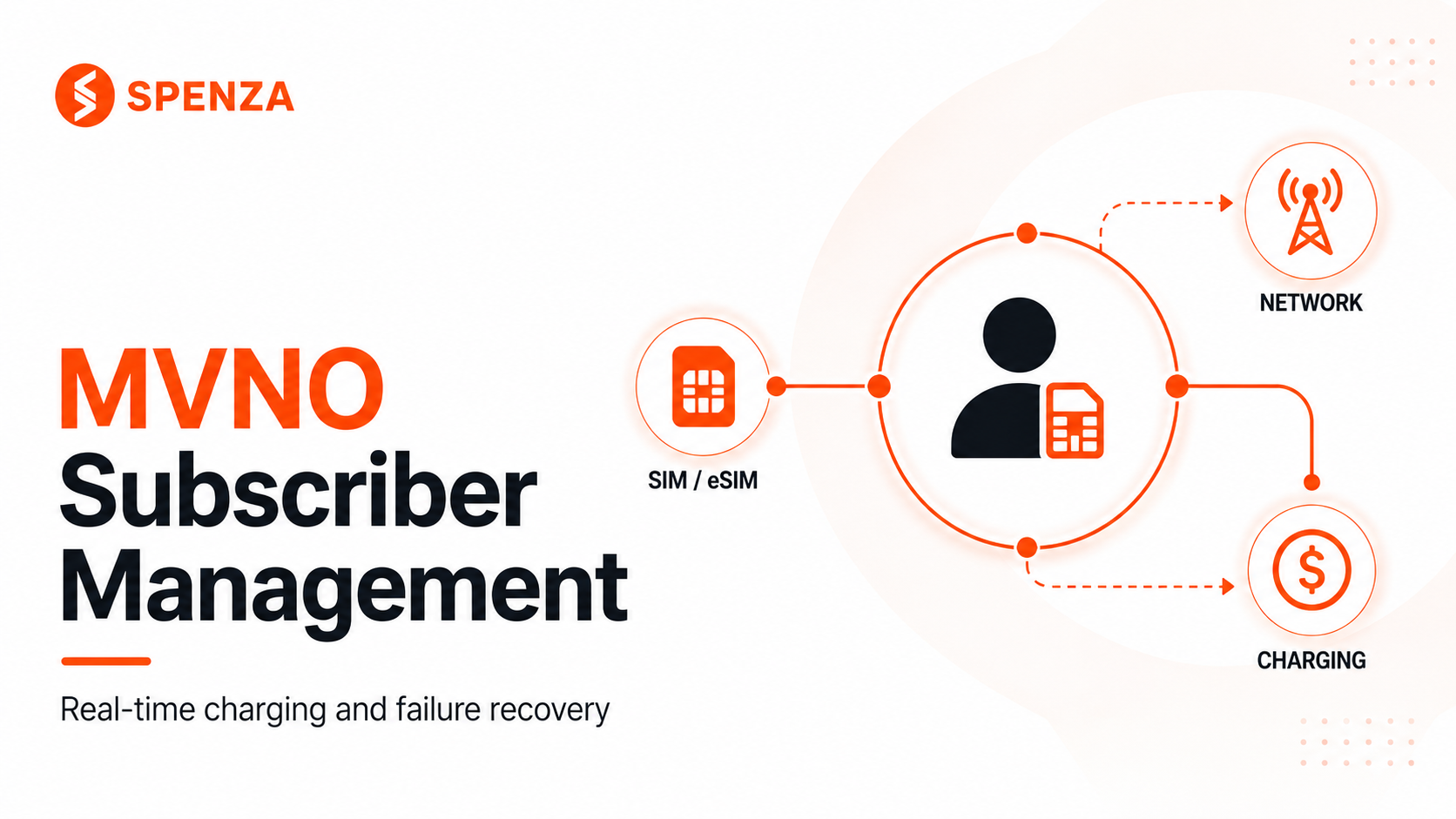
An MVNO subscriber management system is the layer that connects a customer’s commercial subscription to the network service they actually use. It manages the relationship between customers, accounts, subscriptions, SIMs and network identifiers while coordinating provisioning, charging and service-state changes across multiple systems.
The buying question is whether those relationships remain understandable when something changes or fails. A paid order might still be waiting for activation; a terminated subscription might still receive late usage. This guide explains the records, handoffs and operating checks needed to handle those situations. It combines the architecture with a published tenant-management example from Daito, while separating documented capabilities from performance that requires deployment evidence.
What does an MVNO subscriber management system do?
A subscriber management system coordinates the commercial record, assigned connectivity resources and requested service changes for an MVNO. The system connects customer-facing actions to provisioning and billing, while keeping enough history to explain their outcomes. Buying decisions should establish which platform owns each record and which partner confirms each service change.
A useful architecture has four connected responsibilities: identity records, lifecycle rules, provisioning orchestration and charging or billing integration. One vendor may supply several components. A single interface does not establish that the vendor owns every underlying network function. Start with the MVNO operating model, then assign responsibilities to the systems involved.
A light MVNO may ask a partner to perform network changes through an API. A fuller operating model can retain more infrastructure and engineering responsibility. In both cases, the operator needs a reliable view of requested and confirmed service. The MNO, MVNO, MVNE and MVNA roles explain why commercial responsibility and technical execution can sit with different organizations.
Evaluate Spenza against your actual operating boundary: list the customer actions, partner interfaces and retained responsibilities before reviewing platform fit.
Keep subscriber identity separate from assigned resources
A subscriber data model should distinguish the customer, billing account, subscription and assigned network resources. A stable internal subscription identifier connects changes over time, while SIMs and phone numbers remain replaceable assignments. Recording ownership and effective dates helps support teams explain which service, resource and charge belonged together at a particular moment.
An MSISDN is a phone number, not a permanent subscriber identity. A replacement SIM can change resource identifiers without creating a new commercial subscription. Number porting commonly preserves the phone number, so it is not a reliable example of a number change. A later reassignment of a number must not expose an earlier customer’s history.

Separate stable records from assignments so resource changes do not overwrite the history needed for support or reconciliation.
| Record | Represents | History to retain |
|---|---|---|
| Customer and account | Commercial relationship and billing responsibility | Ownership and authorized access changes |
| Subscription | The service agreement and selected offer | Plan, state and effective dates |
| SIM or eSIM resource | The assigned connectivity resource | Assignment, replacement and release |
| Phone number | A number assigned to a service | Porting, release and reassignment boundaries |
Source: editorial architecture checklist derived from the destination’s customer, account, subscription and resource model. This is a proposed review structure, not a measured deployment result.
Model commercial and network states separately
Subscriber lifecycle management needs explicit commercial states and separate observations of network and device readiness. A subscription marked active does not prove that provisioning completed, and a suspended commercial record does not prove that network access stopped. Each transition needs a trigger, an authorized owner, a confirmation condition and an exception path.
Define what pending, active, suspended and terminated mean in your own service contract. Record requested changes separately from observed outcomes. The vocabulary can differ between partners; mappings should preserve meaningful distinctions instead of forcing every status into a single active or inactive flag.
An eSIM profile also has its own lifecycle. Profile availability, installation and enablement are related to service delivery, but they are not substitutes for the commercial subscription record. Customer support needs enough context to distinguish an installation problem from an account restriction or an incomplete partner order.
Termination should preserve the records needed for final billing, disputes and agreed retention obligations. A cancellation request may precede the effective end of service. Test scheduled plan changes and cancellation at renewal boundaries so billing and provisioning do not interpret the same instruction differently.
Confirm provisioning outcomes before retrying
Provisioning connects a commercial request to a confirmed service change through asynchronous partner systems. The application should record the intended operation, correlate partner responses and establish the final outcome before presenting success. An accepted API request is an acknowledgement; activation requires the completion evidence defined for that particular service and provider.
The order record needs a stable operation identifier, target subscription, intended change, submission time and latest known outcome. A timeout can leave the result unknown: the downstream system may have completed the request even though the response was lost. Check status or reconcile before issuing an operation that could create duplicate resources.
| State | Meaning |
|---|---|
| Requested | Intended change recorded |
| Confirmed | Provider outcome established |
| Reconciled | Commercial and service states checked |

Idempotency makes a repeated request safe within a defined contract. Stripe’s idempotency documentation illustrates why key retention and parameter handling matter. Verify those properties with each connectivity provider; an idempotent public endpoint does not automatically make every downstream action idempotent.
Events need similar discipline. Stripe’s webhook guidance documents duplicate deliveries and non-guaranteed ordering. For your integration, authenticate incoming events, record them durably and define deduplication and ordering behavior. Do not let an older event overwrite a newer confirmed state merely because it arrived later.
Keep charging decisions and billing records aligned
Charging controls or records service consumption, while billing turns the applicable commercial rules and usage into customer charges. Subscriber management connects those activities through identity, plan versions and effective dates. Reconciliation should explain differences between allowed service, received usage, rated amounts and invoices without silently rewriting the underlying event history.
For Diameter credit control, RFC 8506 replaces RFC 4006 and describes authorization through credit requests and granted service units. Initial, update and termination exchanges support the session lifecycle. An online charging system can reserve units and reconcile consumed amounts; reservations are not identical to final customer invoices.
Charging failure behavior depends on configured policy and supported mechanisms. Continuing service and stopping service have different financial and customer consequences. Agree the permitted behavior, escalation and recovery before launch; neither a universal fail-open rule nor a universal fail-closed rule is appropriate to claim for every deployment.
Billing synchronization also needs explicit handling of late usage, duplicated records and retrospective corrections. Preserve the original event, the rating inputs and the reason for an adjustment. A newer plan version should not silently change how earlier consumption was priced. The MVNO billing guide covers the wider invoice and reconciliation workflow.
Ask for a worked example of an effective-dated plan change followed by late usage. The example should show which plan applies, whether an invoice changes and how support explains the adjustment. That is more informative than a claim that billing is integrated.
Measure unresolved work and state drift
Subscriber operations should measure incomplete changes and unexplained differences between systems, alongside successful transactions. Useful measures need a defined population, observation window and accountable owner. Counts alone can hide aging failures, while average completion time can conceal long-running exceptions that prevent individual customers from using or changing their service.
Build the operations queue around decisions someone can take. An unknown activation needs investigation; a confirmed failure needs a retry, correction or customer response; a mismatch between commercial and network state needs reconciliation. Distinguishing those cases prevents a generic error queue from becoming a permanent holding area.
Choose measures that reveal actionable exceptions; establish targets from your actual service requirements and baseline.
| Measure | Definition to agree | Operational decision |
|---|---|---|
| Unconfirmed operations | Requested changes without a final outcome, grouped by age | Investigate provider status and assign recovery |
| Activation completion | Confirmed completions from an explicitly eligible order cohort | Identify the failing step or excluded population |
| State mismatches | Compared records with inconsistent commercial and service states | Reconcile the authoritative record and downstream state |
| Billing exceptions | Unmatched usage or adjustments, with age and value where available | Resolve missing records and explain corrections |
Source: proposed editorial operations checklist based on the merged failure and integration topics. No customer baseline or performance benchmark is claimed.
Use the provider selection worksheet to assign acceptance evidence and the launch readiness guide to place those checks before wider release.
Use Daito’s tenant model as a scoped example
Daito’s published case provides a concrete example of tenant-based subscription and number management for shared SMS authentication. Spenza’s described work includes real mobile numbers, API access, incoming-message callbacks, activation and disconnection, and billing for active lines. The case supports those delivered capabilities without establishing a subscriber scale, latency benchmark or independently tested isolation result.
The approved Daito case study describes number pools managed for tenants, with credit and low-balance notifications. That makes the relationship between tenant, number and subscription operationally important: an incoming message and its associated charge must be connected to the intended customer context.
Authorization belongs at the object boundary. OWASP’s object-level authorization guidance explains why each request involving an object identifier needs the appropriate access check. Test cross-tenant access only in an authorized environment with controlled test records; a hidden interface control is not an authorization mechanism.
Ask for observable results from a small acceptance exercise before accepting broader operating claims.
| Test | Evidence to capture | Acceptance question |
|---|---|---|
| Replace a resource | Before and after assignments with effective dates | Does the subscription and its history remain consistent? |
| Replay an operation | Request, callback and final resource records | Are duplicate effects prevented or reconciled? |
| Attempt cross-tenant access | Authorized test request and access decision | Is access denied without exposing another tenant’s data? |
| Reconcile late usage | Usage, rating inputs and any adjustment | Can support explain the final charge? |
Source: proposed acceptance checks informed by the Daito scope and linked API/security documentation. These are blank test requirements, not results from Daito or another customer.
Bring this acceptance checklist to a Spenza platform review and map each test to the responsible system, partner and reviewer.
FAQ: subscriber management architecture and operations
Subscriber management questions often concern the boundary between customer records and delivered service. The answers below separate identities, API acknowledgements and operational evidence so buyers can write clearer acceptance requirements. Apply each answer to the documented behavior of your own providers, especially when resources change, requests time out or subscriptions migrate.
Is subscriber management the same as CRM?
Subscriber management connects the commercial subscription to assigned resources, provisioning and service state. CRM concentrates on the customer relationship and its interactions. The systems can share data, but a CRM record alone does not establish whether a SIM is provisioned, which plan applied to usage or whether a service change completed.
Can a phone number be the main subscriber identifier?
A phone number should not be the permanent internal subscription identifier because numbers can be released or reassigned. Keep a stable service identifier and record number assignments with effective dates. That history lets support and billing follow the right relationship while preventing a later assignee from inheriting another customer’s records.
Does an accepted activation request mean service is ready?
An accepted request confirms receipt under the API contract, not necessarily completed activation. Determine which response, status query or event establishes the final outcome. Track an unknown result separately from a confirmed failure, and reconcile a lost response before repeating an operation that might create duplicate service or resource assignments.
Is idempotency enough to prevent every duplicate effect?
Idempotency protects operations within a specified scope and retention window. It does not automatically cover downstream systems, delayed callbacks or a new request carrying a different key. Review each boundary, test duplicate events and retain reconciliation procedures for situations where the recorded outcome and the actual service state disagree.
What should an operator monitor after launch?
An operator should monitor aged unconfirmed changes, confirmed activation outcomes, state mismatches and billing exceptions. Define the eligible population and time window for each measure, then assign an owner who can act on exceptions. Set targets using the deployment’s requirements and observed baseline rather than importing an unsupported industry benchmark.
What should be tested before a subscriber migration?
A subscriber migration should test identity mappings, resource assignments, plan effective dates, access boundaries and reconciliation across the cutover. Agree how in-flight orders and late usage will be handled, and preserve the history needed for support. Use an approved test cohort and documented rollback conditions before expanding the migration scope.
Choose a system you can operate and explain
A useful subscriber platform keeps identities stable, states explicit and failures recoverable. Begin with the commercial and technical boundaries, then test a resource change, an uncertain activation, a duplicate event and a billing adjustment. Keep the evidence attached to the operation so support can explain what happened. Daito offers a relevant published example of tenant-based workflows; your deployment still needs its own acceptance record. Use the checklist in a Spenza review to agree responsibilities, close unverified assumptions and decide which service changes are ready for release.


