


Daito helps businesses securely manage and share two-factor authentication across teams. Its web-based platform gives authorized users access to shared 2FA tokens while keeping administration, access controls, and auditability centralized.
Daito is currently trusted by more than 250 businesses and serves startups, small and midsize businesses, managed service providers, and security-focused teams. Its product is designed to make shared authentication available from a browser rather than tying access to one employee’s phone.
But one authentication method presented a different challenge: 2FA codes delivered through SMS.
Many online services still send one-time passwords to mobile phone numbers. For teams managing shared accounts, those messages traditionally arrive on a physical phone controlled by one person. Daito needed a way to bring those SMS codes into the same controlled, collaborative experience as the rest of its 2FA platform.
Spenza provided the programmable telecom infrastructure required to make that possible.
Daito enables customers to use a real mobile phone number while displaying incoming SMS verification and authentication codes directly inside a shared inbox. This eliminates the need for customers to purchase, provision, or manage a dedicated mobile phone, simplifying account verification workflows while preserving access to carrier-issued messaging.
Daito now publicly offers this capability as its shared SMS inbox. Customers receive a real, non-VoIP mobile number, and incoming authentication codes become accessible inside Daito. The feature is currently commercialized as a paid add-on priced at $49 per number per month.
Customer Overview
| Company | Daito |
|---|---|
| Product | Web-based 2FA authenticator for businesses |
| Primary Users | MSPs, IT teams, agencies, technology companies, and security-focused businesses |
| Core Use Case | Securely managing and sharing 2FA access across teams |
| Public Traction | Trusted by 250+ businesses |
| New Capability | Shared inbox for SMS-based authentication codes |
| Connectivity Partner | Spenza |
| Implementation Model | Programmable mobile numbers, APIs, webhooks, and centralized line management |
The Challenge: SMS Authentication Was Still Tied to a Phone
Daito had already created a secure way for teams to manage and share authenticator-based 2FA tokens. SMS authentication, however, remained dependent on traditional telecom infrastructure.
When an enterprise account sent a code through SMS, the message normally arrived on a phone or SIM controlled by one employee. Other authorized users then had to wait for that person or ask them to forward the code.
For MSPs and enterprise IT teams, this created several problems.
Physical phone dependency
Organizations often maintained dedicated phones or SIM devices solely for receiving authentication messages.
This introduced:
- Hardware purchasing and replacement costs
- Charging, storage and device management
- Dependence on whoever had access to the phone
- Manual forwarding of sensitive messages
- Additional operational and security risks
No application-level access to messages
Consumer mobile subscriptions are designed for people using handsets. They do not normally provide a straightforward way for a software platform to receive incoming messages through an API.
Daito needed incoming SMS messages to appear directly inside its application, not on a separate device.
Scaling across enterprise customers
A single MSP or enterprise could require multiple dedicated numbers for different customers, platforms or shared accounts.
The target architecture needed to support:
- Multiple numbers per organization
- Rapid number provisioning
- Centralized activation and lifecycle management
- Reliable delivery of time-sensitive messages
- Separation between enterprise tenants
- Growth from hundreds to potentially thousands of managed lines
These requirements formed the basis of the implementation delivered through Spenza.
Why the Common Workarounds Were Not Enough
| Approach | Limitation |
|---|---|
| Dedicated mobile phones | Adds hardware, maintenance, and dependence on physical access. |
| Manual forwarding | Slows down authentication and exposes codes through uncontrolled channels. |
| Consumer mobile plans | Provide no native provisioning, webhook, or tenant-management workflow. |
| VoIP numbers | May not be accepted by services that restrict virtual numbers. |
| Separate carrier portals | Force teams to manage connectivity outside the Daito experience. |
| One shared number for everything | Makes access control, customer separation, and auditing difficult. |
Daito needed more than a virtual-number provider. It needed a programmable mobile operating layer that could be embedded into its existing product.
The Solution: Programmable Mobile Numbers Embedded into Daito
Spenza delivered the carrier connectivity, provisioning workflows, APIs, billing controls and operational infrastructure behind Daito’s shared SMS inbox.
Spenza’s wider platform combines carrier integrations, SIM and eSIM provisioning, billing, subscriber management, branded experiences, REST APIs and webhooks. This allows businesses to embed connectivity into an existing product without building and operating a full telecom stack internally.
1. Real, Carrier-Backed Mobile Numbers
Daito can provide customers with real mobile numbers rather than relying solely on virtual VoIP numbers.
Each number behaves like a standard mobile line and can receive SMS authentication messages from supported external services.
The provisioning layer was designed to support:
- On-demand number allocation
- SIM or eSIM activation
- Number porting where supported
- Subscription activation and disconnection
- Assignment of numbers to specific customer accounts
- Expansion across additional operators and markets
Callout: Real mobile identity
The number presented to the external service is a carrier-backed mobile number. For the customer, the experience remains software-based and no end-user phone is required.
Daito publicly states that its shared inbox uses real, non-VoIP phone numbers and has tested the service with commonly used platforms such as Microsoft, Google, Amazon and Facebook.
2. Incoming SMS Delivered into Daito
When an SMS is sent to a provisioned number, the incoming message is processed through the connectivity and messaging layer and delivered to Daito’s application.
The implemented workflow is:
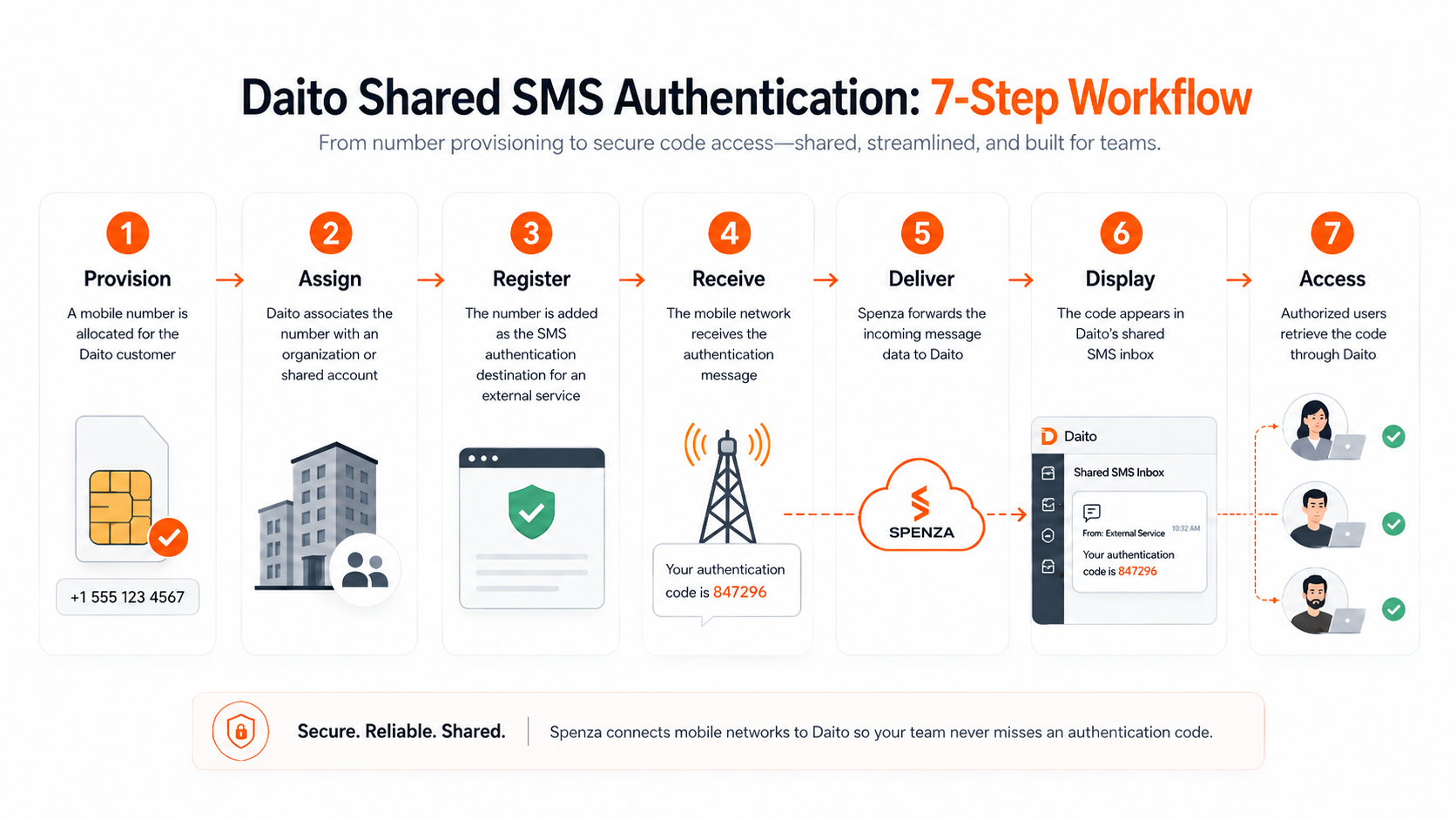
The customer does not have to check another device, access a carrier portal or ask a colleague to forward the message.
3. API and Webhook Integration
Spenza APIs provided the developer layer required to integrate telecom functionality directly into Daito.
The scoped API capabilities included:
- Purchasing or allocating a SIM or eSIM
- Activating a recurring mobile subscription
- Sending an outbound SMS where required
- Registering a callback for incoming messages
- Receiving SMS data through a callback API
- Retrieving message or subscription information
- Managing activation and line lifecycle events
This architecture allows connectivity to behave like another software service inside Daito.
Callout: Connectivity became part of the product
Daito’s users interact with a shared SMS inbox. Spenza handles the telecom operations, carrier integration and mobile-line lifecycle behind that experience.
4. Tenant-Based Number Management
Daito serves teams that may manage authentication across multiple customers, departments or business entities.
The platform was therefore designed to map connectivity resources to Daito’s organizational structure.
The solution supports:
- Dedicated numbers for different enterprise customers
- Number pools organized by tenant
- Provisioning tied to enterprise identifiers
- Separation of messages between organizations
- Role-based access inside the Daito application
- Usage and subscription reporting
This tenant model helps prevent an authentication message intended for one customer from becoming visible to another.
5. Centralized Billing and Operations
Alongside connectivity, Spenza provided the operating layer required to manage recurring telecom services.
The implementation included:
- Centralized line and subscription management
- Prepaid credit management
- Automated low-balance notifications
- Usage and subscription reporting
- Billing for active lines
- Support for plan activation and ongoing charges
- Standard operational support
This allowed Daito to introduce the feature as a commercial add-on without developing a separate telecom billing platform.
The Results
1. A New Shared SMS Inbox Inside Daito
Incoming SMS authentication codes can now be presented within the Daito experience, alongside the company’s existing shared 2FA workflows.
Users no longer need to switch between Daito and a separately managed phone.
2. No End-User Phone Required
Customers do not need to purchase, store, charge or circulate a dedicated mobile phone.
Daito’s public service description confirms that authentication messages can be viewed inside Daito and that the customer does not need to purchase hardware.
3. Real Mobile Numbers Instead of a Basic VoIP Workaround
The solution gives customers access to real, carrier-backed mobile numbers.
This provides a stronger foundation for services that may treat mobile and VoIP numbers differently during verification.
4. A Commercial Add-On Daito Can Sell
Daito has turned the capability into a customer-facing paid add-on.
Its public offering currently lists each number at $49 per month, in addition to the customer’s Daito subscription.
Spenza delivered more than a telecommunications integration. It enabled Daito to launch a recurring connectivity-enabled product capability that complements its existing subscription offering. By embedding mobile services directly into the platform, Daito can increase customer value, strengthen recurring revenue opportunities, and differentiate its product without building telecom infrastructure from scratch.
5. Faster Provisioning and Centralized Management
Instead of requesting lines manually through individual carriers, Daito can manage number allocation, activation and subscription workflows through an integrated platform and APIs.
This reduces the operational effort required as more customers request SMS authentication numbers.
6. A Foundation for Enterprise Scale
The solution was designed around Daito’s expected deployment pattern of multiple numbers per organization and hundreds of potential enterprise customers.
The architecture supports:
- Automated provisioning
- Tenant-level resource management
- Centralized reporting
- Configurable message handling
- Additional operators and geographic markets
- Growth toward thousands of managed lines
This creates a reusable infrastructure layer rather than a one-off integration.
Before and After Spenza
| Before | With Spenza |
|---|---|
| Authentication codes tied to physical phones | Codes available through Daito’s shared inbox |
| Manual SMS forwarding | Automated message delivery into the application |
| Consumer mobile subscriptions | Programmable line and subscription management |
| Separate hardware and carrier workflows | Connectivity embedded into Daito |
| Difficult multi-customer management | Tenant-based number organization |
| Manual line activation | API-driven provisioning |
| Telecom cost handled separately | Integrated billing and operational controls |
| Limited path to scale | Architecture built for large numbers of managed lines |
Why This Partnership Matters
Most telecom services are still delivered as standalone products. Customers receive a SIM, a plan and access to a carrier portal.
Daito and Spenza took a different approach.
The mobile number is not the final product. It is a component inside a broader authentication workflow.
The customer experiences:
- A shared SMS inbox
- Controlled access for team members
- Centralized authentication management
- No end-user phone requirement
- One software interface
Behind that experience, Spenza manages:
- Mobile connectivity
- Number and line provisioning
- Carrier relationships
- Messaging delivery
- Subscription lifecycle
- Billing and reporting
This is an example of telecom becoming embedded software infrastructure.
Rather than asking Daito to become a telecom operator, Spenza provided the programmable connectivity layer required to extend Daito’s core product.
About Spenza
Spenza is an MVNO-in-a-box and connectivity management platform that helps businesses launch, embed and operate mobile services.
Its platform brings together carrier integrations, SIM and eSIM provisioning, billing, subscriber management, branded portals, REST APIs, webhooks and connectivity plans across more than 180 countries.
Spenza enables businesses to add connectivity to an existing product without building their own carrier integrations or telecom operating stack.
Conclusion
Daito’s journey shows how embedded connectivity can transform a traditional telecom dependency into a seamless software experience. By combining Daito’s expertise in shared authentication management with Spenza’s programmable mobile infrastructure, businesses can now access SMS-based 2FA codes through a secure, centralized workflow without relying on physical phones or manual forwarding.
Spenza provided the foundation required to make this possible, from real mobile number provisioning and SMS delivery APIs to automated lifecycle management, billing, and scalable connectivity operations. Instead of building complex telecom infrastructure, Daito was able to focus on its core mission of helping teams securely manage authentication across organizations.
The result is a new category of authentication workflow where mobile connectivity becomes an integrated product capability rather than a standalone service. With a scalable connectivity layer behind the scenes, Daito can continue supporting more customers, expanding enterprise use cases, and delivering a simpler, more secure way for teams to manage shared access.
If your business wants to embed mobile connectivity, launch telecom-powered features, or add programmable SMS and voice capabilities without building carrier infrastructure from scratch, Spenza provides the APIs, platform, and operational foundation to help you launch faster and scale confidently.


