


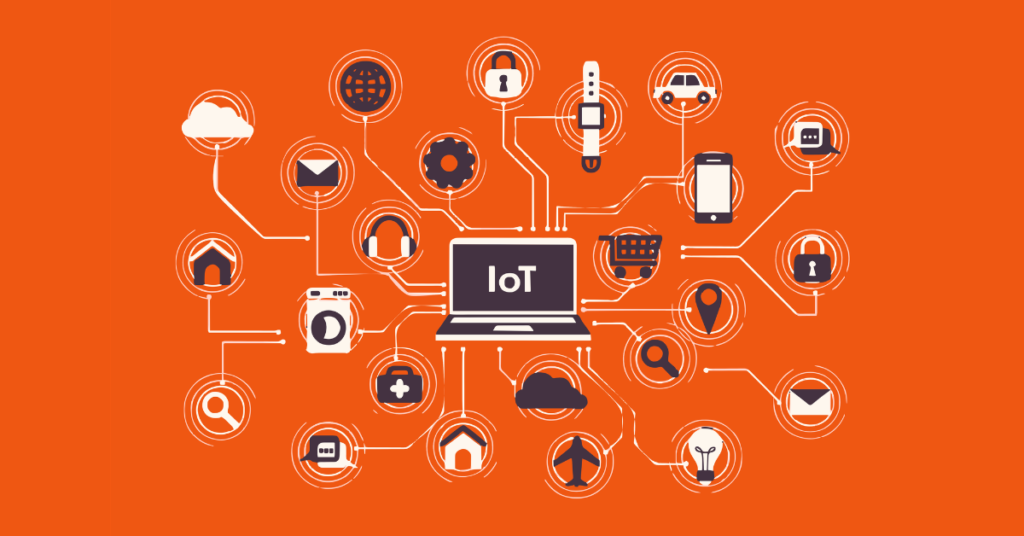
IoT devices are physical objects equipped with sensors, software, and network connectivity that exchange data over the internet or private networks.
The 2026 installed base exceeds 21.1 billion connected devices and is growing roughly 14% year over year, with projections reaching 39 billion devices by 2030.
IoT hardware buyers now generally fall into five categories: consumer brands, OEMs, MSPs and telecom resellers, enterprise IT teams, and industrial integrators.
This is the 2026 IoT devices buyer’s guide built for the people who actually procure connected hardware, not the people writing dictionary entries about it. We organize the entire IoT device landscape around the five buyer types making real decisions today, then layer in the four 2026 device categories most other guides miss: AI-on-device hardware, satellite NTN-capable devices, 5G RedCap modules, and SGP.32-ready eSIM devices.
By the end of this guide, you will know which IoT devices match your buyer profile, how to choose connectivity that survives a 10-year device lifecycle, what the top 15 IoT device manufacturers actually specialize in, and how to model total cost of ownership before you commit a single PO.
What is IoT?
To understand what an IoT device is, first we need to understand IoT.
The Internet of Things (IoT) is a term that covers “the network of physical objects that contain embedded technology to communicate and sense or interact with their internal states or the external environment,” according to the Global System for Mobile Communications Association (GSMA).
What are IoT Devices?
IoT devices are specialized hardware like sensors, actuators, and appliances that connect wirelessly to networks to collect and exchange data. They perform specific tasks and are used across various fields, including medical, industrial, and environmental sectors, enhancing functionality through interconnectedness and real-time data communication.
But let’s deep dive into this term:
The 3rd Generation Partnership Project (3GPP), which develops and maintains technical specifications for mobile telecommunications, breaks up IoT devices into two categories; User Equipment (UE) and Infrastructure.
- User Equipment: Devices that connect to networks (including mobile phones, IoT devices, and computers).
- Infrastructure: The equipment UE connects to for telecommunication services and includes the access network and core network.
It’s interesting here that 3GPP keeps mobile phones and computers separate to IoT devices. So with the information we have at hand, how shall we define IoT devices?
A good definition for IoT devices is “equipment that contains embedded technology to sense or interact with their environment and communicate with the internet.”
Smart home voice assistants like Google Home and Amazon Alexa are two of the most known IoT devices. But the number of generic trackers and environmental monitors deployed far outstrips the number of home assistants globally.
You could argue that smartphones and computers are IoT devices; they can sense the physical world and communicate data on it to the cloud. You can certainly use them as expensive IoT devices, but you usually don’t say something is part of IoT when it requires human interaction or control.
Examples of IoT devices: Sensors, Security devices, Point of Sale (PoS) devices, Medical devices, GPS trackers
How Many IoT Devices Exist in 2026?
The number of IoT-connected devices, according to IoT Analytics, reached 21.1 billion globally in 2025, representing 14 percent year-over-year growth. The market is forecast to grow to 39 billion devices by 2030 and exceed 50 billion by 2035. Wi-Fi accounts for 32 percent of all connections, Bluetooth for 24 percent, and cellular IoT for 22 percent. In addition, cellular IoT chipset revenue is forecast to triple, reaching 14.08 billion dollars by 2030.
Technology Mix of IoT Connectivity in 2026
Three wireless IoT technologies account for nearly 80 percent of all IoT connections globally. The breakdown shapes which IoT devices are commercially viable and which are about to be obsoleted by network sunsets.
| Technology | Share of IoT connections | Best-fit IoT devices |
|---|---|---|
| Wi-Fi (incl. Wi-Fi 6, 6E, 7, HaLow) | 32% | Smart home, enterprise sensors, retail beacons, FWA gateways |
| Bluetooth / BLE | 24% | Wearables, asset tags, indoor location, medical patches |
| Cellular IoT (NB-IoT, LTE-M, Cat-1, 5G, RedCap) | 22% | Asset trackers, smart meters, fleet, EV chargers, vending |
| LPWAN (LoRaWAN, Sigfox, Mioty) | ~8% | Agriculture, environmental monitoring, smart cities |
| Other (Zigbee, Z-Wave, Thread, Matter) | ~14% | Smart home mesh, lighting, locks |
How Internet of Things (IoT) Devices Work
Every IoT device combines five elements: a sensor or actuator that interacts with the physical world, a microcontroller (MCU) that processes inputs, a connectivity module (cellular, Wi-Fi, BLE, or LPWAN), a power source (battery, harvested, or wired), and firmware that manages behavior over the air. The connectivity choice is the most consequential design decision because it locks in cost, coverage, and lifecycle for the next 5 to 15 years.
The 4-Layer Architecture of IoT Devices
| Layer | What it does | Example components |
|---|---|---|
| Device | Senses or acts on the physical world | Sensors, MCU, connectivity module, battery, eSIM |
| Edge | Local aggregation, AI inference, protocol translation | Edge gateways, mini-PCs, AI NPUs, OPC UA gateways |
| Cloud | Storage, analytics, device management, billing | AWS IoT Core, Azure IoT Hub, Google Cloud IoT, custom |
| Application | Business workflows, dashboards, alerts, integrations | Salesforce, SAP, Snowflake, custom mobile and web apps |
Why Connectivity Matters Most in IoT Design
Hardware can be redesigned. Firmware can be patched over the air. The connectivity module decision is permanent for the device generation. If you ship 50,000 NB-IoT meters and a country sunsets NB-IoT in year four, those meters are bricks.
Choose Your IoT Journey: The Five Buyer Types
Most IoT device guides on the internet still organize content by use case (smart home, industrial, healthcare). That works for Wikipedia. It does not work for buyers. A retail brand evaluating GPS-tracker hardware does not self-identify as ‘asset tracking use case.’ They self-identify as ‘a brand looking to ship a connected product.’ Below is the buyer-type taxonomy that matches how 2026 IoT device buyers actually search.
| Buyer type | Typical priorities | Decision criteria | Common devices |
|---|---|---|---|
| Consumer brand | Margin, time to market, brand experience, retail fit | Bundling, eSIM, global SKU, certification, ID and design | Wearables, smart watches, kids GPS trackers, smart home hubs, retail beacons |
| OEM (hardware manufacturer) | BOM cost, lifecycle, time to market, certification | Module cost, multi-RAT, eSIM, SGP.32, FOTA bandwidth | EV chargers, appliances, vending, medical devices, industrial gateways |
| MSP / telecom reseller | Margin, white-label, multi-tenant, support burden | Branded eSIM, MVNE platform, billing, white-label CMP | CPE gateways, fleet trackers, mobile broadband, branded SIM/eSIM |
| Enterprise IT | TCO, security, integration, compliance | Zero Trust, M365/SAP integration, segmentation, audit | HVAC sensors, smart locks, occupancy sensors, video, fleet OBD, ID badges |
| Industrial integrator | SLA, harsh environment, ROI, ISA-95 | Private 5G, OPC UA, RedCap, ruggedization, condition monitoring | Vibration sensors, thermal cameras, PLCs, robotic actuators, condition gateways |
If you sell a branded device directly to consumers, you are a consumer brand.
If you build hardware for another company to brand or deploy, you are an OEM.
If you resell connectivity with optional hardware, you are an MSP.
If you procure devices for deployment inside a single organization, you are enterprise IT.
If you integrate sensors and gateways into industrial systems, you are an industrial integrator.
Most teams fit cleanly into one category. This guide assumes you do.
1. For Consumer Brands: Devices That Carry Your Logo
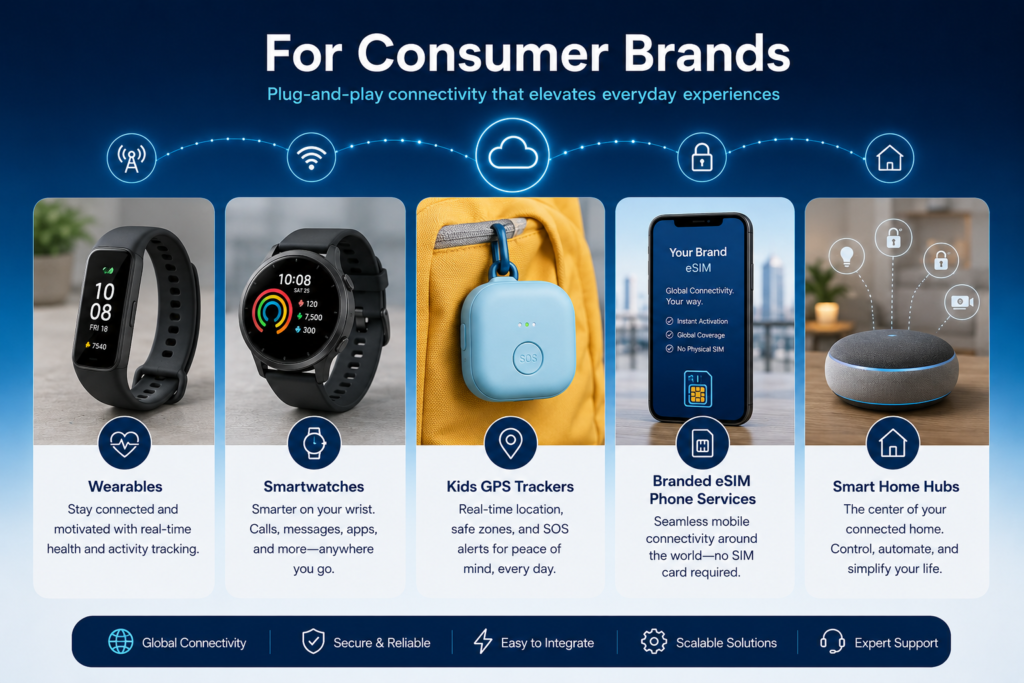
Consumer brand IoT devices are connected products sold directly to end users under your own brand. These include wearables, smartwatches, kids GPS trackers, branded eSIM phone services, and smart home hubs.
The preferred connectivity stack is LTE-M combined with multi-carrier eSIM, supported by a compliance baseline that typically includes FCC, CE, and FCC Robocall Mitigation Database requirements.
LTE-M is the primary connectivity choice for consumer IoT devices because it delivers a strong balance of performance and power efficiency. It provides enough bandwidth for app syncing and firmware-over-the-air (FOTA) updates while maintaining low power consumption that enables multi-day battery life. It is also the only LPWAN option that reliably supports mobility and seamless handovers, which is critical for devices that move with users.
In contrast, NB-IoT is generally not suitable for consumer use cases because it lacks mobility support, voice capabilities, and efficient firmware update handling.
For global product lines, multi-carrier eSIM has become a core requirement. SGP.22 defines current consumer eSIM implementations, while SGP.32 represents the next generation of eSIM provisioning and orchestration that product teams should design for going forward.
Consumer brands can launch a branded MVNO-in-a-box in as little as 7 days using Spenza’s MVNE platform, including:
• Full carrier integrations
• eSIM lifecycle management
• Billing infrastructure
• Shopify-based checkout
Angel Watch, a kids smartwatch brand, uses this exact model to bundle mobile data plans with its hardware.
2. For OEMs: Embedding Connectivity in Hardware
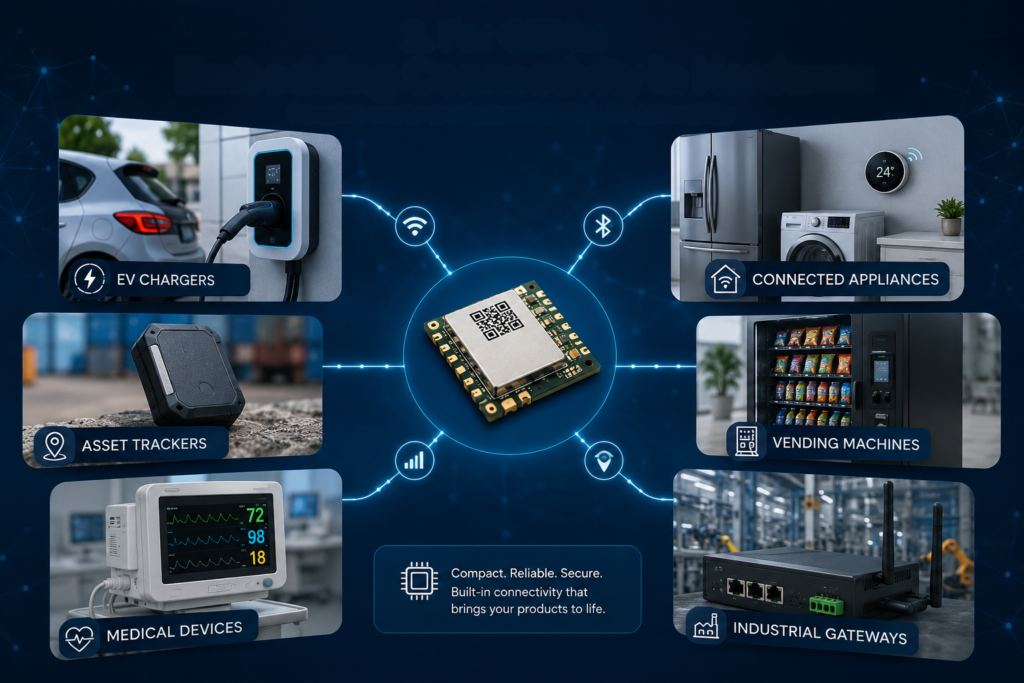
OEM IoT devices are connected products built for another company to deploy or rebrand. They include EV chargers, connected appliances, asset trackers, vending machines, medical devices, and industrial gateways. The most important decisions are the cellular module, the eSIM standard (SGP.22, SGP.32, or iSIM), and the multi-RAT fallback strategy.
| Device class | Connectivity | Module example | Notes |
|---|---|---|---|
| Asset tracker | LTE-M + NB-IoT | Quectel BG95, u-blox SARA-R5 | Multi-RAT critical for global deployments |
| EV charger | LTE-M + Cat-1bis | Quectel EG21, Telit ME910G1 | Higher throughput required for OCPP traffic |
| Smart appliance | Wi-Fi + LTE-M backup | ESP32 + Sequans Monarch 2 | Cellular fallback is critical for uptime |
| Vending machine | LTE-M + Cat-1 | Telit, Sierra Wireless HL7800 | Long lifecycle and reliable FOTA bandwidth needed |
| Connected medical | LTE-M with VoLTE | u-blox SARA-R5, Sequans GM02SP | FDA and CE-MDR compliance requirements apply |
| Industrial gateway | 5G + Cat-4 fallback | Quectel RM500Q, Sierra EM9191 | RedCap upgrade path should be considered |
Spenza provides a single global SIM/eSIM SKU that works across 190+ countries, supports both SGP.22 and SGP.32, and remains operator-neutral.
This allows OEMs to:
• Avoid single-carrier lock-in
• Manufacture one universal hardware variant
• Localize carrier profiles at deployment time
Spenza orchestrates profile localization dynamically, reducing operational complexity across international deployments.
3. For MSPs and Telecom Resellers
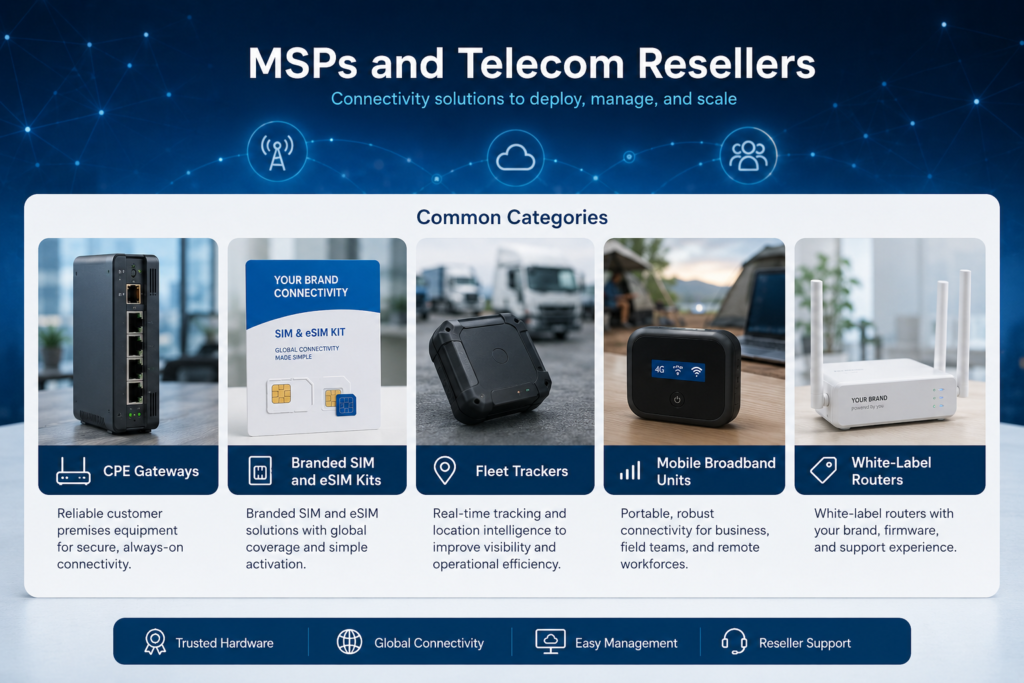
MSP and telecom-reseller IoT offerings typically focus on connectivity-first devices that can be bundled and resold. Common categories include CPE gateways, branded SIM and eSIM kits, fleet trackers, mobile broadband units, and white-label routers.
The key priorities are margin protection, multi-tenant management, and minimizing operational support overhead.
In practice, MSP profitability is less affected by device costs and more by operational inefficiencies such as fragmented management portals and manual SIM handling. Scaling successfully requires unified multi-tenant platforms, branded customer portals, automated billing reconciliation, and SGP.32-ready eSIM provisioning to support modern, large-scale deployments.
Spenza’s MVNE platform is built specifically for managed service providers and resellers, offering a multi-tenant architecture, branded customer portals, integrated billing, and a multi-carrier eSIM marketplace with IoT data coverage in 190+ countries. Instead of spending 12 months building telecom infrastructure, MSPs can launch a fully branded connectivity service in as little as 7 days.
4. For Enterprise IT: Smart Buildings, Fleet, and Mobility
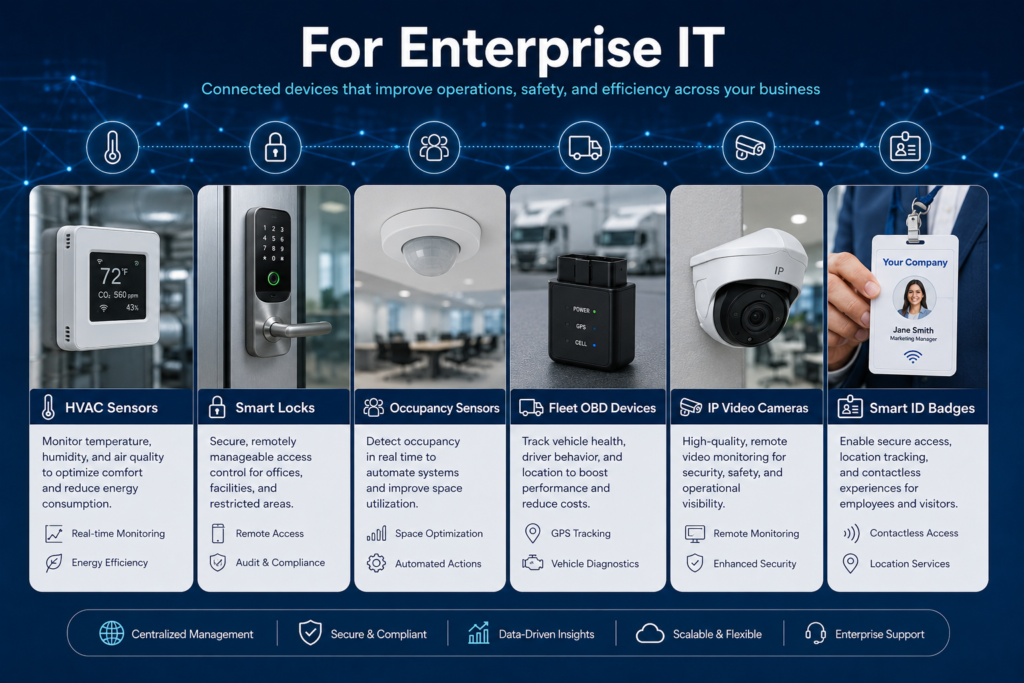
Enterprise IoT devices are deployed within a single organization. Categories include HVAC sensors, smart locks, occupancy sensors, fleet OBD devices, IP video cameras, and smart ID badges. Enterprise priorities include total cost of ownership, security (Zero Trust at the network layer), integration with platforms such as Microsoft 365, Salesforce, and SAP, and audit-ready compliance.
| Category | Typical devices | Connectivity | Lifecycle |
|---|---|---|---|
| Smart building | HVAC, occupancy, water leak, smart locks | Wi-Fi 6, BLE, LoRaWAN | 10 to 15 years |
| Fleet and mobility | OBD-II, dashcams, asset tags, EV chargers | LTE-M, Cat-1, 5G | 3 to 7 years |
| Physical security | IP cameras, access control, intercom | Wi-Fi 6, PoE, LTE backup | 5 to 10 years |
| Workforce productivity | Smart ID badges, room sensors, hot-desk | BLE, Wi-Fi, UWB | 3 to 5 years |
| Healthcare (in-building) | Vital monitors, RTLS tags, fall detection | BLE, Wi-Fi, LTE-M | 5 to 7 years |
Spenza unifies multi-carrier IoT data plans, eSIM lifecycle management, and policy controls into a single platform. This allows enterprise IT teams to reduce overall connectivity costs by 30–40% while consolidating three to seven separate carrier portals into one centralized system.
5. For Industrial Integrators: Predictive Maintenance and Process Automation
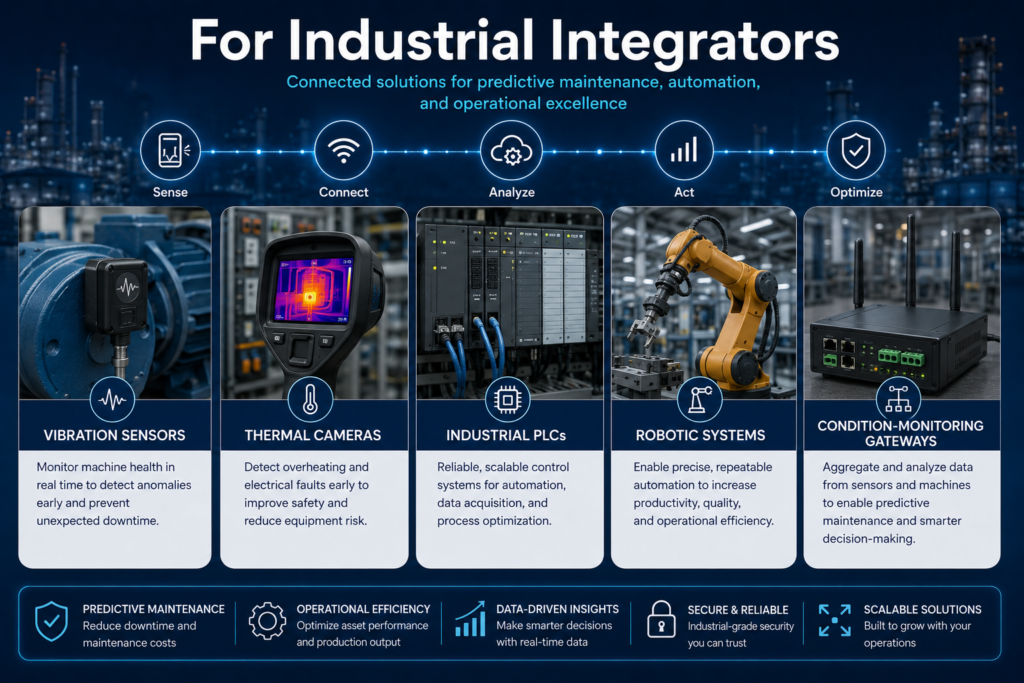
Industrial IoT (IIoT) devices are used in manufacturing, utilities, oil and gas, mining, and energy. Common applications include vibration sensors, thermal cameras, industrial PLCs, robotic systems, and condition-monitoring gateways for predictive maintenance and automation.
Key priorities are reliability (SLA), ruggedization for harsh environments, ISA-95 alignment, and measurable ROI. The main connectivity options include private 5G, Wi-Fi 6/6E, 5G RedCap, and OPC UA integration for industrial systems.
Public cellular networks are generally not suitable for process control. Instead, private 5G (such as CBRS in the US and dedicated spectrum in other regions) provides low-latency, secure, and isolated connectivity, while 5G RedCap offers a cost-efficient middle layer between LTE and full 5G. Predictive maintenance deployments using IIoT can reduce downtime by close to 30 percent.
Spenza supports private 5G, public LTE-M, NB-IoT, 5G RedCap, and satellite NTN connectivity through a single operator-neutral platform. This gives industrial integrators one centralized connectivity management platform (CMP) across mixed network environments, with policy-driven profile switching that respects ISA-95 zone boundaries.
2026 New Device Categories: AI, Satellite, RedCap, and SGP.32
1. AI-on-device IoT hardware
AI-on-device hardware runs ML inference locally instead of streaming raw sensor data to the cloud. This cuts bandwidth, improves latency, and protects privacy. Reference parts include the Bosch BHI360, Nordic nRF54LM20B with Axon NPU, and TDK i3 Micro Module. Specify when sub-100ms response is required or raw data cannot legally leave the device.
2. Satellite NTN-capable IoT devices
Satellite NTN, standardized in 3GPP Releases 17 and 18, makes satellite IoT mainstream. The Nordic nRF92 supports cellular plus satellite fallback in one chip. Use cases include maritime tracking, agricultural sensors, pipeline monitoring, and any deployment crossing cellular dead zones.
3. 5G RedCap IoT devices
5G RedCap, introduced in 3GPP Release 17, is the purpose-built 5G standard for mid-tier IoT. It delivers high speed and low latency at half the cost and power of full 5G. RedCap replaces LTE Cat-4 in cameras, wearables, video telematics, and FWA CPE. Module prices are dropping fast.
4. SGP.32-ready eSIM IoT devices
SGP.32 is the GSMA eSIM standard built for IoT. Released in May 2023, it introduces eIM (eSIM IoT Remote Manager) for fleet-grade remote profile management on headless devices. SGP.32-ready devices switch operator profiles automatically based on coverage, cost, or policy, with no truck rolls.
How to Choose an IoT Device: The 7-Step Framework
1. Define use case and data volume. Tiny packets fit NB-IoT or LoRaWAN. Medium with mobility fits LTE-M. Rich data fits Cat-1, Cat-4, or 5G RedCap. Continuous streaming requires 5G NR or Wi-Fi 6.
2. Choose connectivity. NB-IoT for stationary low-data. LTE-M for mobile low-latency. 5G RedCap for mid-tier. Wi-Fi 6 for indoor high-throughput. Multi-RAT for global SKUs.
3. Pick the power profile. 10+ year battery: NB-IoT or LoRaWAN with PSM and eDRX. 3 to 5 years with mobility: LTE-M. Wired or harvested: optimize for performance.
4. Decide module vs full device. Certified modules cut certification by 6 to 12 months. Modules win for low volume or fast time-to-market. Chipset-down with iSIM wins for high-volume consumer.
5. Plan eSIM strategy. SGP.22 for consumer with UI today. SGP.32 for IoT and headless devices shipping in 2026 and beyond. iSIM for lowest-BOM designs.
6. Validate compliance. FCC for US, CE and RED for EU, RMD for voice, EU Cyber Resilience Act mandatory in 2027.
7. Model 3-year TCO. Hardware is one line. SIM access fees, data plans, platform fees, integration, and support fill the rest. Multi-carrier with pooled data routinely cuts spend by 20 to 30 percent.
The top IoT device manufacturers in 2026 are distributed across sensors, cellular modules, MCUs and semiconductor platforms, gateways, and edge computing systems.
Leading vendors include: Bosch, STMicroelectronics, NXP, Nordic Semiconductor, Honeywell, Sensirion, TDK, Quectel, Telit Cinterion, u-blox, Sequans, Sierra Wireless, Cisco IoT, HARMAN, and Particle.
Compliance and the 2026 Regulatory Landscape for IoT Devices
| Regulation | Jurisdiction | What it requires | Effective |
|---|---|---|---|
| EU Cyber Resilience Act | EU | Security by design, mandatory vulnerability handling, 5-year support window | Mandatory 2027 |
| EU Data Act | EU | Data portability and accessibility requirements for IoT-generated data | In force 2025 |
| FCC Part 15 / 22 / 24 / 27 | USA | RF emissions compliance and intentional radiator approval | In force |
| FCC Robocall Mitigation Database | USA | Voice providers must maintain and certify robocall mitigation plans | In force |
| CE marking + RED | EU | Compliance with the Radio Equipment Directive for market access | In force |
| UK PSTI Act | UK | Default password bans and mandatory vulnerability reporting processes | April 2024 |
| 2G / 3G sunset | Global | Migration away from legacy cellular networks to LTE-M, NB-IoT, or 5G | Rolling 2022 to 2030 |
US operators completed 3G shutdowns by 2022. Europe is mid-sunset. Any IoT device specified with 2G or 3G fallback in 2026 is a continuity risk.
Total Cost of Ownership for IoT Devices
| Cost component | Range per device | Notes |
|---|---|---|
| Hardware | $5 to $500 one-time | Cellular modules typically cost $5 to $25; complete devices vary widely by complexity |
| SIM or eSIM | $0.50 to $3 | iSIM can approach near-zero cost; rugged industrial SIMs cost more |
| SIM access fee | $0.20 to $3 per month | MNO-direct pricing is often higher; MVNO pricing is usually lower |
| Data plan | $0.30 to $15 per month | Pricing depends on region, network technology, roaming, and pooling model |
| Platform fee (CMP) | $0.10 to $1 per month | Modern connectivity management platforms typically charge per active line |
| Integration (one-time) | $5,000 to $250,000+ | Project-based cost covering APIs, provisioning, ERP/CRM integration, and onboarding |
| Support and ops | 10 to 25% of OPEX | Operational cost is usually lower with a unified CMP and automated workflows |
Buy hardware once, but pay for connectivity for the next 10 years. The hardware decision is temporary. The connectivity decision compounds over time.
Common IoT Device Sourcing Pitfalls
- Choosing the device before choosing connectivity. Connectivity is harder to swap and locks the device into a coverage and cost envelope.
- Ignoring the 2G and 3G sunset. Devices relying on 2G or 3G fallback are effectively decommissioned over time.
- Skipping eSIM and SGP.32 future-proofing. A 10-year device without eUICC creates long-term dependency and truck-roll costs.
- Undersizing FOTA bandwidth budgets. Firmware updates are ongoing—plan for continuous data usage.
- Single-carrier lock-in. One outage or regulatory change can disrupt the entire deployment.
- Ignoring CRA and PSTI compliance. Non-compliant devices risk being removed from the market.
- Treating connectivity cost as fixed. It is often the most variable component of IoT TCO and one of the easiest to optimize.
Conclusion: Device Selection Is Half the Equation
IoT devices in 2026 are abundant, capable, and competitively priced. Choosing the right device is increasingly straightforward. The more common failure point is connectivity, and when it is handled poorly, it undermines the entire device decision.
If you identify as a consumer brand, the next step is bundling connectivity with hardware so devices activate immediately upon unboxing in any country. If you are an OEM, the next step is specifying SGP.32-ready hardware to enable a single global SKU. If you are an MSP, the next step is consolidating onto an MVNE platform to eliminate portal sprawl. If you are enterprise IT, the next step is unifying multi-carrier connectivity under a single CMP. If you are an industrial integrator, the next step is combining private 5G, RedCap, and satellite under one operator-neutral control plane.
Spenza is the connectivity layer that supports all five buyer types. It is operator-neutral, multi-carrier, SGP.32-ready, and deployable in seven days. Hardware decisions remain yours. Connectivity is already solved.
FAQs
Building a connected product, deploying an IoT fleet, or launching a branded eSIM service? Get in touch with Spenza to scope the connectivity layer that pairs with your device strategy


