


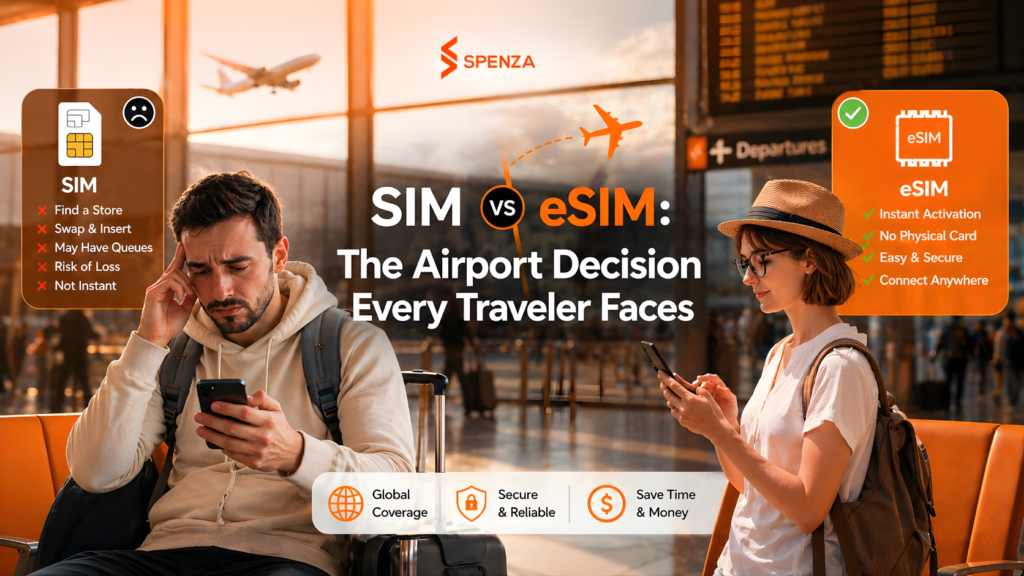
For most travelers in 2026, an eSIM is the better choice at the airport. It is cheaper, faster to activate, and saves you from queueing at a kiosk after a long flight. A physical SIM still wins in three specific cases: long stays, older devices, and destinations where eSIM coverage is patchy. This guide walks through the cost math, the security trade-offs, and the calculator to run your own numbers.
Quick answer: which one should you buy?
For short trips, multi country itineraries, and almost any modern smartphone, an eSIM is the better choice over a physical SIM bought at the airport. You install it before departure, land with data already active, skip the airport kiosk queue, and keep your home number reachable on your primary line. A physical SIM is the better choice when you are staying long term in one country, you need a local phone number for calls and SMS, your phone has no eSIM support, or you are traveling somewhere with limited eSIM coverage.
Airport SIM cards are often marked up 20–300% over local prices. At San Francisco (SFO), tourist SIMs can start at $79 for 3GB. At Newark (EWR), the SIM alone may cost $25 before data. In Bangkok, airport plans sell for around 1,199 THB, while similar plans cost about 300 THB in city stores.
A comparable travel eSIM for the same destinations typically costs $5 to $25.
$79
Cheapest tourist SIM at SFO airport for 3 GB
240%
Tourist markup on airport SIMs in Thailand
2-3 min
eSIM activation time after landing
$15-25
Daily roaming charge from home carriers
What is the difference between an eSIM and a physical SIM?
A physical SIM is a removable plastic card that stores mobile network credentials.An eSIM is a built-in digital SIM that downloads carrier profiles remotely through software.Both provide the same cellular connectivity. The main difference is how users activate and switch network profiles.
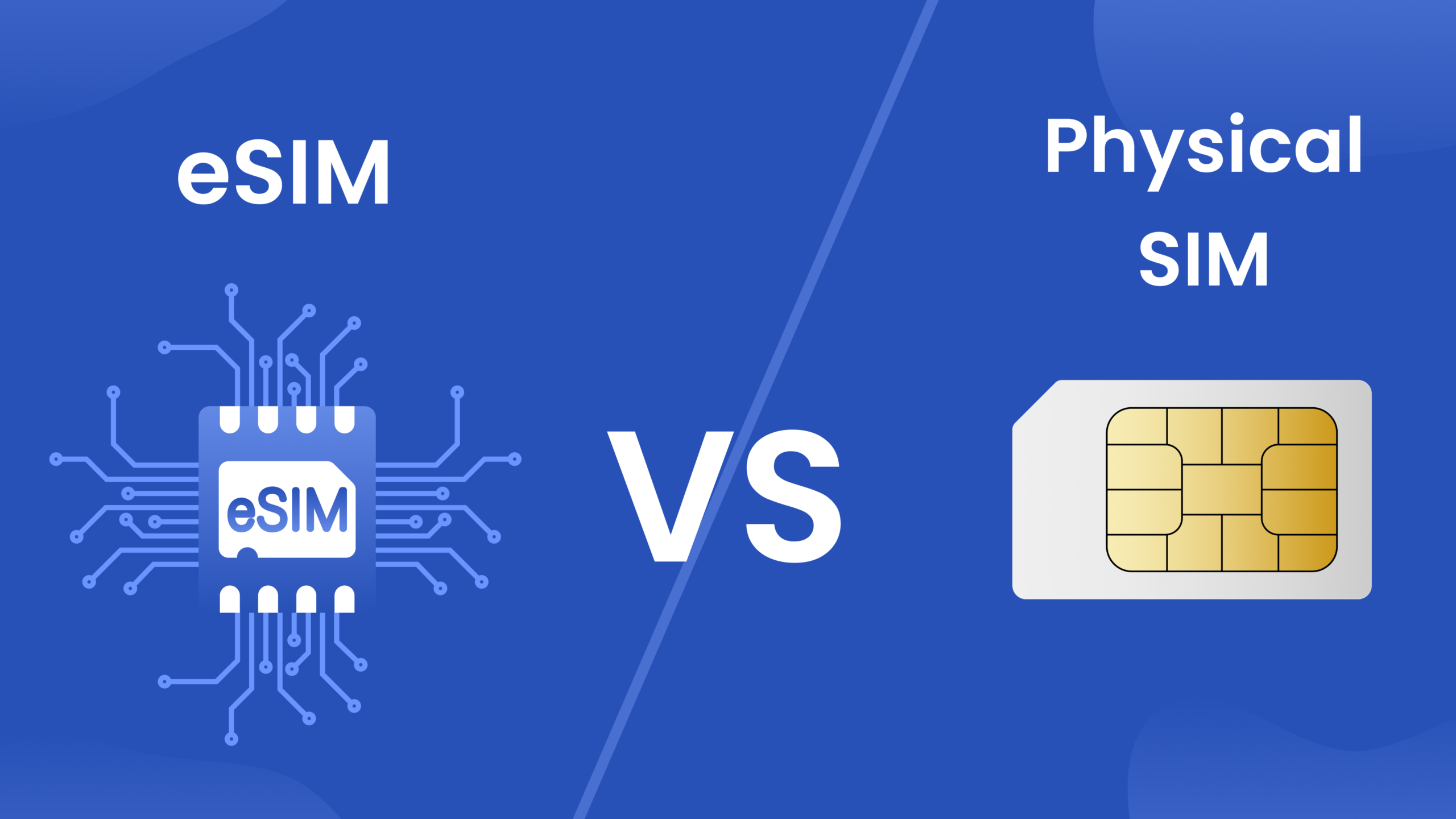
A physical SIM is the small plastic chip you insert into your phone’s SIM tray. It stores your subscriber identity, the credentials your phone uses to authenticate on a mobile network. To switch carriers or get a local plan, you swap the card.
An eSIM, short for embedded SIM, is a 6 by 5 millimeter chip soldered into your phone. Instead of swapping plastic, you download a digital carrier profile by scanning a QR code or tapping an activation link. Modern phones can store multiple eSIM profiles and switch between them in software. The underlying cellular technology is identical. Both connect to the same towers, the same speeds, the same coverage. The only difference is how the credentials get into your phone.
Cost comparison: airport SIM vs eSIM vs roaming
Cost is the headline reason most travelers switch to eSIMs. Three things drive the price difference at airports: real estate (kiosks pay premium rents), captive demand (you have just landed and need data), and short validity periods designed to push you back to the counter on longer trips. Travel eSIMs, sold online with no retail overhead, undercut airport prices by a wide margin in nearly every region.
| Region | Airport SIM (typical) | Travel eSIM (typical) | Home roaming (per day) |
|---|---|---|---|
| USA | $79 to $109 (3–12 GB) | $5 to $20 (3–10 GB) | $10 to $15 |
| Europe (regional) | $25 to $35 per country | $15 to $30 (10–20 GB, 30+ countries) | $12 |
| Thailand / SE Asia | $30 to $45 | $8 to $20 | $10 to $15 |
| Japan | $30 to $60 | $10 to $25 | $10 |
| Global / multi region | Not available at most kiosks | $25 to $50 (10 GB across 100+ countries) | $12 to $15 per country |
The exception is long stays. If you are spending three months in Vietnam or six weeks in Mexico, a local prepaid SIM bought from a carrier shop in town often beats the eSIM on price per gigabyte. The trade off is one or two hours of your first day handling registration paperwork.
Travel SIM Cost Calculator
Why eSIM Usually Costs Less Than Airport SIMs
Travel eSIMs are often cheaper because:
- They avoid airport retail markup.
- They are purchased online before travel.
- They do not require physical inventory.
- Users can compare multiple providers before buying.
- Regional plans reduce the need for multiple SIM cards.
Convenience and activation: the airport queue problem
The hidden cost of a physical SIM is time. Buying one at the airport involves finding the kiosk after immigration, queueing behind other arrivals, presenting a passport for registration in many countries, choosing a plan while jet lagged, swapping the card with a SIM tool, and praying the activation works before you walk out. Real world reports put this at 20 to 45 minutes on arrival.
An eSIM compresses that flow into a 2 to 3 minute scan you finish at home on stable Wi-Fi. You install the profile, leave it dormant, and toggle it on the moment your plane touches the gate. By the time you reach passport control, your maps app already has data and your ride share app has booked you a car.
Install your travel eSIM before you fly, but only enable it for data after you land. Most providers allow profiles to remain unused for 1–2 years without expiring. This lets you buy during promotions, set up on home Wi-Fi, and keep your primary line active throughout your trip.
Best Choice by Traveler Type
Best SIM Choice by Traveler Profile
Short vacation (1–14 days):
Best option: eSIM
Frequent business traveler:
Best option: Global or regional eSIM
Long-term traveler:
Best option: Hybrid approach (travel eSIM first, local SIM later)
Older device without eSIM:
Best option: Physical SIM
Family/group travel:
Best option: eSIM with hotspot support
Compatibility: which phones support eSIM

eSIM compatibility has expanded fast since Apple, Google, and Samsung began shipping eSIM enabled devices in 2018. As of 2026, the supported list covers nearly every flagship and mid range phone bought in the past five years.
- Apple: iPhone XS, XR, and every iPhone after. iPhone 14 and newer in the US are eSIM only with no SIM tray. iPhone 17 and iPhone Air are eSIM only globally.
- Google: Pixel 3 and every Pixel since.
- Samsung: Galaxy S20 series and newer, Galaxy Z Fold and Z Flip series, Galaxy Note 20 and newer.
- Other Android: Most Motorola flagships, Sony Xperia 10 III and later, Huawei P40 and later (region dependent), and a growing list of Oppo, Honor, and Xiaomi flagships.
If you are not sure, open Settings, search for eSIM or Add Cellular Plan. If the option exists, your phone supports it. For the full list of eSIM compatible phones, see our compatibility guide.
Security: SIM swap fraud and stolen phones
An eSIM is harder to attack physically. A thief who steals an unlocked phone with a physical SIM can pop the card out, slot it into another device, and intercept SMS one time passwords for banking, email, and crypto exchanges. An eSIM cannot be removed without the device passcode and remote management credentials.
The other security gain is on the carrier side. SIM swap fraud, where an attacker convinces a carrier to issue a duplicate SIM with your number, is harder to pull off when the SIM is provisioned through encrypted remote channels tied to a verified device. It is not impossible, but the friction is meaningfully higher than handing over a printed card at a retail counter.
Travel eSIMs from third-party providers are typically data-only. They will not receive SMS messages used for bank alerts or two-factor authentication. Keep your home line active in dual SIM mode so verification codes and important messages still reach you.
Environmental impact
One billion physical SIM cards are manufactured every year, each made from PVC plastic and embedded electronics, then shipped, packaged, and discarded. The GSMA estimates eSIM adoption could cut SIM related plastic waste by hundreds of tonnes per year as the industry shifts. For travelers, this is rarely the deciding factor, but it is real, and it is part of why every major handset manufacturer is moving toward eSIM only designs.
Side by side: the full comparison
| eSIM | Physical SIM | |
|---|---|---|
| Buy from home | Yes | No (usually) |
| Setup time on arrival | 2 to 3 minutes | 20 to 45 minutes |
| Cost vs airport price | 30 to 70 percent lower | Marked up 20 to 300 percent |
| Multi country coverage | One profile, many countries | New SIM per country |
| Keeps home number active | Yes (dual SIM) | Only on dual SIM phones |
| Local phone number for calls | Rare (mostly data only) | Yes |
| Works on older phones | No (eSIM required) | Yes |
| Coverage in remote regions | Limited in some countries | Wider local availability |
| Theft and SIM swap risk | Lower | Higher |
| Long stay (1 month+) | Possible but pricier | Often cheaper locally |
eSIM Advantages:
✓ Faster activation
✓ Lower airport pricing
✓ Multi-country support
✓ No physical card required
✓ Better for short trips
Physical SIM Advantages:
✓ Local phone numbers
✓ Works on older phones
✓ Better for some long stays
✓ Wider availability in some regions
Which one should you choose? By traveler profile
Short stay tourist (1 to 14 days)
Choose: eSIM. The math is not close. A 7 day Europe trip can cost $25 on a regional eSIM and $75 to $90 across three airport SIMs. Setup happens at home, your home number stays reachable, and you avoid the kiosk entirely.
Frequent business traveler
Choose: eSIM with a global or regional plan. Multi country profiles like global eSIMs covering 100 plus destinations remove the per trip setup cycle. Many providers offer corporate billing and pooled data, which is exactly the workflow Spenza powers for fleet and IoT customers through its travel eSIM solutions.
Long stay expat or digital nomad (1 month plus in one country)
Choose: hybrid. Land on an eSIM for the first 3 to 7 days, then visit a local carrier shop in town for a long term prepaid plan once you have your bearings. You skip the airport markup and still get the cheaper local rate for the bulk of your stay.
Older phone or eSIM not supported
Choose: physical SIM, but not at the airport. Take a Wi-Fi only path from baggage claim to your accommodation, then buy a local SIM in the city the next day. You will save a meaningful percentage versus the kiosk price.
Traveling with family or a group
Choose: one phone with an unlimited eSIM as the hotspot. Many travel eSIM plans now allow personal hotspot, which lets one paid line cover several devices. Confirm hotspot is included before you buy. Some providers throttle it.
The hybrid approach: when to use both
Experienced travelers in 2026 increasingly run two lines at once. The home physical SIM or primary eSIM stays on for calls, SMS, and bank OTPs. A second travel eSIM handles all data on a local rate. On modern dual SIM phones this is one toggle in settings. You get the cost savings of local pricing without losing the phone number people use to reach you.
FAQs
Power your global eSIM business with Spenza’s MVNE platform—launch, manage, and scale across 180+ countries. Book a demo.


