
Introduction: The “Cell Tower in the Sky”
The telecommunications landscape is undergoing its most significant structural transformation since the shift from circuit-switched voice to packet-switched data. Satellite connectivity operators are no longer merely infrastructure providers selling wholesale bandwidth—they have evolved into full-fledged service providers competing directly with traditional mobile network operators (MNOs).
This shift represents a fundamental re-architecting of the economics of global connectivity. For over three decades, the satellite sector operated as an insulated vertical, with proprietary hardware, high latency, and business models built around selling raw capacity to telecommunications operators. That paradigm has collapsed.
Now, satellite vendors like Starlink, Skylo, and emerging players like AST SpaceMobile and China’s SpaceSail (Qianfan) are positioning themselves as connectivity operators—owning the customer relationship, managing the service layer, and operating under the same economic models as terrestrial mobile networks.
This analysis examines why this transformation matters for enterprise connectivity strategy, how non-terrestrial network (NTN) 3GPP standards enable this shift, and what CTOs and logistics directors must understand to navigate this new reality.
Satellite Connectivity: From Specialized Infrastructure to an Everyday Network
For most of its history, satellite connectivity operated outside the mainstream telecom ecosystem. It served television broadcasting, government and defense, maritime and aviation, and niche users relying on expensive satellite phones. These systems were reliable, but they were costly, complex, and operationally isolated from cellular networks.
Enterprises treated satellite connectivity like heavy infrastructure. Deployments required dedicated hardware, separate contracts, and specialized network operations. In a world shaped by mobile broadband, this complexity limited scale and slowed adoption.
Old vs New: What Changed in Satellite Connectivity
Then: Proprietary satellite islands
Satellite networks historically operated as closed systems. Geostationary satellites offered broad coverage but suffered from extreme latency and required large, power-hungry terminals. Low Earth Orbit systems reduced latency, but they relied on proprietary technology stacks. Devices were network-specific, roaming was not possible, and costs remained high. As a result, satellite connectivity was confined to maritime, aviation, military, and extreme remote use cases.
Now: Satellites as part of mobile networks
With 3GPP Non-Terrestrial Networks, satellites behave like standard cellular access points. Modern smartphones and IoT devices can connect directly using LTE or 5G waveforms, without specialized hardware or user intervention. When terrestrial coverage fades, devices automatically roam to satellite networks.
This shift is architectural, not cosmetic. Standardization removes friction, enables scale, and transforms satellite connectivity from a special-purpose solution into a normal network layer.
This shift is already visible in commercial positioning:
- T-Mobile positions its Starlink-backed service as addressing coverage gaps across 500,000 square miles in the U.S.
- Verizon has commercially launched direct-to-device messaging on Skylo’s NTN and frames it as supplemental coverage where terrestrial networks do not reach.
- Operator and vendor trials across Europe are explicitly anchored to 3GPP Release 17 NTN.
- Starlink sells “Direct to Cell” text and data plans directly to consumers through MNO partnerships
- Skylo operates as a virtual satellite operator, selling IoT connectivity services to enterprises
- MNOs like T-Mobile, AT&T, and Verizon are facilitating this shift, recognizing that terrestrial tower economics hit a “CapEx wall” in rural areas
Why This Shift Matters
Satellite providers are no longer just selling capacity. They are evolving into connectivity operators that manage onboarding, policy, billing, and user experience. At the same time, mobile operators are becoming coverage orchestrators, blending terrestrial and satellite networks under a single brand.
For enterprises, the implication is clear. Connectivity is no longer managed carrier by carrier. It is platform-led, spanning terrestrial and satellite access seamlessly.
Satellite connectivity has moved from the edge of the network to the core of modern coverage strategy. The question for enterprise connectivity managers is no longer “if satellites will be part of their infrastructure strategy“, but “which satellite connectivity operators their devices will roam onto”.
Why Now? The 3 Drivers of the Satellite Operator
The transformation of satellite providers into full connectivity operators is not accidental. It is the result of three converging forces: enterprise demand for ubiquitous coverage, cellular standardization through 3GPP, and economic pressure reshaping telco coverage models.
Driver 1: Enterprise Demand for Ubiquitous Connectivity
Enterprises do not buy connectivity for comfort. They buy it because operations fail when visibility fails. Even as population coverage improves, operational coverage gaps persist across oceans, deserts, mountains, and rural production zones.
- The GSMA continues to highlight that billions remain offline on mobile internet, underscoring persistent gaps in reach and adoption.
- T-Mobile’s own positioning quantifies the U.S. geographic gap as 500,000 square miles without coverage, which is a useful shorthand for enterprise boards debating risk exposure.
Key sectors driving satellite connectivity demand include logistics, agriculture, and public safety. It keeps supply chains visible across oceans, supports remote farming with connected equipment, and ensures communication during disasters when ground networks fail.
Driver 2: 3GPP Non-Terrestrial Network Standardization
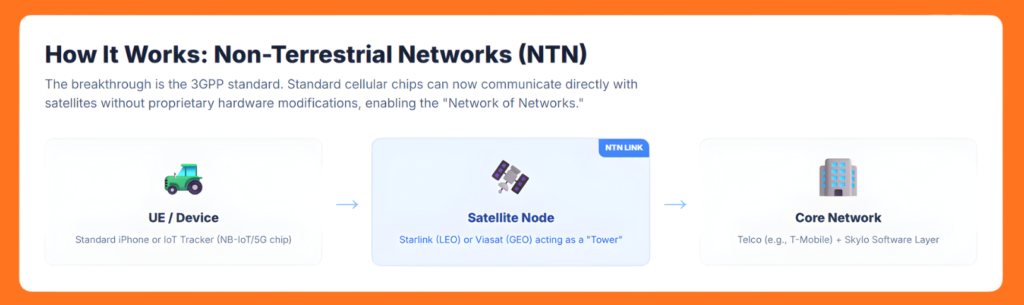
The most important technical enabler is standardization.
3GPP Release 17 formally introduced Non-Terrestrial Networks into the cellular standard, with Release 18 continuing this work as part of 5G Advanced. For the first time, satellites are treated as a native access network within the cellular ecosystem.
In practical terms, this means:
- Devices can acquire, authenticate, and operate over satellite links using standard cellular behavior
- Chipmakers can build satellite support at cellular scale rather than through proprietary designs
- Operators can integrate satellite access into existing roaming, identity, and service frameworks
As a result, satellite readiness is moving into mass-market silicon. Smartphones and IoT modules no longer need dedicated satellite modems, dramatically reducing cost and friction.
This standardization removes the biggest historical barrier to satellite adoption: isolation from the cellular ecosystem.
Driver 3: The Telco Partnership Imperative
Mobile network operators face a structural reality. They cannot economically cover every inch of the planet with terrestrial infrastructure.
Terrestrial networks are optimized for population density and revenue per square kilometer. Remote regions are expensive to build, slow to permit, and costly to maintain. Yet regulators, enterprises, and consumers still expect safety coverage and service continuity.
This mismatch is driving a wave of telco satellite partnerships.
In many cases, operators are allowing satellite providers to use licensed terrestrial spectrum. This enables standard phones to connect directly without hardware changes and fundamentally changes satellite economics.
Satellite connectivity is no longer competing with telcos. It is becoming an extension of their coverage strategy.
The Titans of the New Space Race
Starlink (The “Direct-to-Cell” Giant)

The Play: Launching satellites that act as LTE cell towers.
Starlink’s direct-to-cell strategy is best understood as “cellular access from space” tied tightly to operator partnerships and device compatibility. It is being commercialized as a consumer-facing extension of coverage that can evolve from messaging to broader services over time.
- T-Mobile frames the initial problem as geographic coverage gaps and positions the satellite as an extension layer.
- Reuters reporting on Starlink’s direct-to-cell deals indicates scale and momentum: Starlink is reported to have over 7 million users, over 8,000 satellites, and hundreds of direct-to-cell capable satellites, with rollouts planned across multiple countries and operators.
The Impact: They are signing deals to provide text, voice, and data directly to unmodified smartphones (e.g., T-Mobile partnership).
Two implications matter for telco strategy and enterprise risk:
- Distribution: A satellite player that rides on telco distribution becomes an operator-like entity without owning retail stores.
- Control points: Whoever controls service packaging, prioritization, and enterprise access policies becomes strategically important, even if the underlying spectrum is managed via partnership.
Skylo (The “Network of Networks”)
The Play: Skylo doesn’t launch satellites; they build the software layer (NTN) that connects cellular devices to existing satellite constellations (like Viasat).
Skylo’s model resembles a connectivity operator in a different way: it positions itself as an NTN service provider that integrates with satellite operator partners and the cellular ecosystem.
- Skylo explicitly claims large-scale coverage and frames itself as an NTN service provider operating across continents, built on 3GPP standards.
- Partnerships with MNOs and OEM ecosystem players show it behaving like an operator platform rather than a hardware supplier.
Use Case: Perfect for IoT. A tracker on a shipping container uses cellular in the city and switches to Skylo satellite in the middle of the ocean, seamlessly.
This is the enterprise-grade value proposition: a unified connectivity behavior across terrestrial and non-terrestrial links.
Signals that this is commercial, not theoretical:
- Verizon positions Skylo-based satellite messaging as a commercial direct-to-device service layer for customers where terrestrial coverage is absent.
- Tele2 launched a commercial satellite IoT connectivity service with Skylo and explicitly frames it as 3GPP-based direct-to-device satellite IoT with automatic switching between terrestrial and satellite coverage.
The Challengers (SpaceSail & AST SpaceMobile)
SpaceSail: China’s answer to LEO constellations, aiming for global broadband.

SpaceSail (often referenced via its Qianfan or “Thousand Sails” constellation) is part of a broader acceleration of commercial LEO deployments. From a market structure perspective, the key point is not the brand. It is that multiple sovereign and commercial constellations are emerging, which will fragment supply and create regional policy constraints.
- Reuters reports SpaceSail’s expansion steps and frames China’s commercial LEO activity as accelerating, with SpaceSail pursuing international partnerships and scale.
- China Daily reports constellation growth milestones and integration into aviation connectivity solutions, illustrating commercial intent beyond pure infrastructure.
AST SpaceMobile: Building massive “BlueBird” satellites to deliver broadband speeds (5G) from space to mobile phones.

AST’s thesis is distinct: fewer, larger satellites aiming for higher capacity and broader handset compatibility.
- AT&T’s announcement around the first five commercial BlueBird satellites states an explicit goal of providing voice, data, text, and video services to standard smartphones without special devices, and cites peak speeds up to 120 Mbps with stated coverage ambitions.
- AST highlighted early milestones including two-way voice calls to unmodified smartphones using BlueWalker 3, with partner involvement across operators.
Comparison of Modern Satellite Operator Models
| Player | Core model | Primary target | Dependency | Near-term service reality | Strategic risk |
|---|---|---|---|---|---|
| Starlink Direct-to-Cell | Constellation operator expanding into cellular access | Consumer safety and coverage extension, later enterprise | Heavy MNO partnership and spectrum strategy | Messaging first, staged expansion | Regulatory, spectrum coordination, capacity governance |
| Skylo NTN | NTN service layer integrating multiple satellite operators | IoT and operator partnerships | Satellite operator partners, device ecosystem | Operator-integrated D2D messaging and IoT switching | Experience consistency across partners, SLA complexity |
| AST SpaceMobile | Large-satellite broadband direct-to-device | Broadband-like handset connectivity | Spectrum partnerships, constellation scaling | High ambition, early milestones demonstrated | Capital intensity, deployment cadence |
| SpaceSail | Large-scale LEO broadband constellation expansion | Broadband coverage, regional and global deals | National industrial base, cross-border approvals | Scaling constellation footprint | Geopolitics, market access constraints |
The Enterprise Opportunity: From “Dead Zones” to “Always On”
The enterprise opportunity is often described as “coverage everywhere.” The more precise framing is: operational continuity everywhere.
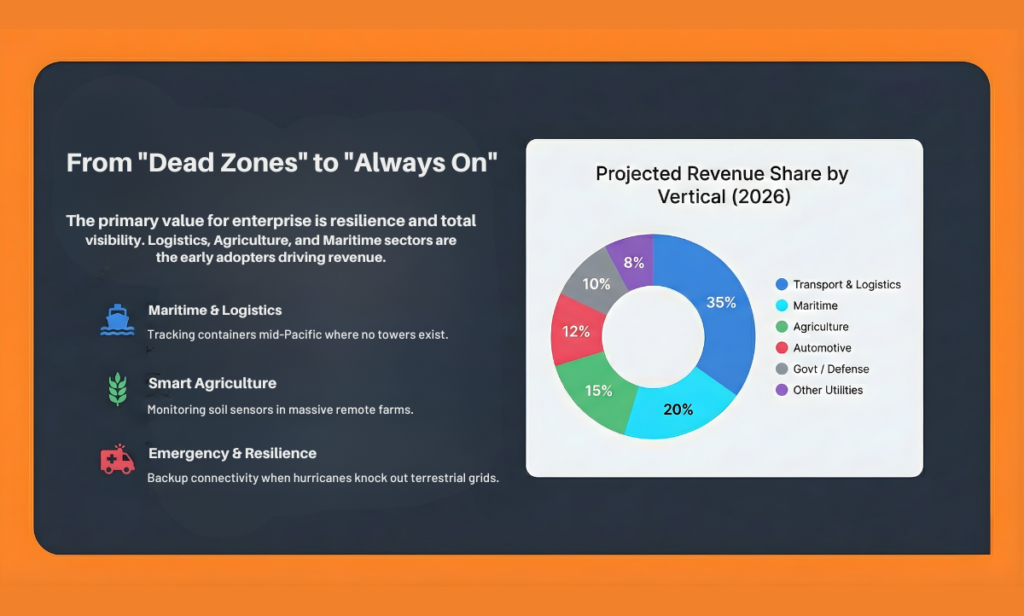
Logistics: Real-time tracking of containers crossing the Pacific Ocean (Maritime).
Logistics operations care about:
- Chain-of-custody telemetry
- ETA confidence and exception prediction
- Cold-chain integrity
- Theft and tamper detection
In practice, enterprises often rely on a patchwork of cellular roaming, port Wi-Fi, and periodic satellite pings. NTN enables a more continuous connectivity model, particularly for low-data-rate telemetry and messaging, allowing devices to seamlessly switch between terrestrial and satellite networks across industries such as logistics and maritime.
Agriculture: Monitoring soil sensors in massive farms where no cell tower exists.
Agriculture connectivity is increasingly about sensor density and operational scale:
- Soil moisture and nutrient monitoring
- Equipment telemetry
- Worker safety and field coordination
These deployments often span large rural footprints where terrestrial coverage is uneven. The economic argument is not “satellite replaces cellular.” It is “satellite eliminates the blind spots that drive operational loss.”
Automotive: Connected cars that can call for help even in the most remote deserts.
Automotive strategy teams increasingly treat connectivity as a safety layer:
- Emergency messaging and location
- Telemetry for remote diagnostics
- Over-the-air updates in constrained environments
This is where “direct-to-device satellite” becomes a board-level risk reducer, even before it becomes a high-throughput consumer product.
Resilience: If a hurricane knocks out local cell towers, the satellite network keeps emergency services online.
Resilience is becoming a procurement criterion. Operators are also adjusting policy frameworks to enable “supplemental coverage from space.”
In the U.S., the FCC’s Supplemental Coverage from Space framework is explicitly designed to enable satellite systems to provide service using terrestrial spectrum under defined conditions, which is a regulatory signal that the satellite-terrestrial boundary is being formalized rather than treated as an exception.
The Solution: Spenza’s Connectivity Aggregation Platform
The Problem: An enterprise doesn’t want 10 bills (one for AT&T, one for Jio, one for Starlink, one for Skylo).
As satellite connectivity operators and NTN mobile operators multiply, enterprise complexity rises:
- Multiple carrier contracts and billing formats
- Separate provisioning and device lifecycle tooling
- Disconnected observability across terrestrial and satellite links
- Fragmented cost optimization and policy enforcement
This is exactly the failure mode enterprises already experienced with multi-carrier cellular deployments. NTN adds another layer unless it is abstracted.
The Spenza Fix: “Spenza acts as your B2B connectivity solution layer.”
The strategic role of an aggregation layer is not to replace operators. It is to standardize how enterprises consume them:
- Operator-neutral posture that avoids lock-in to any single connectivity provider
- A platform approach that treats connectivity like an operational system with unified workflows rather than a set of contracts
Unified Management:
We integrate terrestrial cellular (4G/5G) and satellite (NTN) into one dashboard.
From an enterprise operations standpoint, the required outcomes are consistent:
- Unified inventory (SIMs, eSIM profiles, devices)
- Unified monitoring (usage, connectivity state, anomaly detection)
- Unified governance (policy, spend controls, compliance hooks)
This maps to how modern connectivity management platforms are described in Spenza’s own positioning around centralized management, multi-carrier support, and orchestration.
One SIM/eSIM
Our multi-IMSI technology can manage the handover logic, ensuring you get the best cost and coverage, whether it’s from a tower 1 mile away or a satellite 500 miles up.
Enterprises should translate “one SIM/eSIM” into operational and architectural consequences:
- Fewer device SKUs and fewer deployment variants
- More consistent onboarding and replacement workflows
- A clearer path to policy-based network selection and cost control
Spenza’s blueprint language emphasizes multi-carrier orchestration and unified dashboards as core to this model.
Conclusion: The Sky is No Longer the Limit
As connectivity continues to evolve, the future of enterprise networks is becoming hybrid, resilient, and intelligent. What was once a world of isolated satellite links and fragmented terrestrial coverage is now transforming into a seamless connectivity fabric that spans from cell towers on the ground to satellites in the sky. This shift isn’t just technological — it’s strategic, enabling enterprises to achieve ubiquitous coverage, operational continuity, and cost predictability even in the most remote environments.
In this new era, enterprises must look beyond traditional carrier silos and embrace solutions that deliver unified connectivity management across terrestrial and non‑terrestrial networks. That’s where platforms like Spenza play a vital role. By offering an operator‑neutral connectivity aggregation platform with global eSIM management, unified billing, and real‑time cost controls, Spenza helps organizations simplify complex multi‑operator environments and optimize connectivity spend across IoT, mobile, and satellite links.
Ultimately, the winners in this connectivity transition will be those who treat connectivity not as a utility bought per carrier, but as a strategic, managed platform that supports continuous operations, minimizes risk, and drives measurable business value.
FAQs
Planning for hybrid terrestrial and satellite connectivity? Discover an operator-neutral view of how NTN, direct-to-device satellite, and multi-carrier orchestration can seamlessly fit into your enterprise architecture. Reach out to Spenza today!