


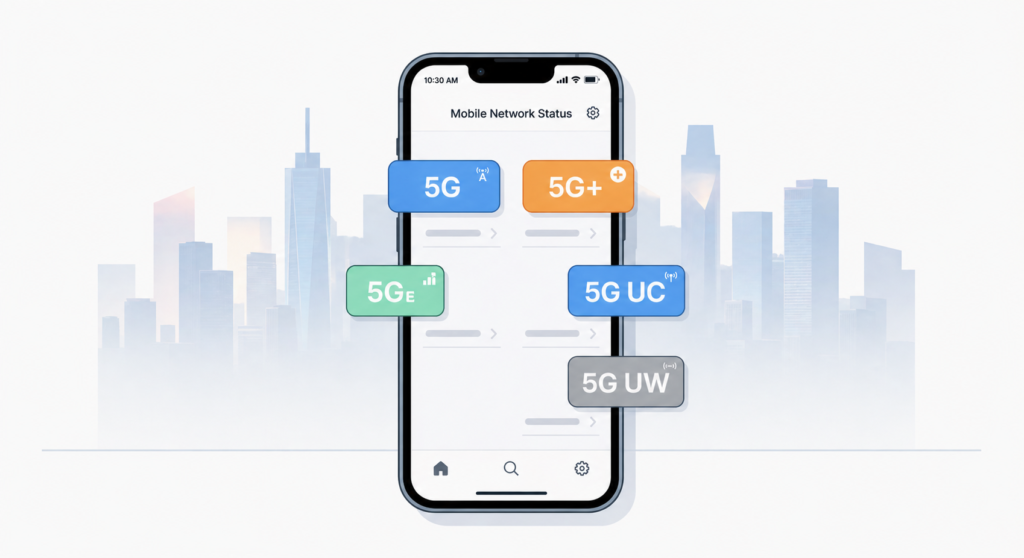
What do 5G, 5GE, 5G+, 5G UC, and 5G UW mean?
If you just want the short version before diving deeper, here it is:
| Label | Carrier | What It Actually Is |
|---|---|---|
| 5G | All carriers | Genuine 5G NR standard, typically low-band with speeds similar to LTE |
| 5GE | AT&T | Advanced 4G LTE marketed as “5G Evolution,” not real 5G |
| 5G+ | AT&T | High-speed 5G using mid-band and mmWave spectrum |
| 5G UC | T-Mobile | Ultra Capacity 5G using mid-band and some mmWave |
| 5G UW | Verizon | Ultra Wideband 5G using mid-band and mmWave |
To understand why these labels exist, you need to look at how carriers built and marketed 5G in the US. Especially if you are buying a smartphone, selecting an IoT module, or planning a connected device deployment.
👉 Short on time? Jump straight to the 5G vs 5GE vs 5G+ vs 5G UC vs 5G UW: Master Comparison Table to see key differences at a glance.
Why Do Carriers Brand 5G Differently?
Think of 5G like coffee. “Coffee” is a broad category, but a barista would distinguish between a regular drip coffee, a flat white, and a cold brew. They are all coffee, but the experience is very different.
Similarly, 5G is a broad wireless standard, but each carrier has created its own branded label to describe which tier of its 5G network a device is currently using.
The problem began when AT&T introduced the “5GE” icon on iPhones in 2018 — before the commercial rollout of real 5G networks had even started. It was a marketing decision that confused millions of consumers and drew formal complaints to the National Advertising Division (NAD) in 2019.
Verizon and T-Mobile followed with their own premium tier labels, each describing different spectrum performance rather than different standards. The result is a status bar alphabet soup that leaves most people genuinely confused about what connection they actually have.
The FCC does not regulate how carriers label network tiers, which is why AT&T was able to market an LTE connection as “5GE” without legal consequences. The NAD ruling in 2019 was advisory, not legally binding.
5G vs 5GE vs 5G+ vs 5G UC vs 5G UW: Master Comparison
This table depicts the features of all 5 carrier brands of the 5G network in one place.
| Feature | 5G (Generic) | 5GE (AT&T) | 5G+ (AT&T) | 5G UC (T-Mobile) | 5G UW (Verizon) |
|---|---|---|---|---|---|
| Real 5G? | Yes | No (4G LTE-A) | Yes | Yes | Yes |
| Frequency | Low-band (Sub-1GHz) | LTE bands | C-band + mmWave | 2.5 GHz + mmWave | C-band + mmWave |
| Typical Speed | 30–100 Mbps | 20–75 Mbps | 100–800 Mbps | 100–900 Mbps | 150–1000 Mbps |
| Coverage | Wide | Wide | Limited (urban) | Wide mid-band | Limited (urban) |
| 3GPP Release | Rel-15+ | Rel-14 (LTE) | Rel-15 / 16 | Rel-15 / 16 | Rel-15 / 16 |
| IoT Module Need | Basic 5G NR | LTE module | n77/n78 bands | n41 band | n77/n78 bands |
| Best For | General use | Legacy devices | Premium urban IoT | Fleet / wide-area IoT | High-speed urban IoT |
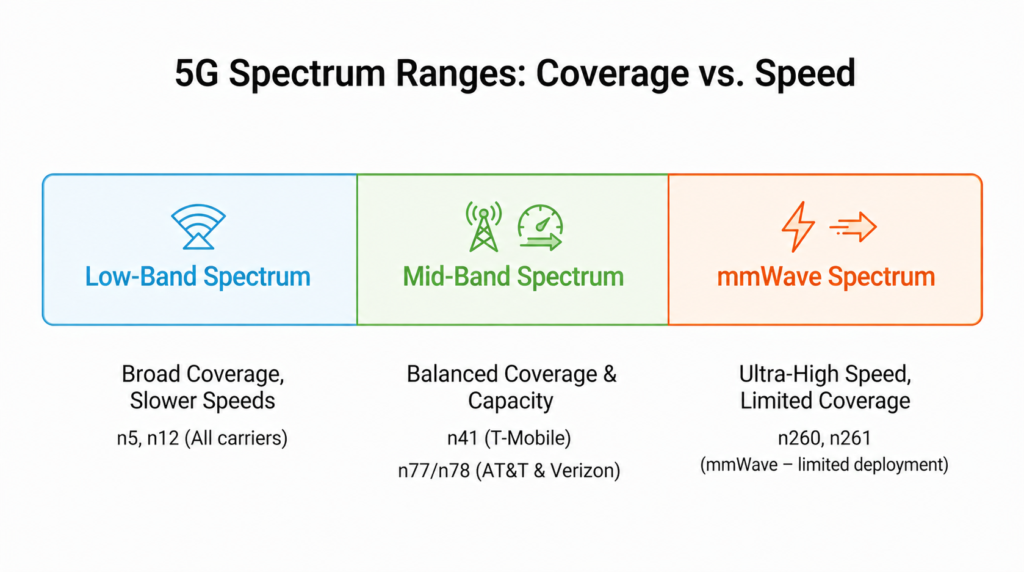
All labeled networks except 5GE are real 5G, but their performance depends on spectrum, coverage, and use case.
What Is 5G? The 3GPP Standard Definition
Most people assume “5G” is just a general label carriers slap on anything faster than 4G. So what is 5G exactly?
According to 3GPP, 5G NR (New Radio) was formally introduced in Release 15, ratified in 2018. It introduces a new radio access technology alongside a core network architecture called 5G Core (5GC).
5G NR operates across three spectrum layers:
- Low-band (Sub-1 GHz): Wide coverage, good building penetration, speeds comparable to strong LTE.
- Mid-band (1–6 GHz): Best balance of speed and coverage, backbone of most real-world 5G deployments.
- mmWave (above 24 GHz): Extreme speeds across very short distances, suited for dense urban environments.
It also introduced two deployment modes critical for IoT:
- NSA (Non-Standalone): 5G radio anchored to a 4G LTE core — most early deployments use this.
- SA (Standalone): Full 5G with a native 5GC core, unlocking network slicing and ultra-low latency.
The FCC does not regulate how carriers label network tiers, which is why AT&T was able to market an LTE connection as “5GE” without legal consequences. The NAD ruling in 2019 was advisory, not legally binding.
5GE: AT&T’s Marketing Mislabel (Not Real 5G)
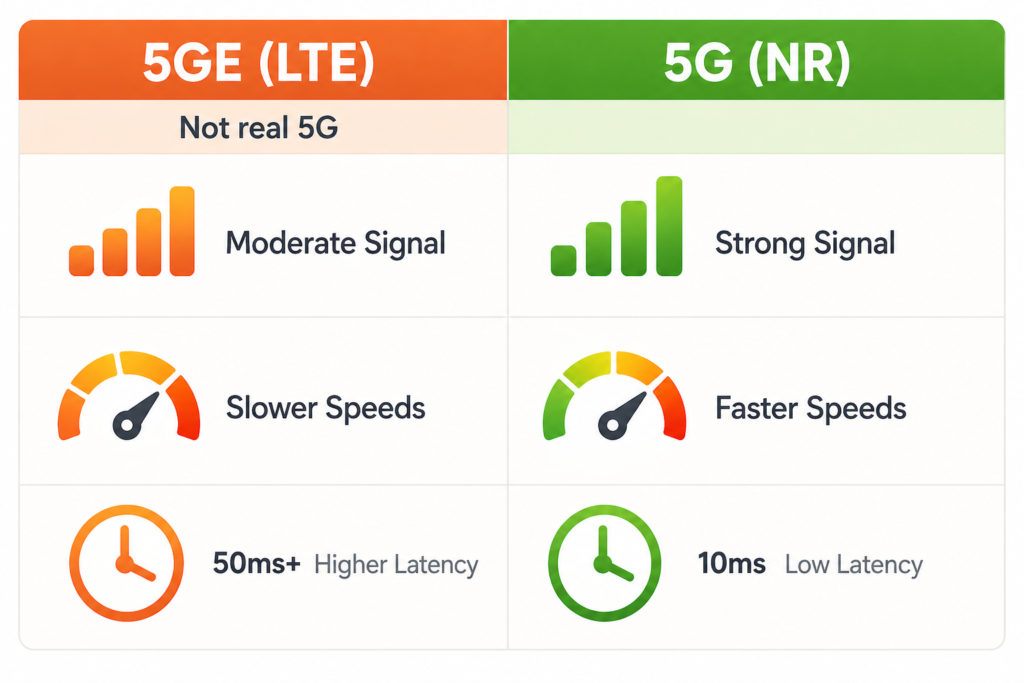
What is 5GE exactly? 5GE stands for “5G Evolution,” and it’s simply AT&T’s branding for advanced 4G LTE, not real 5G. Specifically, LTE-Advanced with technologies like 4×4 MIMO, 256 QAM, and carrier aggregation.
The only reason your AT&T iPhone might show “5GE” is that AT&T chose to display that label when your device connects to a sufficiently upgraded LTE tower.
If your older iPhone or Android device shows “5GE” on AT&T, you are actually on 4G LTE, not a true 5G network. Your speeds will reflect LTE performance, not 5G.
For IoT buyers, this matters significantly. If you are sourcing modules for connected devices and your supplier mentions 5GE compatibility, they are describing a 4G LTE module, not a true 5G module. Pricing and planning should reflect that distinction.
What is 5G+ on AT&T? AT&T’s Real 5G Network
When your AT&T device shows “5G+” instead of just “5G” or “5GE,” you have finally entered real 5G territory. AT&T’s 5G+ network uses C-band and mmWave spectrum, the same mid-to-high frequency bands that make premium 5G noticeably faster.
Speeds in 5G+ zones typically range from 100 Mbps to over 800 Mbps, but the coverage is concentrated in dense urban areas, stadiums, airports, and select metro corridors. For fixed urban IoT deployments like retail kiosks or smart building sensors, this works well. But for mobile or multi-region deployments, it is too patchy to rely on alone.
According to Ookla’s Speedtest Intelligence Q4 2025 data, AT&T’s median 5G download speed sits around 90 to 150 Mbps nationally, with 5G+ zones delivering considerably higher peaks.
5G UC: T-Mobile’s Ultra Capacity Network
T-Mobile’s 5G UC label stands for Ultra Capacity, and it is arguably the most strategically significant premium 5G tier when it comes to coverage breadth.
T-Mobile gained access to a massive block of 2.5 GHz mid-band spectrum, which became the backbone of its 5G UC network. T-Mobile has deployed this mid-band 5G across a wider geographic footprint than any other US carrier’s premium tier.
Typical 5G UC speeds range from 100 Mbps to 900 Mbps. Real-world urban users regularly experience 200 to 400 Mbps connections.
T-Mobile’s 5G UC network primarily operates on the n41 band (2.5 GHz). If you are selecting an IoT module that needs access to this mid-band layer, your hardware must include n41 support.
Many budget LTE-M and NB-IoT modules do not support this band, which can limit performance and coverage.
5G UW: Verizon’s Ultra Wideband Network
What does 5G UW actually mean in real-world usage? Verizon’s 5G UW stands for Ultra Wideband. It has the highest peak speeds of any US carrier where mmWave is deployed, though geographic reach is more limited than T-Mobile’s mid-band network.
One important detail for subscribers: access to 5G UW requires a compatible Verizon plan. As of 2026, Verizon’s Unlimited Plus or Ultimate plan tiers include 5G UW access, while lower-tier plans may only connect to standard 5G.
For IoT modules targeting Verizon’s premium network, look for n77 and n78 band support for C-band access, plus n260 and n261 for mmWave access.
Verizon’s mmWave 5G UW delivers extremely high speeds, but its range is very limited, often just a few hundred meters from a tower.
It typically works indoors only in specially equipped venues. Step outside a stadium or dense coverage zone, and you may drop from 5G UW to standard 5G almost instantly.
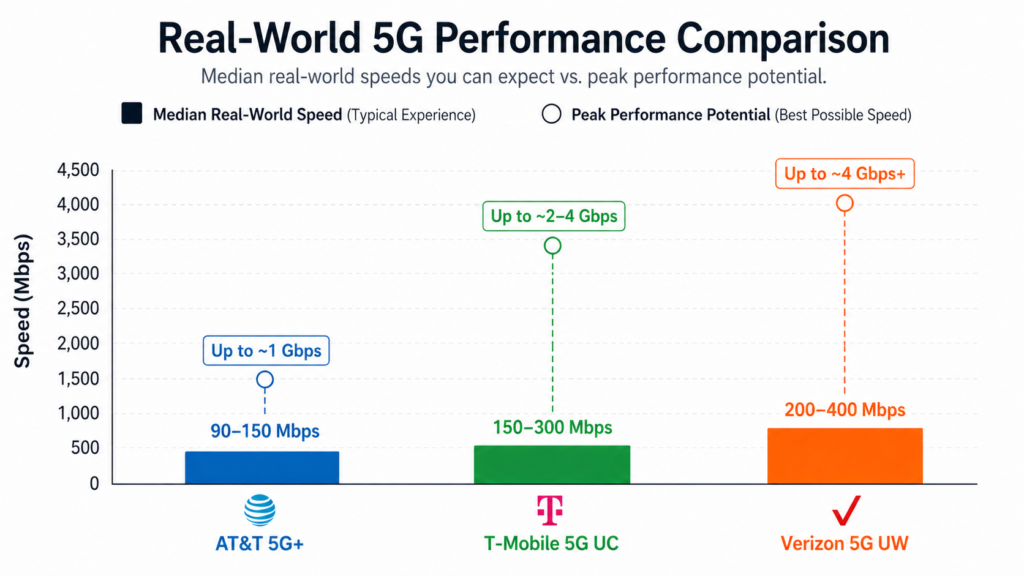
Speed comparisons between carrier tiers depend heavily on whether you are measuring peak theoretical speeds, real-world median speeds, or coverage-weighted averages.
- 5G+ (AT&T): Delivers strong speeds in select urban zones (typically ~90–150 Mbps median), but performance drops outside core metro areas where coverage is limited.
- 5G UC (T-Mobile): Delivers the best consistent speeds across cities, suburbs, and highways (often ~150–300 Mbps), thanks to its wide mid-band deployment.
- 5G UW (Verizon): Peaks highest in dense urban mmWave zones (200–400 Mbps median, with peaks above 1 Gbps). But coverage is highly localized and can vary block by block. Source: Opensignal 5G Experience Report, Q4 2025
For most IoT deployments, consistent speed across a wider geography matters more than peak speeds in a limited footprint.
What Each 5G Brand Means for IoT Module Selection
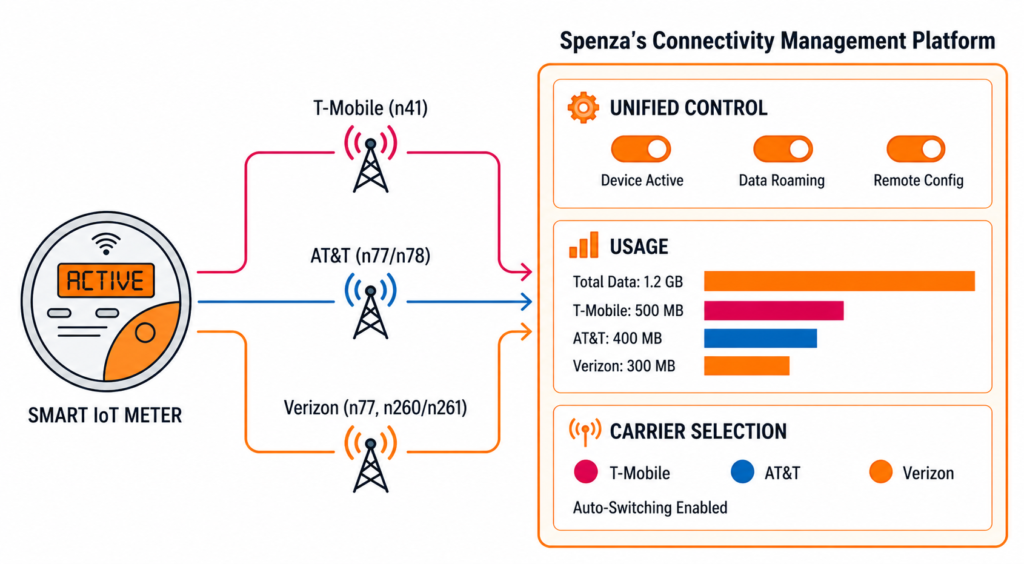
This is where the carrier branding conversation becomes genuinely critical for the IoT space.
When you select an IoT module for a connected product, the hardware itself determines which network tiers your device can access. Choosing the wrong module means your device physically cannot connect to a carrier’s premium 5G layer, even if coverage is available overhead.
Here is a practical breakdown:
| Target Network | Required Module Band | Example Use Case |
|---|---|---|
| T-Mobile 5G UC | n41 (2.5 GHz) | Fleet tracking, nationwide logistics |
| Verizon 5G UW (C-band) | n77 / n78 (3.7–4.0 GHz) | Smart building sensors, urban kiosks |
| AT&T 5G+ (C-band) | n77 / n78 (3.45–3.55 GHz) | Fixed urban deployments |
| mmWave (all carriers) | n260 / n261 | High-density venue applications |
| General 5G / LTE fallback | Sub-6 GHz + LTE bands | Wide-area, low-power IoT |
Selecting a module that supports multiple bands across carriers gives your IoT product the flexibility to roam between networks based on signal strength and coverage, rather than being locked to a single carrier’s performance in one geography.
This is exactly where Spenza’s multi-carrier connectivity platform provides a practical advantage. Instead of committing your IoT deployment to a single carrier brand and its coverage limitations, Spenza’s operator-neutral marketplace allows you to mix and match connectivity plans from multiple carriers on a single management dashboard. Whether your devices need T-Mobile’s wide mid-band reach or Verizon’s dense urban performance,
Spenza’s IoT data plans let you optimize per deployment zone rather than accepting a one-size-fits-all carrier commitment.
3GPP Release Mapping: The Standard Behind the Brand
Every carrier brand maps back to an underlying 3GPP technical release. Understanding this helps IoT architects make informed module and chipset decisions.
- 5GE (AT&T): Based on Release 14 (LTE-Advanced), meaning it’s still part of 4G and does not use 5G NR at all.
- Generic 5G: Built on Release 15, the first official 5G standard that introduced 5G NR and initial deployments globally.
- 5G+, 5G UC, 5G UW: Also based on Release 15/16, but enhanced with better spectrum use, higher speeds, and evolving support for standalone (SA) networks.
- RedCap (IoT focus): Introduced in Release 17, designed to reduce cost and complexity for IoT devices that don’t need full 5G performance.
- eRedCap (forward look): Coming in Release 18, further optimizing 5G for low-power and large-scale IoT deployments.
Release 17 introduced 5G RedCap (Reduced Capability), a version of 5G specifically designed for IoT devices that do not need the full power of a smartphone-grade 5G module. RedCap modules are expected to be significantly more affordable than full 5G NR modules, making them a key technology for the next generation of connected devices. For a deeper dive, see Spenza’s 5G RedCap guide.
For lower-power IoT deployments that do not need full 5G, teams should also compare NB-IoT vs LTE-M before committing to a module roadmap.
IoT Data Plan Implications by Carrier Brand
The network your IoT device connects to directly affects how you choose data plans, manage costs, and plan deployments.
For example, a fixed device like a retail terminal in a busy city can rely on a single network such as Verizon 5G UW. But a delivery vehicle moving across regions will switch between different carrier networks along the way. If it’s tied to just one carrier, you’ll likely run into coverage gaps where that network performs poorly.
This is where Spenza’s multi-carrier eSIM approach makes a difference. Instead of juggling multiple carriers and billing systems, everything is managed in one platform with unified billing and controls.
For enterprises managing large IoT fleets, Spenza’s connectivity management platform can reduce wireless costs by up to 30% through automated invoice auditing, stranded asset detection, and proactive overage alerts.
Decision Framework: Which 5G Brand Fits Your Use Case?
Choosing the right 5G tier comes down to your location, use case, and whether your hardware can actually access that network. Here is a practical guide for both mobile users and IoT teams.
| Use Case | Recommended Approach |
|---|---|
| Smartphone user (AT&T) | Check for 5G+ coverage; 5GE means you’re still on LTE speeds |
| Smartphone user (T-Mobile) | Look for the 5G UC icon for the best performance |
| Smartphone user (Verizon) | 5G UW is available only on higher-tier unlimited plans |
| Fixed IoT (urban) | Choose a carrier based on local coverage; use n77/n78-compatible modules |
| Mobile IoT (multi-state fleet) | Use multi-carrier eSIM with n41 and n77/n78 support |
| Industrial IoT (needs 5G SA) | Opt for Verizon 5G UW or T-Mobile 5G UC with SA-capable modules |
| Low-power wide-area IoT | Use low-band 5G or LTE-M/NB-IoT; carrier branding is less important |
The right choice depends more on your use case and coverage needs than the label on the network.
Conclusion: Carrier Brands Describe Spectrum Tiers, Not Standards
The key takeaway is simple. 5G, 5GE, 5G+, 5G UC, and 5G UW describe network tiers/labels of different carriers for 5G, not different technologies.
The smartest IoT deployments do not bet on a single carrier brand. They build for flexibility using multi-band modules and multi-carrier connectivity management.
That is precisely what Spenza is built for. As a Connectivity-as-a-Service platform, Spenza gives IoT teams and enterprises access to a multi-carrier marketplace, unified eSIM management, and intelligent data plan optimization across AT&T, T-Mobile, Verizon, and global operators through a single platform — without the complexity of negotiating with each carrier individually.
FAQs
Stop guessing which carrier your IoT devices should rely on. Discuss multi-carrier IoT connectivity with Spenza and receive a complimentary assessment of your deployment requirements.


