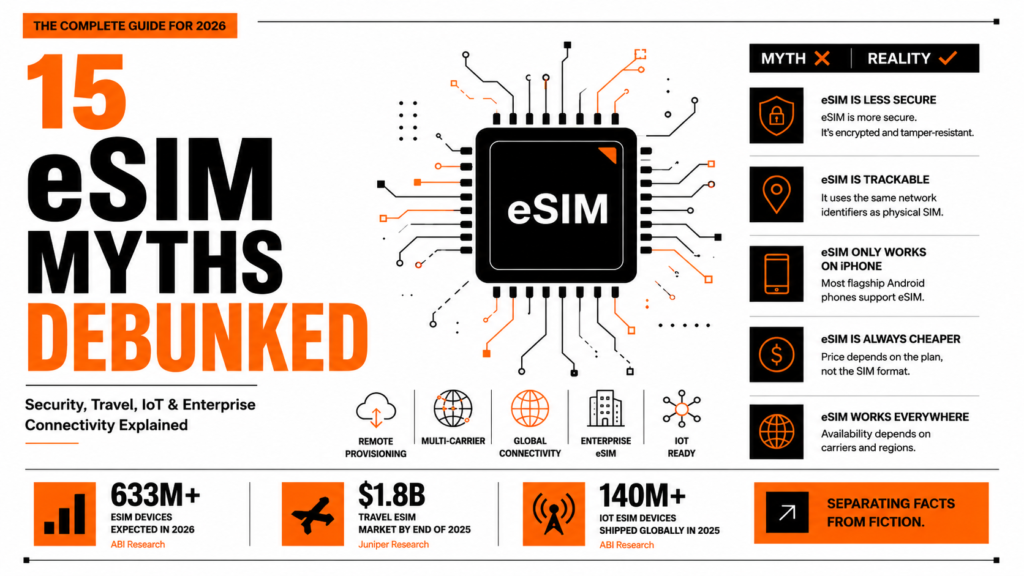
As eSIM technology becomes the new standard for mobile connectivity in 2026, millions of travelers, remote workers, and smartphone users are making the switch from traditional physical SIM cards to digital SIM cards. With instant eSIM activation, seamless network switching, and affordable international data plans, eSIMs offer a smarter and more flexible way to stay connected anywhere in the world.
However, despite their growing popularity, many myths and misconceptions about eSIMs continue to circulate online. Some people believe eSIMs are only available on premium smartphones, while others worry that eSIM setup is complicated, insecure, or unreliable for international travel. These outdated assumptions often prevent users from taking advantage of the convenience, cost savings, and global connectivity that eSIM technology provides.
In this comprehensive eSIM Mythbusters 2026 guide, we’ll separate fact from fiction and debunk the most common eSIM misconceptions. Whether you’re considering an eSIM for international travel, looking for a better mobile data solution, or simply curious about how eSIMs work, this article will help you understand the reality behind today’s most popular eSIM myths and make an informed decision about your mobile connectivity needs.
What is an eSIM?
An eSIM (embedded SIM) is a digital SIM built into a device that allows users to activate, switch, and manage mobile plans remotely without inserting a physical SIM card. It supports secure remote provisioning, multiple carrier profiles, and is widely used in smartphones, wearables, travel eSIMs, and IoT devices.
Everything You Should Know About eSIM in 2026
An eSIM, or embedded SIM, is a digital SIM built directly into a device that allows users to activate mobile plans without inserting a physical SIM card. Instead of manually replacing SIMs, connectivity can now be managed remotely through software, making activation faster and far more convenient.
Today, eSIM technology is used across smartphones, smartwatches, tablets, connected vehicles, and IoT devices.
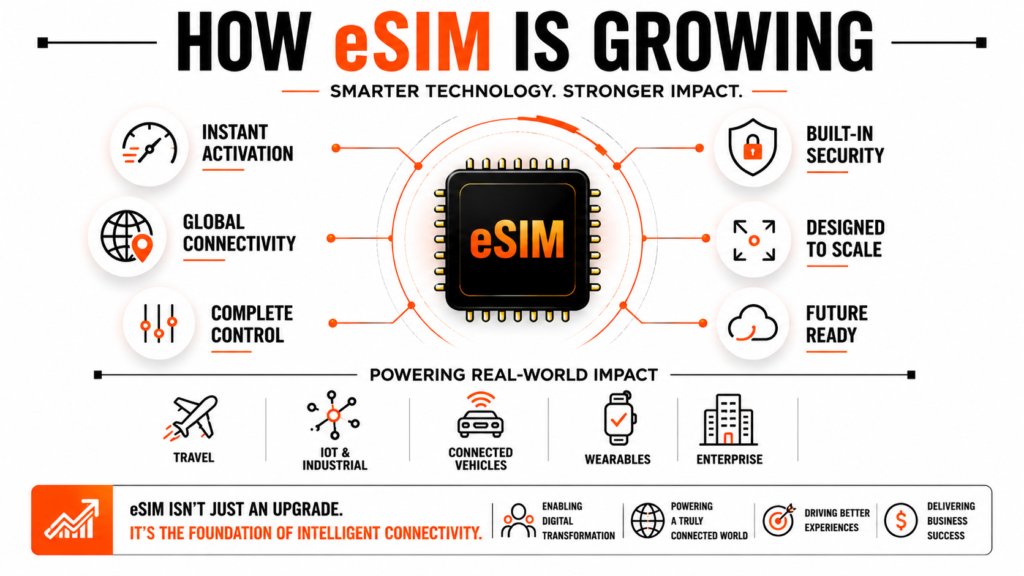
Why Is eSIM Growing So Fast?
According to the GSMA, eSIM adoption is accelerating rapidly across global markets as both consumers and businesses move toward digital connectivity management. What was once seen as a smartphone innovation is now becoming a key part of enterprise connectivity, travel networking, and IoT deployments worldwide.
Common Connectivity Problems eSIM Solves
| Challenge With Physical SIMs | How eSIM Helps |
|---|---|
| Manual SIM replacement | Remote activation and provisioning |
| Difficult carrier switching | Digital operator profile switching |
| Expensive roaming during travel | Easy access to local data plans |
| Hard to manage global IoT fleets | Centralized remote connectivity management |
| Delays in device deployment | Faster zero-touch provisioning |
| Separate SIMs for work and personal use | Multiple profiles on one device |
eSIM is helping solve several modern connectivity challenges, including expensive roaming fees, managing multiple mobile profiles, remote sim provisioning, and scaling connected devices across different regions and operators.
If you’re evaluating eSIM adoption, don’t limit your thinking to mobile phones. In 2026, some of the strongest growth is coming from connected vehicles, wearables, tablets, and IoT devices. As organizations look to simplify provisioning, reduce logistics costs, and support global deployments, eSIM technology is becoming a foundational component of modern connected products across multiple industries.
Why Does It Matter for Businesses?
As businesses deploy more connected devices globally, managing operators, plans, provisioning, and telecom expenses becomes significantly more complex. New GSMA standards like SGP.32 now allow enterprises to remotely provision and manage IoT devices at scale without relying on physical SIM replacements.
This shift is pushing businesses toward centralized connectivity management platforms that simplify multi-operator orchestration, provisioning, and telecom expense management across connected ecosystems.
15 eSIM Myths, Debunked
Myth #1: “There’s No Real Difference Between eSIM and Physical SIM”
Reality
An eSIM works very differently from a traditional SIM card.
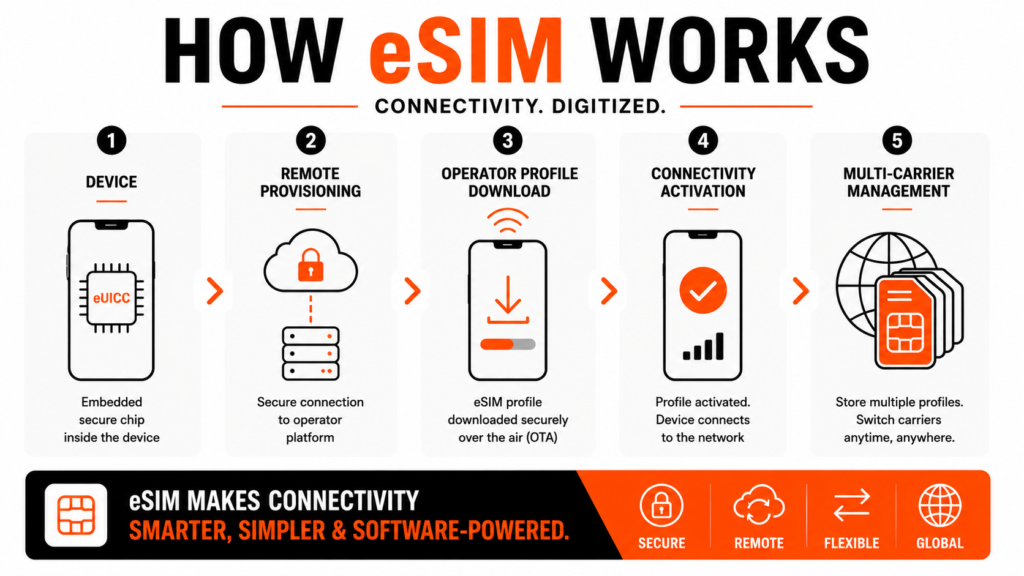
With a physical SIM, changing carriers usually means removing the SIM card and inserting another one manually. eSIM removes that entire process by allowing mobile profiles to be downloaded remotely.
That means users can activate plans, switch operators, and manage connectivity digitally without touching the hardware.
The technology behind this is called Remote SIM Provisioning (RSP), which allows mobile plans and carrier settings to be securely downloaded to a device without needing a physical SIM card.
In simple terms, connectivity becomes software-driven instead of hardware-dependent.
Myth #2: “eSIM and eUICC Are Interchangeable Terms”
Reality
This is one of the biggest areas of confusion around eSIM technology.
An eSIM is the embedded SIM hardware inside the device. eUICC is the technology that allows multiple carrier profiles to be downloaded and managed remotely.
Think of it like this:
- eSIM = the hardware
- eUICC = the functionality powering remote profile management
This distinction matters because eUICC capabilities are what make remote provisioning possible across smartphones, wearables, and IoT devices.
Modern eSIM technology now exists in several form factors, including soldered eUICC chips commonly used in IoT hardware and newer iSIM architectures that integrate SIM functionality directly into the device processor or modem. These approaches reduce hardware footprint, improve durability, and simplify connectivity management for next-generation connected devices.
Myth #3: “eSIM Works on Every Smartphone”
Reality
Not every smartphone supports eSIM yet.
Most flagship devices now include eSIM support, including:
- iPhone XS and newer
- Google Pixel 3 and newer
- Samsung Galaxy S20 and newer
But many budget and mid-range Android phones still skip eSIM hardware entirely.
Support can also vary depending on the country, carrier, and device model, which is why checking compatibility before purchasing an eSIM plan is still important in 2026.
Before purchasing an eSIM plan, always verify that your phone, tablet, or IoT device supports eSIM functionality and is compatible with the carriers available in your region. Device support can vary by model, firmware version, and country, so checking compatibility beforehand can prevent activation issues and unnecessary plan purchases.
Myth #4: “eSIM Is Always Cheaper”
Reality
The SIM format itself doesn’t determine pricing, the mobile plan does.
An eSIM plan and a physical SIM plan from the same carrier often cost exactly the same. Where eSIM usually saves money is international travel, where users can activate local data plans instead of paying expensive roaming charges.
According to Juniper Research, the travel eSIM market reached nearly $1.8 billion in revenue by the end of 2025, growing rapidly as more travelers shifted toward digital mobile plans abroad.
Myth #5: “eSIM Is Less Secure”
Reality
In many ways, eSIM is actually more secure than traditional SIM cards.
Because the SIM is embedded into the device, it becomes much harder to physically remove, steal, or tamper with. Modern eSIM systems also use encrypted remote provisioning standards developed by the GSMA.
One of the biggest mobile security threats today is SIM swap fraud, where attackers take control of a user’s phone number. Since eSIM is embedded directly into the device, it reduces many of the risks associated with physically swapping or stealing SIM cards.
Myth #6: “eSIM Makes You Easier to Track”
Reality
No. Mobile networks identify users through subscriber and device identifiers that exist whether a SIM is physical or embedded.
An eSIM does not create new tracking capabilities on its own. In some cases, its flexibility can even make temporary or travel profiles easier to separate from primary mobile identities.
The same core network identifiers used with physical SIM cards, including identifiers such as the IMSI, ICCID, and IMEI, are also used with eSIM technology. While eSIM changes how connectivity profiles are provisioned and managed, it does not fundamentally alter the underlying network identification or tracking model used by mobile operators.
Myth #7: “eSIM Works Everywhere”
Reality
eSIM adoption is growing quickly, but support still depends on the country and carrier ecosystem.
Some regions fully support eSIM across major operators, while others are still expanding carrier compatibility and regulatory approvals. This is one reason travel eSIM services have grown so rapidly over the past few years.
Always verify carrier support before traveling internationally.
Myth #8: “All iPhones Are eSIM-Only”
Reality
Only certain regional iPhone models are fully eSIM-only.
In the United States, Apple removed physical SIM trays from newer iPhone models starting with the iPhone 14 lineup. But many international versions still support both physical SIM and eSIM together.
This often creates confusion because users assume all iPhones work the same way globally.
Myth #9: “You Can’t Transfer an eSIM to Another Phone”
Reality
This used to be difficult, but the process has improved dramatically.
Modern smartphones now support faster eSIM transfer systems, including device-to-device Quick Transfer workflows during setup. Many users can now move profiles directly between phones without manually contacting their carrier.
The experience still varies by operator, but transferring eSIMs in 2026 is much easier than it was a few years ago.
Myth #10: “You Can Only Use One eSIM at a Time”
Reality
Most modern devices can store multiple eSIM profiles at the same time.
Many smartphones now support separate work, personal, and travel profiles simultaneously, making connectivity management much more flexible than traditional SIM setups.
Your device may be able to store multiple eSIM profiles at the same time, allowing you to keep plans from different carriers or regions ready for use. However, the number of profiles that can remain active simultaneously depends on the device hardware and operating system. Many modern smartphones can store several profiles but only allow one or two to be active at any given time.
Myth #11: “eSIM Drains Battery Faster”
Reality
There’s very little evidence showing meaningful battery differences between eSIM and physical SIM usage.
Battery life depends far more on signal strength, network conditions, and device optimization than on the SIM format itself.
For IoT devices especially, newer eSIM standards are being designed to support low-power and energy-efficient deployments, helping connected devices operate longer with minimal battery usage.
Myth #12: “Consumer eSIM and IoT eSIM Are the Same”
Reality
They’re built for very different use cases.
Consumer eSIM standards like SGP.22 focus mainly on smartphones and user-driven activation. Newer IoT-focused standards like SGP.32 are designed specifically for remote provisioning and lifecycle management across large connected device fleets.
Unlike smartphones, many IoT devices operate without screens, user input, or manual setup. That’s exactly why SGP.32 was developed, to enable fully remote provisioning and connectivity management for large-scale device deployments.
This distinction becomes extremely important for businesses deploying connected products globally.
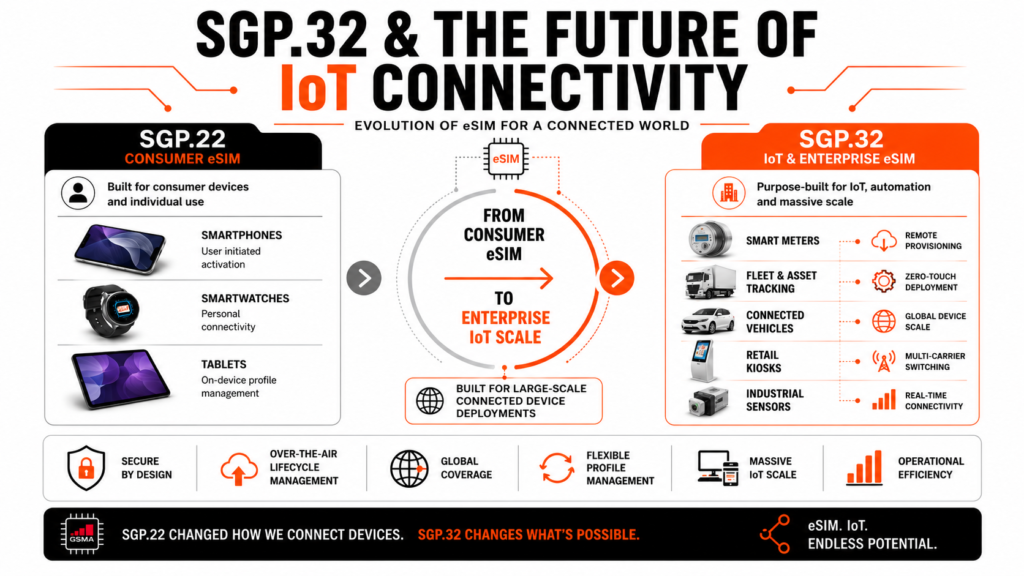
Understanding SGP.22 vs. SGP.32: Learn how eSIM standards are evolving from consumer-focused activation to fully automated IoT connectivity management.
Myth #13: “eSIM Isn’t Suitable for IoT Deployments”
Reality
In fact, IoT is becoming one of the biggest growth drivers for eSIM adoption worldwide.
According to ABI Research, more than 140 million IoT eSIM devices shipped globally in 2025 alone.
Managing physical SIM cards across thousands of connected devices quickly becomes operationally difficult. eSIM simplifies deployment by allowing remote provisioning, carrier switching, and centralized management across regions.
That’s why industries like logistics, connected vehicles, retail, utilities, and fleet management are increasingly adopting eSIM-first strategies.
Myth #14: “eSIM Locks You Into One Carrier”
Reality
eSIM was designed to increase flexibility, not reduce it.
Instead of replacing physical SIM cards manually, businesses can remotely switch carrier profiles and manage connectivity across multiple operators more efficiently.
For global deployments, this flexibility becomes a major operational advantage because connectivity can adapt without replacing hardware in the field.
Myth #15: “eSIM Is Just a Trend”
Reality
The industry momentum behind eSIM is very real.
According to ABI Research, global eSIM device shipments are expected to exceed 633 million units in 2026 across smartphones, wearables, connected vehicles, and IoT devices.
Major manufacturers and telecom providers are continuing to invest heavily in eSIM-first ecosystems because remote provisioning and software-based connectivity management are becoming essential for modern connected devices.
Physical SIM cards won’t disappear overnight, but the long-term industry direction is becoming increasingly clear.
How Spenza Helps Simplify eSIM Connectivity Management
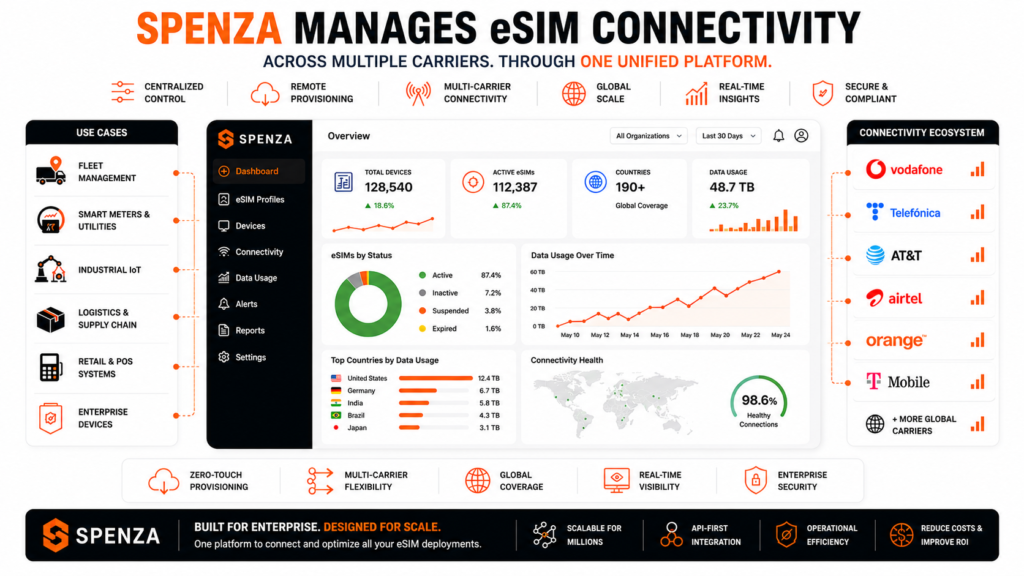
While eSIM technology makes connectivity more flexible, managing multiple carriers, contracts, usage plans, billing systems, and connected devices can quickly become complex. Spenza helps businesses centralize and automate the entire connectivity lifecycle through a single platform.
Key Capabilities of Spenza
1. Multi-Carrier Connectivity Management: Spenza brings multiple mobile operators into one unified platform, removing the need to manage separate carrier portals. It allows businesses to choose and switch networks easily while keeping full visibility and control over global connectivity.
2. Remote eSIM Provisioning: Spenza enables fully digital eSIM activation without any physical SIM handling. Businesses can deploy, activate, and update connectivity profiles remotely, making large-scale device rollouts faster and more efficient.
3. Contract and Carrier Management: Spenza centralizes all carrier agreements in one place, helping businesses track contracts, compare operator terms, and manage relationships without fragmented systems or manual tracking.
4. Billing and Revenue Management: Spenza automates billing workflows across multiple carriers, including invoicing, reconciliation, and payments. This reduces manual effort while ensuring accurate and transparent financial operations.
5. Real-Time Usage Analytics: Spenza provides live visibility into data usage and connectivity performance across all devices and regions. Businesses can track consumption trends, identify inefficiencies, and make faster data-driven decisions.
6. Telecom Expense Management (TEM): Spenza helps businesses control telecom spend by identifying wastage, unused services, and billing issues. It improves cost visibility and helps optimize plans for better efficiency.
7. Automation and API Integration: Spenza enables API-driven automation for provisioning, activation, and lifecycle management. Businesses can integrate connectivity workflows into existing systems and scale operations with minimal manual effort.
Why Businesses Choose Spenza
Whether you’re running a travel eSIM business, deploying thousands of IoT devices, launching a connected product, or managing enterprise mobility, Spenza brings connectivity, provisioning, billing, analytics, and expense management together in a single platform. This allows organizations to focus on growth and customer experience instead of carrier administration and operational complexity.
Conclusion
eSIM technology is no longer just a mobile phone feature. In 2026, it has become a core foundation for modern connectivity across smartphones, wearables, connected vehicles, and large-scale IoT deployments. As industries continue shifting toward software-defined and remotely managed connectivity, eSIM is enabling greater flexibility, faster provisioning, and more scalable global operations.
The move toward eSIM and advanced standards like SGP.32 is also accelerating enterprise adoption, especially in sectors that rely on distributed devices and cross-border connectivity. This evolution is making connectivity more dynamic, programmable, and efficient than traditional physical SIM-based models.
However, as adoption grows, businesses also face new challenges in managing multiple carriers, contracts, billing systems, and device fleets at scale. This is where centralized connectivity management becomes critical for operational efficiency and cost control.
Spenza helps enterprises simplify this complexity by unifying multi-carrier eSIM management, provisioning, billing, analytics, and telecom expense management into a single platform designed for modern global connectivity needs.
FAQs
Managing eSIM connectivity across multiple carriers and regions? Discover how Spenza simplifies enterprise eSIM operations at scale.