Last verified 2 November 2026.
IoT connectivity is the communication layer that lets a connected device send data, receive commands and reach an application. The main options fall into four families: cellular (NB-IoT, LTE-M, LTE Cat-1bis, 5G RedCap), unlicensed low-power wide-area networks (LPWAN) such as LoRaWAN, short-range links such as Wi-Fi, Bluetooth Low Energy and Zigbee, and satellite non-terrestrial networks (NTN). No family wins everywhere. Choose by payload, power budget, mobility, site access and who will operate the connection, then confirm the choice with a field pilot.
In practice that gives a short rule set. NB-IoT suits stationary devices that send small, infrequent messages. LTE-M suits things that move and may need voice. Cat-1bis is the practical 2G and 3G replacement when you need more throughput. 5G RedCap serves devices that need more bandwidth than LTE-M without full 5G cost. LoRaWAN works when you can run your own gateways. Satellite fills coverage gaps. Most real products combine two layers, and the part that keeps a mixed fleet manageable is the control layer on top: eSIM, multi-network access and a connectivity management platform. The sections below compare each option, then walk through the choice.
What is IoT connectivity?
IoT connectivity selection starts with deployment constraints, not a preferred radio. Define where devices operate, what they transmit, how they receive commands and who maintains each connection. Compare complete paths from device to application, including any gateway and backhaul, before choosing the technology that fits those requirements.
Think of the options as a toolbox. No single tool handles every job, and a building sensor, a moving tracker and a video terminal can need different networks within the same product portfolio. The choice also outlasts the purchase. Connectivity planning is a lifecycle decision as well as a procurement decision. According to IoT Analytics, there were about 21.1 billion connected IoT devices at the end of 2025, with a forecast of 39 billion by 2030, so the installed base is already large enough that migration mistakes are expensive.
The four layers of IoT connectivity
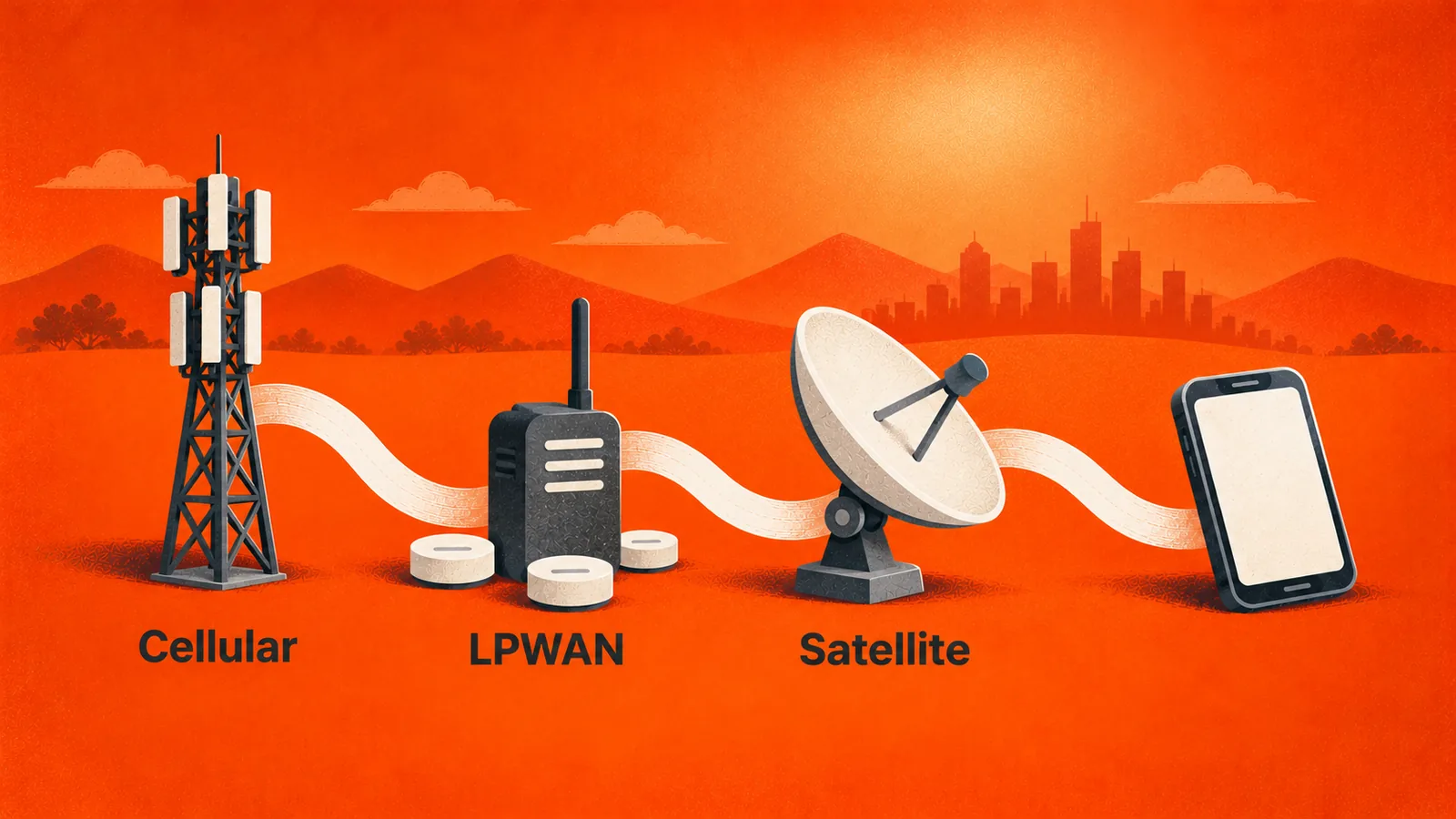
1. Cellular wide-area networks. Cellular IoT uses licensed spectrum, the same regulated bands that carry phone traffic. That makes it dependable for devices that travel across cities or countries. LTE-M, NB-IoT, Cat-1bis, RedCap and 5G NR all sit here, each at a different point on the speed, power and cost curve.
2. Unlicensed LPWAN. LoRaWAN and Wi-Fi HaLow use unlicensed bands. That keeps recurring cost low but trades away some range predictability and interference protection. They suit low-data, battery-powered sensors where cellular is absent or not worth paying for.
3. Short-range links. Wi-Fi, Bluetooth Low Energy, Zigbee and Thread connect devices to nearby infrastructure, and a separate connection usually carries the data onward. A smart building might use Zigbee sensors feeding a cellular gateway that provides the backhaul. Matter is an application-layer standard that runs over Wi-Fi, Thread and Ethernet, not a competing radio.
4. Satellite NTN. Non-terrestrial networks use satellites to reach places where ground infrastructure does not exist. Since 3GPP Release 17, satellite access for NB-IoT and LTE-M is part of the cellular standard rather than a separate proprietary world.
IoT connectivity options compared
The table puts the common technologies side by side. Rates are the commonly cited peak or nominal figures for the technology, not what a deployed device will see; real throughput depends on coverage, configuration and the network operator. Treat suitability as conditional, not as a performance ranking.
| Technology | Family | Nominal data rate | Range | Power draw | Mobility | Typically used for |
|---|---|---|---|---|---|---|
| NB-IoT | Cellular | Low: tens of kbps up to a few hundred in later releases | Wide area, strong indoor reach | Very low | Low (stationary preferred) | Smart metering, parking and stationary sensors |
| LTE-M | Cellular | Low to medium: up to about 1 Mbps | Wide area | Low to medium | High; voice possible where supported | Asset tracking, wearables, fleet, remote patient monitoring |
| LTE Cat-1bis | Cellular | About 10 Mbps downlink | Wide area | Medium | Medium to high | 2G and 3G replacement, payment terminals, general telematics |
| 5G RedCap | Cellular | Around 150 Mbps downlink, 50 Mbps uplink | Wide area, 5G coverage | Medium | High | Cameras, industrial wearables, EV charging, smart factories |
| LoRaWAN | LPWAN | Roughly 0.3 to 50 kbps | Kilometers; up to about 15 km in rural areas | Very low | Low | Private sensor networks, agriculture, campuses |
| Wi-Fi | Short-range | High (hundreds of Mbps in practice) | Tens of meters | Medium to high | Low | Indoor gateways, cameras, displays |
| BLE / Zigbee | Short-range | BLE up to 2 Mbps (2M PHY); Zigbee 250 kbps | Tens of meters, longer with mesh | Very low | Low | Wearables, proximity sensing, building mesh |
| Satellite NTN (NB-IoT / LTE-M) | Satellite | Low | Global, with sky view | Medium to high | Varies | Remote assets, maritime, agriculture, mining |
For a deeper side-by-side of the three cellular standards most teams shortlist, read the NB-IoT vs LTE-M vs 5G RedCap comparison.
Cellular IoT: NB-IoT, LTE-M, Cat-1bis and RedCap
Cellular IoT is not one technology. It is a family of standards, each optimized for a different operating profile. Narrowband IoT (NB-IoT) and Long-Term Evolution for Machines (LTE-M) entered the 3GPP standards in Release 13. The GSMA Mobile IoT Deployment Guide explains how network configuration affects reachability and energy use.
LTE-M
LTE-M supports connected mobility and can support voice where the device and service implement it. That makes it the usual choice for anything that moves: a medical wearable that travels across a city while sending telemetry, a delivery van reporting position, or a tracker on a pallet. It offers more throughput than NB-IoT, including room for occasional firmware updates, at a higher power draw. Typical uses: asset tracking, connected wearables, fleet management and remote patient monitoring.
NB-IoT
NB-IoT is often appropriate for small, infrequent messages from devices that stay put and need years of battery life. A smart water meter sending one small reading an hour is the textbook case: it needs low power and deep indoor coverage, not bandwidth. Avoid reading that as a universal ban on moving devices; the point is that its mobility handling is more limited than LTE-M, so test before committing. Typical uses: smart metering, parking sensors, agricultural sensors and utility infrastructure.
Two power features matter for both standards. Power Saving Mode and extended Discontinuous Reception reduce receiver activity, but they can delay delivery to a sleeping device. A battery-life claim needs the traffic pattern, coverage, timers and hardware assumptions behind it.
LTE Cat-1bis
Cat-1bis is the practical 2G and 3G replacement for devices that need a dependable data connection without moving to 5G. It uses a single-antenna design, which lowers hardware complexity and cost compared with earlier LTE categories while keeping throughput around 10 Mbps downlink. It suits payment terminals, telematics, security equipment and logistics devices that outgrow LPWAN.
5G RedCap and eRedCap
5G Reduced Capability (RedCap) is a Release 17 New Radio device category. It reduces complexity relative to more capable 5G devices and fills the gap between LPWAN and full 5G. It is not another name for LTE-M. Common examples are EV charging stations, industrial cameras, mid-tier industrial automation and wearables that need more bandwidth than LTE-M offers. Enhanced RedCap (eRedCap), introduced in Release 18, goes further down in capability and cost, with a peak rate around 10 Mbps, for constrained devices that still want a 5G connection.
Watch out. A carrier selling ordinary LTE service does not establish that the same agreement includes NB-IoT, LTE-M, RedCap, roaming or voice. Ask for the supported combination of radio, bands, operator and service.
LPWAN and short-range technologies still matter
Not every IoT problem needs a cellular subscription. Sometimes the practical answer is a private network or a local mesh. Note that LPWAN describes a category, not one protocol: cellular NB-IoT and LTE-M also belong to it. This section covers the non-cellular members.
When LoRaWAN makes sense
LoRaWAN fits when a company can deploy its own gateways. A large farm, an industrial campus or a smart city pilot can build a private network and connect many sensors without paying per-device cellular fees. The LoRa Alliance describes LoRaWAN as operating in unlicensed ISM bands with range of up to 15 km in rural areas; dense urban deployments see far less. The trade-off is infrastructure ownership and very limited bandwidth.
For a LoRaWAN deployment, identify who installs the gateways, who provides their upstream connection and who operates the network server. Unlicensed spectrum does not make equipment, support or application integration free. Device class matters too. Class A receive windows follow an uplink, Class B adds scheduled receive opportunities, and Class C keeps the receiver open much more of the time at greater energy cost. Command timing should drive the class choice.
Wi-Fi HaLow and Sigfox
Wi-Fi HaLow (IEEE 802.11ah) is a distinct Wi-Fi option that works in sub-1 GHz spectrum, with the Wi-Fi Alliance citing roughly 1 km of range and strong wall penetration. It has its own equipment and regional requirements, so an ordinary Wi-Fi installation does not imply HaLow support.
Sigfox has faced serious disruption. The company entered French insolvency proceedings in January 2022 and was bought by UnaBiz later that year, and its French operating unit went through a further court-supervised restructuring in 2025. Designing a new product around Sigfox means taking on continuity risk. If you are evaluating any provider-operated LPWAN service, request current local availability and a lifecycle plan, and keep coverage and commercial continuity in the procurement record.
Where BLE, Zigbee, Thread and Matter fit
Short-range protocols complement cellular rather than compete with it. Wi-Fi works when the site owner can provide and maintain access; settle who changes credentials, replaces access points and diagnoses intermittent connections before deployment. Bluetooth Low Energy connects wearables and sensors to a phone or gateway, and advertised range depends on radio mode, antenna, transmit power and surroundings, so test inside the real enclosure. Thread and Zigbee support local mesh designs. A hybrid design uses local links for sensors and cellular backhaul for the gateway.
Definition. Backhaul is the upstream connection from local infrastructure, such as a gateway, toward the wider network or application. Its availability is a separate dependency from the endpoint’s local radio link.
| Connectivity model | Best for | Main advantage | Main trade-off |
|---|---|---|---|
| Public cellular | Fleets, vehicles, distributed IoT | Wide-area coverage and mobility | Recurring connectivity cost |
| LPWAN (private LoRaWAN) | Smart meters, agriculture, low-data sensors | Low power and long device life | Limited bandwidth; you run the gateways |
| Private cellular | Factories, ports, campuses, critical industrial sites | Dedicated control, coverage and quality of service | Infrastructure and operational complexity |
| Hybrid cellular and NTN | Remote and cross-border assets | Terrestrial coverage with satellite fallback | Higher architecture complexity |
Satellite NTN: reaching where cellular does not
If cellular IoT is the highway network, satellite NTN is the off-road capability that reaches where the highway does not. Satellite connectivity still needs compatible equipment, a supported service and suitable operating conditions. Confirm the installation’s view of the sky, delivery timing and power demand before treating satellite as a primary connection or a fallback.
What 3GPP Release 17 and 18 changed
Before Release 17, satellite IoT mostly ran on proprietary systems that were hard to integrate with cellular deployments. According to 3GPP, Release 17 specified NB-IoT and eMTC (LTE-M) support for NTN, reusing NR NTN functionality and assuming GNSS-capable devices. Release 18 added the radio performance requirements and new LTE bands for NB-IoT and eMTC over NTN, plus improvements to mobility, measurements and handling of discontinuous coverage. Release 19 work continues on store-and-forward operation and uplink capacity.
The standard does not upgrade every installed modem. NTN support requires the relevant terminal capabilities, so ask whether the specific module and firmware you plan to use support it. Providers such as Skylo run commercial NB-IoT NTN services built on Release 17, but availability differs by country and provider, so confirm it for your regions.
LEO, MEO and GEO at a glance
| Orbit | Altitude | What it means for IoT |
|---|---|---|
| LEO (low Earth orbit) | Up to roughly 2,000 km | Lowest delay; satellites move across the sky, so service comes in passes or through a constellation |
| MEO (medium Earth orbit) | Between LEO and GEO | Fewer satellites cover more ground; delay sits between the two |
| GEO (geostationary) | About 35,786 km above the equator | Fixed position in the sky; signal travel time alone is around a quarter of a second each way |
Hybrid cellular and satellite design
The most resilient pattern uses cellular as the primary connection and satellite as fallback. A logistics tracker crossing remote regions might use LTE-M for most of its route and switch to satellite in coverage gaps. For a combined terrestrial and satellite product, define the switching policy, duplicate-message handling and billing, and test the real hardware and service route rather than assuming fallback works from a product description. Ask how the application behaves between delivery opportunities, indoors and when a device cannot obtain service.
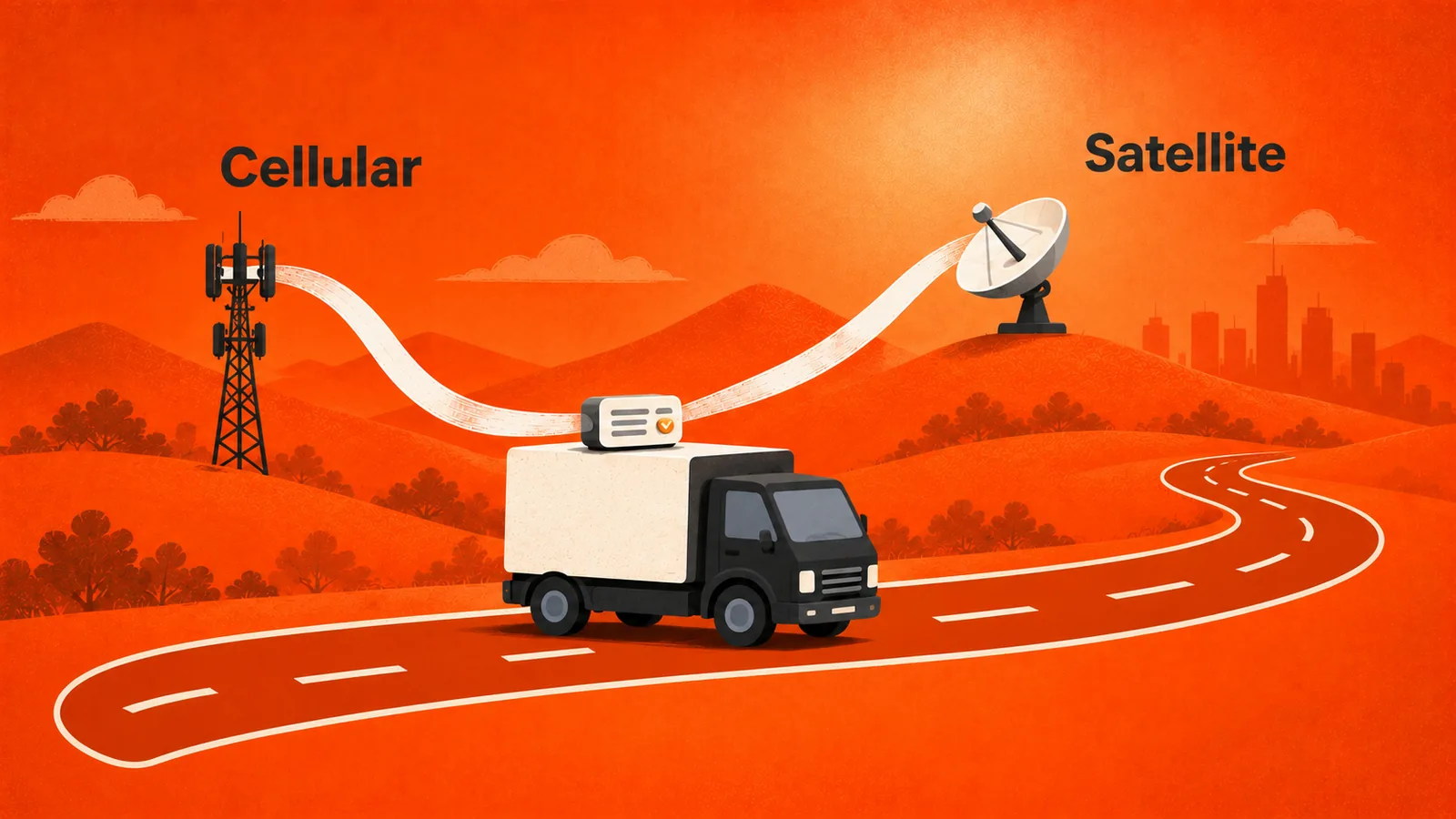
eSIM, SGP.32 and multi-IMSI: the control layer
Hardware decides what a device can connect to. Software decides how it connects, when it switches and what it costs to operate. An eSIM does not add radio bands to a modem or make an unsupported operator accept a device; it changes how supported subscription profiles are provisioned and managed. Within those limits it is the main tool for keeping a fleet flexible.
Why eSIM matters for IoT
An embedded SIM (eUICC) lets cellular profiles be provisioned, switched and managed remotely, without physical access to the device. For a fleet spread across countries, that is an operational requirement, not a convenience. At scale it usually calls for a connectivity management platform (CMP) that handles provisioning, policy and usage visibility across thousands of endpoints. See the comparison of leading IoT connectivity management platforms for what to look for, and the IoT SIM cards guide for the SIM formats involved.
What SGP.32 standardizes
SGP.32 is the GSMA eSIM IoT technical specification for remote provisioning and management of eUICCs in IoT devices with network- or user-interface-constrained environments (see the GSMA SGP.32 document). Earlier consumer eSIM standards assumed a screen and a user to approve actions. SGP.32 removes that assumption, which is what makes large-scale eSIM management practical for headless, battery-powered devices. For how it differs from the consumer standard, read the SGP.22 vs SGP.32 guide; for the orchestration that sits on top, see eSIM orchestration for global IoT.
Why multi-IMSI matters
A multi-IMSI SIM carries several network identities in one physical or embedded SIM. When a device crosses a border or loses its primary carrier, the selection logic can move it to another available network. That reduces dependence on one operator’s roaming agreements. The wider risk is covered in single-carrier IoT risks: single-carrier simplicity can create significant operational exposure at scale.
A CMP can help operate subscriptions, usage and related service actions. It does not automatically manage firmware, device applications or every non-cellular network, so define those boundaries before comparing platforms. Spenza’s platform works at this layer: it manages SIM lifecycle states, data usage, rate plans, alerts and APIs across many devices and carriers.
How to choose the right IoT connectivity stack
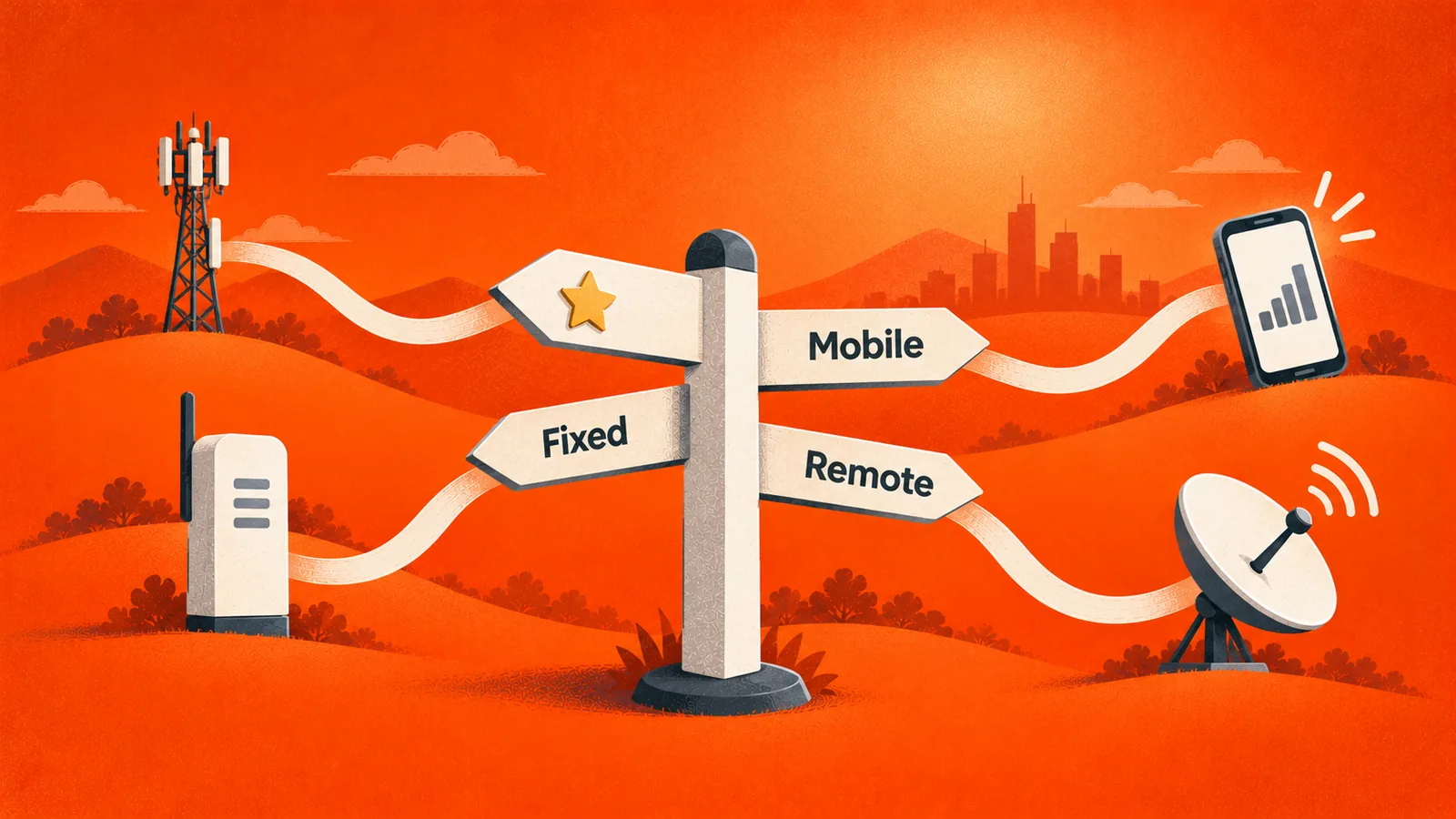
The best technology depends on device mobility, data volume, power constraints, coverage, deployment duration and cost. NB-IoT and LoRaWAN suit low-data, low-power deployments; LTE-M suits mobile devices; Cat-1bis supports reliable mid-tier connectivity; RedCap targets higher-bandwidth IoT; and NTN extends coverage where terrestrial service is unreliable. Five questions narrow the shortlist.
1. Where will devices operate?
A single site or campus can use Wi-Fi or a private LoRaWAN network. Devices spread across a country or several countries usually need cellular, and cross-border fleets often add multi-IMSI or eSIM so one SKU can work in many markets. Remote infrastructure with no terrestrial coverage points to satellite NTN, or to LoRaWAN if you can run your own gateway.
2. How much data, and how often?
Tiny messages every few hours fit NB-IoT. Small to medium payloads from moving devices fit LTE-M. Images, voice or moderate video point to Cat-1bis or RedCap, and sustained video points to RedCap or full 5G. Write down the normal payload and the largest exceptional transfer, such as a firmware update, and record the acceptable delay for alarms separately from routine telemetry. Mismatching data volume to technology is one of the most common and costly design errors.
3. What are the power constraints?
A battery that must last many years points to NB-IoT, LoRaWAN or BLE-class designs, accepting limits on downlink timing. Line-powered devices can use Cat-1bis, LTE-M or RedCap freely.
4. How long will devices stay deployed?
A temporary campaign has different requirements than a utility meter expected to run for a decade or more. The longer the life, the more you need eSIM flexibility, a modem generation that will still be supported, and a plan for the operator changing or retiring its network.
5. Which pricing model fits?
Per-device plans suit predictable usage, pooled plans suit fleets with uneven consumption, and metered per-megabyte pricing suits very low-volume devices. Cost scales quickly: an illustrative $2 a month per device is $24 a year each, or $24 million a year across a million devices, so small differences matter at scale. The IoT connectivity cost guide shows how to model it with your own quotes.
Typical stacks by vertical
| Vertical | Typical stack | Why it works |
|---|---|---|
| Fleet management | LTE-M or Cat-1bis, multi-network eSIM, pooled data | Mobility and roaming resilience. See fleet and automotive connectivity costs |
| Smart metering | NB-IoT, per-device pricing | Low power and predictable usage |
| EV charging | Cat-1bis or RedCap with a pooled plan | Variable bandwidth patterns |
| Healthcare monitoring | LTE-M with voice where supported | Reliable alerts and mobility. See remote patient monitoring connectivity |
| Asset tracking | LTE-M, with satellite for remote legs | Wide coverage and battery life. See the asset tracking guide |
| Agriculture and remote infrastructure | NB-IoT or LoRaWAN, with satellite NTN where there is no signal | Rural coverage resilience |
How to future-proof an IoT deployment
The biggest connectivity mistake is designing around today’s network availability instead of tomorrow’s infrastructure roadmap.
Network sunsets
Operators have been retiring 2G and 3G for years, and the schedule differs by country and by operator. There is no single worldwide retirement date. A device built around 2G or 3G today faces forced migration, so inventory the hardware you have, obtain current operator notices and test replacement options. For most simple data devices the path leads toward Cat-1bis, for mobile uses toward LTE-M, and for higher bandwidth toward RedCap.
The 3GPP roadmap
Release 17 (2022) introduced RedCap and NTN for NB-IoT and LTE-M. Release 18 added eRedCap and better NTN support, and Release 19, the second 5G-Advanced release, had its specifications ready at the end of December 2025. For devices with long working lives, check which release your module supports and what the vendor plans to maintain.
Validate before you commit
A specification sheet does not replace a field pilot. Agree acceptance criteria first, then collect three kinds of evidence: supported capability in the lab, useful service in the field and repeatable operating control. A successful connection is only one observation. The application also needs timely delivery, recoverability, workable support and a known cost model.
| Check | Evidence to retain | Owner |
|---|---|---|
| Supported combination | Module, firmware, band, operator and service configuration | Engineering |
| Application delivery | Location, message outcome, delay and recovery logs | Product and fleet operations |
| Power behavior | Measured current trace with traffic and radio conditions | Device engineering |
| Operating control | Provisioning, incident and invoice reconciliation records | Operations and finance |
Include weak-signal conditions, retries and downlink activity, and record unsuccessful tests as well as successful ones so the rollout decision has explicit limits.
Conclusion
The future of IoT connectivity is not about picking one network. It is about building a stack flexible enough to survive changing coverage, changing standards and changing business models. The right deployment usually combines layers: a primary cellular or LPWAN connection chosen for the application, eSIM-based carrier flexibility, satellite where coverage demands it, and a management platform that gives one view across all of it.
Start with device constraints, test the supported service in representative conditions, and price the whole path to the application. Keep local infrastructure, radio capability, subscription management and firmware ownership distinct, and assign each responsibility to a named team. For the wider market picture, see IoT connectivity trends and the global IoT connectivity guide.
FAQs
What is the difference between NB-IoT and LTE-M?
NB-IoT is built for stationary, low-data devices that need long battery life and deep indoor coverage. LTE-M supports mobile devices, higher throughput and, where the device and service implement it, voice. Both entered 3GPP in Release 13.
What is the difference between IoT connectivity and IoT connectivity management?
IoT connectivity is the network connection between a device and the application platform. Connectivity management controls how that connection is provisioned, monitored, switched and optimized across devices, carriers, SIM or eSIM profiles and usage policies.
What is 5G RedCap and which devices use it?
5G RedCap (Reduced Capability) is a Release 17 New Radio device category for mid-tier IoT that needs more bandwidth than LTE-M but not full 5G. Typical uses include industrial cameras, wearables, EV charging and smart factory equipment.
Is satellite IoT ready for production?
It can be, for specific cases. 3GPP Release 17 standardized NB-IoT and LTE-M over NTN, and commercial services exist, but support depends on the module, the provider and the country. Test the actual hardware and service route before relying on it.
Why does eSIM matter for IoT connectivity?
eSIM allows supported subscription profiles to be provisioned and changed remotely, which avoids physical SIM swaps and lets one hardware SKU serve many markets. It cannot add radio bands to a modem or make an unsupported operator accept a device.
What is multi-IMSI in IoT?
A multi-IMSI SIM holds several network identities, so a device can move to another network when it crosses a border or loses its primary carrier. It reduces dependence on one operator’s roaming agreements.
Which connectivity stack works best for fleet management?
LTE-M or Cat-1bis with a multi-network eSIM and a pooled data plan is a common starting point because it handles mobility and roaming. Confirm the exact bands, roaming terms and voice support with your carrier.
What is SGP.32?
SGP.32 is the GSMA eSIM IoT technical specification for remote provisioning and management of eUICCs in IoT devices with network- or user-interface-constrained environments.