Last verified 2 November 2026.
An IoT MVNO is a mobile virtual network operator whose customers are businesses running connected devices, such as sensors, trackers, vehicles, meters and wearables, instead of people buying phone plans. Like any MVNO, it buys network access from one or more mobile network operators (MNOs) and sells service under its own brand. What sets it apart is the work built around that access: SIM and eSIM provisioning, device-level monitoring, billing by device or cohort, and support for hardware that may sit unattended for years.
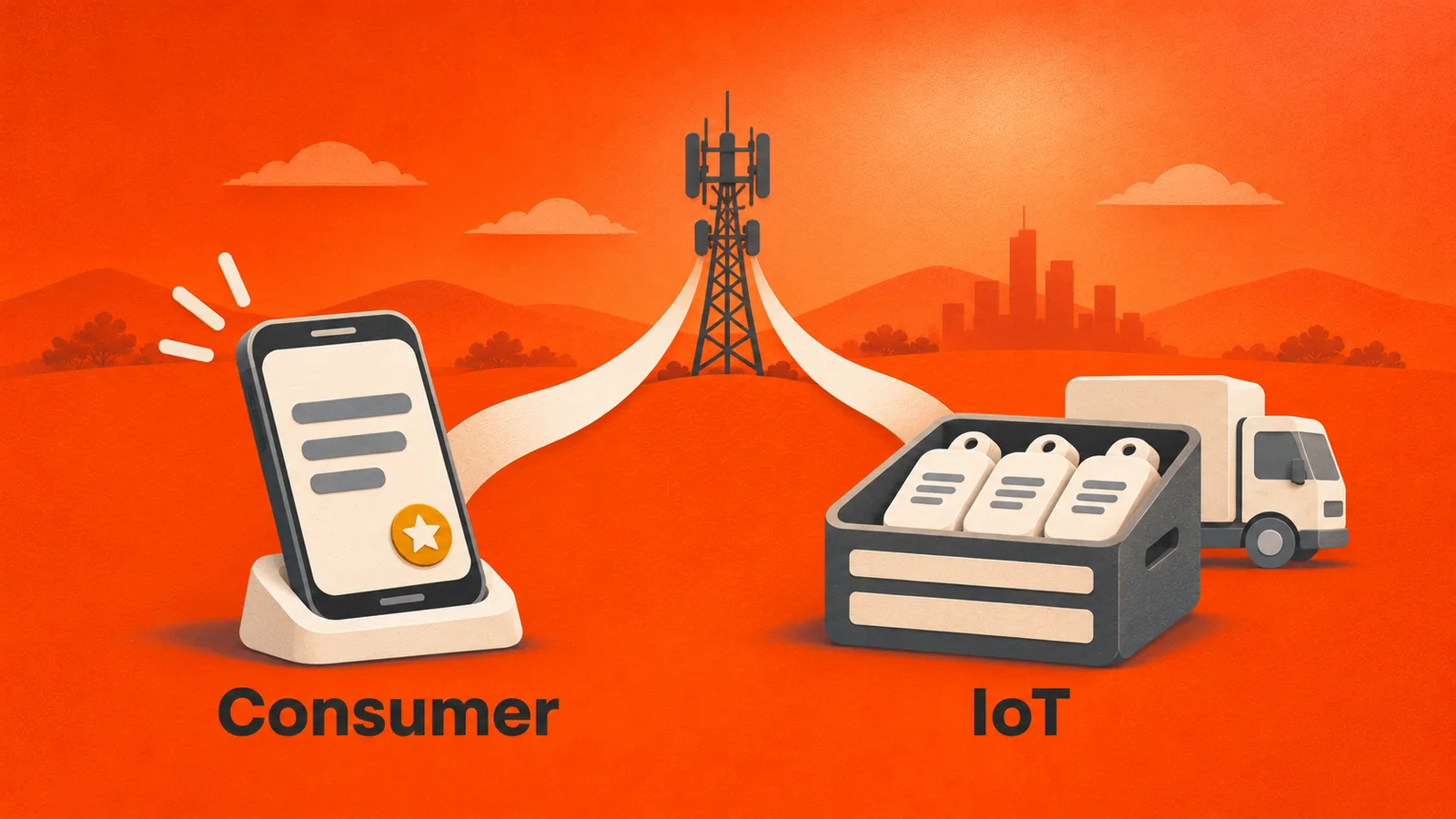
A traditional (consumer) MVNO is organized around subscribers: a person signs up, pays, calls and texts, and phones the help desk when something breaks. An IoT MVNO is organized around a fleet and its lifecycle. The two can share the same wholesale access, so the label alone settles little. This guide compares them on the points that change a buying or launch decision, covers what to check on radio, eSIM, multi-carrier behavior, cost and contracts, and ends with a pilot you can run before committing. For the model definitions themselves, see MVNO types and the roles of MNO, MVNO, MVNE and MVNA; this article does not repeat them.
What is an IoT MVNO?
An IoT MVNO sells cellular connectivity for machines, using access supplied by mobile network operators. The offer usually bundles data plans, SIM or eSIM supply, a management portal or API, and support. Whether the MVNO runs its own core network functions or leans on an enablement partner varies by model, so the “MVNO” label does not tell you who controls routing, identities or service quality. Ask which functions the provider runs itself and which it buys.
IoT is a market focus, not a fourth network model. A full MVNO, a light MVNO and a branded reseller can all be pointed at devices. The difference is in what the provider has built for them: provisioning before a device ships, usage patterns made of short bursts, and accounts that belong to a company, a site and a reseller hierarchy rather than to one person.
Short answer. Choose an IoT MVNO when you manage devices, not people: many units, unattended, often moving between countries, billed per device or per cohort. Choose a traditional MVNO when the user is a person with a phone and a monthly plan.
IoT MVNO vs traditional MVNO
Both buy wholesale network access, so the radio is often the same. The comparison below is about the operating model on top. It describes what each kind of provider is typically built for. It is a set of evaluation questions, not a claim that every consumer provider lacks these features or every IoT provider has them.
| Decision | Traditional (consumer) MVNO | IoT MVNO |
|---|---|---|
| Who the customer is | An individual or family | A business: device maker, fleet operator, integrator or reseller |
| What is sold | Voice, messaging and data for phones | Data connectivity for devices, sometimes with SMS or voice for specific uses |
| Activation | Person signs up and activates after purchase | Often tested at the factory, stored, then activated at installation |
| Usage pattern | Continuous, person-driven | Short bursts, scheduled reports, firmware downloads; some devices nearly idle |
| Account structure | Subscriber account | Business, site, device and reseller hierarchy |
| Billing basis | Per-user plan or allowance | Per device, per cohort, pooled or event-based |
| Support | A user can describe the symptom | Evidence has to come from an unattended device |
| Integration | Portal and app for the subscriber | API and platform connections for provisioning, usage and lifecycle |
| Retirement | Cancel or transfer a line | Recover or retire assets, stop charges, keep records |
Treat the left column as a starting point, not a verdict. Some consumer MVNOs offer APIs, and some IoT offers are little more than a data SIM with a spreadsheet behind it. Compare the actual lifecycle you need.
Why the device lifecycle changes the model
A phone has a person who can read instructions and retry an activation. A sealed sensor may spend months in a warehouse before installation. A gateway on a truck may change country while its owner expects the application to keep receiving data. These are different operating tasks, and an IoT MVNO is judged on how it handles each stage.
| Stage | What the provider must support | What to verify |
|---|---|---|
| Factory | Test service, record the SIM identity against the device | Can you test without starting full billing? Is the identity record exportable? |
| Warehouse | Hold inventory in a defined state | Which state is free, and which starts a fee or a clock? |
| Deployment | Activate in the field, confirm the application works | Is activation automated, and who sees a failure? |
| Operation | Monitor, change plans, switch profiles or networks | What can you change remotely, and how fast? |
| Retirement | Suspend, recover or transfer, stop charges | Do charges stop when the device is decommissioned, and are records kept? |
The warehouse stage is where surprises appear. Providers may charge for access, inventory, testing or elapsed time under different rules, so “free until installed” is only true if the service terms say so. Record the event that starts billing and reconcile it against manufacturing and shipment records, so a deployment delay does not quietly change your margin.
Radio, SIM and eSIM: what the MVNO can and cannot change
Connectivity depends on four things working together: the device radio, the host network’s service, the subscription permissions and the data path. An IoT MVNO can package them in one commercial relationship, but it cannot create radio coverage a module does not support. Match the module, its bands and the operator features before choosing the SIM or the provisioning method.
NB-IoT, LTE-M and 5G RedCap serve different needs for bandwidth, mobility and battery life; the NB-IoT vs LTE-M vs 5G RedCap comparison walks through the trade-offs. A technology that exists in a country is not necessarily available through a particular wholesale agreement, so ask for the technologies and countries covered by your agreement, not only the network’s marketing map. The GSMA publishes a Mobile IoT Deployment Guide covering NB-IoT and LTE-M features that support interoperability and roaming between networks; it is useful as a checklist of what operators should support.
eSIM for IoT
An eSIM lets a device change its operator profile without swapping a card, which is why it matters for sealed or hard-to-reach devices. For IoT, the relevant GSMA specification is SGP.32 (eSIM IoT technical specification, v1.2), which defines an architecture with an eSIM IoT remote manager (eIM) on the server side and an IoT profile assistant (IPA) on the device side. Consumer eSIMs follow a different specification, SGP.22; the SGP.22 vs SGP.32 guide explains the difference.
Neither specification adds bands to a modem or grants commercial access to an operator. Before treating “eSIM-ready” as fleet-ready, specify the bootstrap path, the profiles the device may receive, the components that must be compatible, and what happens when a profile download is interrupted. Downloading a profile, attaching to a network and delivering an application message are three separate acceptance events.
Watch out. eSIM does not remove roaming agreements or guarantee local service. Confirm the profile, the operator access and the country conditions for the deployment. For a plain-language primer on SIM formats, see the IoT SIM card guide.
Multi-carrier connectivity and resilience
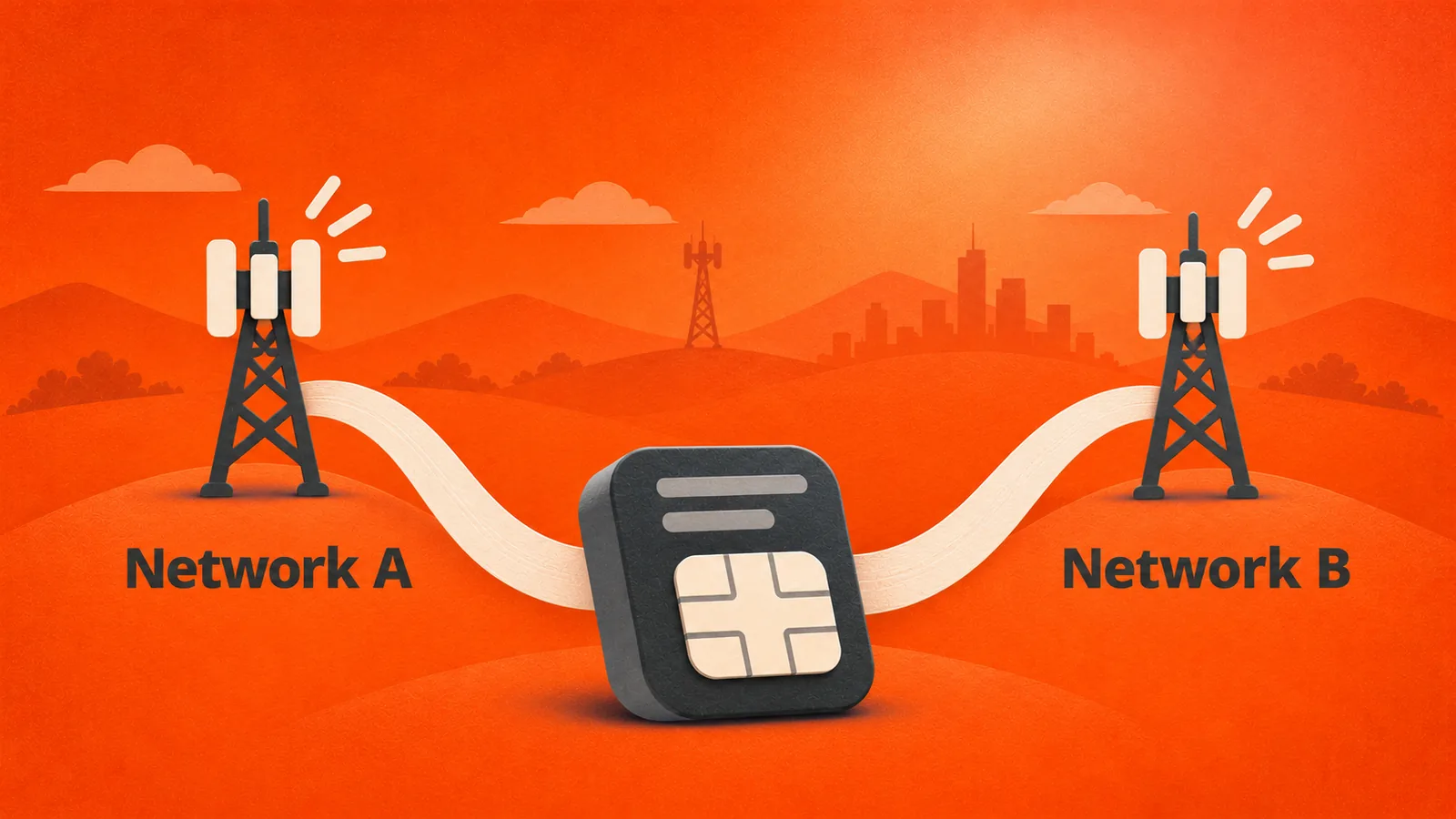
Multi-carrier access is one of the main reasons to pick an IoT-focused provider. A device that can use more than one network is less exposed to a single carrier’s outage, coverage gap or commercial change. The single-carrier IoT risks article covers that exposure in more depth.
“Multi-carrier” is not one feature, so ask how it works in practice:
- How is a network chosen? By signal, by cost, by a rule you set, or by the device? A stronger signal can still deliver worse application performance.
- What triggers a change? Loss of attach, a failed session, a timer or a manual action?
- Are the alternatives independent? Two networks that share infrastructure can fail together.
- What does the device experience? Does the session reconnect, and does the application buffer and retry?
If you manage many devices across providers, a connectivity management layer can help; see the guide to IoT connectivity management platforms and the notes on eSIM orchestration for global IoT.
How to model IoT MVNO costs
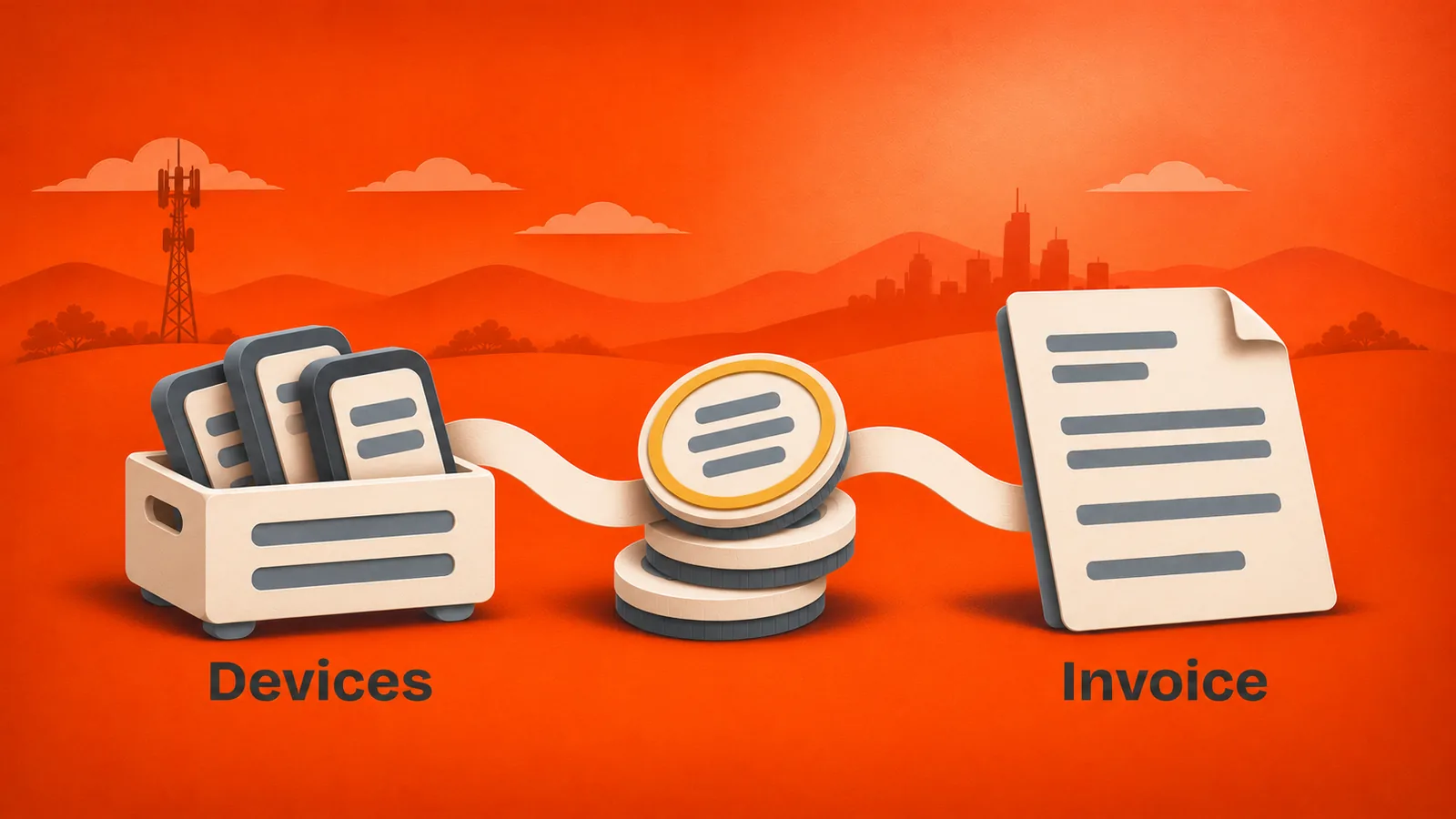
Judge cost on a cohort: a defined group of devices over the same period, with revenue and every attributable cost on one sheet. Wholesale data is only one line. Access fees, dormant inventory, platform services, support, integration and contract commitments can change the result even when average data use looks low.
A useful starting equation: cohort contribution equals customer revenue minus the attributable wholesale, platform, provisioning, support and service-credit costs. State which shared costs sit outside it. A positive contribution is not company profit, and an average per-device figure can hide expensive subgroups.
| Input | What to record | Question before pricing |
|---|---|---|
| Customer revenue | Currency per cohort per month | What is bundled, discounted or refunded? |
| Access and data | Billable subscriptions and metered units | Which countries and networks incur charges? |
| Provisioning | Profile and lifecycle events | Are retries or failed attempts billable? |
| Platform and integration | Recurring fees, allocated engineering time | What stays manual after onboarding? |
| Support | Cases, handling time, escalations | Which faults need partner or field intervention? |
| Commitments and credits | Minimum spend, unused capacity, remedies | Who bears demand or service shortfalls? |
Populate it with your own records; this article gives no benchmark prices because they vary by country, volume and contract. Test usage distributions, not only averages: include firmware downloads, retransmissions, deployment delays and decommissioned devices that still incur charges. Compare pooled and individual allowances under the same workload. The IoT connectivity cost guide covers plan structures in more detail, and the IoT connectivity comparison places cellular next to other options.
Contracts and industrial requirements
An IoT MVNO contract should define the supported services, operating boundaries, incident ownership and remedies for your application. Telemetry collection and time-critical machine control are different problems. A general cellular service should not be presented as deterministic or safety-qualified without the architecture, testing and contractual evidence that use case needs.
NIST’s Guide to Operational Technology (OT) Security (SP 800-82 Rev. 3) addresses systems with their own performance, reliability and safety needs. Apply that distinction to connectivity buying: a delayed temperature report and an unavailable control instruction do not have the same consequence, and the application owner must define acceptable behavior when connectivity is lost.
| Boundary | Evidence to request | Owner to name |
|---|---|---|
| Network availability | Included operators, technologies and exclusions | Connectivity supplier and host operator |
| Application behavior | Buffering, retry and offline-state design | Device and application engineering |
| Security | Identity, access, routing and incident process | Your security owner and the suppliers involved |
| Support | Escalation path, response scope and evidence required | Your operations team and the provider |
| Exit and change | Record export, profile rights, transition help | Commercial owner |
This is a checklist for your own negotiation, not a service-level agreement. Test at the real installation: the antenna location and enclosure for a warehouse sensor, the route and recovery after coverage loss for mobile equipment, and the control-system designer’s involvement for machinery.
When to choose an IoT MVNO, and when not to
Choose an IoT MVNO when most of these are true:
- Devices send telemetry more often than they receive data, in short bursts.
- Devices are remote, mobile, battery-powered or deployed in several countries.
- Downtime or lost data disrupts operations.
- Billing has to be per device, per cohort or per event.
- SIM provisioning needs to be automated and tied to your own systems.
A traditional MVNO or an MNO may be enough for a small number of devices in one country with steady coverage, or where the product is really a phone, tablet or hotspot used by a person. Being an MNO customer directly is also reasonable when its service, support and commercial terms fit the deployment. If you are still deciding whether cellular is the right network at all, start with the connectivity comparison.
Becoming an IoT MVNO
A device maker or connectivity business may want to be the provider, not the customer. The question is how much to build. A full MVNO takes on core functions, billing and customer systems; a model built with an enablement partner or a white-label MVNO platform moves much of that work to a supplier. Compare ownership, staffing, integration, support and exit terms before treating core ownership as a goal in itself. The broader process is in what an MVNO is.
Spenza is a connectivity management platform (MVNO/MVNE) for device OEMs, managed service providers and enterprise IoT teams. Its site describes pooled plans across operators, automated SIM and eSIM lifecycles, usage tracking from one console, and over-the-air operator switching without a physical SIM swap, all through one API. A published example is Angel Watch, a kids’ smartwatch maker that sells the watch and its plan in a single checkout. As with any provider, test the claims against your own devices, countries and acceptance criteria.
How to validate an IoT MVNO offer
Run a representative pilot before wider sale. Confirm the device connects, the application receives the expected data, the subscription record is correct and the invoice follows the agreed terms. Include failures, so the pilot tests operations as well as activation.
- Pick one narrow use case. Record the buyer, device type, countries, data pattern and expected outcome.
- Agree responsibilities. Map host access, core services, provisioning, device software, application support and billing ownership.
- Price the full workload. Include dormant inventory, bursts, support and commitments with normal usage.
- Test real conditions. Use the actual module, firmware and locations, not a substitute phone.
- Exercise recovery. Try a rejected activation, lost coverage, delayed usage and an interrupted profile download.
- Reconcile and approve. Match records to charges, document exceptions and name who approves expansion.
Conclusion
IoT MVNOs and traditional MVNOs can run on the same networks, yet they are built for different customers. The consumer model is organized around a person and a plan. The IoT model is organized around a fleet, its lifecycle and the evidence you need when a device is out of reach. Choose on control and fit, not on the label or the price per gigabyte.
If your business depends on device connectivity, write a pilot scope with named owners, acceptance conditions and an exit path, then test providers against it. Claims about coverage, eSIM or multi-carrier behavior are only as good as the test on your own hardware.
Frequently asked questions
What is the difference between an IoT MVNO and a traditional MVNO?
A traditional MVNO sells phone-oriented service to individual subscribers. An IoT MVNO sells connectivity for devices to businesses, with provisioning, monitoring, billing and support organized around fleets and their lifecycle. Both can use wholesale access from the same mobile network operators.
What is an IoT MVNO?
An IoT MVNO is a mobile virtual network operator that provides cellular connectivity for connected devices such as sensors, trackers and vehicles. It buys access from network operators and adds SIM or eSIM management, plans, support and often an API or portal.
When should a business use an IoT MVNO?
Consider one when you run many devices that are remote, mobile or unattended, deploy across regions, need automated provisioning, and want billing by device or cohort. For a few devices in one country, an MNO or a simpler plan may be enough.
Can an IoT MVNO support eSIM?
Yes, many do, but support varies. For IoT the relevant GSMA specification is SGP.32. Ask which profile operations are supported, how a failed download is handled, and whether the operator access you need is covered, since eSIM does not by itself grant network access.
Can an IoT MVNO use multiple carriers?
Often. Multi-carrier connectivity lets a device use different networks depending on coverage and rules, reducing dependence on one carrier. Ask how a network is selected, what triggers a change, and whether the alternatives are independent.
Does a multi-network SIM always pick the strongest signal?
No. Selection depends on supported networks, device behavior, steering rules and service permissions. A stronger radio signal can still give worse application performance, so ask the provider to demonstrate selection and recovery under your field conditions.
Are SIMs free while devices sit in the warehouse?
Only if the service terms say so. Providers can charge for access, inventory, testing or elapsed time under different rules. Record the event that starts billing and reconcile it against shipment records.
Should a device maker become a full MVNO?
Only if the control and business case justify the added responsibilities. A service built with an enablement partner may meet the product need with a lighter operating burden. Compare ownership, staffing, integration, support and exit terms first.