Every regional ISP is watching the same movie. A national carrier shows up in the footprint selling home internet plus mobile on one bill, and broadband customers who never complained start leaving. Strategy leaders keep asking whether mobile is feasible without becoming a carrier. The two largest broadband providers in America already answered, in public, with numbers they report every quarter, and the broadband MVNO play they proved now runs at regional scale. This playbook covers the evidence, the three ways to add mobile, the launch path, and the bundle math.
Why Converged Operators Win (the 2026 Evidence)
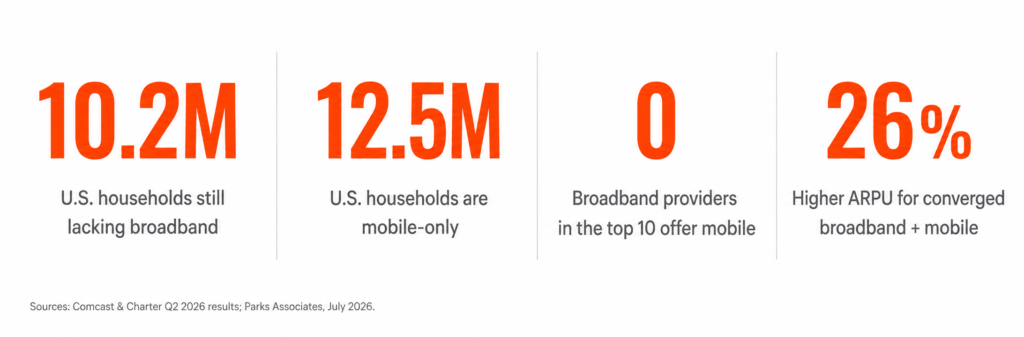
Fixed-mobile convergence (FMC) means one provider selling fixed broadband and mobile together, on one bill, usually at a bundle discount. In 2026 it went mainstream in the US: Parks Associates counts 26% of US households on an integrated internet-plus-mobile offering and notes that AT&T and Verizon both introduced unified fixed-and-mobile plans in the first half of 2026.
What Cable’s 22 Million Mobile Lines Prove
The proof sits in two earnings reports published a day apart in July 2026.
Comcast, Q2 2026: Xfinity Mobile passed 10.2 million lines after adding 448,000 in the quarter, which the company called its best quarterly result on record. Wireless service revenue grew 14.2% year over year, and management pointed to wireless as “substantial runway to deepen convergence.”
Charter, Q2 2026: Spectrum Mobile reached 12.5 million lines, up 15.5% year over year, adding 406,000 in the quarter. Mobile service revenue grew 18.9% to $1.1 billion while the internet base declined 1.7%. Mobile is the growth engine; broadband is what it protects.
Neither company built a radio network. Both run as MVNOs on wholesale agreements with Verizon, and in July 2025 both signed a second MVNO deal with T-Mobile for business mobile launching in 2026. Comcast Business president Edward Zimmermann called it a “capital-light partnership” that “strengthens our growth strategy in wireless.”
The retention logic is just as public. Parks Associates estimates major cable providers lost 280,000 broadband subscribers in Q1 2026 (improved from 320,000 a year earlier) while their MVNOs added roughly 830,000 mobile lines in the same quarter. Kristen Hanich, the firm’s senior director of research, describes the shift: “The competitive landscape has shifted from winning subscribers at any cost to keeping existing customers through better pricing, simplified service offerings, and integrated connectivity.” Comcast now attaches a free mobile line for a year to its flagship broadband offers. A company does not give mobile away unless retained broadband is worth more than mobile margin.
Watch what the giants signed, not just what they report. Adding a second host network in 2025 helped make multi-network wholesale a standard approach for cable operators. That same multi-network access is one of the core capabilities an MVNE packages for smaller operators, giving them access to carrier diversity without having to negotiate and integrate multiple wholesale relationships themselves.
The Convergence Opportunity for ISPs and WISPs
A May 2026 FTI Consulting analysis describes the board in one sentence: mobile operators are reaching into the home through FWA and fiber acquisitions, cable defends itself with converged bundles built on MVNO agreements, and “most of the smaller fiber and cable companies lack a mobile offering.”
That last clause is you. The giants proved the play and armed themselves. The regional ISP, WISP, overbuilder, and co-op broadband unit are the undefended tier, facing converged attackers without a converged answer.
The Attacker Is Already Converged (FWA)
FWA (fixed wireless access) is home internet delivered over a carrier’s 5G network, and it is the fastest-growing broadband product in the country. Per New Street Research, T-Mobile added about 1.8 million FWA subscribers in 2025, Verizon 1.1 million, and AT&T 0.9 million, with combined capacity built for up to 32 million against targets of 12 million (T-Mobile, 2028) and 8 to 9 million (Verizon). Each of those subscriptions arrives from a national mobile brand the household already knows, priced as a bundle the standalone ISP cannot match.
For a WISP the threat is direct: FWA competes for the same fixed-wireless households with a national brand. For electric co-ops and municipal fiber, exposure is the same but the counter is stronger. Local trust is the one asset a national carrier cannot copy, and a mobile plan under the local brand converts that trust into a second service and a stickier account.
Convergence is defense as much as offense. When evaluating a bundle strategy, compare it against the do-nothing case, not just the incremental revenue opportunity. FWA and fiber bundles can compound their competitive advantage household by household, gradually increasing customer stickiness while an unbundled base becomes harder to defend.
Three Ways to Add Mobile: Add-On, Full Brand, or Agent
| Model | What It Is | Best For | Tradeoff |
|---|---|---|---|
| Mobile add-on (attach) | Mobile lines under your broadband brand, sold to your base as a bundle line | Most regional ISPs and WISPs; the fastest path and the cable pattern | Mobile is a retention feature, not a growth brand |
| Full-brand MVNO | A standalone mobile brand with its own plans and acquisition funnel | Operators with reach beyond their footprint | Real marketing spend; standalone-mobile economics are unforgiving |
| Agent / reseller | Selling a carrier’s mobile service for commission | Operators wanting zero operational lift | No customer ownership, no bundle billing; the churn benefit accrues to the carrier |
The MVNE is the delivery path underneath the first two models, not a fourth model. For most regional operators the add-on is the default: it monetizes an audience you already own, and it is the configuration behind cable’s numbers. The agent model deserves a plain warning. Commission checks are easy, but the mobile relationship, the single bill, and the churn protection all stay with the carrier, so the defensive purpose is forfeited. (Our MVNO types guide maps the full spectrum.)
Defending broadband? Choose an attach model.
Able to acquire mobile customers beyond your footprint? Consider a full-brand MVNO.
Only want a commission? Understand that you are effectively renting your customer relationship to a carrier, with less control over the mobile product, economics, and customer experience.
How ISPs Add Mobile Through an MVNE: The Launch Path
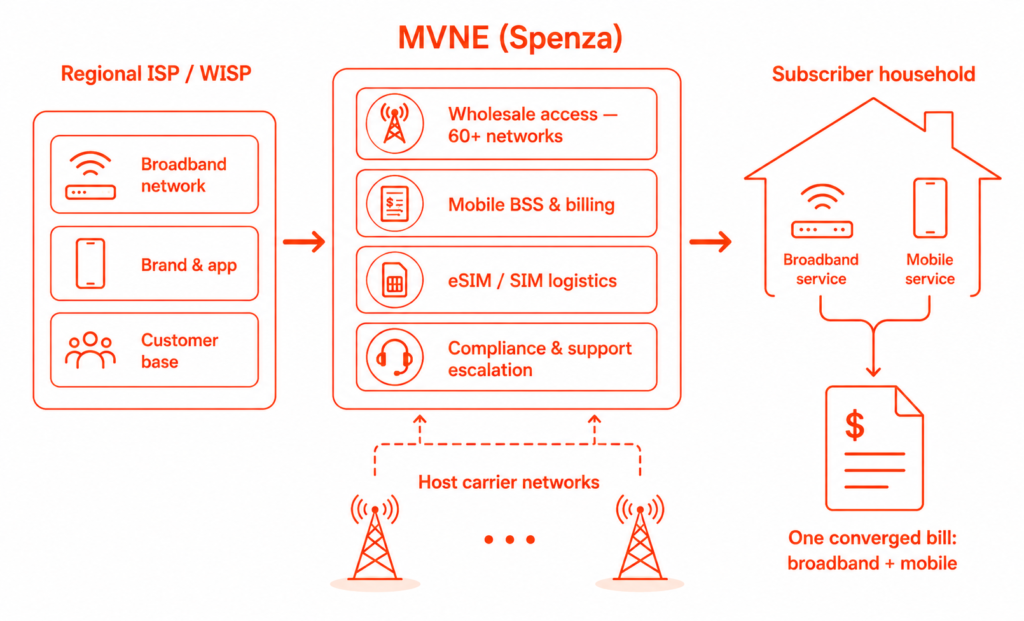
An MVNE (mobile virtual network enabler) operates the mobile infrastructure between you and the host networks: wholesale capacity, provisioning, the BSS (business support systems, the billing and subscriber-management stack), SIM and eSIM logistics, and compliance. You bring the brand and the customers. Here is how MVNEs work in detail.
Can a 20,000-Subscriber ISP Get a Wholesale Deal?
Not directly, and it no longer matters. Comcast and Charter got wholesale terms because tens of millions of subscribers make a host network listen; a regional ISP cannot get Verizon on the phone. The MVNE closes that gap by aggregating wholesale access across operators and delivering it with billing, SIM logistics, and compliance as a platform consumed per line. Rates are contracted per line, and subscribers and numbers remain your assets, portable if you ever change enabler. The regional operator runs the same strategic play with the leverage problem removed.
The market has already tested this below cable scale. Cable One launched Sparklight Mobile in December 2025 as an MVNO, and NCTC’s master MVNO agreement lets its 700-plus member operators, TDS Telecom among them, add mobile through pooled buying power. Aggregation is now the normal way smaller broadband providers get carrier terms.
The sequence once you engage an MVNE:
- Pick the model: attach or full brand (table above).
- Engage the MVNE for wholesale access and the mobile BSS. This replaces the carrier negotiation.
- Integrate billing so the customer sees one converged invoice.
- Train broadband support on mobile tier-1: activation, eSIM setup, and port-ins (moving a customer’s existing number over). Carrier-side escalations stay behind the MVNE.
- Launch to your base first, BYOD and eSIM-first: customers keep their phones and their numbers, activation happens from your existing app or portal, and you carry no handset inventory, financing, or returns operation.
- Open acquisition later, only if you chose the full-brand path.
Through an MVNE, launches run weeks to low months, driven mostly by billing integration depth. A direct build, with carrier negotiations, a billing stack, and SIM supply chains, runs 12 to 18 months. The full launch requirements and cost breakdown are documented separately, and the failure modes are catalogued in our MVNO mistakes guide; this article stays at the decision level.
Bundle and Billing Convergence (One Bill or It Isn’t a Bundle)
The single bill is the convergence product. Two invoices from one brand is not convergence, it is two subscriptions sharing a logo, and customers treat them that way. The churn benefit in the FMC literature attaches to genuinely converged accounts: one bill, one support number, a visible bundle discount.
Two integration patterns cover almost every ISP: feed mobile charges into your existing billing through an API, or let the MVNE’s billing issue the consolidated invoice under your brand. The choice depends on how attached your finance team is to the current stack, and it is reversible. (New to the terminology? Start with what a BSS actually is.)
Support convergence is the cost center nobody budgets. Your broadband CSRs will field mobile questions, and they need tier-1 scripts for three things: activation, eSIM transfers, and porting. Everything carrier-side stays behind the MVNE. Put a support-training line in the launch budget.
The Economics of the Converged Bundle
Standalone margin on an attached mobile line is thin. Wholesale data, platform fees, and the bundle discount eat most of the retail price, and cable’s own behavior confirms it: Comcast prices a mobile line at zero for a year as a retention tool, which only works because retention, not the mobile P&L, pays for it.
So the return lives in what the bundle does to broadband churn. S&P Global Market Intelligence puts average US broadband churn at 1.25% per month (Q3 2025 data), roughly 14% of the base per year. Analysys Mason’s FMC research finds fixed-mobile bundles produce a real but modest reduction in fixed churn, and warns that convergence alone does not guarantee loyalty. Spenza’s own ISP deployments report a larger effect, roughly 31% lower churn on bundled subscribers. Plan between those markers. Even the conservative end changes the account math, because a retained broadband account keeps paying its full margin, not just the mobile increment.
A Worked Example: Churn Saved vs Margin Earned
| Assumption (10,000-Sub Regional ISP) | Value | Basis |
|---|---|---|
| Broadband ARPU (average revenue per user) | $70/month | Illustrative |
| Baseline churn | 1.25%/month (~14%/year) | S&P Global industry average, Q3 2025 |
| Attach rate | 30% of base (3,000 accounts) | Year 2–3 target; launch-year attach typically runs 10–15% |
| Mobile retail price | $35/month, one line per bundled account | Illustrative |
| Mobile margin per line | $3–6/month | Illustrative, post-wholesale, post-discount |
| Not modeled | Support training, SIM stock, promo spend | See the launch cost guide |
Run it for a year at the steady state. The 3,000 bundled accounts lose about 11.4% instead of 14%, keeping roughly 80 broadband accounts that would have churned: about $67,000 of protected annual broadband revenue, compounding each year those accounts stay. The mobile lines contribute $108,000 to $216,000 of margin. And roughly $1.26 million of new billed mobile revenue flows through the base, lifting ARPA (average revenue per account) by about $35 on bundled homes.
Each stream alone looks modest. Together they stack: thin mobile margin, protected broadband margin, and a larger revenue base for the next retention point to act on. That stack is why cable keeps buying wholesale capacity at scale. Model your own base with the MVNO calculator before you commit pricing.
Bottom line: Do not build the business case on mobile margin. Build it on retained broadband lifetime plus ARPA lift, and treat mobile margin as upside. That is the math the 2026 earnings season keeps validating.
How Spenza Adds the Mobile Leg
Spenza is the MVNE platform built for exactly this move. An ISP launches a branded mobile plan on Spenza’s wholesale access (60-plus carrier networks), runs eSIM and physical SIM activation from its own app or portal, and bills it all on one converged invoice, while Spenza handles provisioning, porting, payouts, and compliance underneath. There is no carrier negotiation and no network engineering on your side. One operator on the platform has attached 4,630 bundled mobile subscribers, a 38% attach rate, adding about $162,000 in monthly mobile revenue (Spenza platform data). Launches go live in about a week when Spenza issues the converged invoice under your brand; feeding charges into your own billing stack adds integration time.
Conclusion: Turn Your ISP Into a Converged Connectivity Provider
The move from ISP to MVNO gives broadband providers a practical way to add mobile, increase ARPU, and strengthen customer retention. The growth of fixed-mobile convergence shows that customers increasingly value having broadband and mobile services from one provider.
For regional ISPs, WISPs, fiber operators, and other broadband providers, an MVNE removes much of the complexity. Instead of building a mobile network or negotiating directly with carriers, providers can launch a branded mobile service with wholesale connectivity, eSIM, provisioning, billing, and porting handled through an MVNE platform.
The best starting point for most ISPs is simple: launch mobile to your existing broadband customers, bundle it with internet, and measure the impact on churn, ARPU, and customer lifetime value.
The opportunity is clear. Adding mobile can turn an ISP into a converged connectivity provider without the cost and complexity of becoming a traditional carrier.
FAQs
Ready to add mobile to your broadband business? Explore how Spenza can help you launch an MVNO, add mobile to your ISP.