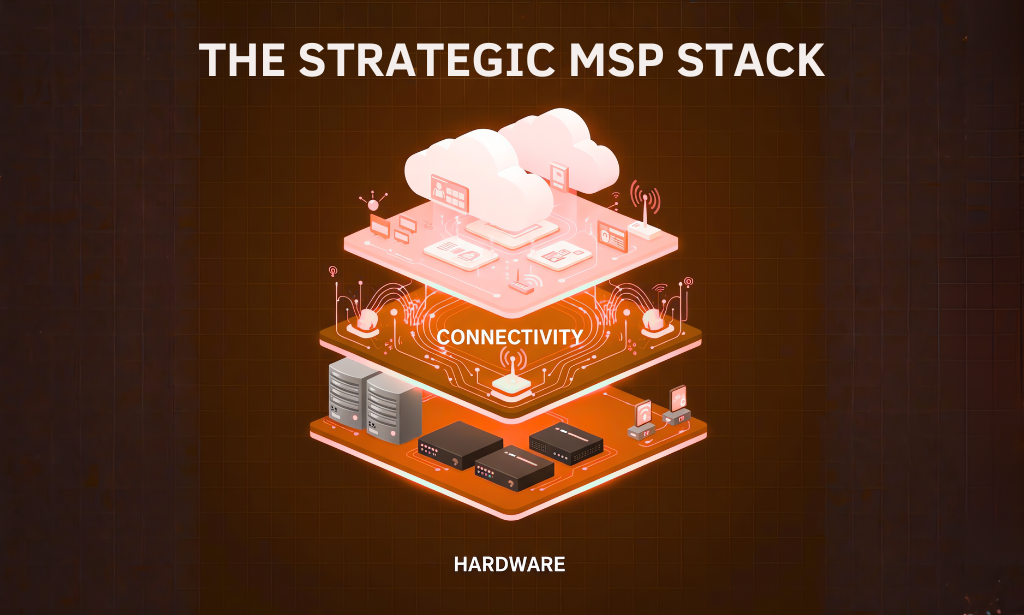
The “Connectivity Gap” in Your MSP Agreement
Picture this: your enterprise client just ordered 500 rugged tablets for their field operations team. You delivered the hardware on time, configured the devices, and deployed your management software. Everything’s ready to go.
Except it isn’t.
Now your client has to contact a carrier to procure 500 SIM cards, negotiate a data plan, manage provisioning, and figure out how to integrate connectivity into their device management workflow. What should have been a seamless deployment turns into a multi-vendor coordination nightmare.
Then, inevitably, a device goes offline in the field. Your client calls you. You point to the carrier. The carrier blames the hardware configuration. The client is stuck in the middle, frustrated, losing productivity, and questioning the value of your “managed” service.
This is the connectivity gap, and it’s costing MSPs millions in lost revenue, strained client relationships, and growing competitive risk.
According to industry research , the global managed services market is projected to grow from $335 billion in 2024 to over $731 billion by 2030. But here’s the catch: MSPs who continue operating as simple “box shifters” are leaving the most lucrative and sticky revenue streams on the table.
The most successful MSPs in 2025 aren’t just delivering hardware; they’re closing the connectivity gap entirely. By bundling hardware and connectivity into a single, integrated, fully supported solution, they transform from simple device suppliers into indispensable strategic partners.
The question isn’t whether to make this shift. It’s how quickly you can execute it.
The Shift: From Device Supplier to Solution Partner
The Old Model: Fragmented and Frustrating
Let’s be honest about how most MSP-client relationships have traditionally worked:
- MSP Role: Hardware procurement, device provisioning, and break/fix support
- Carrier Role: Provides SIMs and a data plan through a separate agreement
- Enterprise’s Pain: Multiple vendors, multiple invoices, integration headaches, and zero single point of accountability
When something goes wrong (and it always does), everyone points fingers. The MSP blames network issues. The carrier blames device configuration. IT directors waste hours troubleshooting what should be a simple connectivity problem.
This fragmentation doesn’t just create operational inefficiency. It fundamentally undermines the value proposition of managed services.
The New Model: Integrated and Indispensable
Forward-thinking MSPs are rewriting the playbook entirely. Instead of stopping at hardware delivery, they’re providing a complete, ready-to-deploy solution:
- The device (via Hardware-as-a-Service)
- The optimized connectivity plan (multi-carrier, global coverage)
- Unified management and monitoring (single pane of glass)
- One point of accountability (true end-to-end support)
This is the evolution from device supplier to solution partner, and it’s driving the industry’s most impressive growth metrics.
Monthly recurring services now constitute 37% of total MSP revenue, with the most valuable MSPs deriving the majority of their income from subscription-based offerings. The valuation premium is clear: recurring revenue models command 3–5× higher multiples than project-based businesses.
Why This Matters: The Benefits of the Bundled Solution
The convergence of hardware and connectivity is not just a new sales strategy; it is a fundamental business model upgrade that creates exponential value for both the enterprise client and the MSP.
For the Enterprise Client: Simplicity, Speed, and Performance
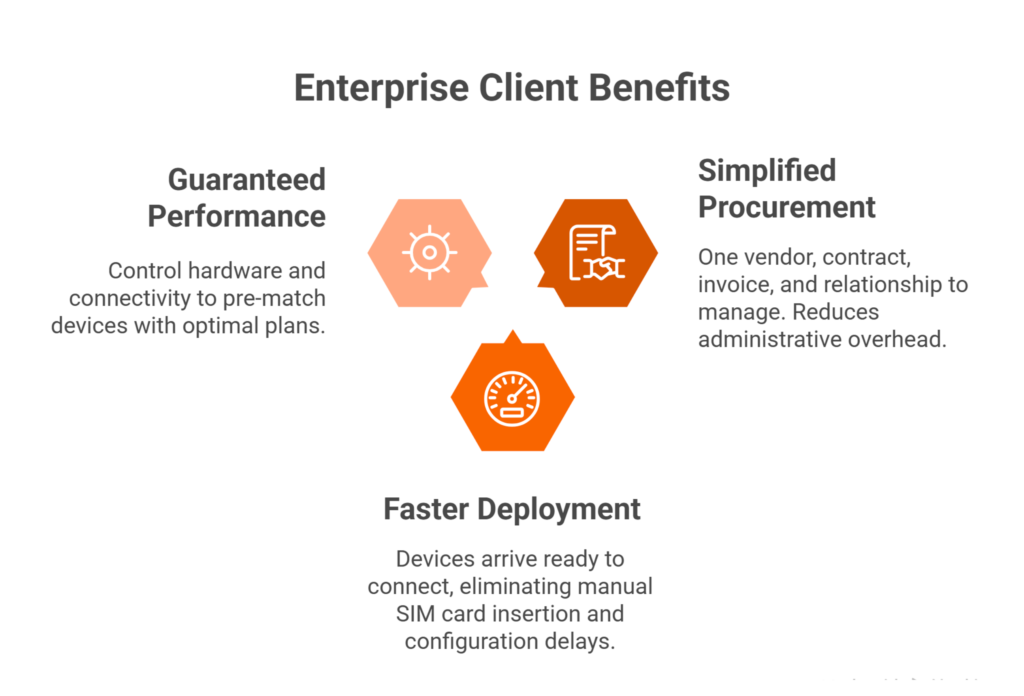
1. Simplified Procurement
One vendor. One contract. One invoice. One relationship to manage.
Instead of juggling multiple technology vendors, enterprises gain a single strategic partner responsible for the entire connectivity lifecycle. This consolidation can reduce administrative overhead by up to 30% according to procurement efficiency studies.
2. Faster Deployment
Devices arrive “hot” and ready to connect. No more unboxing 500 tablets to manually insert SIM cards. No waiting for carrier provisioning. No configuration delays.
Your client’s field team goes from order to operational in days, not weeks. In industries like logistics, retail, and healthcare where downtime equals revenue loss, this speed advantage is transformative.
3. Guaranteed Performance
When you control both the hardware and the connectivity, you can pre-match devices with optimal plans:
- Multi-carrier eSIMs for logistics trackers requiring seamless coverage
- High-bandwidth 5G plans for video-enabled devices
- Low-power IoT plans for sensors and monitoring equipment
The result? Devices that work exactly as intended, with connectivity optimized for their specific use case.
Comparison between Traditional and Bundled MSP Models
| Aspect | Traditional Model | Bundled MSP Model |
|---|---|---|
| Vendor Relationships | 3–5 separate vendor relationships | Single strategic partner |
| Deployment Speed | Weeks to deploy connectivity | Days to full operational status |
| Accountability | Finger-pointing during outages | Single point of accountability |
| Connectivity Plans | Generic carrier plans | Optimized, fit-for-purpose connectivity |
| Cost Structure | Unpredictable costs | Fixed, predictable OpEx |
For the MSP: Revenue, Relationships, and Defensibility
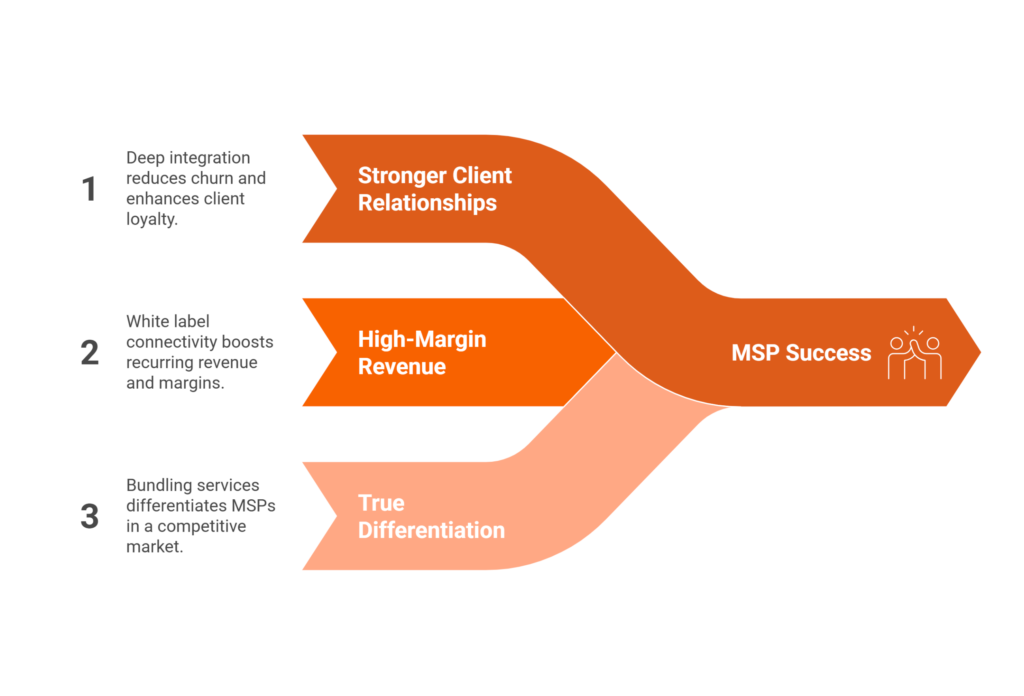
1. Stronger Client Relationships
You are no longer “just” the vendor. When you manage a client’s entire technology stack, from the physical device to the network connection, you become embedded in their daily operations. You are not expendable. You are essential.
This deep integration dramatically reduces churn. Research shows that MSPs offering bundled solutions experience up to 30% lower customer attrition compared to those providing fragmented services.
2. New, High-Margin Recurring Revenue
Connectivity reselling through white label models offers gross margins of about 50 to 60 percent, compared with just 10 to 20 percent in traditional agent or referral setups.
Because you control branding, pricing, and billing, you are no longer receiving a passive commission; instead, you own the revenue stream and capture a far greater margin.
Even better, this model builds recurring revenue that compounds over time. As you manage the full stack of connectivity and device services for clients, churn falls and lifetime value rises. Not only are the margins higher, but the long term business value is significantly stronger.
Discover how telecom MSPs Can Scale to $10M+ using white-label connectivity.
3. True Differentiation
In a commoditized market where every MSP offers “24/7 support” and “proactive monitoring,” bundling hardware and connectivity creates genuine differentiation. You can now compete on the value of your integrated solution, not just the price of a laptop.
This positions you to win enterprise deals against larger competitors and protects you from the race-to-the-bottom pricing pressure that plagues transactional IT services.
The Challenge: How Can an MSP “Become” a Connectivity Provider?
At this point, the value proposition is clear. But there’s an obvious objection:
“We’re a hardware and support specialist, not a telecom company. We don’t have carrier agreements, telecom expertise, or a platform to manage thousands of SIMs across multiple networks.”
This barrier has historically been significant. Let’s look at the traditional approaches and why they often fail:
The Old “Hard Way”: Becoming an MVNO
Some MSPs have attempted to become full Mobile Virtual Network Operators (MVNOs), negotiating direct reseller agreements with carriers. This approach involves:
- Multi-million dollar minimum commitments
- Complex legal and regulatory compliance
- Building or licensing connectivity management platforms
- Hiring telecom-specific expertise
- 12-18 month implementation timelines
For all but the largest MSPs, this path is prohibitively expensive, slow, and complex. It diverts resources from core competencies and introduces massive execution risk.
If building an MVNO isn’t feasible, explore MVNO alternatives for MSPs, resellers, and IoT providers.
The Agent Model: The Low-Value Trap
The simpler alternative has been to become a carrier agent, referring clients to major carriers in exchange for a small commission.
The problems with this approach:
- Minimal margins (10-20%)
- No customer ownership (carrier controls the relationship)
- No brand differentiation (you’re just a referral channel)
- Zero impact on business valuation
This is connectivity reselling in name only. You aren’t building sustainable value; you’re simply collecting a referral fee.
The New “Smart Way”: White-Label Connectivity Platforms
White‑label connectivity management platforms like Spenza enable MSPs to tap into carrier networks instantly, without having to build their own infrastructure or invest heavy capital. These platforms allow you to brand the service as your own, set your own pricing, handle billing directly, and deliver connectivity and device‑services under your own name.
Read how MSP-A scaled 3x faster using Spenza to manage devices and connectivity seamlessly.
Spenza: The “Connectivity-in-a-Box” for MSPs
With Spenza, MSPs can start reselling and managing connectivity with their hardware right away, maximizing profit and scaling effortlessly.
Think of Spenza as “Stripe + Shopify for connectivity.” Just as Stripe democratized payment processing and Shopify enabled anyone to launch an e-commerce store, Spenza removes the barriers that have prevented MSPs from offering professional-grade connectivity services.
How Spenza Transforms Your MSP Business
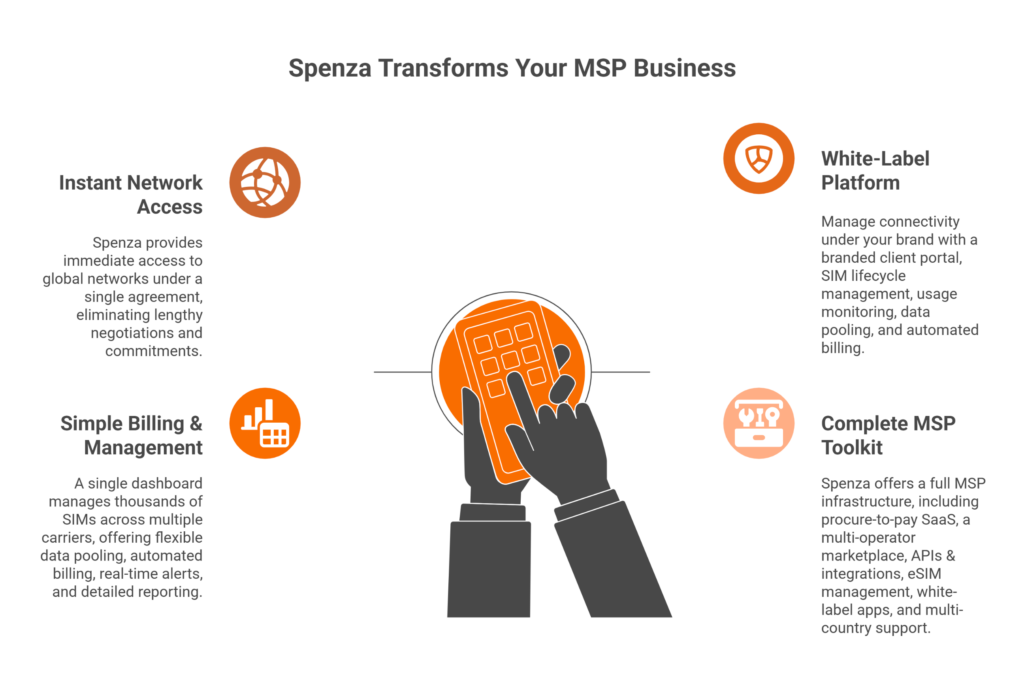
1. Instant Multi‑Carrier Network Access
Spenza gives you instant access to global networks, all under a single agreement. No multi-million-dollar commitments. No drawn-out carrier negotiations. No waiting a year for contracts. Deliver multi-network, worldwide connectivity to your clients in days, not years.
2. White-Label Platform: Your Brand, Your Customers
Manage connectivity entirely under your brand:
- Branded client portal with your logo
- SIM lifecycle management (activation, suspension, termination)
- Usage monitoring and alerts
- Data pooling across subscribers
- Automated billing integration
Your clients see you, not Spenza. You control the experience, own the relationship, and capture the value.
3. Simple Billing & Management: All-in-One Dashboard
Manage thousands of SIMs across multiple carriers from a single dashboard.
- Flexible data pooling to optimize costs
- Automated billing synced with your PSA/RMM tools
- Real-time alerts to prevent overages
- Detailed reporting for client reviews
- Easily bundle connectivity with Hardware-as-a-Service or managed services for one transparent monthly charge
4. The Complete MSP Toolkit
Spenza is more than connectivity; it’s your full MSP infrastructure:
- Procure-to-Pay SaaS: Streamlined ordering and billing
- Multi-Operator Marketplace: Access multiple networks with no extra agreements
- APIs & Integrations: Connect to PSA, RMM, and CRM systems
- eSIM Management: Faster deployment, fewer logistics
- White-Label Apps: Branded user experience for BYOD
- Multi-Country Support: Serve enterprise clients anywhere
The End Result: Your Competitive Moat
With Spenza, you can present your clients with one clear, compelling offer:
“Here are your new tablets along with a global, multi-carrier connectivity plan. Everything is fully managed by us through a single dashboard, billed in one place, and supported by a dedicated point of contact.“
This is more than a simple upgrade. It transforms your MSP from a tactical service provider into a strategic technology partner.
Because connectivity is deeply woven into your clients’ operations, linking their devices, applications, and workflows, it creates significant switching costs. This reduces churn and strengthens your client relationships for the long term.
Learn 5 proven strategies to monetize connectivity effectively for MSPs and OEMs.
Conclusion: Stop Selling Boxes. Start Selling Solutions.
The future of the MSP industry is not in selling boxes or offering fragmented services. Success belongs to those who deliver fully integrated, end-to-end solutions where hardware, connectivity, security, and management work together seamlessly under a single point of accountability. Bundling hardware and connectivity is no longer optional; it is a strategic imperative.
MSPs who make this shift will capture more revenue from existing clients, generate predictable recurring income, build stronger and more valuable businesses, and establish themselves as indispensable strategic partners.
Those who continue to focus on isolated products will face commoditization, price pressure, increased churn, and stagnant business growth.
Today, platforms like Spenza have removed the traditional barriers of capital, complexity, and carrier relationships, making it easier than ever to transform into a solution-driven MSP and secure a lasting competitive advantage.
The question is no longer whether to bundle hardware and connectivity. The question is how quickly you can execute.
Your clients are already looking for a single provider who can deliver complete, integrated solutions. They’re tired of managing multiple vendors and pointing fingers during outages. They want simplicity, accountability, and expertise.
Are you going to be the MSP who delivers it, or the one who gets left behind?
FAQs
Ready to evolve? Book a free demo to learn how your MSP can become the strategic partner that enterprises demand.