Last verified 30 October 2026.
MVNOs fail because the unit economics never worked and nobody stress-tested them, not because the technology is hard. A subscriber costs money to acquire, costs money every month and leaves faster than most plans assume. In the US this is harder than it looks: the national carriers run their own value brands, and Americans used a record 132 trillion megabytes of wireless data in 2024 and 159.3 trillion in 2025, according to CTIA. Usage climbs, retail prices do not, and the gap lands on your gross margin.
So the most common MVNO launch mistakes are ordinary decisions, made early with optimistic numbers, that compound. This guide covers fifteen of them, grouped by the stage where they happen, each with a warning sign you can check against your own plan today. If two or more warning signs describe your plan, fix those before you sign anything.
The 15 Most Common MVNO Launch Mistakes at a Glance

| # | Mistake | Early warning sign | The fix |
|---|---|---|---|
| 1 | No real differentiation | You cannot name your customer in one sentence. | Pick one segment and build pricing, support and distribution around it. |
| 2 | A plan built on generous assumptions | Churn looks low, ARPU high, support cheap. | Rebuild the model at half your forecast volume and double your churn. |
| 3 | Underestimating capital and runway | Burn rises faster than net adds. | Fund 18 months, not 6, and model deposits and support separately. |
| 4 | A wholesale agreement you cannot live with | High minimums, no renegotiation clause, vague 5G language. | Negotiate volume flexibility, quality of service and a rate review. |
| 5 | Pricing from competitor screenshots | Margin per GB falls as usage grows. | Price up from wholesale cost, taxes and support, then compare to market. |
| 6 | Chasing subscribers over quality revenue | Gross adds rise while contribution margin stays flat. | Track margin and payback per acquisition cohort. |
| 7 | Treating an MVNO as simple reselling | No owner for failed activations, rating disputes or porting. | Assign day-two ownership before day one. |
| 8 | Launching with billing and BSS half integrated | Double charges, failed payments, manual credits. | Test rating, billing and dunning against real traffic in staging. |
| 9 | Skipping eSIM-first onboarding | Big drop-off between purchase and first data session. | Instant eSIM activation, with device eligibility checked before checkout. |
| 10 | Ignoring fraud and revenue leakage | Unexplained usage spikes, chargebacks, SIM farming. | KYC at signup, usage caps, monthly rated-versus-billed reconciliation. |
| 11 | Missing US regulatory registrations | No FRN, no Form 499 plan, no CPNI or E911 owner. | Register early, or work with a partner that holds the filings. |
| 12 | Pricing without telecom taxes and USF | Retail price set with no tax and fee layer. | Model taxes, USF and state fees from the first spreadsheet. |
| 13 | Ignoring messaging and voice compliance | OTP texts undelivered; calls labelled as spam. | Register A2P 10DLC brand and campaigns; file in the Robocall Mitigation Database. |
| 14 | Depending on a single host MNO | No fallback if terms change or a network sunsets. | Prefer multi-carrier access; plan the renegotiation early. |
| 15 | Misreading a growth stall as a marketing problem | Growth slows and the reflex is to discount and spend. | Diagnose first: segment ceiling, churn or unit economics. |
MVNO Strategy Mistakes
These three happen before anyone writes code, and no platform partner can fix them for you.
1. Launching Without Real Differentiation
The generic cheap-SIM play loses. You cannot out-price a carrier that owns the spectrum, and any discount you offer is one they can match next week. The brands that keep subscribers own a specific group: diaspora communities calling one corridor, RV owners who care about coverage maps more than gigabytes, contractors who want lines they can switch on by the week.
Warning sign: you cannot describe your customer in one sentence without the word “everyone” or “affordable”.
The fix: choose one segment and let it decide your pricing, support hours, channel and app. Reach matters less than fit, and the MVNO types guide shows how the operating model changes with the segment.
2. Building the Plan on Generous Assumptions
Almost every failed model shares three inputs: churn set too low, ARPU set too high and support cost set near zero. Each is defensible alone. Together they turn a business that loses money into a spreadsheet that makes money.
Warning sign: your model assumes 1.5 percent monthly churn because that is what the national carriers report. Their postpaid phone churn has recently run at roughly 0.9 percent a month, but that reflects device contracts, family plans and bundled home internet. You have none of those.
The fix: rebuild the model at half your forecast volume and double your assumed churn. If it still clears, you have a business. Then run the numbers through the MVNO launch cost guide before you commit to a wholesale term.
3. Underestimating Capital and Runway
Founders budget for the platform and forget what surrounds it: the wholesale deposit, SIM inventory, the payment gateway reserve, three months of support before self-service works, and marketing that keeps running while payback catches up.
Warning sign: burn is rising faster than net adds two months running, and the plan has no line item for the cause.
The fix: fund eighteen months. Six months assumes you find product-market fit on the first attempt. The build-versus-partner decision is largely a runway decision.
MVNO Commercial Mistakes
This group decides whether each subscriber earns money. Get these wrong and growth makes the problem bigger, not smaller.
4. Signing a Wholesale Agreement You Cannot Live With
The wholesale contract sets your cost floor, your feature access and your room to move when reality differs from the forecast. Founders under time pressure sign the first workable offer and meet its constraints at renewal. Read these clauses before signing:
- Minimum monthly commitments, and the penalty for the months you miss them.
- Whether a renegotiation clause exists, what triggers it and how often you can use it.
- Per-GB rate bands, and whether your effective rate improves or worsens as usage grows.
- Explicit VoLTE, 5G and network-sunset language, not a general reference to “available services”.
- Data, voice and SMS priced separately, so a shift in usage mix does not surprise you.
Warning sign: you cannot answer “what does this contract cost me if usage per subscriber doubles” without emailing your account manager.
The fix: model the deal across three usage scenarios before signing, and negotiate flexibility ahead of headline rate. A slightly worse per-GB price with a real renegotiation clause beats a great rate locked in for 36 months.
5. Pricing From Competitor Screenshots Instead of Wholesale Cost
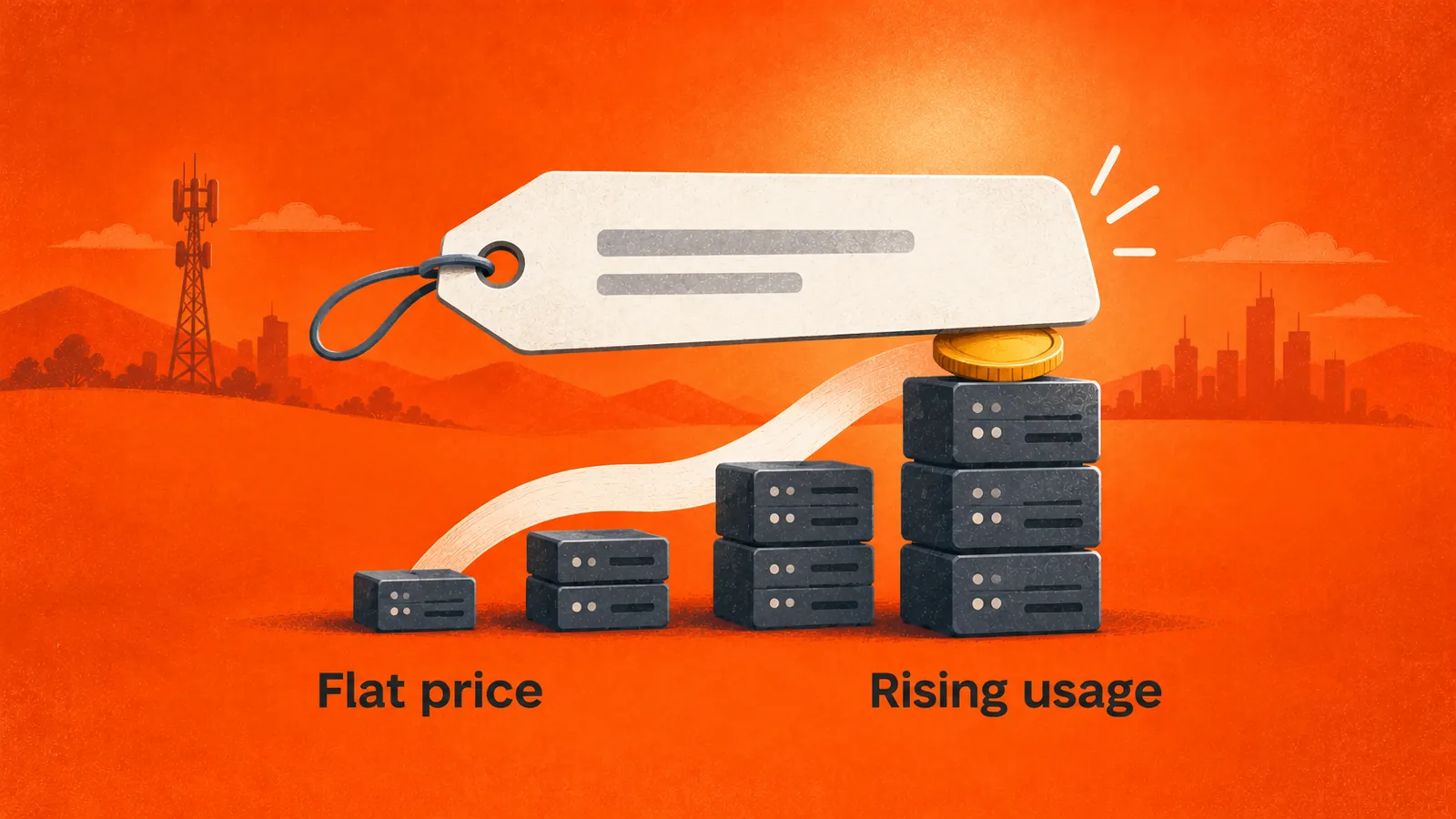
Copying a competitor’s price copies a cost base you do not have. Then usage does what US usage keeps doing: CTIA reported 132 trillion MB in 2024 (up 32 percent) and 159.3 trillion MB in 2025 (up 20 percent). If your per-GB wholesale rate is flat and your plan price is flat, your margin is not flat. It is falling.
Warning sign: margin per subscriber is thinner this quarter than last, and nothing about your pricing changed.
The fix: build price from the bottom: wholesale cost at expected usage, plus taxes and fees, support, payment processing and target margin. Then compare to market. If the market price sits below your floor, the segment is wrong, not the spreadsheet. Add-ons and bundles often carry margin that raw data cannot.
Reality check. Two operators launch the same $25 monthly plan. One forecasts 8 GB per subscriber and stops there. The other also models 35 percent annual usage growth, which puts a typical subscriber near 12.5 GB eighteen months later while the price is still $25. This is arithmetic, not a benchmark, but it shows why profitability is usually set before launch.
6. Chasing Subscribers Instead of Quality Revenue
Subscriber count is the metric investors ask about and the one that hides the most. You can grow the base every month while every new cohort loses money, and the total looks healthy right up until acquisition spend pauses.
Warning sign: gross adds are up and contribution margin is flat or negative.
The fix: report by cohort. For each acquisition month, track acquisition cost, monthly contribution margin and payback period. As a purely hypothetical comparison, a cohort that pays back in nine months is a business, while one that pays back in thirty-one is a subsidy.
Technical and Operational Mistakes
The platform is rarely what breaks. What breaks is everything that has to happen after a subscriber goes live.
7. Treating an MVNO as Simple Reselling
Reselling ends the moment a customer has a problem. Activations fail, ports stall at the losing carrier, a rating rule misfires and forty accounts are billed twice. If nobody owns these on day two, your support queue becomes your product. Write down who does what between the MNO, MVNE and MVNO before launch.
Warning sign: you have no named owner for failed activations, porting exceptions or rating disputes.
The fix: assign day-two ownership before day one, either to a person on your team or as a contractual responsibility on your platform partner.
8. Launching With Billing and BSS Half Integrated
Billing failures cost you customers who were otherwise happy: a double charge, a failed renewal that silently suspends service, a plan change that does not take effect until next cycle. Each is a ticket, a refund and often a cancellation.
Warning sign: anyone on your team issues account credits by hand more than once a week.
The fix: test rating, billing, dunning and plan changes against real traffic in staging before launch. When you compare MVNO billing platforms, look hardest at mid-cycle plan changes, proration and failed-payment retries, because that is where the tickets come from.
9. Skipping eSIM-First Onboarding
Every step between payment and first data session costs you customers. Physical SIM shipping adds days and a delivery failure rate. Manual APN instructions add a support call. A QR code buried in an email adds drop-off.
Warning sign: there is a meaningful gap between paid signups and first data session, and nobody tracks it as a funnel step.
The fix: offer instant eSIM provisioning with in-app activation, and check device eligibility before checkout rather than after. An eSIM compatibility check at the top of the funnel prevents refunds at the bottom.
10. Ignoring Fraud and Revenue Leakage
The Communications Fraud Control Association (CFCA) estimated global telecom fraud losses at $38.95 billion in 2023, up 12 percent. For a small MVNO the damage is rarely one large event. It is subscription fraud on stolen cards, SIM farming against your international rates, and a slow gap between rated and billed usage.
Warning sign: usage spikes you cannot explain, a rising chargeback rate, or a rated-versus-billed difference nobody reconciles.
The fix: apply KYC at signup, velocity limits on new accounts, real-time caps on international and premium destinations, and a monthly reconciliation of rated usage, invoiced revenue and collected cash. Three numbers, once a month. Most leakage shows up there first.

US Compliance Mistakes (FCC, CPNI, E911 and 10DLC)
This is where US launches get delayed. None of it is optional, and none of it has a small-provider exemption you can rely on. For the full picture, see the guide to launching an MVNO in the US.
11. Missing US Regulatory Registrations
You need an FCC Registration Number through the FCC’s CORES system before you can do most business with the Commission. Most providers of interstate telecommunications also carry FCC Form 499 filing obligations and contribute to the universal service fund through USAC. The CPNI rules in 47 CFR Part 64, Subpart U require you to protect customer call detail and account data, train staff on handling it and file an annual compliance certification with the FCC by March 1. E911 obligations cover routing emergency calls and delivering caller location to the answering point.
Warning sign: no FRN, no owner for the annual CPNI certification, and no answer for how a 911 call on your service reaches the right dispatcher.
The fix: give each obligation a named owner and a date, or work with an MVNE or partner that takes on part of the filings. Get in writing exactly which filings it holds and which remain yours.
12. Pricing Without Telecom Taxes and USF
The Tax Foundation found that taxes, fees and government surcharges reached a record 27.6 percent of a typical US wireless bill in 2025, ranging by state from about 17 percent to 38.32 percent in Illinois. Separately, the FCC’s universal service contribution factor, set quarterly, was proposed at a record 38.8 percent for the third quarter of 2026, applied to assessable interstate and international end-user revenue. Whether you absorb these or pass them through changes your effective price and your margin.
Warning sign: your pricing model has one line called “revenue” and no line called “taxes and regulatory fees”.
The fix: decide the pass-through policy before you publish a price, model it by state rather than nationally, and confirm your billing system presents it correctly on the invoice. A national launch is not a single tax position.
13. Ignoring Messaging and Voice Compliance
The three national carriers now block unregistered application-to-person traffic on 10-digit numbers rather than filtering it. If your brand and campaigns are not registered with The Campaign Registry, your one-time passcodes may not arrive, and you will see it as a login failure rate rather than a messaging problem. On voice, STIR/SHAKEN caller ID authentication sets your attestation level, and weakly attested calls get labelled as spam risk and stop being answered.
Warning sign: OTP delivery is poor, or the support queue is full of customers who never got the code.
The fix: register the brand and every campaign use case before launch, keep sending behavior matched to the approved use case, maintain your Robocall Mitigation Database entry and treat OTP delivery as a first-class metric.
Post-Launch Mistakes: What Goes Wrong After Go-Live
The launch worked and subscribers are activating. These two mistakes turn a working MVNO into a stalled one.
14. Depending on a Single Host MNO
One host network is one negotiation away from a different business. Terms change at renewal, coverage degrades in a region you sell into, or a network sunsets and part of your base loses service on a schedule you do not control.
Warning sign: you have no answer for what happens if your host raises rates 15 percent at renewal.
The fix: prefer multi-carrier access from the start, even if you launch on one network. Adding a second carrier later costs far more than choosing a platform that already supports it.
15. Misreading a Growth Stall as a Marketing Problem
Growth slows and the reflex is to discount and raise ad spend. Sometimes that is right. More often the stall has one of three causes, and two of them get worse with more spend:
- Gross adds falling while acquisition cost rises: you are hitting the ceiling of your segment. More budget buys worse customers. Expand the offer or the segment.
- Gross adds steady but net adds falling: churn rose and acquisition is filling a leak. Fix retention first.
- Both steady but contribution margin flat: pricing or the wholesale deal is the constraint, not demand.
Warning sign: the only response in the room is a discount.
The fix: separate gross adds, churn and margin per cohort before you change the budget. A stall is a measurement question first.
Five Launch Myths, and What Is Actually True
Several of the mistakes above start as beliefs founders absorb before launching. Here are the five most common, set against what holds in practice.
| Myth | Reality |
|---|---|
| MVNOs have inferior network quality | MVNOs use their host MNO’s infrastructure, so coverage is the same. What differs is the service level and any deprioritization written into the wholesale agreement. |
| MVNOs are simple resellers | Running an MVNO means billing, provisioning, customer management, compliance and support (mistake 7). |
| MVNOs cannot support modern devices | Current phones, 5G and eSIM can all be supported, but only if the host network and your agreement include them (mistake 4). |
| MVNOs always carry hidden fees | Pricing depends on the operator and plan. Transparent plans are often the brand’s whole value proposition, provided taxes and fees are modeled honestly (mistake 12). |
| MVNOs are profitable almost immediately | Profit depends on acquisition cost, wholesale rates, operating cost, pricing, usage and churn (mistakes 2, 3, 5 and 6). |
Each myth is half true: the network is the same, but contract terms decide the experience. Your launch cost estimate should reflect the model you choose, since a branded reseller or eSIM-first model can need far less capital than a light or full MVNO.
The Hidden Costs Founders Miss
These rarely appear in a first-pass budget and reliably appear in month four.
- Support before self-service works. Ticket volume peaks in the first ninety days, when your app is least complete.
- Payment gateway reserves and chargeback fees. New telecom merchants can face rolling reserves, which is working capital you cannot spend.
- Billing changes. Every new plan, promotion or tax jurisdiction is configuration work.
- Regulatory filings and professional fees. Form 499 preparation, CPNI certification and state registrations take staff time or outside counsel.
Consumer vs IoT and Enterprise: Two Different Businesses
Several operators launch consumer-first, find the margin thin, then discover the same platform serves enterprise and IoT connectivity with different economics. Decide this deliberately rather than drifting into it.
| Dimension | Consumer MVNO | IoT and enterprise MVNO |
|---|---|---|
| Usage pattern | Volatile, grows with video and 5G | Often predictable and small per device |
| Churn | Higher, switching is instant | Typically lower, tied to hardware and contracts |
| Contract term | Month to month | Often multi-year, sometimes with volume commitments |
| Margin profile | Thin, sensitive to usage growth | Often steadier, priced per device or account |
If your product is a connected device rather than a phone plan, the economics differ again, because connectivity is bundled into a hardware or software price instead of sold on its own.
How to De-Risk Your Launch (and Where an MVNE Fits)
The fifteen mistakes split into two groups. One is structural: wholesale access, billing, provisioning and compliance filings. A platform partner can remove much of that risk. The other is strategic: who you serve, what you charge and whether they stay. Nobody removes that for you. If you are weighing the partner route, how an MVNE accelerates an MVNO launch explains what it does, and launching an MVNO in 7 days shows how short a launch timeline can get.
Spenza is an MVNE and connectivity platform. Against these mistakes, the relevant parts are multi-carrier network access (mistakes 4 and 14), SIM and eSIM provisioning (mistake 9), plan and billing management with reseller billing (mistake 8), and usage analytics that help surface anomalies before the invoice does (mistake 10). Compliance filings (mistakes 11 to 13) are the area to ask about directly, with a written split of what the partner holds and what you hold. The MVNE page describes the platform.
The honest limit. An MVNE can reduce much of the technical, operational and regulatory complexity of launching an MVNO. It cannot choose your target market, create a value proposition, set the right price or keep your subscribers. Any vendor that suggests a platform alone guarantees commercial success is solving only the part it controls.
Conclusion: Building an MVNO That Lasts
Launching an MVNO is no longer mainly a technology challenge. Most failures trace back to weak unit economics, thin differentiation, an inflexible wholesale agreement, and underestimating the operational and compliance work needed to scale. You reduce launch risk by validating assumptions early, negotiating flexible carrier terms, getting billing and eSIM onboarding reliable before launch, and tracking profit per cohort instead of subscriber growth alone.
Use the table at the top as a pre-signing checklist: score each warning sign against your plan and fix the ones that apply. To pressure-test a plan, you can talk to the Spenza team with your segment, pricing assumptions and target launch date.
MVNO Launch Mistakes FAQs
Why do MVNOs fail?
Mostly for strategy, economics and operational reasons rather than technical ones. The recurring causes are weak differentiation, optimistic churn and ARPU assumptions, an inflexible wholesale agreement, pricing set from competitors instead of cost, billing that breaks at scale, and missed US compliance obligations.
What is the biggest mistake new MVNOs make?
Launching without real differentiation. If you cannot name your customer in one sentence, you are competing on price against companies that own the network. Underestimating capital comes second.
Are MVNOs profitable?
They can be, on disciplined unit economics. Profitability depends on the gap between wholesale cost and effective retail revenue after taxes, fees, support and acquisition cost. That gap narrows as usage grows, which is why margin can look fine at launch and thin a year and a half later.
How much capital do you need to launch an MVNO in the US?
It depends on the model. A full in-house build costs far more than a branded or light model on a partner’s platform, where cost scales more closely with revenue. Our MVNO launch cost guide breaks the ranges down by model. Plan for roughly eighteen months of runway, not six.
Do MVNOs need FCC approval in the US?
There is no single MVNO license, but registration and compliance obligations apply. Most providers need an FCC Registration Number, and many carry Form 499 filing and universal service obligations alongside CPNI, E911, and messaging and voice compliance. A partner may take on some of these filings, so confirm the split in writing.
What is a good churn rate for an MVNO?
There is no single benchmark, so model a range. National carriers’ postpaid phone churn has recently run around 0.9 percent a month, but that reflects contracts and bundles an MVNO lacks. Stress-test your plan at several times that figure, for example 3 to 6 percent monthly, which is a planning range rather than an industry statistic.
Does eSIM reduce operational cost for MVNOs?
Generally yes. eSIM removes physical shipping and returns, reduces activation errors and lets customers activate instantly, so support handles fewer logistics issues.
Can I avoid these mistakes by using an MVNE?
An MVNE can remove several structural risks: wholesale access, billing, eSIM provisioning and, depending on the provider, compliance filings. It does not remove strategy, pricing discipline or retention. Those stay with you.