Last verified 2 November 2026.
M2M (machine-to-machine) is direct communication between devices over a wired or wireless network, without human involvement. A device collects data, sends it across a network, and a receiving system stores it, acts on it or sends a command back. Nobody presses a button. An M2M SIM is a SIM built for that job: it authenticates an unattended machine to a mobile network, survives harsher conditions than a phone SIM, and is managed remotely from software rather than swapped by hand.
Buy a SIM for a phone and you are buying a month of service. Buy a SIM for a machine and you are buying years of it, because the SIM may be potted into a water meter under a sidewalk or soldered onto a tracker that nobody will touch again. That is why M2M SIMs are engineered, priced and managed differently. This guide covers what M2M is, how it differs from IoT, what separates an M2M SIM from a normal one, the eSIM standards that decide whether you can ever change carrier, and what to ask a provider before you commit hardware.
What is M2M?
The term predates IoT by decades, and standards bodies never dropped it. 3GPP calls the cellular version machine-type communication (MTC), and its service requirements specification for it, TS 22.368, has a Release 10 version dating to 2010-2011 (see the 3GPP specification page). Marketing moved to “IoT”, but the same SIMs, modules and networks sit underneath both words.
A typical M2M system is purpose-built: a utility meter reports to a billing system, a vending machine reports stock, an ATM talks to its bank. Each device sends data to a known destination for a known purpose, usually over cellular but sometimes over wired, satellite or private links.
Where the money sits. IoT Analytics counted about 4.7 billion cellular IoT connections in 2025 and reports that mobile operators earned about $20.8 billion from them (IoT Analytics). Dividing the two gives roughly $4.40 per connection per year, about 37 cents a month. That division is our arithmetic, not an IoT Analytics figure, and other analysts count differently. The point stands either way: the connectivity itself is a small part of the value of a connected product. The data and the service on top of it are where most of the value sits.
M2M vs IoT: what is the difference?
M2M is connectivity: devices exchange data without a person involved. IoT is connected intelligence: a fleet of devices feeds cloud platforms, analytics, APIs and automation, and the value of the data is not fixed when the device is designed. M2M is a link. IoT is an architecture built from many links, and M2M-style communication is often the device-level layer inside it. IoT did not replace M2M; it grew out of it.
| Dimension | M2M | IoT |
|---|---|---|
| Communication model | Device to device, or device to one application | Many devices to shared platforms and many applications |
| Typical network | Cellular, wired, satellite or private links | Cellular and other networks feeding cloud platforms |
| Architecture | Point to point | Layered: devices, connectivity, cloud, analytics, applications |
| Data use | Collect and transmit; monitor and control | Analyze, predict, automate, integrate with business systems |
| Internet dependency | Not always required | Normally internet-connected |
| Interoperability | Often proprietary, application-specific | API-driven and standards-based |
| Common protocols | SMS, USSD, Modbus, proprietary | MQTT, CoAP, LwM2M, HTTP |
| Typical examples | ATMs, vending machines, utility meters, alarm panels | Predictive maintenance, asset tracking, connected healthcare, smart cities |
A smart meter shows the split. When it sends a reading to a billing system, that is M2M. When the same readings are analyzed to forecast demand, flag anomalies and automate decisions, the meter has become part of an IoT system. Same device, same SIM, more layers on top. If you only need machines to report reliably to one destination, an M2M design may be enough. If you need analytics, automation and integration with other systems, you are building IoT, and it will still run on M2M-style connections.
Is an M2M SIM the same as an IoT SIM?
Often the hardware is the same, and providers use the two names interchangeably. There is no standard that defines an “IoT SIM” as a separate product. What differs from one SIM to the next is a set of capabilities: whether it reaches one network or several, whether it carries an eUICC that can take new profiles remotely, and how it is managed. Older M2M SIMs were typically tied to one operator in one region. Newer ones are often multi-network and remotely provisioned. So if a vendor charges more for an “IoT SIM”, ask which of those capabilities you are paying for.
How M2M communication works
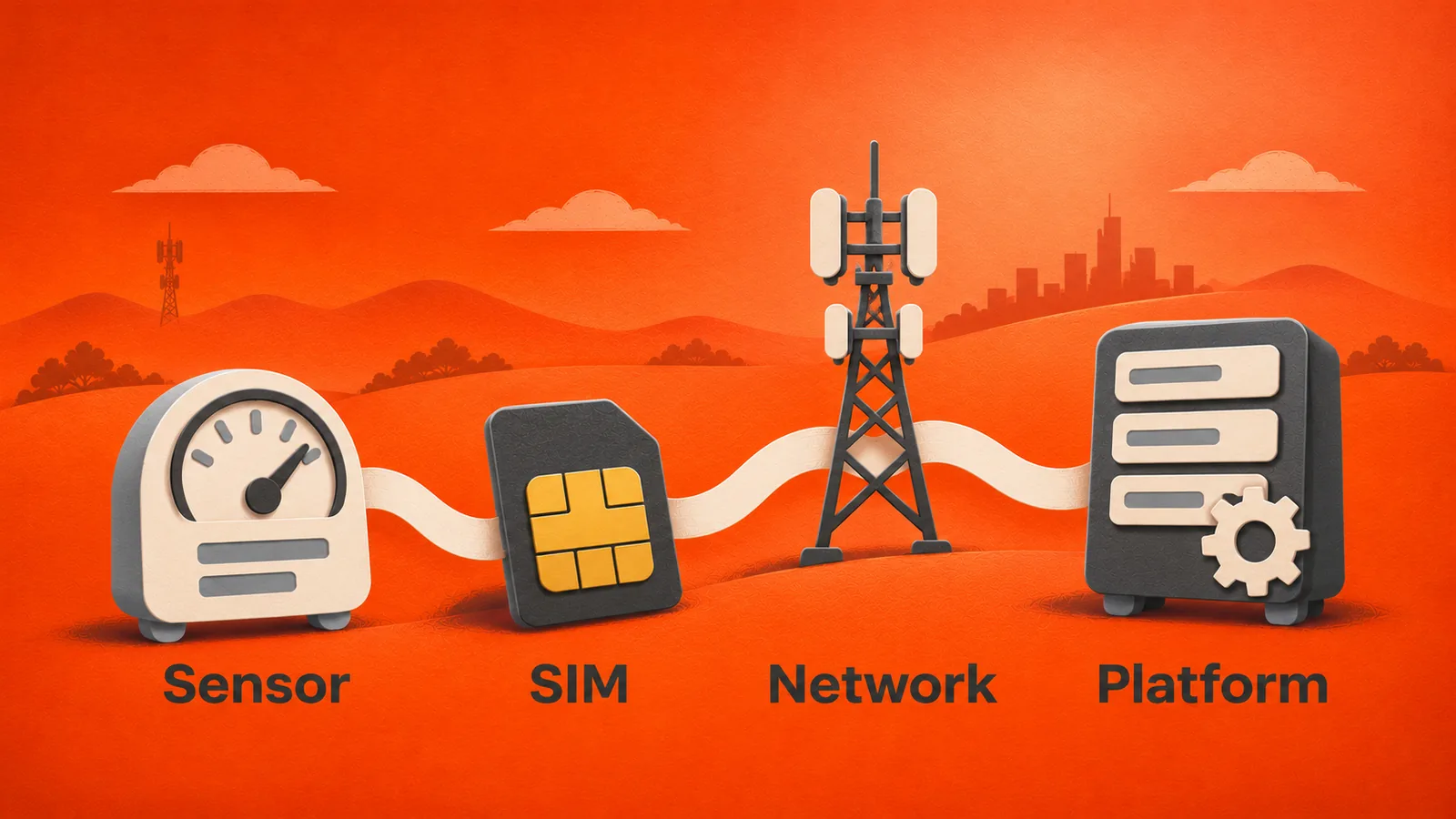
Every cellular M2M deployment resolves into four layers. Knowing which layer owns a problem is how you debug a fleet at 2 a.m.
- Sensing. Sensors, meters, actuators, GPS. This layer decides what gets measured and how often.
- Device and SIM. The cellular module, firmware and the SIM or eUICC. This layer decides which networks the device can reach, and whether that can ever change.
- Network. Radio access, the core network, the APN and roaming agreements. This layer decides coverage, power draw and whether the device keeps working across a border.
- Application. The connectivity management platform and business logic. This layer decides provisioning, usage caps, alerts and billing.
A sensor reads a value, the modem wakes and authenticates with the credentials on the SIM, the payload crosses to a platform, and the device sleeps. On a battery-powered device much of the energy goes into acquiring the radio link, not sending the payload, so the cheapest saving is usually to attach less often rather than to say less each time.
What is an M2M SIM card?
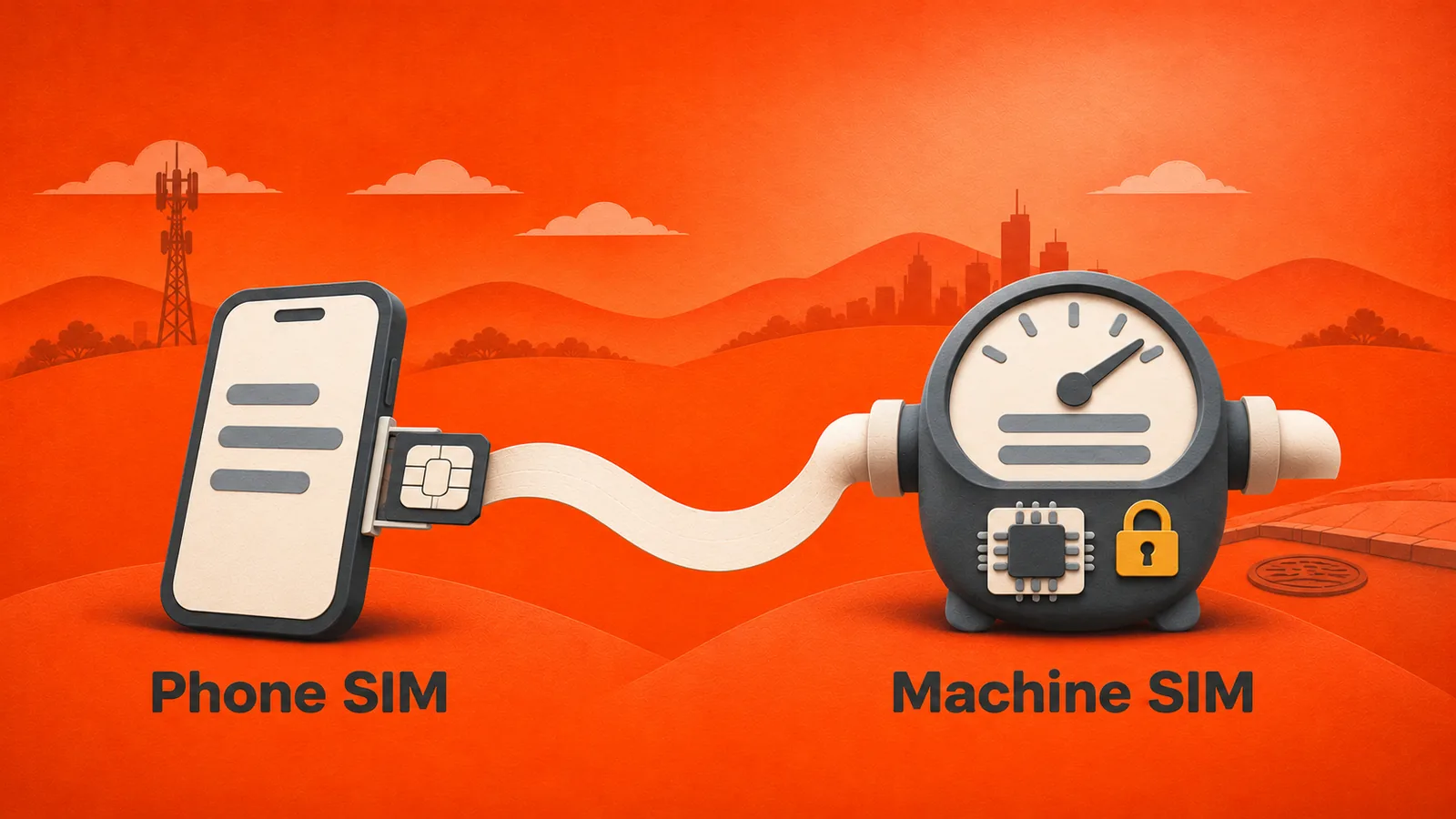
An M2M SIM card is a subscriber identity module designed for unattended machines rather than people. It does the same core job as a phone SIM, holding the subscriber identity and keys that let a device prove itself to a network. Everything around that job differs: the physical build, how long it must last, how many networks it can reach and how it is managed.
Part of that is standardized. ETSI TS 102 671 defines additional UICC form factors and environmental conditions for machine-to-machine use, including temperature classes from -25 to +85 degrees C up to -40 to +125 degrees C (see the ETSI specification). Industrial-grade SIMs are commonly sold against the -40 to +105 degrees C class, which a standard phone SIM is not built for.
M2M SIM vs normal SIM
| Dimension | Consumer SIM | M2M SIM |
|---|---|---|
| Temperature | Standard class, roughly -25 to +85 degrees C | Industrial classes down to -40 and up to +105 degrees C or wider; check the datasheet |
| Lifespan | Built around a phone replacement cycle | Specified for long-life devices; ask for data retention and write-cycle figures |
| Build | Plastic card, removable | Ruggedized, often soldered (MFF2) or integrated (iSIM) |
| Network access | One home network, with limited roaming | Multi-network, multi-IMSI or eUICC |
| Management | Manual; swap the card | Remote provisioning of many devices through a platform or API |
| Security | PIN protection and network authentication | IMEI-to-IMSI locking, private APNs, fixed IPs and VPN support |
Security warning. A stolen consumer SIM usually leads to unauthorized phone or data charges. A stolen M2M SIM deployed in a fleet without IMEI-to-IMSI locking can become an enterprise-billed data channel with access to your private APN. Bind each SIM to its authorized device before deployment so it cannot be used in other hardware.
Can you use a normal SIM in an IoT device?
For a prototype, yes. For production, no. A consumer SIM works on a bench and tends to fail in the field. Carriers can detect non-human traffic and end a consumer subscription. Roaming rules may cut off a device that sits in another country long term. Plastic cards degrade outdoors. And you cannot suspend thousands of consumer SIMs remotely without thousands of individual actions. Our IoT SIM cards guide goes further.
M2M SIM form factors
- Removable (2FF, 3FF, 4FF) for field-serviceable gateways and trackers.
- Soldered (MFF2) for anything exposed to vibration, moisture or temperature cycling.
- Integrated (iSIM) for ultra-compact devices, with the module and SIM function on one chip.
Form factor is not eUICC. MFF2 and iSIM are hardware form factors. eUICC is a software architecture that allows remote profile management. They are independent choices. A soldered MFF2 SIM with a single fixed operator profile and no eUICC support combines the drawbacks of both: the hardware cannot be replaced and the carrier cannot be changed remotely. See our guide to SIM card types and form factors.
eUICC and remote provisioning: SGP.02, SGP.22 and SGP.32
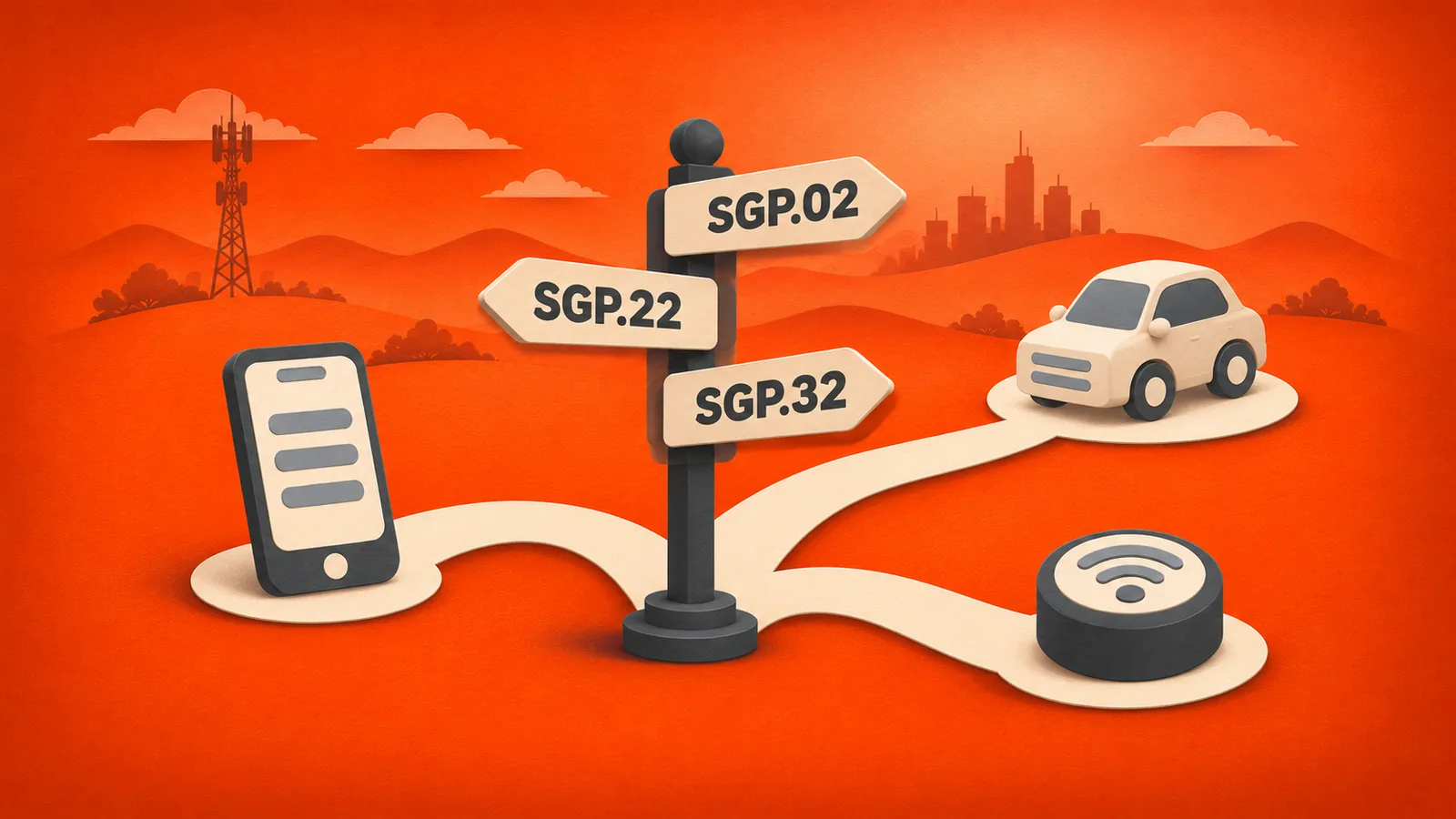
This is the part of M2M that carries real money, because it decides whether you can change carrier after the hardware ships. An eUICC is a SIM that can hold several operator profiles and switch between them. Remote SIM provisioning (RSP) installs those profiles over the air. The GSMA has published three architectures, and they are not interchangeable.
| Feature | SGP.02 (M2M) | SGP.22 (consumer) | SGP.32 (IoT) |
|---|---|---|---|
| Designed for | Connected cars and industrial deployments | Phones, tablets and wearables | Headless, low-power IoT devices |
| Provisioning model | Server push through an SM-SR | User pull, typically a QR code and a local profile assistant | Remote management through an eIM, with an IoT Profile Assistant (IPA) on the device or eUICC |
| Transport | SMS or TCP/IP; SMS is not supported on every network | HTTPS over TCP | HTTPS, with CoAP and DTLS as lighter options |
| Needs a person | No | Yes | No |
| Operator lock-in | Higher: each eUICC is bound to one SM-SR | Lower | Depends on the eIM; a configurable eIM is optional in the spec |
SGP.32 is the newest. The GSMA published v1.0 in May 2023 and has revised it since, so check the GSMA specification for the current version. The eSIM IoT Remote Manager (eIM) issues download, enable, disable and delete commands on behalf of the enterprise, and the IPA on the device carries them out. No screen, no QR code, no person. Because the eIM sits apart from the connectivity supplier, in principle the party managing your fleet need not be the party supplying your connectivity. In practice that depends on the product, since a configurable eIM is optional, so confirm it before you buy.
Plan for two stacks. Do not assume an SGP.02 or SGP.22 eUICC already in the field can be converted to SGP.32. Ask the SIM vendor whether a specific part can be moved, and assume older devices stay on their original architecture for their working life, which for meters can be very long. Mixed estates should plan to run old and new provisioning side by side. A platform that manages both through one interface keeps that manageable. Our SGP.22 vs SGP.32 guide covers the differences in more depth.
Which network technology suits which M2M device
The SIM authenticates. The radio decides what the device can afford in power and in dollars. The practical match looks like this:
- NB-IoT for static, deep-indoor devices with tiny payloads, such as water and gas meters. Mobility is poor, and features such as voice and SMS vary by network.
- LTE-M for battery-powered devices that move, such as trackers and medical alerts. Check coverage in each market.
- LTE Cat 1 bis as a common replacement for 2G and 3G modems, with broad LTE coverage and mature roaming, though it is not low power.
- 5G RedCap for video telematics and industrial gateways that need more throughput than LTE-M. Verify availability market by market.
- Satellite (NTN) where terrestrial coverage ends, at the cost of latency and price per byte.
If you price an NB-IoT fleet per megabyte, you have a large number of nearly free connections, so price per device instead. For the full comparison, read NB-IoT vs LTE-M vs 5G RedCap.
M2M use cases
Most M2M use cases avoid a truck roll, bill for something once estimated, or prevent a failure that costs more than the sensor.
| Industry | What the machine does | Connectivity constraint |
|---|---|---|
| Utilities and smart metering | Reports energy or water use over many years | Deep indoor coverage, tiny payloads; NB-IoT is often a good fit |
| Fleet and connected vehicles | Location, diagnostics, emergency calling | Devices cross borders, so roaming rules matter |
| Asset tracking and logistics | Reports where containers and shipments are and their condition | A cheap tracker becomes expensive if it roams internationally |
| Healthcare and remote monitoring | Cardiac telemetry, glucose monitors, medical alerts | Downtime affects patient care; LTE-M offers reliability with low power |
| Industrial and manufacturing | Predictive maintenance and condition monitoring | Vibration favors soldered MFF2 or embedded SIMs over removable plastic |
| Consumer connected products | Kids’ smartwatches, pet trackers, EV chargers | Connectivity is invisible until it fails, then customers blame the brand |
Two Spenza customer stories show the range: global connectivity for a kids’ smartwatch and a smart-building sensor fleet. For cross-border tracking in particular, see the IoT asset tracking guide and our note on remote patient monitoring connectivity.
What M2M connectivity costs
Do not expect to pay 37 cents a month. The global average is pulled down by very large volumes of low-cost connections on domestic tariffs, and it tells you the wholesale floor is low. The price you are quoted is mostly platform, support and margin. Enterprises tend to negotiate the data rate and then lose money on the other lines:
| Cost component | How to control it |
|---|---|
| Data | Pool data across the fleet so a high-usage device can borrow from low-usage devices. |
| Platform fee | Negotiate billing on active SIMs only, so SIMs in warehouse stock carry no recurring charge. |
| Roaming | Use local operator profiles through eUICC where the rules and the product allow it. |
| Truck rolls | Remote provisioning means a change does not need a site visit, and a single visit can cost more than a long stretch of connectivity. |
See our IoT connectivity cost guide for worked examples.
Moving a legacy M2M fleet off 2G and 3G
Network sunsets are the main reason M2M fleets get rethought. Many older deployments, such as smart meters, alarm panels and fleet trackers, were built on 2G and 3G. Operators are retiring those networks to reuse the spectrum for LTE, 5G, LTE-M and NB-IoT. The SIM is rarely the problem. A modern M2M SIM already works on 4G and 5G. The problem is the modem inside the device: if it is 2G-only, the device stops working whatever SIM you put in it.
The plan is short: audit the fleet by radio technology, per SIM and per country; choose a replacement (LTE-M, NB-IoT, Cat 1 bis or 5G) against coverage, power, mobility and device life; check whether modules can be upgraded; and put the fleet under one management platform with remote provisioning where it fits, so the next carrier change is a software job.
One fault worth knowing: a 4G module configured as data-only may still request voice-centric signalling. If the network answers data-centric, the module can go looking for a 3G network that no longer exists and report “No Service”. Check your module vendor’s documentation for the voice and IMS settings.
How to choose an M2M SIM provider
The questions that matter are the ones a proprietary vendor cannot answer cleanly.
- How many networks does the SIM reach in each target country? You want a named list, not “global coverage”.
- Is the eUICC SGP.02, SGP.22 or SGP.32? Expect a specific answer and a list of modules the vendor has tested with.
- Will the eIM install a profile I source from another operator? The answer should be yes, with a documented process. Anything else is lock-in.
- What are the permanent-roaming rules in your target countries? Brazil, India, Turkey and China are commonly cited as restrictive, but the rules change and sources disagree, so confirm them with the national regulator and your supplier before you ship.
A single-carrier SIM concentrates risk, as we explain in why single-carrier IoT is risky. A central platform lowers it; see single-pane-of-glass connectivity management and our comparison of IoT connectivity management platforms.
Common M2M mistakes
- Shipping a soldered SIM with one fixed operator profile. Unswappable hardware plus an unchangeable carrier is the most expensive combination.
- Setting usage policy in firmware instead of the platform. Firmware can take months to update across a fleet. A platform rule takes effect in seconds, and it is a defence against a compromised device running up a bill.
Conclusion
M2M is not a choice you make once. It is a set of constraints you inherit for the operating life of a product. The radio decides whether the device survives the next spectrum change. The form factor decides whether anyone can touch the SIM again. The eSIM standard decides whether you can change carrier, or whether your carrier can change your prices. The devices are cheap and the connectivity is cheap; the lock-in is not.
So define M2M as machines exchanging data without people, treat IoT as the layers you build on top, and judge any SIM by what it can do rather than by its label: networks reached, eUICC standard, form factor and how it is managed. Get those four right before the hardware ships and the rest is operations.
FAQs
What is an M2M SIM card in simple terms?
An M2M SIM card is a SIM built for machines rather than phones. It authenticates a device to a mobile network, survives harsher conditions, is specified for long device lifetimes, can reach multiple carrier networks and is managed remotely from a software platform instead of by hand.
What is the difference between M2M and IoT?
M2M is connectivity between machines, often point to point for one purpose. IoT connects fleets of devices to cloud platforms for analytics, automation and integration. M2M-style links are often the device-level layer inside an IoT system, so IoT builds on M2M rather than replacing it.
Is an M2M SIM the same as an IoT SIM?
Often the hardware is the same and the names are used interchangeably. What varies is the grade, the form factor, whether the SIM reaches several networks and whether it carries an eUICC that supports remote provisioning. Ask a vendor which capabilities justify any price difference.
Can I use a normal SIM card in an IoT or M2M device?
For a prototype, yes. For production, no. Carriers can terminate consumer subscriptions that carry machine traffic, roaming rules may cut off devices that stay in another country, consumer plastic degrades outdoors, and you cannot manage thousands of consumer SIMs remotely.
Does M2M require the internet?
No. Traditional M2M systems can run over private cellular, wired, satellite or proprietary networks without internet connectivity. IoT systems normally connect to the internet or cloud platforms.
What happens to my M2M SIM when 2G or 3G shuts down?
The SIM usually keeps working, because modern M2M SIMs already support 4G, 5G and low-power networks. The shutdown affects the modem inside the device. If the modem is 2G-only, the device stops working whatever SIM it holds, so audit your fleet by radio technology, per SIM and per country.
How much does an M2M SIM cost per month?
Enterprise pricing varies widely with data volume, roaming, SIM grade and platform features. Operator revenue per connection is very low on average, about $4.40 a year by IoT Analytics figures, but that average is not a price you will be quoted. Request quotes against your own usage and countries.