


Connectivity rarely breaks IoT deployments. It quietly erodes their margins.
Every connected device promises efficiency, automation, and better decision-making. Yet once deployments scale past a few hundred SIMs, connectivity costs become one of the most unpredictable line items on the balance sheet.
The global IoT market is projected to grow from $547 billion in 2025 to $865 billion by 2030. With 21.1 billion connected devices expected in 2025 alone, the volume of active SIMs is growing faster than most finance teams can track.
What begins as a controlled pilot can quickly spiral into a tangle of unused SIMs still generating bills, roaming charges from cross-border deployments, devices transmitting more data than expected, multiple carrier dashboards with limited visibility, and misconfigured hardware quietly inflating costs.
Connectivity can represent 10-20% of the total cost of an IoT deployment for narrowband applications. At that scale, choosing the right IoT data plan is no longer just about coverage. It is about long-term cost governance.
This guide explores how enterprises evaluate IoT data plans, where hidden costs emerge, and what strategies consistently reduce telecom spend without compromising performance.
The Evolving Economics of IoT Data Plans
Unlike consumer mobile plans built for streaming and browsing, IoT data plans are structured for machine-to-machine communication. They must handle highly variable traffic patterns, millions of concurrent devices, sporadic telemetry bursts, firmware updates, and deployments operating deep indoors or across multiple geographies.
A major source of waste in IoT deployments is misalignment between billing models and actual device behavior. When plans do not reflect how devices actually transmit data, the gap between projected spend and actual invoices widens every month.
The Two Primary IoT Billing Models
Enterprises typically choose between two IoT data plan structures: pooled data plans and per-device pay-as-you-go (PAYG) plans. Each model offers cost advantages but also introduces distinct operational and financial risks.
Per-Device (PAYG) IoT Data Plans
How It Works
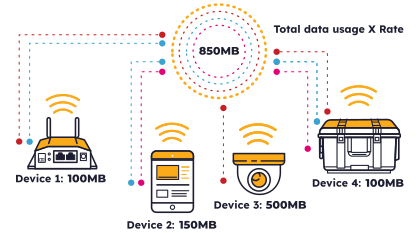
In per-device plans, each SIM is billed individually based on exact data volume transmitted, often calculated down to the kilobyte. Costs align directly with consumption, making this a strictly usage-based structure.
Where It Works Best
PAYG works well for devices with low or sporadic data patterns: smart meters transmitting once daily, agricultural soil sensors, intermittent cold-chain trackers, or logistics devices active only during transit. For assets that remain idle for extended periods, PAYG prevents paying for unused capacity.
Structural Advantages
- Eliminates aggregate over-provisioning
- Enables precise cost attribution per device or asset
- Supports heterogeneous fleets with uneven usage patterns
Pooled Data Plans for IoT Deployments
How Pooled Plans Work
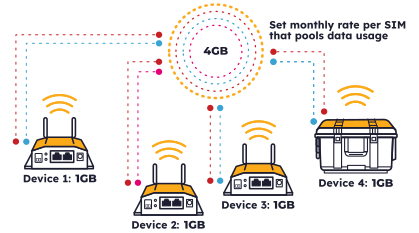
In pooled plans, multiple SIMs share a common data allowance. Instead of allocating fixed usage per device, the total data pool is distributed across the fleet. For example, 1,000 devices with a nominal 10 MB allocation each would share a collective 10 GB pool. Devices with higher usage draw from surplus capacity generated by lower-usage devices, stabilizing overall spend.
Why Enterprises Choose Pooled Plans
Pooled plans help manage uneven data consumption. Usage spikes from certain devices are balanced by others that remain idle or transmit less, resulting in smoother patterns and improved cost predictability.
Structural Advantages
- Greater cost predictability across large deployments
- Reduced risk of localized overage charges
- Simpler budgeting and financial forecasting
PAYG vs. Pooled IoT Data Plans Comparison
| Factor | Per-Device (PAYG) | Pooled Data Plans |
|---|---|---|
| Billing Structure | Pay per SIM based on usage | Shared data allowance across SIMs |
| Best For | Low or sporadic usage devices | Large fleets with variable usage |
| Cost Advantage | Precise per-device cost attribution | Predictable fleet-wide spend |
| Primary Risk | Uncapped spikes from malfunctions | Over-provisioned pools reduce ROI |
| Scalability | Simple for small, uniform fleets | Better for 1,000+ device deployments |
There are also shared plans and unlimited plans for IoT data. Shared plans are ideal if you use large amounts of data and are typically the best choice for large fleets of IoT devices. With a shared plan, your total usage is split between all your devices, for example 500 GB of data can be shared across your deployment. Unlimited plans are ideal for applications that use lots of data because they do not have data overage charges and you pay a fixed amount for unlimited use.
Zone-Based vs. Global Pricing in IoT Data Plans
For enterprises deploying devices across multiple regions, pricing structure directly affects connectivity expenses, compliance, and performance. Understanding the difference between zone-based and global pricing is critical for scaling IoT connectivity internationally.
Zone-Based Pricing
Zone-based plans apply different data rates depending on the country or region where devices operate. While cost-effective for localized deployments, this model introduces volatility for fleets operating internationally.
- Competitive pricing for single-region operations
- Roaming surcharges add unpredictable costs for cross-border devices
- Countries like Brazil, Turkey, and China have tightened restrictions on long-term foreign SIM usage
- Latency from home routing can add 150-300 milliseconds per transmission
Global Pricing
Global plans offer standardized pricing across multiple regions, often supported by multi-carrier agreements and remote SIM provisioning (eSIM/eUICC) technologies.
- Reduced roaming exposure and simplified billing
- Improved operational flexibility for global fleets
- Some enterprises report 15-30% recurring cost reductions after implementing carrier localization via global SIM capabilities
Hidden Cost Drivers in Scaled IoT Deployments
In large IoT fleets, cost overruns rarely stem from poor initial pricing. They emerge from operational drift and unmanaged lifecycle complexity. Here are the five most common culprits.

1. Orphan SIMs
Active SIMs tied to decommissioned devices, stored equipment, lost hardware, or completed projects continue billing unless proactively suspended. A global deployment of 50,000 devices might have 3-5% inactive units at any time. At $1.50/month per SIM, that is $27,000-$37,500 per year wasted on connections that serve no purpose (Spenza IoT Cost Guide).
2. Retry Loops and Background Data
Network timeouts, intermittent coverage, and backend delays trigger automated retries. Individually, these micro-transmissions seem negligible. Across thousands of devices, they accumulate into measurable data usage and inflated monthly bills.
3. Misconfigured Devices
Real example: Industrial CCTV devices set incorrectly for continuous streaming have consumed over 500 GB in a single billing cycle, completely erasing deployment margins. Configuration errors are among the fastest-escalating cost risks in IoT.
4. SIM Theft and Misuse
Extracted enterprise SIMs inserted into consumer devices for streaming or downloads generate substantial charges before detection. Without IMEI locking and usage alerts, this risk grows with fleet size.
5. Permanent Roaming Exposure
Long-term roaming violations increase costs through surcharges and degrade performance. Home routing can add 150-300 milliseconds of latency per transmission, undermining real-time applications. Many regions now enforce penalties for permanent roaming, making carrier localization increasingly important.
- Costs become visible only after invoices arrive, making optimization reactive instead of proactive.
- No unified carrier view exists, making it difficult to control overall spend.
- Inactive SIMs remain active and generate unnecessary recurring charges.
- Roaming charges fluctuate frequently, often indicating missing localization strategies.
- A single pricing model applies across devices with very different data usage patterns.
4 Proven Strategies to Cut IoT Data Costs
Successful cost optimization combines operational discipline with technical improvements. No single change delivers transformational savings. The highest returns come from layering these four strategies together.

Strategy 1: Data Optimization
Efficient data allocation is the first step in controlling telecom spend. Techniques such as pooled plans, continuous right-sizing, and usage-based device grouping help prevent overprovisioned plans and unused data allowances. Device behavior often shifts after deployment, so periodic adjustments are essential.
Practical Tip: Review usage trends quarterly. Downgrade inactive or low-data devices instead of keeping them on default plans. Even small adjustments across thousands of SIMs can compound into meaningful savings.
Strategy 2: Anomaly Detection
Unexpected data spikes are a common cause of billing surprises. Misconfigured devices, retry loops, SIM misuse, or network issues can quickly inflate usage. Real-time monitoring, automated alerts, and usage thresholds support proactive cost control by catching abnormal patterns before they escalate.
Practical Tip: Set conservative data thresholds during early deployments to detect unusual usage before it impacts your budget. A well-configured alert system can prevent a single misconfigured device from generating significant unnecessary costs.
Strategy 3: Carrier Orchestration
Carrier pricing, coverage quality, and regulations vary by geography. Using a multi-carrier strategy, eSIM capabilities, and flexible plans allows devices to switch to local networks, avoid roaming penalties, and improve reliability. This approach also strengthens negotiating leverage.
Practical Tip: Localize connectivity for long-term international deployments. Permanent roaming typically costs two to three times domestic rates and can add significant latency. A device using 200 MB abroad might cost 6 dollars per month instead of 2 dollars on a localized profile.
Strategy 4: Network and Protocol Efficiency
Choosing the right network technology and optimizing how devices transmit data can significantly reduce data expenses. Low-power technologies such as NB-IoT or LTE-M are often sufficient for sensors and trackers. Compressed payloads, optimized transmission intervals, and efficient protocols reduce unnecessary usage while extending battery life.
Practical Tip: Audit payload size, transmission frequency, and network requirements during device design. Early optimization helps ensure plans remain cost efficient at scale. In many regions, NB-IoT already supports the majority of massive IoT connections at a fraction of traditional cellular costs.
Real-World Savings Scenarios
Cost optimization in IoT connectivity is rarely driven by a single change. Most savings come from combining better data allocation, monitoring, carrier strategy, and operational controls. Here are three enterprise scenarios showing the compounding effect of layered optimization.
Scenario 1: Industrial Sensor Fleet (5,000 devices)
Initial Problem: A manufacturing company deployed 5,000 environmental sensors across 12 facilities. After 6 months, the team discovered that 22% of devices were on plans provisioned for 50 MB/month but consistently using under 5 MB. Meanwhile, 8% of sensors had intermittent retry loops inflating their usage by 3-4x.
Actions Taken: The team pooled data across facilities, right-sized individual allocations, adopted compressed payload formats, and deployed automated anomaly controls to flag devices exceeding 2x their average consumption.
Result: ~28% annual connectivity cost reduction within 9 months. The largest single saving came from eliminating unused data capacity across low-usage sensors.
Scenario 2: Global Logistics Fleet (12 countries)
Initial Problem: A logistics provider tracked shipping containers across 12 countries using a single-carrier roaming plan. Roaming surcharges exceeded domestic rates by 2.5x in several regions. Latency from home routing delayed real-time tracking updates by 200+ milliseconds, causing customer-facing dashboard lag.
Actions Taken: The team implemented localized carrier profiles via eSIM provisioning, reduced roaming exposure, and enabled automated carrier selection to prioritize cost and signal quality per region.
Result: ~35% recurring cost savings with measurably lower latency. Container tracking accuracy improved, and customer satisfaction scores rose within the first quarter.
Scenario 3: Construction Equipment Deployment
Initial Problem: A construction equipment OEM found that several SIMs had been extracted from idle machinery and inserted into personal devices for streaming. Three SIMs generated over 50 GB each in a single month, creating unexpected bills exceeding $2,000 per SIM.
Actions Taken: IMEI locking prevented SIM use outside approved devices. Standby SIM scheduling suspended connectivity during off-hours. Usage alerts flagged any SIM exceeding 500 MB within a 24-hour window.Result: ~20%+ cost reduction and complete elimination of bill-shock incidents. The OEM recovered costs within two billing cycles and prevented future misuse.
What Enables Consistent IoT Cost Optimization
Consistent cost optimization comes down to three pillars: visibility, control, and automation. Without a centralized view across carriers, SIMs, and deployments, inefficiencies like unused data, roaming exposure, and delayed anomaly detection surface only after invoices arrive.
Spenza helps enterprises manage IoT connectivity costs by bringing usage visibility, cost monitoring, and carrier orchestration into a single platform. Teams can track SIM usage across carriers, detect abnormal data patterns early, continuously right-size data plans, and reduce roaming exposure through multi-carrier optimization.
How Organizations Use Spenza
- Real-Time Usage Monitoring: Track connectivity usage and telecom spend as it happens, not weeks later on an invoice.
- Anomaly Detection: Detect unusual data patterns early to prevent bill shock before it hits.
- Data Plan Optimization: Right-size allocations based on actual usage patterns, not estimates.
- Carrier Orchestration: Reduce roaming costs and improve performance through multi-carrier optimization and eSIM management.
- Unified Visibility: Consolidate telecom expense tracking across all deployments, carriers, and geographies in one dashboard.
Bottom Line: Spenza shifts connectivity management from reactive invoice tracking to proactive cost governance, improving predictability while supporting global IoT scale. If you manage large device fleets, even small inefficiencies compound quickly.
Conclusion: Maximize IoT Value and Cut Connectivity Costs in 2026
Effective IoT data plan choices are no longer optional in 2026, they are a business imperative. Enterprises that match billing models to real device behavior, tackle hidden cost drivers like orphan SIMs and retry loops, and adopt best practices such as anomaly detection, carrier orchestration, and data right‑sizing consistently reduce connectivity costs while maintaining performance. This approach not only improves ROI but also strengthens operational resilience as device fleets grow.
Platforms like Spenza make strategic cost optimization easier by providing real‑time visibility, automated alerts, multi‑carrier eSIM management, and unified control over all IoT connectivity components. By leveraging these tools alongside layered optimization strategies, organizations can turn unpredictable telecom expenses into predictable, efficient investments.
Start applying these proven techniques and see how smart IoT data plan management helps drive ongoing cost savings, better performance, and stronger scalability throughout 2026 and beyond.
FAQs
Unify your IoT connectivity before fragmentation becomes a liability. Schedule a call with Spenza today to assess your global IoT operations.


