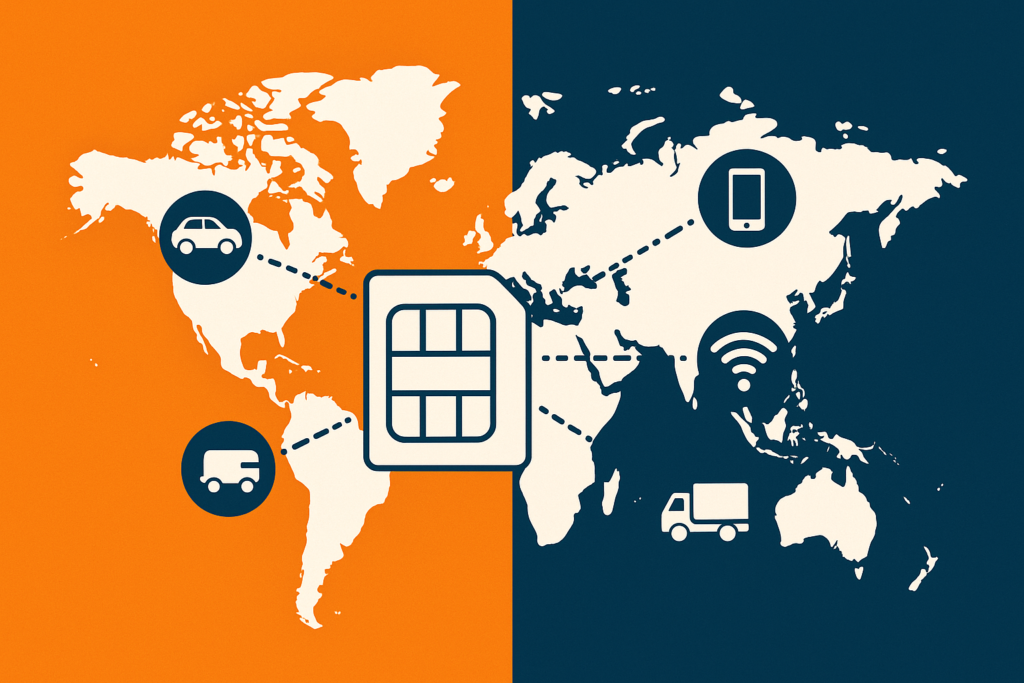
Introduction: Your Business is Global. Is Your Connectivity?
How do you keep thousands of devices connected when they’re scattered across cities, countries, and continents? Cellular IoT is continuing to scale globally: GSMA Intelligence projects licensed cellular IoT connections to reach 5.8 billion by 2030, up from 3.5 billion in 2023. As deployments expand across markets, businesses face growing complexity around network availability, roaming, device management, and regulatory requirements.
The challenge isn’t just cost; it’s also about performance and control. Global IoT SIM cards change that. They connect to the best available local network automatically, avoid punitive roaming rates, and give you a single platform to manage all devices worldwide.
This is why many companies now move to Global IoT SIM cards, a modern, efficient answer to the outdated patchwork of local SIMs. In this blog, we break down exactly what these SIMs are, how they work, and why they’re now an operational necessity for global deployments.
What Would You Get by the End of the Article?
- A clear definition of Global IoT SIM cards.
- Data-backed reasons to replace traditional roaming SIMs.
- Understanding of multi-carrier SIM technology.
- The top five business benefits of adopting a global connectivity solution.
- Why eSIM for IoT is future-proofing device fleets.
- How to think about IoT SIM management platform requirements.
What is a Global IoT SIM Card? (Hint: It’s Not Just a Roaming SIM)
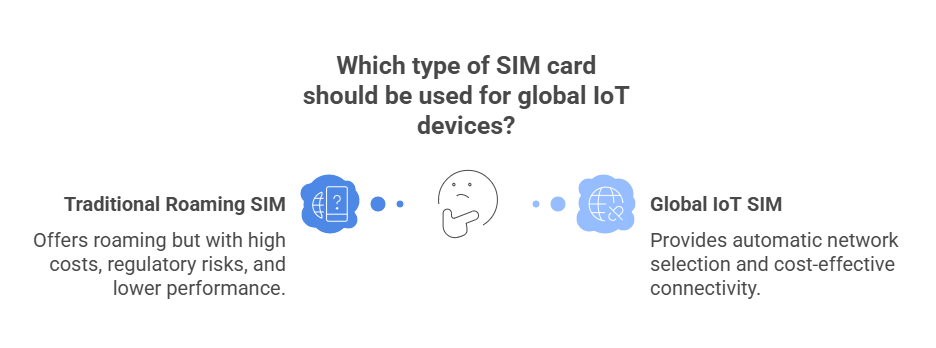
What is a Global IoT SIM card?
A Global IoT SIM card is a physical SIM or eSIM designed to connect IoT devices across multiple countries and mobile networks through a single connectivity service. Depending on the implementation, it can use multiple network agreements, IMSIs, or remotely provisioned eSIM profiles to maintain connectivity without requiring a different physical SIM for each market.
Many assume a “global SIM” is simply a consumer SIM with roaming turned on. But that’s outdated thinking.
Traditional roaming SIMs have three major issues:
- High and unpredictable costs: Retail roaming rates can be 10–50× higher than negotiated IoT rates.
- Regulatory risk: Countries like Brazil, China, and Turkey limit or block permanent roaming for IoT devices.
- Lower performance: Carriers “steer” roaming traffic to preferred partners, even with weaker signals.
A true Global IoT SIM card is different. It’s a single SIM (physical or eSIM for IoT) with multiple carrier profiles and pre-agreed terms with hundreds of operators worldwide. It connects to the strongest local network automatically, without punitive roaming fees.
The Core Technology: Multi-Carrier Access
Global IoT SIM solutions can provide access to multiple mobile networks through technologies such as multi-IMSI SIMs, roaming agreements, and eUICC profiles. Instead of being permanently tied to a single operator, an IoT device can be authorized to connect to multiple available networks according to the connectivity provider’s network-selection and failover policies. This creates redundancy when a network becomes unavailable or unsuitable.
The Top 5 Advantages of a Global IoT SIM Strategy
Using a global connectivity solution for IoT is no longer about convenience, it’s about making deployments sustainable and profitable.
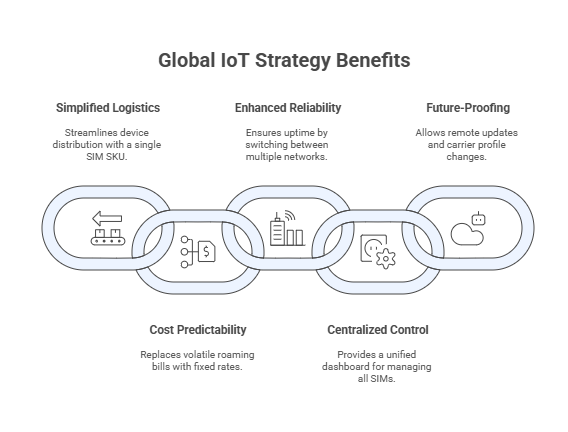
1. Radically Simplified Logistics
With one SIM SKU for all devices, there’s no need to stock different SIMs or design region-specific hardware. Manufacturers build once and ship anywhere.
2. Predictable and Lower Costs
Global IoT SIM cards replace volatile roaming bills with fixed or zoned rates. That means accurate forecasting. No more bill shock when a device crosses a border.
3. Superior Uptime and Reliability
With multi-carrier SIM logic, downtime drops sharply. If one network is congested, the SIM auto-switches to another available network.
4. Centralized Global Control
A strong IoT SIM management platform lets you track usage, set alerts, and control every SIM from one dashboard, whether devices are in New York or Nairobi.
5. Future-Proof with eSIM
Many Global IoT SIM cards now come as eSIM for IoT. That means you can push new carrier profiles remotely, avoiding costly site visits or recalls.
Why Global IoT SIM Cards are Becoming the Default
The GSMA projects global IoT connections to exceed 5.5 billion by 2030. The U.S. leads North America in adoption, with enterprise IoT spending expected to hit $315 billion by 2027. In this scale of growth, relying on outdated IoT roaming SIM approaches simply cannot meet demand.
An international IoT SIM is not just a tech upgrade, it’s an operational safeguard. Whether tracking containers across ports or managing fleets in multiple countries, one SIM that works everywhere reduces both cost and operational friction.
A Note on Scalability
The bigger your IoT footprint, the more your costs and risks multiply if you stick with single-carrier or roaming SIMs. For a company deploying 50,000 devices in 20 countries, moving to a global connectivity solution can mean saving millions over a five-year period while boosting uptime by several percentage points.
Over time, remote eSIM provisioning reduces operating costs, speeds up compliance changes, and ensures your devices stay connected to the most competitive networks available, for years after deployment.
Traditional Roaming vs Global IoT SIM Cards
For years, IoT devices relied on roaming-enabled SIMs designed for short-term use by travelers. Businesses tried to adapt these for permanent IoT deployments, but this created major operational and financial pain points.
Global IoT SIM cards eliminate these risks. They connect directly to the best available local network, thanks to multi-carrier SIM technology. They avoid punitive roaming fees through pre-negotiated agreements and keep devices online with built-in redundancy. Combined with an IoT SIM management platform, these SIMs deliver predictable costs, higher reliability, and centralized control.
Comparison Table
| Feature / Factor | Traditional IoT Roaming SIM | Global IoT SIM Cards |
|---|---|---|
| Cost Predictability | Low – subject to variable roaming rates | High – fixed or zoned rates under one global connectivity solution |
| Performance | Routed via home network – higher latency | Local breakout for lower latency and better real-time performance |
| Network Choice | Steered to preferred roaming partners | Automatically selects best signal from multiple carriers |
| Regulatory Compliance | Risk of permanent roaming bans | Localized profiles comply with country regulations |
| Uptime & Redundancy | Dependent on single partner network | Multi-carrier redundancy for maximum uptime |
| Management | Multiple carrier portals, no single view | One IoT SIM management platform for all devices globally |
| Future-Proofing | Requires physical SIM swap | eSIM for IoT allows remote profile changes without site visits |
Why Spenza’s Approach to Global IoT SIM Cards Stands Out
Many providers sell SIM cards, but very few deliver an end-to-end global connectivity solution designed for business-critical IoT deployments. Spenza is built for companies that need to manage thousands, even millions, of connected devices across borders without the headaches of traditional telecom operations.
Spenza is a modern MVNE that supports both traditional MVNOs and IoT-first businesses. Its cloud-native, API-first platform means every aspect of connectivity, from provisioning to billing, is accessible in real time. This makes it ideal for CTOs, operations managers, and business leaders seeking scalability.
A Truly Global Network
Spenza’s Global IoT SIM cards give access to hundreds of top-tier networks in over 190 countries. That means a device in Los Angeles can use AT&T or Verizon today, then operate in Singapore tomorrow on Singtel or StarHub, without any hardware change. Every SIM is a multi-carrier SIM, so devices automatically connect to the network with the best signal and performance wherever they are deployed.
This level of coverage is critical for industries like logistics, fleet management, energy, and smart manufacturing. For example, a shipping container tracker can remain connected across multiple continents without losing signal or incurring roaming surcharges.
Performance Through Multi-Carrier Access
Spenza’s SIMs operate with non-steered connectivity. Unlike traditional roaming, where the home carrier forces the SIM to use a specific partner, Spenza’s SIM selects based on real-world signal strength and reliability. This improves uptime and ensures stable connections even in rural or congested urban areas.
For time-sensitive IoT applications like payment terminals or medical monitoring devices, this reduction in downtime directly impacts revenue and customer experience.
Centralized IoT SIM Management Platform
Spenza pairs its SIM cards with a powerful IoT SIM management platform. This platform lets you:
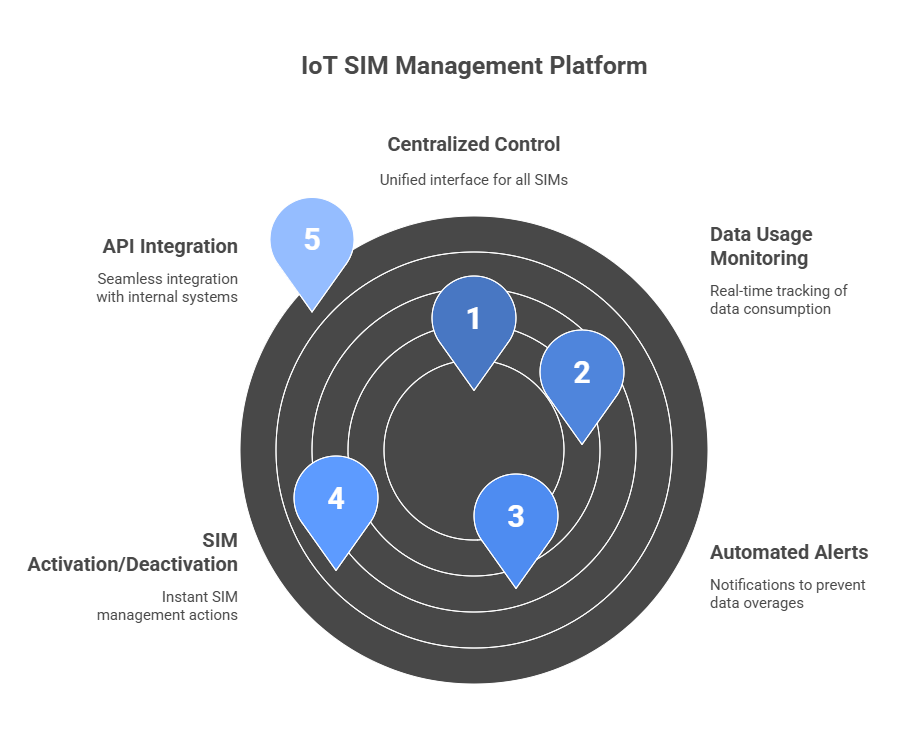
- Monitor data usage across all devices in real time.
- Set automated alerts to prevent overages.
- Activate or deactivate SIMs instantly from a single dashboard.
- Integrate SIM management into your internal systems via APIs.
This centralized control is especially important for enterprises running international deployments. Instead of juggling multiple carrier portals and billing systems, you control every device through Spenza’s unified interface.
Predictable, Scalable Pricing
Cost control is one of the main reasons companies switch to Global IoT SIM cards. Spenza removes the guesswork with a single, transparent rate structure. You can forecast connectivity costs accurately, even as you scale to new markets. Because Spenza negotiates wholesale rates with carriers, customers avoid the extreme markups common with IoT roaming SIMs.
Future-Proof with eSIM for IoT
Spenza offers both physical SIM and eSIM for IoT options. eSIMs (enabled by eUICC technology) allow remote profile provisioning. That means you can switch carriers, add profiles, or update access settings without touching the device. For enterprises managing devices across multiple regions, this eliminates costly truck rolls and minimizes downtime.
Spenza also supports remote eSIM provisioning, covered in detail in their guide on remote eSIM provisioning, ensuring your devices can adapt to market changes or regulations instantly.
Spenza as a Connectivity Partner
Spenza does not just supply SIMs. Their team works closely with clients to design connectivity strategies. That includes:
- Coverage planning for specific regions.
- Advising on regulatory compliance.
- Optimizing data usage to match business needs.
Their consultative approach ensures businesses get both the technology and the support required for successful IoT scaling.
Example Use Cases
- Fleet Management – Vehicles crossing borders remain connected without driver intervention.
- Smart Energy – Remote meters in rural areas stay online via the strongest available local signal.
- Retail Payments – POS terminals avoid outages during network failures by switching carriers automatically.
- Healthcare IoT – Medical devices maintain compliance in regions with permanent roaming restrictions.
How Spenza Integrates Across IoT Lifecycle
From the moment you design your IoT hardware, Spenza can provide SIMs that will work globally without modifications. As devices ship, they’re tracked and managed through the IoT SIM management platform. As your network grows, billing, provisioning, and analytics remain centralized.
Final Thoughts
For global deployments, the right connectivity choice can mean the difference between profitable scaling and costly operational chaos. Global IoT SIM cards with multi-carrier access, predictable costs, and centralized management are no longer optional, they are essential.
Spenza delivers all of this plus expert guidance, a world-class management platform, and a truly global network footprint. If you’re deploying thousands of devices or expanding into new markets, Spenza’s global connectivity solution ensures you maintain control, cost efficiency, and uptime.
FAQs
Ready to simplify your global IoT deployments and take full control of your connectivity? Contact Spenza today to schedule your eSIM strategy session and see how fast and profitable your eSIM launch can be.