IoT connectivity types include cellular networks, noncellular low-power wide-area networks, local wireless links, satellite services and wired connections. Choose among them by payload, power budget, mobility, site access and operating responsibilities. A radio specification narrows the shortlist; supported service and field tests determine whether the complete deployment works.
For product, engineering and fleet teams, the decision starts with what the application must deliver. A building sensor, moving tracker and video terminal can need different networks within the same portfolio. Use this guide to choose a shortlist, assign responsibilities and define a pilot. Then use the IoT connectivity cost guide to model spending and the sensor connectivity guide to check device requirements.
How do you compare IoT connectivity types?
IoT connectivity selection starts with deployment constraints, not a preferred radio. Define where devices operate, what they transmit, how they receive commands and who maintains each connection. Compare complete paths from device to application, including any gateway and backhaul, before choosing the technology that fits those requirements.
Write down the normal payload and the largest exceptional transfer, such as a firmware update. Record the acceptable delay for alarms separately from routine telemetry. Specify whether devices move during a session, need voice, or must remain reachable while saving power. Those requirements eliminate unsuitable options before procurement.
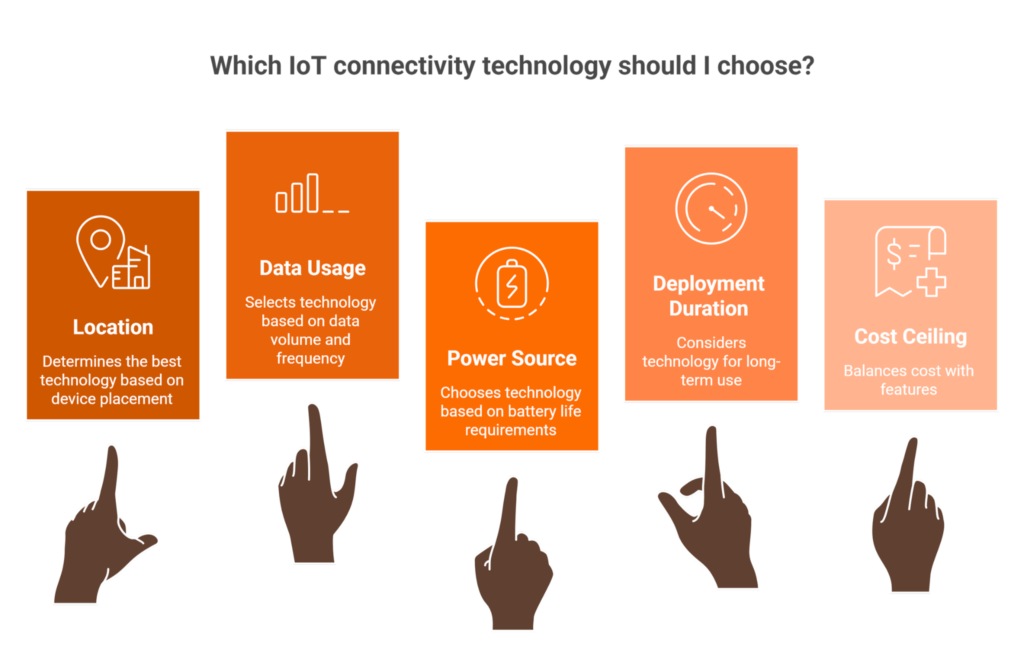
Choose a network family by the constraint it solves, then test its limiting condition.
| Network family | Choose when | Verify before commitment |
|---|---|---|
| Cellular, including NB-IoT and LTE-M | Devices need operator-provided wide-area service | Exact radio, bands, roaming and power features |
| LoRaWAN or another noncellular LPWAN | Small messages can use a suitable local or public network | Gateway coverage, downlink needs and service ownership |
| Wi-Fi, Bluetooth or mesh links | Devices can reach managed local infrastructure | Provisioning, interference and the upstream connection |
| Satellite service | Required locations lack suitable terrestrial coverage | Terminal support, sky visibility and delivery windows |
| Wired networks | Installation permits fixed connections | Cabling, power, redundancy and maintenance access |
Source: editorial synthesis of the primary technical sources linked below. Suitability is conditional, not a measured performance ranking.
Bring the shortlist, device requirements and target locations to review your fleet connectivity requirements with Spenza, an MVNE platform for connected-product teams.
Which cellular network fits the device?
Cellular IoT networks differ in device complexity, mobility, data handling and energy behavior. NB-IoT and LTE-M serve low-power applications, while LTE categories and 5G RedCap address other capability needs. Select a supported modem and service together, then verify performance under the actual traffic pattern and radio conditions.
Narrowband IoT (NB-IoT) and Long-Term Evolution for Machines (LTE-M) entered the 3GPP standards in Release 13. LTE-M supports connected mobility and can support voice where the device and service implement it. NB-IoT is often appropriate for small, infrequent messages; avoid interpreting that as a universal prohibition on moving devices.
The GSMA Mobile IoT Deployment Guide explains how network configuration affects reachability and energy use. Power Saving Mode and extended Discontinuous Reception reduce receiver activity, but can delay delivery to a sleeping device. A battery claim needs the traffic, coverage, timers and hardware assumptions behind it.
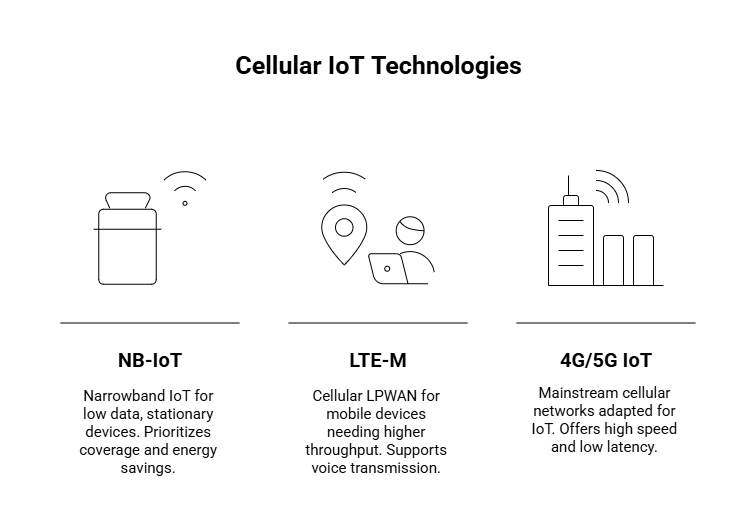
5G Reduced Capability (RedCap) is a Release 17 New Radio device category. It reduces complexity relative to more capable 5G devices; it is not another name for LTE-M. LTE Cat-1 and Cat-1bis may also belong on the shortlist. Use the NB-IoT, LTE-M and RedCap comparison for the detailed decision.
When does noncellular LPWAN make sense?
Noncellular low-power wide-area networks (LPWANs) suit deployments whose small messages can use available gateways and whose owners accept the network’s operating constraints. A private network offers infrastructure control but adds installation and maintenance work. A public service shifts some responsibilities to a provider, subject to its coverage and contract.
LPWAN describes a category, not one protocol: cellular NB-IoT and LTE-M also belong to it. For a LoRaWAN deployment, identify who installs gateways, provides their upstream connection and operates the network server. Do not assume unlicensed spectrum makes equipment, support or application integration free.
The LoRa Alliance’s description of device classes explains an important trade-off. Class A receive windows follow an uplink; Class B adds scheduled receive opportunities; Class C keeps reception available much more of the time at greater energy cost. Command timing should drive the class choice.
For other provider-operated LPWAN services, including Sigfox, request current local availability and a lifecycle plan. Coverage and commercial continuity belong in the procurement record, not in an assumption based on a technology label.
How do local wireless and wired networks fit?
Local IoT networks connect devices to nearby infrastructure, while a separate connection often carries data to the application. Wi-Fi, Bluetooth and mesh networks can reduce the need for a cellular subscription on every endpoint. Their suitability depends on local ownership, onboarding, interference, gateway availability and support access.
Choose Wi-Fi when the site owner can provide and maintain appropriate access. Establish who changes credentials, handles replacement access points and diagnoses intermittent connections. Wi-Fi HaLow is a distinct Wi-Fi option with its own equipment and regional requirements; an ordinary Wi-Fi installation does not imply HaLow support.
Bluetooth Low Energy can connect wearables or sensors to a phone or gateway. The Bluetooth SIG’s range guidance identifies factors including the radio mode, antenna, transmit power and surroundings. Avoid selecting a product from a single advertised distance without testing its enclosure and installation.
Thread and Zigbee can support local mesh designs. Matter is an application-layer connectivity standard, not a competing radio: the Connectivity Standards Alliance’s Matter FAQ describes its use with Wi-Fi, Thread and Ethernet. A compatible application ecosystem does not remove the need to design the underlying network.
Where wired links belong
Ethernet and other wired links remain candidates for fixed equipment. Budget for installation, cable damage and power failure. RFID and NFC usually serve identification or proximity interactions rather than replacing a continuous wide-area connection. A hybrid design can use local links for sensors and cellular backhaul for the gateway.

When is satellite IoT appropriate?
Satellite IoT can extend service to locations where terrestrial networks do not meet the application requirement. Satellite connectivity still needs compatible equipment, a supported service and suitable operating conditions. Confirm the installation’s view of the sky, delivery timing and power demand before treating satellite as a primary connection or fallback.
Non-terrestrial networks (NTN) are not a single interchangeable service. The 3GPP Release 17 report describes NTN enhancements for NB-IoT and machine-type communications, alongside RedCap developments in a separate section. NTN support requires the relevant terminal capabilities; the standard does not upgrade every installed terrestrial modem.
Ask how the application behaves between delivery opportunities, inside buildings and when a device cannot obtain service. For a combined terrestrial and satellite product, define switching policy, duplicate-message handling and billing. Test the actual hardware and service route rather than assuming automatic fallback from a product description.
What costs and responsibilities survive radio selection?
IoT connectivity costs continue beyond the modem and data plan. Site infrastructure, service integration, monitoring, support, replacements and migration all consume budget. Assign each responsibility to a named team or supplier, then model the expected device lifecycle using quoted terms and measured usage rather than a generic monthly price.
A connectivity management platform (CMP) can help operate subscriptions, usage and related service actions. It does not automatically manage firmware, device applications or every noncellular network. Define those boundaries using the CMP scope guide before comparing platforms.
Compare the following cost inputs for the same deployment and service period.
| Input | Record needed | Likely owner |
|---|---|---|
| Hardware and installation | Module, antenna, gateway, cabling and labor quotes | Product and field engineering |
| Recurring service | Active, idle, roaming, overage and minimum-charge terms | Procurement and finance |
| Support and operations | Incident workload, access and escalation responsibilities | Fleet operations |
| Lifecycle changes | Updates, replacements, contract exit and migration plan | Engineering and service owner |
Source: proposed procurement worksheet, September 2026. These are inputs to collect, not prices or measured customer costs.
An eSIM changes how supported subscription profiles can be provisioned and managed. It cannot add missing modem bands or make an unsupported operator accept a device. For an installed fleet, follow the separate connectivity migration guide; selection and migration involve different risks.
How should you validate the deployment?
IoT deployment validation should establish three kinds of evidence: supported capability in the lab, useful service in the field and repeatable operating control. Agree on acceptance criteria before testing. A successful connection is only one observation; the application also needs timely delivery, recoverability, workable support and an understood cost model.
Use the GSMA energy-efficiency guidance to frame power measurements around configuration and use case. Include representative weak-signal conditions, retries and downlink activity. Record unsuccessful tests as well as successful ones so the rollout decision has explicit limits.
| Evidence level | What to establish |
|---|---|
| Lab capability | Supported radio and configuration |
| Field service | Coverage, power and application results |
| Operating control | Support, ownership and cost records |
A specification sheet does not replace a field pilot.
A useful pilot record connects each acceptance question to evidence and an owner.
| Check | Evidence to retain | Decision owner |
|---|---|---|
| Supported combination | Module, firmware, band, operator and service configuration | Engineering |
| Application delivery | Location, message outcome, delay and recovery logs | Product and fleet operations |
| Power behavior | Measured current trace with traffic and radio conditions | Device engineering |
| Operating control | Provisioning, incident and invoice reconciliation records | Operations and finance |
Source: proposed acceptance checklist, September 2026. No fleet test results or universal thresholds are asserted.
The published Butlr case study documents a sensor company’s expansion across the US, UK, France and other markets. Spenza supplied tailored mobile plans, centralized connectivity operations and unified billing. The case supports an operational lesson about matching service and administration to regional deployment; it does not establish the best radio for your sensors.
Use your expected traffic and support model to discuss a regional IoT pilot.
Choose the connectivity stack that satisfies the application and that your team can operate through its expected life. Start with device constraints, test the supported service in representative conditions and price the whole path to the application. Keep local infrastructure, radio capability, subscription management and firmware ownership distinct. A shortlist becomes a deployment decision only when the evidence shows what works, what fails and who handles each exception. Spenza can help scope the connectivity and operational requirements; bring your locations, hardware, traffic assumptions and acceptance record to that discussion.
Frequently asked questions
IoT connectivity questions often concern the boundary between a technology’s capability and the service a fleet can actually use. Coverage, sleep behavior, subscriptions and security need separate checks. The answers below identify what to validate before applying a general technology comparison to a specific product or deployment.
Does a coverage map prove that an indoor device will connect?
A coverage map does not prove service at a specific indoor installation. Building materials, antenna placement, the enclosure and the supported radio all affect the result. Test representative sites with the intended hardware and configuration. Retain both application delivery results and radio observations, including failures and recovery behavior.
Can eSIM replace an unsuitable modem?
An eSIM cannot replace an unsuitable modem or add radio bands to it. Profile management changes subscription credentials on compatible equipment. The modem, antenna, firmware, operator agreement and local network must still support the required service. Check those dependencies before treating a profile change as a remedy for poor connectivity.
Can a battery-powered sensor receive commands immediately?
A battery-powered sensor cannot always receive commands immediately while its receiver is asleep. The answer depends on the radio, power-saving configuration and supported network behavior. Define the maximum acceptable command delay, then test the chosen configuration. A low average power figure is insufficient if the application misses required response times.
Should every product use more than one radio?
Multiple radios are useful only when the additional connection solves a defined requirement. A second radio adds hardware, integration, power and support work. Compare that effort with the cost of lost service and the application’s recovery options. Validate switching and failure behavior rather than assuming a second connection provides effective redundancy.
How should a long-lived device handle network sunsets?
A long-lived device needs a migration plan based on its actual operators, countries and technology support. There is no single worldwide retirement date for legacy networks. Obtain current notices and contractual guidance, inventory affected hardware and test replacement options. Preserve enough time for certification, field access and customer communications without assuming a standard schedule.
Does choosing cellular solve device security?
Choosing cellular does not complete device security. Network authentication is one part of a wider design that includes application protection, credential handling, firmware updates, access control and incident response. Assign ownership for each layer and validate the implemented controls. A connectivity supplier’s security features should not be treated as a blanket certification of the product.