


Introduction
In today’s fast-changing telecom landscape, starting a Mobile Virtual Network Operator (MVNO) business opens up exciting chances for companies aiming to join the mobile service market without building expensive network infrastructure. Yet, finding your way through the complex ecosystem of mobile network players can be tough when it comes to understanding what Mobile Virtual Network Enablers (MVNEs) and Mobile Virtual Network Aggregators (MVNAs) do.
What Is the Difference Between an MVNE and an MVNA?
An MVNE (Mobile Virtual Network Enabler) provides the technology and operational infrastructure an MVNO needs to run its mobile service, including platforms, billing, provisioning, and SIM management. An MVNA (Mobile Virtual Network Aggregator) primarily aggregates wholesale network access from mobile network operators and resells it to multiple MVNOs. In simple terms, an MVNE supports the technology and operations, while an MVNA supports wholesale network access and commercial aggregation.
What You’ll Learn in This Article
By the end of this comprehensive guide, you’ll understand:
- The fundamental roles and functions of MVNEs and MVNAs in the telecom ecosystem
- How each entity supports MVNO operations differently
- The key differences in their business models and infrastructure offerings
- How to determine which partner type best suits your MVNO business needs
- Practical considerations for selecting between an MVNE and an MVNA
What are Mobile Virtual Network Enablers (MVNEs)?
Mobile Virtual Network Enablers (MVNEs) are essential players in the telecommunications industry, providing the technical infrastructure and services that Mobile Virtual Network Operators (MVNOs) need to function effectively. Unlike MVNOs, MVNEs do not offer cellular connectivity directly to end users. Instead, they focus on delivering critical tools and services, such as billing systems, customer management platforms, and SIM card activation, which enable MVNOs to manage their operations smoothly.
Core Services and Infrastructure Offered
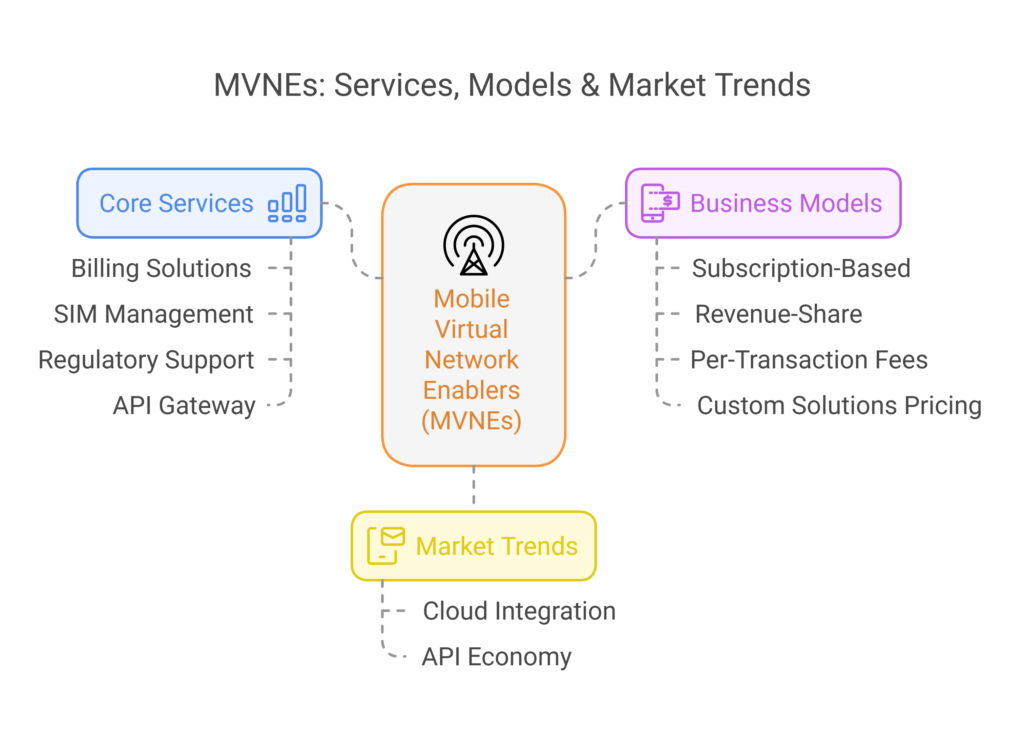
MVNEs offer a full range of technical and operational services such as:
- Billing and Platform Solutions: MVNEs offer specialized MVNO billing software. This software helps MVNOs manage customer accounts, track data usage, and generate bills. They provide robust software solutions for operations, billing, and customer relationship management (CRM).
- SIM Management: They take care of activation and setting up SIM cards for MVNOs.
- Regulatory Support: MVNEs ensure compliance with telecom regulations, which reduces the risk of MVNOs violating these rules.
- API Gateway: MVNEs provide API gateways that simplify and streamline connections to other third-party systems and services for MVNOs.
MVNE Business Models
MVNEs run their operations using different business models. They charge MVNOs in one or more of these ways:
- Subscription-Based Model: MVNEs ask for a regular fee to access their platform and services.
- Revenue-Share Model: The MVNE gets a cut of the MVNO’s revenue for its services.
- Per-Transaction Fees: MVNEs apply charges for specific actions like new sign-ups or billing events.
- Custom Solutions Pricing: For MVNOs requiring specialized functions or integrations.
As technology improves, so does the MVNE market. There are signs that cloud integration will make it easier to scale services, and the API economy is growing, which will enhance third-party interactions.
What are Mobile Virtual Network Aggregators (MVNAs)?
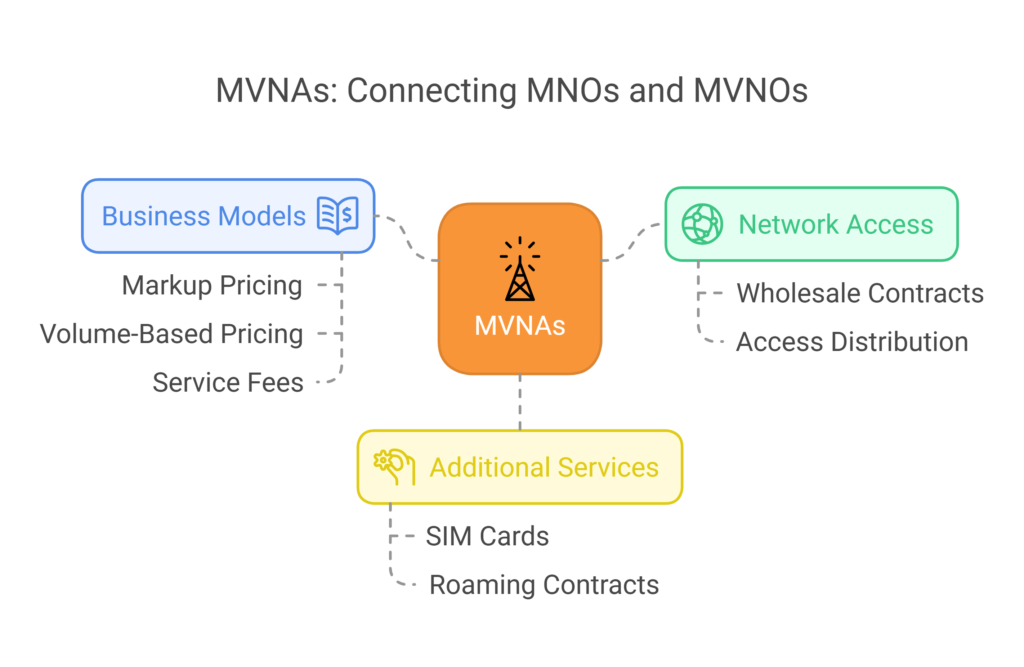
Mobile Virtual Network Aggregators (MVNAs) act as intermediaries between Mobile Network Operators (MNOs) and multiple Mobile Virtual Network Operators (MVNOs). MVNAs purchase network access in bulk at wholesale rates from MNOs and resell this access to various MVNOs. By aggregating the demand from multiple smaller MVNOs, MVNAs can negotiate better deals and secure more favourable pricing for cellular network access.
How MVNAs Connect MNOs and MVNOs
MVNAs act as a key link in the telecom world by doing these things:
- Wholesale Airtime Contracts: MVNAs acquire network services in bulk at lower wholesale prices from MNOs.
- Simpler MNO Relationships: Many MNOs prefer working with multiple MVNOs through a single middleman (the MVNA) instead of negotiating separate deals with several smaller MVNOs.
- Network Access Distribution: MVNAs redistribute the network access purchased from MNOs to various MVNOs, often offering more favorable rates.
- Aggregation Platform: MVNAs manage aggregation platforms that handle resources and billing for multiple MVNO clients.
MVNA Business Models and Revenue Streams
MVNAs typically generate revenue through several channels:
- Markup on Network Access: The primary revenue source comes from purchasing network access at wholesale rates and selling it to MVNOs at a markup.
- Volume-Based Pricing: MVNAs often implement tiered pricing structures based on the volume of traffic or number of subscribers an MVNO brings.
- Additional Service Fees: Many MVNAs charge for supplementary services such as number ranges, SIM cards, and roaming contracts.
- Multi-Tenant Platform Services: Some MVNAs provide shared resource platforms that allow MVNOs to reduce costs through economies of scale.
With smart contracts for automated, transparent transactions and IoT and edge computing capabilities enabling more robust and localized services, MVNAs are evolving alongside the telecom industry.
Key Differences Between MVNEs and MVNAs
Let’s look at the comparison table below:
| Aspect | MVNEs | MVNAs |
|---|---|---|
| Operational Focus | Provide technical infrastructure and platform services; focus on the “how” of running an MVNO business. | Focus on securing and reselling network access; address the “what” of connectivity. |
| Infrastructure & Platform Offerings | Offer comprehensive platforms including billing systems, customer management, provisioning, and operational support through software-based solutions. | Provide aggregation platforms designed to manage network resources and billing across multiple MVNOs. |
| Relationship with MVNOs and MNOs | Have direct relationships with MVNOs, supporting them with backend operational capabilities. | Maintain contracts with both MNOs (to purchase wholesale network access) and MVNOs (to resell access), often with stronger negotiating power. |
| Pricing & Contract Models | Typically use flexible pricing based on platform usage, transaction volumes, or subscriptions. | Offer competitive wholesale rates that may require volume commitments and include markups on the secured rates. |
Should an MVNO Choose an MVNE or an MVNA?
An MVNO should choose an MVNE when its main need is technical infrastructure, billing, provisioning, SIM management, and operational support. An MVNA is more appropriate when the priority is wholesale network access, carrier relationships, purchasing power, and favorable connectivity terms. Some MVNOs may use both when they need separate technology enablement and network aggregation capabilities.
Making the Right Choice For Launching an MVNO: MVNE vs MVNA
When picking between an MVNE and an MVNA, MVNOs should consider:
- Business Goals: Determine whether technical expertise or favorable network access terms align better with your business plan.
- Size and Usage: Evaluate your expected number of subscribers and their anticipated network usage.
- Technical Skills: Assess your in-house technical capabilities and the level of external support required for operations.
- Launch Timing: Consider how quickly you need to launch and whether speed or customization is your priority.
- Long-term Plans: Factor in your growth strategy and the flexibility needed in your partnership.
When to Choose an MVNE as a partner to launch an MVNO
An MVNE might be the better choice when:
- You Already Have Network Access: If you’ve secured favorable terms with an MNO or already have an established relationship with one.
- Technical Infrastructure Is Your Priority: When you need complete backend systems, billing platforms, and operational support.
- You Seek Operational Flexibility: If you want to control your service offerings and customer experience while outsourcing the technical complexities.
- You Require Specialized Features: When you need custom capabilities for specific market segments or unique service offerings.
Smaller MVNOs that lack technical expertise can collaborate with a capable MVNE to access top-notch billing software and other essential tools to run their business. This approach helps them avoid significant upfront investments.
When to Choose an MVNA
An MVNA might make more sense when:
- Negotiating Power Is Key: If obtaining favorable network access terms is your main priority, especially for smaller MVNOs with limited bargaining power.
- You Don’t Have Strong MNO Ties: When you lack established relationships with MNOs and need a quicker market entry strategy.
- Volume Matters: If you want to benefit from the group purchasing power that MVNAs leverage for multiple MVNOs.
- You Need Full Wholesale Services: When you require more than just network access, such as number ranges, SIM cards, and roaming agreements.
Many mobile network operators prefer to work with MVNOs through a single intermediary, like an MVNA, rather than managing multiple individual agreements. This makes MVNAs valuable allies in specific market scenarios.
Spenza’s Role in Helping MVNOs Launch
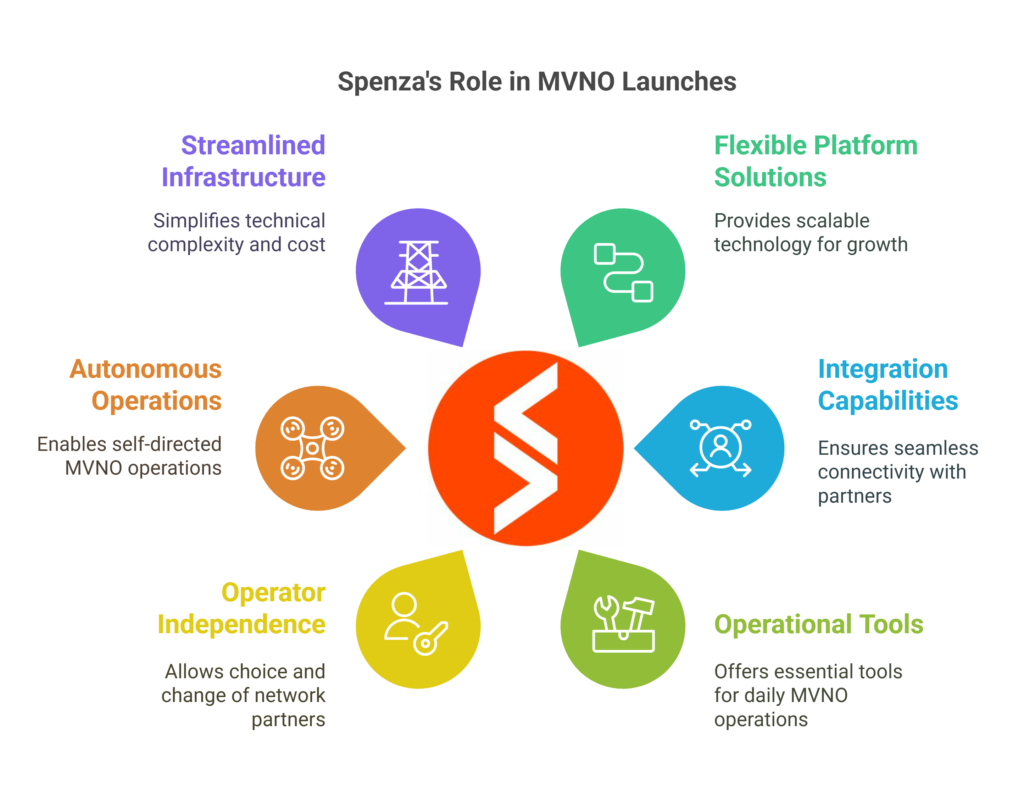
Spenza operates as a lightweight MVNE+MVNA, focusing on technology enablement with a multi-operator marketplace of mobile plans. As an operator-neutral platform, Spenza provides MVNOs with the technical infrastructure they need without tying them to specific mobile network operators. Spenza is uniquely positioned to support smaller MVNOs by providing:
- Operator Independence: Spenza allows MVNOs to choose and change network partners according to their needs.
- Autonomous Operations: Spenza enables MVNOs to run their operations independently while providing the necessary technical facilities.
- Streamlined Technical Infrastructure: Focused solutions that avoid overwhelming smaller MVNOs with unnecessary complexity or cost.
- Scalable Support: Technology that grows with the MVNO, supporting everything from market entry to expansion.
- Choice of Services: Spenza offers a full spectrum of mobile plans from multiple operators, MVNOs, and IoT platforms. These include local and roaming plans for IoT/mobile, industrial/consumer devices requiring high-bandwidth or low-bandwidth applications.
This approach makes Spenza particularly valuable for smaller MVNOs that need technical enablement without the constraints of more comprehensive managed service arrangements.
Conclusion
Successful MVNOs need the right partners. MVNEs provide technical solutions and operational support, while MVNAs negotiate better network deals through group buying power. You may benefit from both partner types or choose the one that fits your needs best. Your decision should depend on your technical requirements, business goals, and growth plans. For long-term success, focus on finding partners that offer flexibility, scalability, and strategic alignment with your MVNO vision.
FAQs
Ready to start? Talk to Spenza’s team for a tailored roadmap. Share this guide with your executives to align your strategy.


