Introduction
Mobile connectivity fuels everything from smart factories to wearable devices. But building a telecom network from scratch? That’s slow, expensive, and risky. Instead, companies lean on models like MVNOs (Mobile Virtual Network Operators) and MVNEs (Mobile Virtual Network Enablers) to launch services faster.
The global MVNO market will hit $128.06 billion by 2032, driven by IoT adoption and demand for niche connectivity. But success hinges on picking the right partners and tools. Let’s simplify the differences between MVNOs and MVNEs, and why they matter.
What Is the Difference Between an MVNO and an MVNE?
An MVNO (Mobile Virtual Network Operator) is a company that sells mobile services to customers using network capacity from a mobile network operator (MNO). An MVNE (Mobile Virtual Network Enabler) provides the technology and operational infrastructure that helps an MVNO launch and manage those services, including capabilities such as billing, SIM management, provisioning, and network integration.
What Is an MVNO?
An MVNO (Mobile Virtual Network Operator) sells mobile services without owning cell towers or spectrum. It rents network access from carriers like AT&T or Vodafone, then brands and resells plans to its customers. Example: A smart thermostat company becomes an MVNO to offer bundled data plans with its devices. Spenza helps MVNOs launch faster with pre-built billing and eSIM tools.
What Is an MVNE?
An MVNE (Mobile Virtual Network Enabler) provides the tech backbone for MVNOs to operate. Think of it as the hidden engine that powers mobile services without the MVNO building systems from scratch. MVNEs handle SIM management, billing, carrier integrations, and compliance. They let MVNOs focus on branding, sales, and customer support.
Example: A fitness tracker brand wants to sell LTE-enabled wearables with data plans. Instead of negotiating with carriers or coding billing software, they partner with an MVNE.
The MVNE connects them to three mobile networks, sets up automated data tracking per device, and manages invoices. The brand slashes launch time from 12 months to 60 days and cuts costs by 40%.
MVNO vs MVNE: The Key Differences
Let’s compare their roles side-by-side:
| Factor | MVNO | MVNE |
|---|---|---|
| Customer Focus | Sells to end users (B2C/B2B) | Sells to MVNOs (B2B) |
| Ownership | Owns brand, customer relationships | Owns tech platform, no brand |
| Responsibilities | Marketing, pricing, support | Billing, carrier deals, compliance |
| Revenue Model | Subscription fees, data markup | SaaS fees, service charges |
Bottom Line: MVNOs face the market. MVNEs power the engine.
Should a Business Choose an MVNO or an MVNE?
An MVNO is the appropriate model for a business that wants to sell mobile connectivity under its own brand and manage the customer relationship. An MVNE is appropriate for a business that needs the technology and operational infrastructure required to launch and manage an MVNO. They are not competing business models: an MVNO can use an MVNE as its technology and operational partner.
Why MVNO vs MVNE Choices Impact Your Bottom Line
The MVNO vs MVNE debate isn’t technical jargon—it’s a dollar-and-cents choice. MVNOs own the customer-facing brand. They set prices, design plans, and handle support. But without MVNEs, they drown in backend chaos.
Here’s the math: Building billing systems, carrier deals, and SIM management from scratch costs over $5M and around 18 months. Partnering with an MVNE slashes that to under $200K and 90 days.
For IoT companies, this means faster ROI. You skip coding invoices or begging carriers for contracts. Instead, you plug into an MVNE’s ready-made platform and focus on your devices.
Example: A logistics startup needs data plans for 10,000 GPS trackers. Going solo means hiring engineers and lawyers. Using an MVNE? They pick pre-negotiated rates, brand their portal, and launch in 8 weeks.
The risk? Choosing wrong. A thin MVNO model saves cash but limits customization. A full MVNO offers control but needs heavy upfront spend. MVNEs bridge the gap—offering flexibility without the burn rate.
The Benefits of MVNO: 3 Ways They Empower MVNEs
MVNOs and MVNEs share a symbiotic bond. While MVNEs provide the tech backbone, MVNOs drive demand, innovation, and revenue back to them. This cycle fuels growth for both. MVNOs act as the market-facing arm, testing new niches and pushing MVNEs to adapt. Without MVNOs, MVNEs lose their reason to exist.
Here’s how MVNOs fuel MVNE success—and why this partnership is non-negotiable in today’s telecom race.
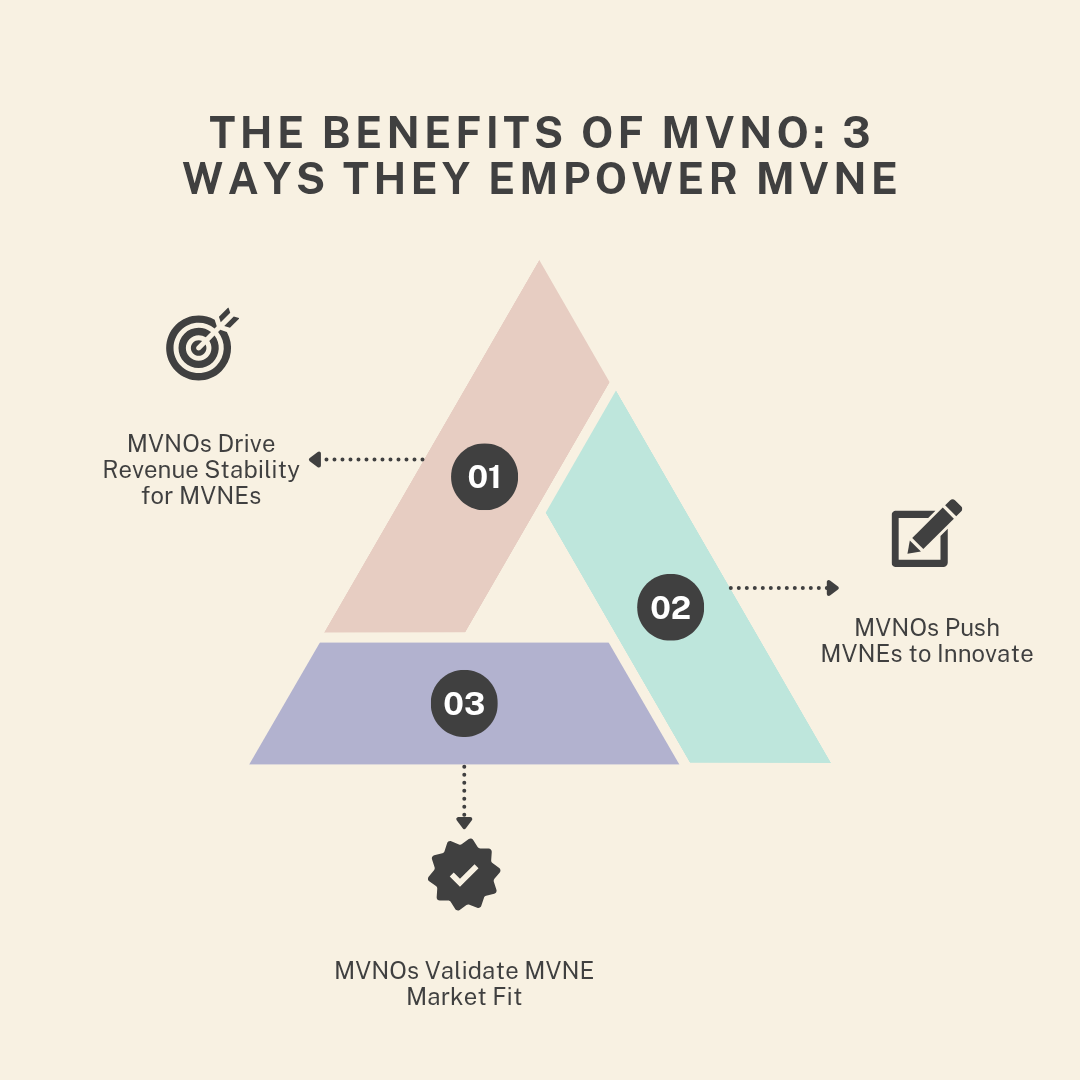
- MVNOs Drive Revenue Stability for MVNEs
MVNEs earn through SaaS fees, usage cuts, or setup charges. The more MVNOs they host, the steadier their income. MVNOs also commit to multi-year contracts, shielding MVNEs from market swings. This model scales. If an MVNO grows from 1K to 1M SIMs, the MVNE’s cut grows without extra work.
- MVNOs Push MVNEs to Innovate
MVNOs face real-world demands. A farming IoT MVNO might need low-data plans for soil sensors. A healthcare MVNO demands HIPAA-compliant billing. These requests force MVNEs to upgrade their platforms. Spenza, for instance, added eSIM support after MVNOs requested global IoT coverage. MVNEs that ignore feedback lose clients to rivals.
- MVNOs Validate MVNE Market Fit
MVNEs build tools they think MVNOs need. But real MVNOs test these tools in the wild. If 8/10 MVNOs use a feature like auto-top-up, the MVNE doubles down on it. If a tool flops, they scrap it fast. This feedback loop keeps MVNEs relevant. It also attracts new MVNOs seeking proven solutions.
MVNO Market Boom: $128.06 Billion by 2032
The MVNO market grows 8.2% during 2024-2032. A key driver is the rise of connected devices and faster networks. As 5G spreads and IoT becomes common, demand grows for low-cost, flexible data plans.
Big telecom firms struggle to adapt quickly to these needs. This gap creates space for MVNOs—smaller players who rent network access but tailor services to specific users.
Think of smartwatches that send health data, sensors in delivery trucks, or home security systems. These devices don’t need expensive, one-size-fits-all plans. MVNOs can craft solutions that save money while keeping performance sharp.
Focus on These High-Value Areas to Lead the Market:
- Low-Power Medical Devices: Wearables that track heart rate or blood sugar. MVNOs offer plans as low as $0.10 per gigabyte, perfect for devices sending small data bursts.
- Fleet Tracking: Trucks crossing state lines need seamless GPS updates. Partnering with MVNEs (companies that build MVNO systems) guarantees nationwide coverage without gaps.
- Smart Home Security: Cameras and sensors using 2GB monthly. MVNOs use bulk data plans to slash costs by nearly half compared to traditional carriers.
Companies that act fast will shape this space. By combining an MVNO’s speed with an MVNE’s technical backbone, businesses can undercut rivals, scale faster, and stay ahead long-term.
How Do MVNEs Support MVNO Operations
MVNEs are the unsung heroes. They offer four critical tools:
- Billing Systems: Automate invoicing, customer billing, CRM, and usage alerts. For IoT, this means tracking thousands of SIMs in real time.
- Carrier Aggregation: Connect MVNOs to multiple MNOs (Mobile Network Operators) for better coverage and rates.
- Compliance Management: Handle GDPR, FCC, and regional telecom laws so MVNOs avoid legal risks.
- APIs for Customization: Let MVNOs build branded apps, loyalty programs, or data dashboards.
MVNO vs MVNE for IoT: Which Scales Better?
IoT growth demands flexible networks. MVNO vs MVNE models decide if you scale fast or hit walls. MVNOs control their stack, adding carriers as needed. But each new carrier deal takes months. MVNEs offer instant access to 100+ carriers via APIs.
In the MVNO vs MVNE race for IoT, MVNEs win on speed. A smart farm project used an MVNE to link sensors in 15 countries in 60 days. MVNOs would need a year to sign 15 carriers.
But MVNOs rule customization. They tweak data plans per device type. MVNEs offer less flexibility. For IoT firms with unique needs, MVNO vs MVNE leans MVNO. For global reach, MVNE fits best.
Spenza’s Role in Simplifying MVNO Launches
Spenza bridges gaps for IoT-focused MVNOs. Their platform offers:
- Multi-Carrier eSIM Support: Switch networks automatically for better coverage.
- Customizable Billing: Set pay-as-you-go or bulk data plans per device.
- Real-Time Analytics: Monitor data usage, device health, and costs in one dashboard.
Final Thoughts
The telecom world is changing fast. New tech like 5G and IoT devices means old ways of selling data no longer fit. Big carriers move slow, but MVNOs can pivot quickly. They design plans for exact needs, like tiny data chunks for health wearables or bulk deals for smart homes. This focus cuts waste and cost.
But success needs more than just ideas. MVNEs give MVNOs the tools to build strong networks fast. Think of it like this: MVNOs cook the meal; MVNEs supply the kitchen. Together, they serve niche markets big players ignore.
The next decade will reward those who act now. Firms that target specific needs—medical tech, logistics, smart homes—will lock in loyal clients. Slow movers will lose ground. To win, pair nimble ideas with solid tech partners. Keep costs low, cover gaps, and stay ready to adapt.
The future of connectivity isn’t about who has the biggest network. It’s about who uses it smartest.
FAQs
Ready to start? Talk to Spenza’s team for a tailored roadmap. Share this guide with your executives to align your strategy.