Disclosure: Spenza builds the platform MVNOs run on. We do not sell consumer phone plans, we earn no affiliate commission, and no brand paid to appear on this page.
Best MVNO Plans & Carriers for 2026 | Top Picks by Network
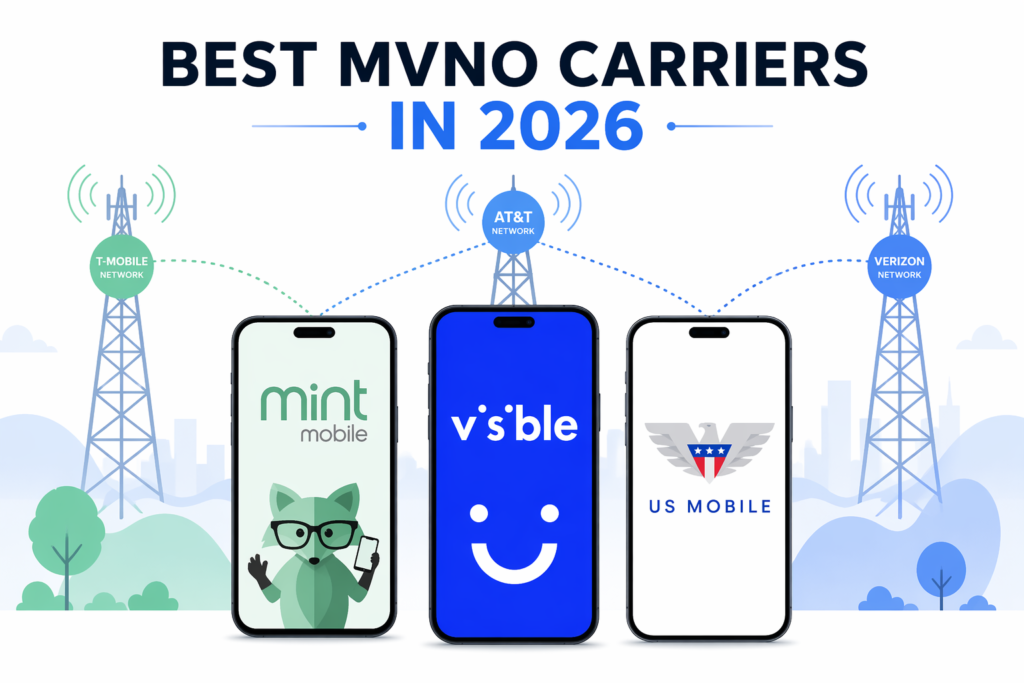
An MVNO (mobile virtual network operator) sells phone service on Verizon’s, T-Mobile’s or AT&T’s towers under its own brand. One unlimited line costs $25 to $35 a month at our four network picks, against $50 to $110 at the big three. Coverage comes from the host network, so the best MVNO is the best brand on the network that works at your address.
Our picks for September 2026:
- On Verizon: Visible, $25 a month with taxes and fees included.
- On T-Mobile: Mint Mobile, $30 a month for unlimited data on a 12 month plan, and $15 a month for a new customer’s first term.
- On AT&T: Cricket Wireless, $35 a month with taxes included, or four lines for $100.
- On any of the three: US Mobile, $25 a month with taxes included, and you choose the network.
The trade off is data priority. On most low cost plans your data waits behind the host carrier’s own customers when a tower is busy. Spenza is an MVNE: we activate lines on all three US networks and run billing for MVNOs. This guide uses that inside view to show who owns each brand, how priority works, and what each plan costs after taxes.
| Pick | Best for | Network and owner | One line, per month | High-speed data | Try before you port |
|---|---|---|---|---|---|
| US Mobile | Best overall; you choose and switch the network | Verizon, T-Mobile or AT&T; independent | $25 monthly, or $199 for the first year on an annual plan, then $270 | 70 GB on the Verizon and T-Mobile based networks, unlimited on the AT&T based one | 30 days free, only if you port your number in |
| Visible | Best on Verizon; $25 flat with taxes included | Verizon; owned by Verizon | $25, or $35 for Visible+ | Unlimited, at lower priority on the $25 plan | 15 days, no card |
| Mint Mobile | Best on T-Mobile if you prepay a year | T-Mobile; owned by T-Mobile | $15 for 6 GB up to $30 for unlimited, on 12-month plans | 50 GB on unlimited | 7-day money-back guarantee |
| Cricket Wireless | Best on AT&T; stores; four lines for $100 | AT&T; owned by AT&T | $35 with AutoPay | Unlimited, and may slow whenever the network is busy | 14 days, 3 GB |
| Tello | Cheapest for light users | T-Mobile; owned by Miron Enterprises (KeepCalling) | $5 minimum, $10 for 2 GB, $25 unlimited | 50 GB on unlimited | None |
| Google Fi Wireless | Best for international travel | T-Mobile; owned by Google | $35, $50 or $65 | 30, 50 or 100 GB, then 256 kbps | 7 days, 10 GB |
| Consumer Cellular | Best for ages 50 and over; top-rated support | AT&T for new customers; owned by GTCR | $20 for 1 GB, $35 unlimited at 50 and over, with AutoPay | 35 GB on one unlimited line | 30-day guarantee, limited to 500 MB of data |
| Total Wireless | Best family price on Verizon: four lines for $95 | Verizon; owned by Verizon | $35 with AutoPay, or $25 for new customers who bring a phone | Standard data on Starter; premium data on the MAX and All Access plans | None found |
Same Towers, Smaller Bill: What Switching Saves
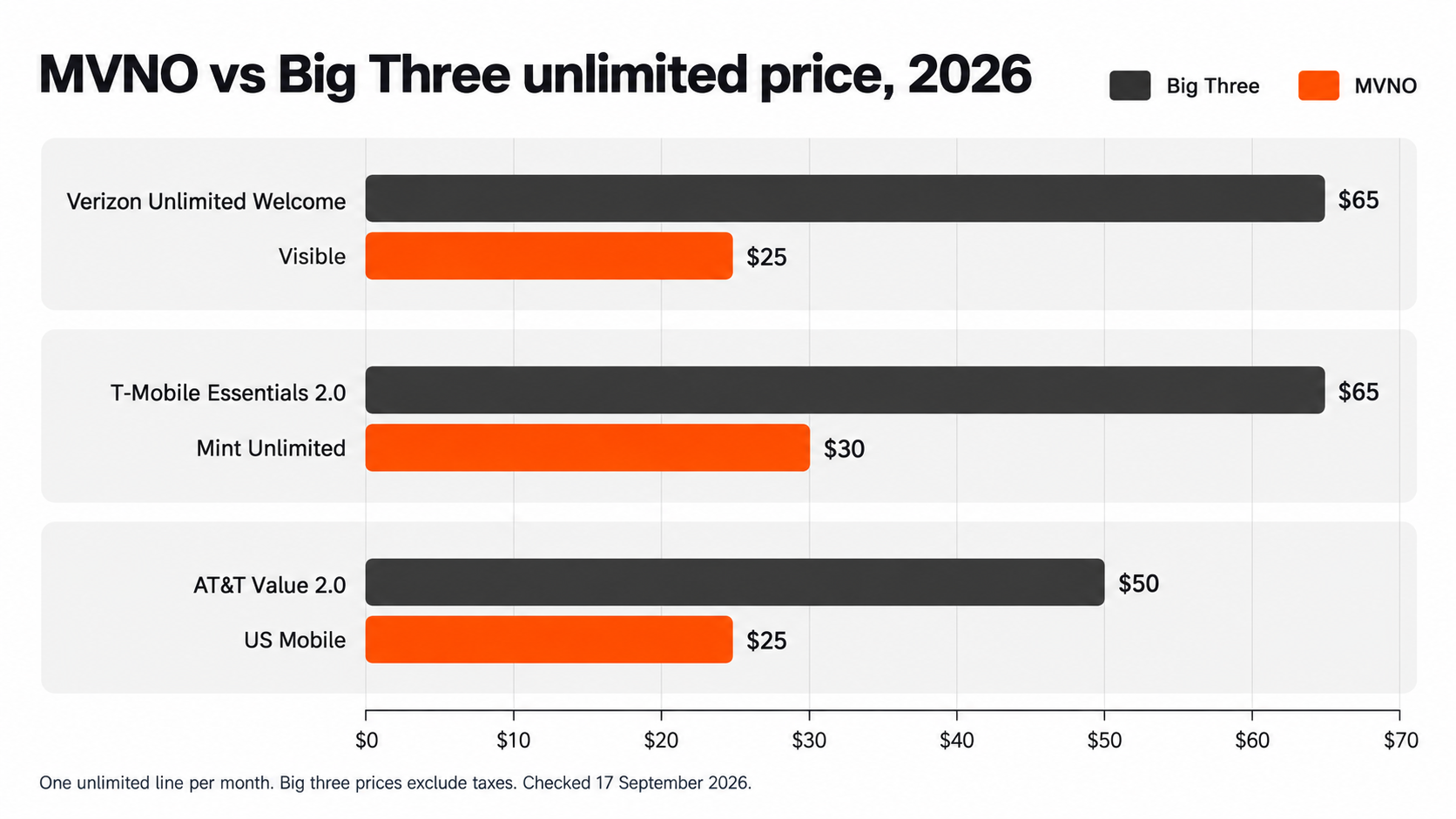
Moving one unlimited line from a big three entry plan to an MVNO on the same network saves $15 to $40 a month, or $180 to $480 a year. The gap is wider than it looks, because Visible, US Mobile and Cricket include taxes and fees in the price and the big three add them.
| Network | The carrier’s own entry unlimited plan, one line | The carrier’s top plan | Our MVNO pick on the same towers |
|---|---|---|---|
| Verizon | Unlimited Welcome , $65 with Auto Pay | Unlimited Ultimate, $95 | Visible, $25 |
| T-Mobile | Essentials 2.0 , $65 before the AutoPay discount | Experience Beyond 2.0, $105 before the AutoPay discount | Mint Mobile unlimited, $30 on a 12-month plan |
| AT&T | Value 2.0 , $50 with AutoPay | Elite 2.0, $110 | US Mobile on AT&T’s network, $25, or Cricket at $35 |
People who switched report the same thing. In Consumer Reports’ latest survey of 123,670 members, 60 percent of people who changed provider in the past year cut their monthly bill, and almost a third saved more than $40 a month.
Why an MVNO can charge less for the same network
Spenza sits on the supply side of this market, so we see where the money goes. An MVNO buys network access from the host carrier at a wholesale rate. It builds no towers and bids on no spectrum. Most MVNOs sell online, run support through an app and take payment up front, which removes store rent, credit checks and unpaid bills. Many also accept a lower priority class for their traffic and stream video in standard definition, and both choices shrink their network bill.
Your phone still connects to the same towers. The savings come from the business model around the network.
Cheaper has not meant less satisfied
The American Customer Satisfaction Index 2026 study scores value MVNOs at 79 out of 100 and full service MVNOs at 77. Network operators as a group score 76: T-Mobile 78, Verizon 76 and AT&T 76. J.D. Power’s 2026 Wireless Carrier Satisfaction Study, Volume 2 surveyed 57,339 customers on a 1,000 point scale. Consumer Cellular scored 720 and Mint Mobile 711. T-Mobile, the highest ranked network operator, scored 636 among postpaid customers.
MVNO vs Major Carriers: Pros, Cons & the One Trade-Off That Matters
An MVNO can give you access to a major carrier’s network for roughly $25 to $45 a month, often at a fraction of the $50 to $110 you might pay for a direct carrier plan. The trade-off is usually lower data priority when a network is congested, app-based or online support, and fewer phone deals or financing options.
For light to moderate users, the math can make sense. If you use less than 30 GB a month and your usual towers are rarely congested, an MVNO can offer most of the network experience at a lower monthly cost. The catch is that the difference becomes much more noticeable when you’re using your phone in crowded places at busy times.
The major carriers also deprioritize some of their own lower-cost plans. T-Mobile, for example, says its Essentials plan may be subject to lower network priority during congestion, while Verizon’s network management policy applies to certain plans. In other words, even a direct carrier customer is not necessarily at the top of the queue.
Deprioritization and throttling are two different slowdowns
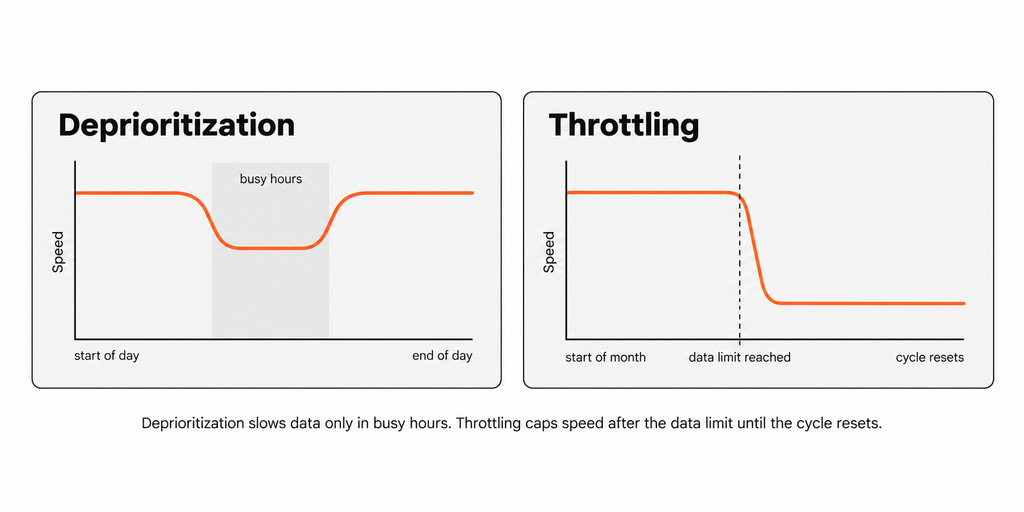
Deprioritization and throttling are often lumped together, but they work differently.
Every data session on an LTE or 5G network is assigned a quality-of-service priority. The 3GPP standards define QCI for LTE and 5QI for 5G. While a cell has plenty of spare capacity, that priority may make little practical difference. When the cell becomes congested, however, higher-priority traffic gets served first.
That’s deprioritization. A carrier assigns different priority levels to different plans or brands, and a lower-priority connection may slow down when the tower is busy. The important part is that the slowdown is conditional. Once congestion clears, speeds can return to normal. Verizon’s network policy describes this directly: “Once the demand on the site lessens, or if you connect to a different site not experiencing high demand, your speed will return to normal.“
Throttling is different. It is a fixed speed reduction that kicks in after a defined threshold, regardless of whether the tower is congested. Google Fi, for example, reduces speeds to 256 kbps after the applicable high-speed data threshold on certain plans. Boost Mobile has plans that reduce speeds to 512 kbps after 30 GB, while some Mint plans reduce speeds to 2G levels after the included high-speed allotment is used.
The exact treatment varies by brand and plan, so the fine print matters.
In practice, deprioritization is most likely to show up in places such as stadiums, airports, crowded commuter trains and dense downtown areas during peak hours. On a quiet suburban tower, you may never notice it.
That’s why the most useful test is not a speed test from your living room. Use the carrier’s free trial, where available, and test the service at the places and times that matter to you.
Best MVNO carriers for 2026
How we picked
We did not run month long speed tests, and we will not pretend we did. Our picks rest on what an operator checks before buying capacity:
- The host network and the brand’s owner.
- The published priority policy.
- The price after taxes, fees, AutoPay and intro periods.
- Plan terms we could read on the brand’s own plan page or broadband label on September 2026.
- Independent satisfaction data from J.D. Power (57,339 customers), ACSI (26,963 surveys) and Consumer Reports (123,670 members).
- Whether you can try the service before you port your number.
Labels say “best for” and carry no ranks from 1 to 8. The right network at your address outranks any list.
1. US Mobile: best overall, and the only pick that lets you choose the network
US Mobile removes the biggest risk in switching, which is guessing the network. It sells the same plans on all three networks under its own names. According to WhistleOut’s network comparison, Warp runs on Verizon, Light Speed on T-Mobile and Dark Star on AT&T. You pick one at signup and can move your line later. The first two switches are free, then $2 each, and Unlimited Premium customers switch free without limit.
- Plans: Unlimited Starter costs $25 month to month or $270 a year, which is $22.50 a month. New lines pay $199 for the first year. Unlimited Premium costs $44 a month or $390 a year. Unlimited Flex is annual only, $210 for 10 GB a month. The Light plan gives 2 GB for $8 a month on an annual plan.
- Taxes and fees: included.
- Data: Starter carries 70 GB of high speed data on the Verizon and T-Mobile based networks and unlimited on the AT&T based one. Premium carries unlimited priority data and 20 GB of international roaming.
- Priority: US Mobile is the rare brand that publishes its QCI classes, shown in the fine print table above.
- Second network: a $10 a month add on keeps another network active on the same phone.
- Trial: 30 days free with 30 GB of data, but only when you port your number in. To test US Mobile before porting, start a paid month on a new number.
- Satisfaction: Quartz reports that US Mobile topped Consumer Reports’ 2026 member ratings for the second year running.
Choose US Mobile if you want to try more than one network and keep the option to move. Skip it if you want a store, or a free trial that leaves your number where it is.
2. Visible: best MVNO on Verizon
Visible is Verizon’s own online brand. Its $25 plan includes taxes and fees, and its 15 day trial needs no credit card. The catch sits in the fine print: data on the $25 plan can slow whenever the network is busy, and the plan leaves out 5G Ultra Wideband, Verizon’s fastest layer.
- Plans: Visible costs $25 a month or $275 a year. Visible+ costs $35 or $375. Visible+ Pro costs $45 or $450.
- Visible+ adds unlimited premium data, 5G Ultra Wideband, a 10 Mbps hotspot and 2 GB a day of roaming in Mexico and Canada. Pro adds 4K video, a 15 Mbps hotspot, smartwatch service and calling to more than 85 countries.
- The $25 plan includes an unlimited hotspot at 5 Mbps and 480p video.
- One inconsistency to check: Visible’s plan page lists unlimited premium data on Visible+, and a footnote elsewhere on its site still mentions 50 GB away from Ultra Wideband. Read the broadband label before you buy.
- Families: Visible has no shared family plan. Inner Circle links up to seven separate accounts and takes $5 a month off Visible+ and Visible+ Pro monthly plans.
- Trial: 15 days, no credit card, on an eSIM, while your current carrier stays active.
- Satisfaction: 708 in J.D. Power’s prepaid MVNO segment, second to Mint.
Choose Visible if Verizon is the strongest network where you live and you want one flat number on your statement. Skip the $25 plan if your usual towers are crowded, and pay $35 for Visible+.
3. Mint Mobile: best MVNO on T-Mobile
Mint Mobile sells T-Mobile’s network in bulk. You prepay 3, 6 or 12 months, and the 12 month price is the lowest. T-Mobile has owned Mint since 1 May 2024.
- Price per month on a 12 month plan: 6 GB for $15, 17 GB for $20, 23 GB for $25, unlimited for $30. The same unlimited plan costs $35 a month on 6 months and $40 on 3 months.
- New customers pay $15 a month for any plan on any term for the first term, under a promotion that started on 1 July 2026.
- Unlimited means 50 GB before speeds may slow on a busy network, a 20 GB hotspot and SD video.
- Taxes and fees: extra.
- Families: Mint Family joins two to five lines in one account, and each line can sit on a different plan. There is no multi line discount.
- Satisfaction: highest in J.D. Power’s prepaid MVNO segment for a third straight volume at 711, and 79 on the ACSI.
Choose Mint if T-Mobile covers you well and you can pay $180 to $360 up front. Skip it if you want monthly billing or a price with taxes included.
4. Cricket Wireless: best MVNO on AT&T, and the pick for store support
Cricket Wireless is AT&T’s prepaid brand. It costs more than the online only brands. In exchange you get AT&T’s network, taxes inside the price, and a store where someone will move your number for you. Wave7 Research counts more than 4,000 Cricket stores.
- Plans with AutoPay: Sensible 10 GB for $30, Select Unlimited for $35, Smart Unlimited for $45 with a 15 GB hotspot, and Supreme Unlimited for $55 with a 50 GB hotspot and HBO Max Basic with Ads. The first month costs $5 more. Select Unlimited is for new lines only.
- Four lines of Select Unlimited cost $100.
- Taxes: included.
- Priority: every plan may slow when the network is busy, and video streams in standard definition.
- Trial: 14 days and 3 GB through the tryCricket app.
- Satisfaction: 652 in J.D. Power’s prepaid MVNO segment and 76 on the ACSI.
Choose Cricket if AT&T is strongest at your address and you want a store or a four line family price. Skip it if you are buying one line online: US Mobile’s AT&T based Starter plan costs $25 with taxes included.
5. Tello: cheapest MVNO for light users
Tello lets you build a plan from $5 a month, so you pay for what you use. It suits people who sit on Wi-Fi most of the day. Tello does not name its host network; BestMVNO identifies it as T-Mobile.
- Prices: $5 for 300 minutes and texts with no data, $10 for 2 GB with unlimited talk and text, $15 for 10 GB, $20 for 20 GB and $25 for unlimited.
- Unlimited means 50 GB of high speed data, a 10 GB hotspot, and rollover of unused data up to 100 GB since 10 August 2026.
- Taxes are extra, plus a cost recovery fee of up to 30 cents.
- Trial: none. Tello’s help center says it does not offer one.
- Satisfaction: Quartz reports Tello tied for second in Consumer Reports’ 2026 ratings.
Choose Tello if you use under 10 GB a month and want the lowest bill with no annual prepay. Skip it if you want a trial, a store or priority data.
6. Google Fi Wireless: best MVNO for international travel
Google Fi Wireless puts data in more than 200 destinations inside its $65 Unlimited Premium plan, with up to 50 GB at high speed abroad. No other pick matches that without day passes. In the US, Fi runs on T-Mobile’s network.
- One line: Unlimited Essentials costs $35 with 30 GB, no hotspot and no international data. Unlimited Standard costs $50 with 50 GB, a 25 GB hotspot, and data in Canada and Mexico. Unlimited Premium costs $65 with 100 GB and a 50 GB hotspot. Flexible costs $20 plus $10 per GB.
- Four lines: $90 for Essentials, $100 for Standard and $160 for Premium.
- Past the data limit, every plan drops to 256 kbps.
- Taxes and government fees are extra.
- Trial: 7 days with 10 GB on an unlocked eSIM phone. It converts to Unlimited Standard at $50 unless you cancel.
- Satisfaction: 673 in J.D. Power’s postpaid MVNO segment, second to Consumer Cellular, and 75 on the ACSI.
If you carry an iPhone, read our guide to Google Fi on iPhone first, and see our Google Fi plans and coverage review for the details.
Choose Fi if you travel abroad several times a year or need four lines with international data. Skip it if you stay in the US on one line: $65 is more than twice Visible’s price.
7. Consumer Cellular: best for ages 50 and over
Consumer Cellular holds the highest ACSI score of any wireless brand in 2026, 84 out of 100. It has also led J.D. Power’s postpaid MVNO segment for three straight volumes, at 720. It wins on service, and it prices for people aged 50 and over. The company opened its 100th store on 25 June 2026.
- Network: AT&T for all new customers, according to Clark’s review, updated 14 September 2026.
- Plans with AutoPay: 1 GB for $20, 5 GB for $25, 10 GB for $35 and 20 GB for $45. Unlimited costs $35 at ages 50 and over and $60 for ages 18 to 49. Two unlimited lines cost $60 at 50 and over.
- High speed data slows after 35 GB on one line, or 50 GB combined on a multi line plan.
- AARP members get 5 percent off monthly service and a 45 day risk free guarantee. Other customers get 30 days, and both guarantees cap data use at 500 MB.
- Taxes and fees are extra.
EDITOR: Consumer Cellular’s plan grid would not load for us. Confirm every price above on consumercellular.com before publishing.
Choose Consumer Cellular if you are 50 or older and want a person on the phone when something breaks. Skip it if you are under 50 or use more than 35 GB a month.
8. Total Wireless: best family price on Verizon, and the $100 family rule
Total Wireless is Verizon’s prepaid store brand. Its lineup, new since 13 May 2026, puts four unlimited lines on Verizon’s network for $95 a month with AutoPay, taxes and fees included. Verizon guarantees the base rate for five years; the guarantee excludes promotions and the AutoPay discount.
- Total Starter: $35 for one line, $75 for two, $85 for three and $95 for four. Data is standard priority with no 5G Ultra Wideband, and the hotspot is 10 GB at 5 Mbps.
- Total MAX 5G: $50 for one line and $105 for four, with premium data, 5G Ultra Wideband and an unlimited 5 Mbps hotspot.
- Total MAX 5G BYO: the same premium plan for $25 on one line with AutoPay, for new customers who bring a phone and sign up online. A banner on the plans page showed $20 a month after a $30 first month when we checked.
- Total All Access: $60 for one line, with Disney+ Premium.
- Satisfaction: 74 on the ACSI, the lowest score among our picks.
The $100 family rule: each host carrier’s own prepaid brand sells four unlimited lines for about $100 with taxes included. Total Wireless charges $95 on Verizon, Metro by T-Mobile charges $100 on T-Mobile, and Cricket charges $100 on AT&T. Choose the network first, because the price is about the same on all three.
Other family routes: Google Fi Essentials at $90 plus taxes for four lines, Mint Family, which groups up to five lines with no multi line discount, and US Mobile at a flat $25 a line. Visible bills each line on its own. For a child’s first phone or watch, see our guide to safe phone and watch plans for kids.
Choose Total Wireless if your family needs Verizon coverage and a price that holds. Skip Starter if you need premium data, and price MAX 5G at $105 for four lines.
Cable internet customers: Xfinity Mobile and Spectrum Mobile
If you already pay Comcast or Charter for home internet, check their mobile brands before anything else. Both ride Verizon’s network and both sell to their internet customers only. They are also the largest MVNOs outside the carriers’ own brands: Comcast reported 10.2 million lines and Charter 12.5 million at the end of June 2026.
- Spectrum Mobile: one Unlimited line costs $40 a month, and two or more lines cost $30 each. Unlimited Plus and Unlimited Plus Premium cost $40 and $50 a line on multi line accounts. Taxes and fees are included, and Unlimited may slow after 30 GB. New customers get the first Unlimited line free for a year with Spectrum Internet and AutoPay.
- Xfinity Mobile: Mobile Select costs $30 a line and may slow after 50 GB during congestion. Mobile Plus costs $45. Taxes are extra. One Select line is free for a year with Xfinity Internet at 300 Mbps or faster. Cancel the internet service and Comcast adds a $25 monthly charge.
EDITOR: Spectrum’s pages give no one line price for Unlimited Plus or Unlimited Plus Premium. Confirm both before publishing.
Why Boost Mobile is not a pick this year
Boost Mobile’s $25 Unlimited plan promises the price “forever” and includes 30 GB of premium data before a drop to 512 kbps. Taxes are extra and the price needs AutoPay. On paper it matches the lowest unlimited prices on AT&T’s towers. We left Boost out because its network arrangement changed inside the past twelve months, and we want to see a full year of service on AT&T’s towers first.
Best MVNOs by Network: The Complete List
Start with the network that works at your address, then choose a brand on it. Each table lists the major brands on one network with the cheapest unlimited price for one line, checked 17 September 2026.
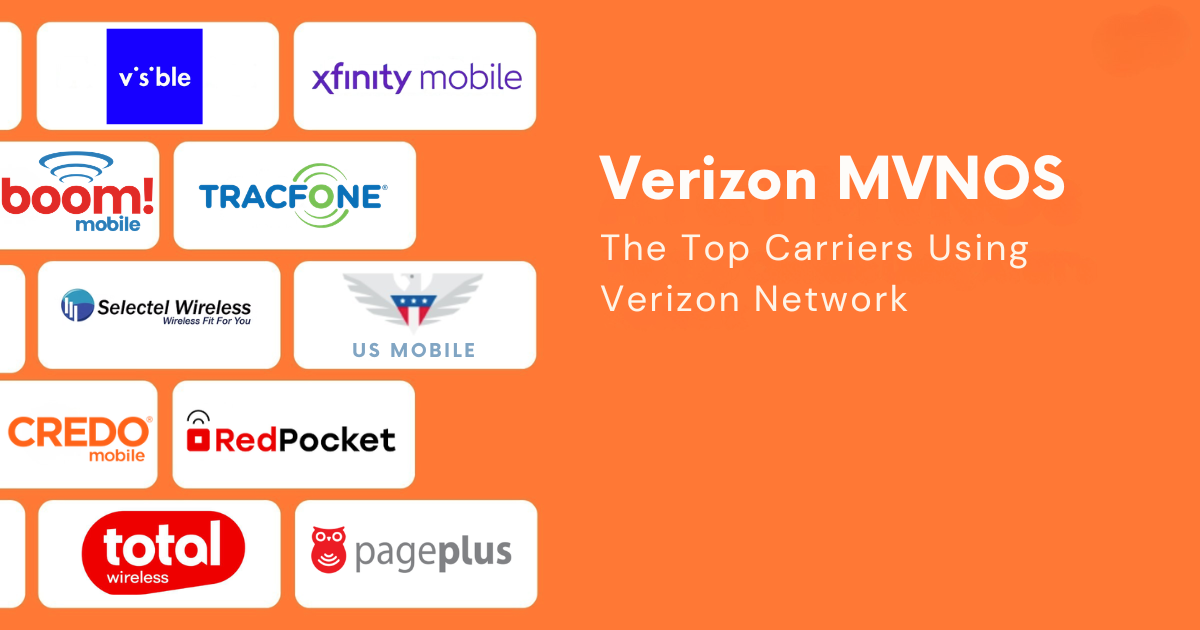
Verizon MVNOs
The best Verizon MVNO is Visible for one line and Total Wireless for a family.
| Brand | Owner | Cheapest unlimited, one line | Taxes and fees | Worth knowing |
|---|---|---|---|---|
| Visible | Verizon | $25 | Included | 15 day trial; premium data from $35 |
| Total Wireless | Verizon | $35 with AutoPay, or $25 for new customers who bring a phone | Included | Five year price guarantee |
| Straight Talk | Verizon | $45, or $25 on the bring your own phone plan for a new line | Extra | Sold at Walmart; Walmart+ comes with the Gold and Platinum plans |
| US Mobile | Independent | $25 | Included | Priority data on the $44 plan |
| Spectrum Mobile | Charter | $40 for one line, $30 a line for two or more | Included | Spectrum Internet customers only |
| Xfinity Mobile | Comcast | $30 a line | Extra | Xfinity Internet customers only |
| Red Pocket | Independent | $30 for 50 GB | Extra | Also sells AT&T and T-Mobile based lines |
T-Mobile MVNOs
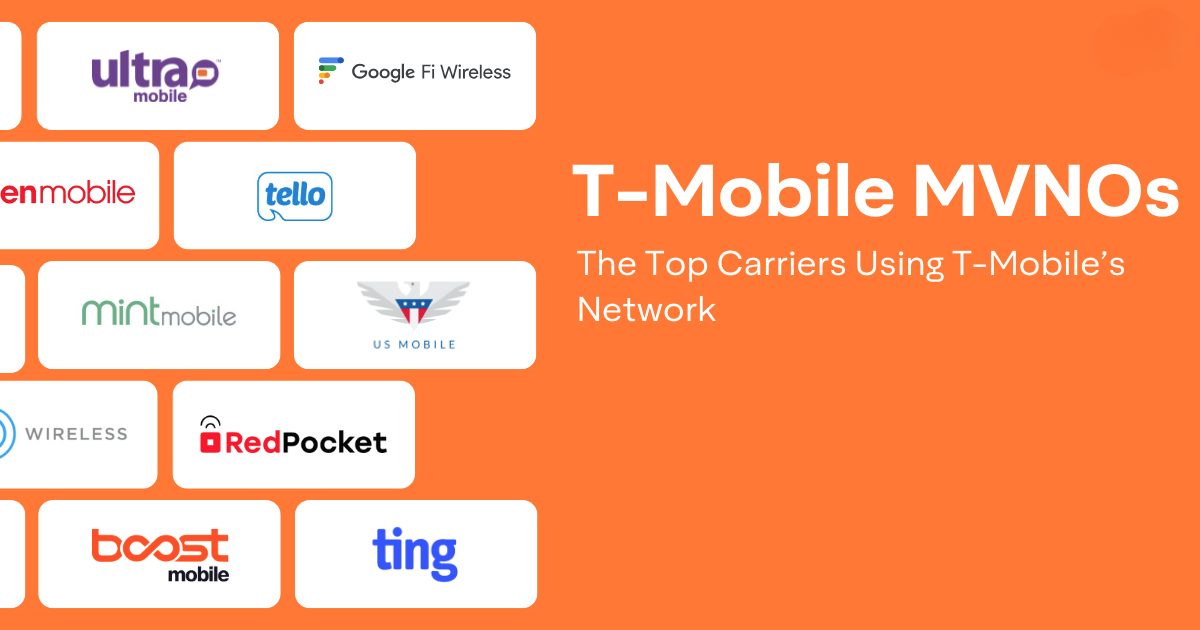
The best T-Mobile MVNO is Mint Mobile for value, Google Fi for travel and Tello for light use.
| Brand | Owner | Cheapest unlimited, one line | Taxes and fees | Worth knowing |
|---|---|---|---|---|
| Mint Mobile | T-Mobile | $30 on a 12 month plan | Extra | $15 a month for a new customer’s first term |
| Metro by T-Mobile | T-Mobile | $25 online with AutoPay and your own phone, or $20 a month on a 6 month prepaid plan for new customers | Included | Stores; four lines for $100 on the $40 plan |
| Ultra Mobile | T-Mobile | $49 monthly, or $34 a month on a 12 month plan | Extra | Built around international calling |
| Google Fi Wireless | $35 | Extra | Data abroad on the $65 plan | |
| Tello | Miron Enterprises (KeepCalling) | $25 | Extra | Plans from $5 |
| US Mobile | Independent | $25 | Included | Same plan names and prices; allowances differ by network |
| Helium Mobile | Noble Mobile, acquisition announced 2 June 2026 | $30 | Extra | Its free Zero plan was retired on 11 June 2026 |
AT&T MVNOs
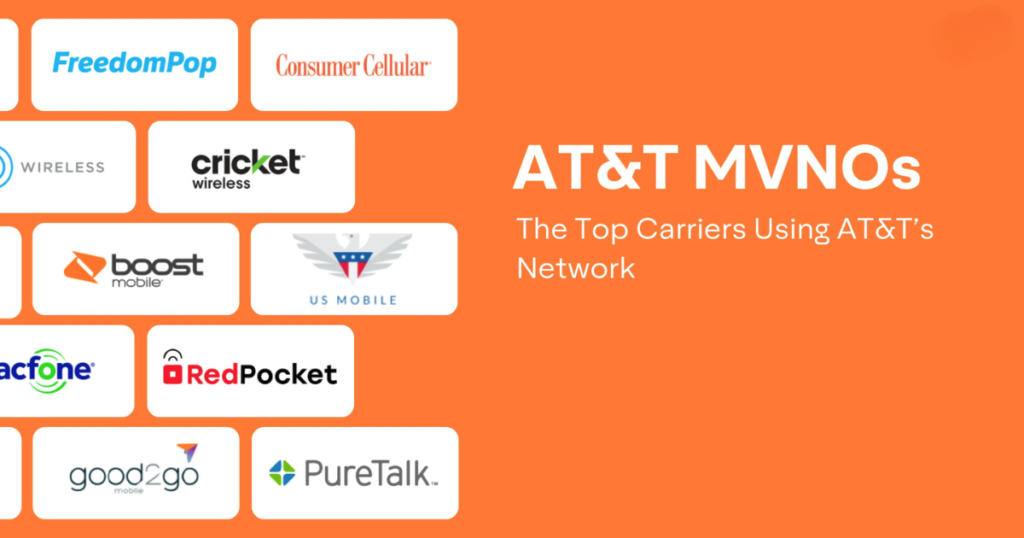
The best AT&T MVNO is Cricket for families and stores, and US Mobile for one line.
| Brand | Owner | Cheapest unlimited, one line | Taxes and fees | Worth knowing |
|---|---|---|---|---|
| Cricket Wireless | AT&T | $35 with AutoPay | Included | Stores; four lines for $100 |
| US Mobile | Independent | $25 | Included | Unlimited high speed data on the Starter plan |
| Consumer Cellular | GTCR | $35 at ages 50 and over, $60 under 50, with AutoPay | Extra | Highest ACSI score in wireless |
| Boost Mobile | EchoStar | $25 with AutoPay | Extra | Hybrid operator on AT&T’s towers |
| H2O Wireless | Telrite Holdings | $30, or $27 with AutoPay | Extra | International calling to more than 100 countries |
| Red Pocket | Independent | $30 for 50 GB | Extra | eSIM on its AT&T based lines only |
| Klarna | Klarna | $40 | Extra | A fintech brand’s plan, launched in 2025 |
MVNOs that work on more than one network
- US Mobile sells all three networks and lets you move between them. Two switches are free, later ones cost $2, and a $10 a month add on keeps two networks active at once.
- Red Pocket lets you choose a Verizon, T-Mobile or AT&T based SIM when you buy.
- Boost Mobile uses AT&T’s towers first and keeps access to T-Mobile’s network, according to EchoStar.
- Consumer Cellular puts new customers on AT&T. Some long time customers remain on T-Mobile.
- Google Fi has been T-Mobile only since it dropped UScellular in 2023.
We know of no consumer MVNO that moves your phone between all three networks on its own. US Mobile comes closest, and the switch is a manual step.
Cheap MVNO Plans: Best Switch Deals & Savings | 2026
US Mobile’s custom plans start at $4 a month and Tello’s at $5. For unlimited data, seven brands sell a month to month plan at $25: Visible, US Mobile, Metro by T-Mobile, Tello, Boost Mobile, Straight Talk (new line, your own phone) and Total Wireless (new customers, your own phone). Visible, US Mobile, Metro and Total Wireless include taxes and fees in that price. Prepaying cuts it further: Metro’s 6 month plan works out to $20 a month, US Mobile’s annual plan to $22.50, Visible’s annual plan to about $23, and H2O’s 12 month plan to $24.
Cheapest plans with a data cap
| Plan | Price per month | What you get | Taxes and fees |
|---|---|---|---|
| Tello, minutes only | $5 | 300 minutes and texts, no data | Extra |
| US Mobile Light | $8 on an annual plan, $10 monthly | 2 GB, and data stops at the cap | Included |
| Tello 2 GB | $10 | 2 GB with unlimited talk and text | Extra |
| Red Pocket Essentials | $10 | 3 GB | Extra |
| Ultra Mobile 4 GB | $10 for new customers on a term of 3 months or longer | 4 GB | Extra |
| Mint Mobile 6 GB | $15 on a 12 month plan | 6 GB | Extra |
| Tello 10 GB | $15 | 10 GB with unlimited talk and text | Extra |
| Helium Mobile Air | $15 | 10 GB | Extra |
MVNO Switch deals for new customers in 2026
- Mint Mobile: Any plan on any term for $15/month during the first term. Clark reports an end date of September 30, 2026; Mint lists none.
- Visible: Code SAVE6 takes $6/month off monthly plans for 12 months, through September 30, 2026.
- Google Fi Wireless: 50% off select unlimited plans for 12 months on new lines, through September 30, 2026.
- US Mobile: First year of Unlimited Starter for $199, or Unlimited Premium for $299.
- Total Wireless: MAX 5G BYO costs $30 for the first month, then $20/month.
- Boost Mobile: $10/month for the first three months of Unlimited.
- Ultra Mobile: Unlimited for $25/month on a 3-, 6-, or 12-month term.
- Spectrum Mobile: First Unlimited line free for a year with Spectrum Internet and AutoPay.
- Xfinity Mobile: One Mobile Select line free for a year with Xfinity Internet at 300 Mbps or faster.
What a cheap plan costs you
Plans under $15 a month come with small data buckets, standard definition video, app only support and lower priority on busy towers. For a phone that lives on Wi-Fi, none of that matters. If you tether a laptop or commute through crowded cells, budget $25 to $45 for a plan with a real hotspot and premium data.
How to Choose an MVNO in 2026: 4 Key Questions
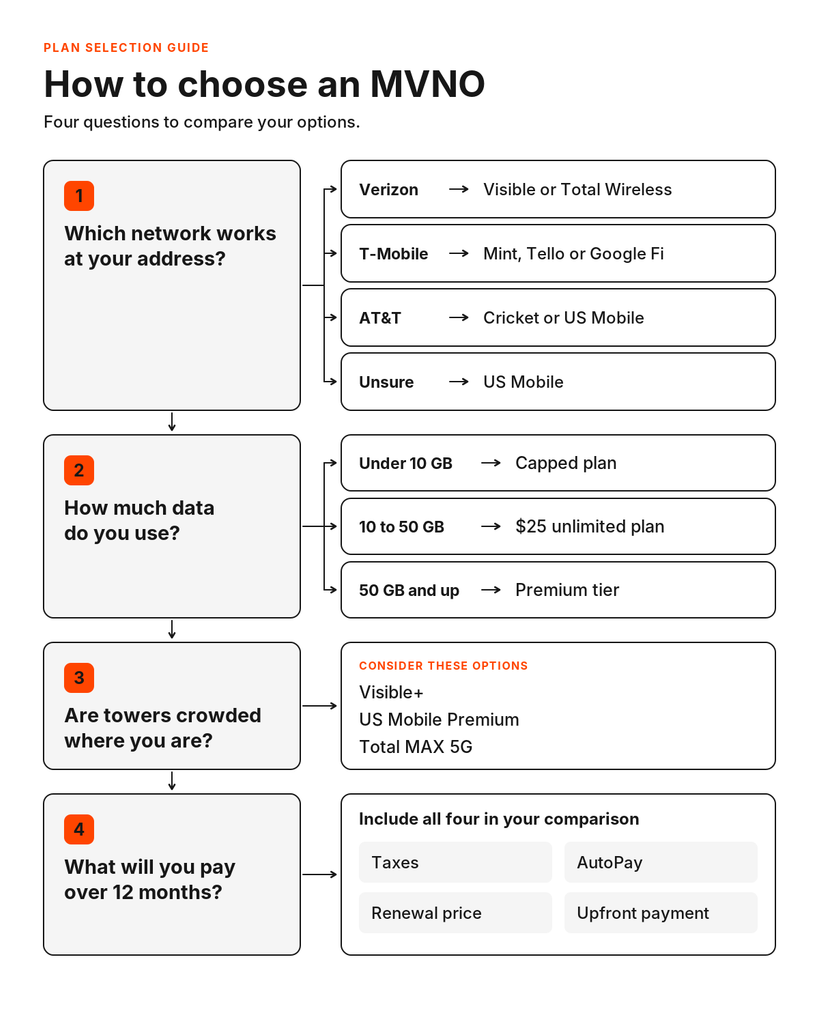
- Which network works where you live and work? Check your home and work addresses on the Verizon, T-Mobile and AT&T maps, then cross check on the FCC’s National Broadband Map. Maps predict outdoor signal. Your kitchen is the real test, and a free trial settles it.
- How much data do you use? Open your current carrier’s app and read the last three bills. Under 10 GB, buy a capped plan. Between 10 and 50 GB, a $25 unlimited plan fits. Above 50 GB, or with a laptop on the hotspot, buy a premium tier.
- Are your usual towers crowded? If your data crawls at the stadium, on the train or downtown at 6 pm, pay for priority: Visible+ at $35, US Mobile Unlimited Premium at $44, Total Wireless MAX 5G, or Google Fi.
- What will 12 months cost? Add taxes, the AutoPay condition, the renewal price and any upfront payment, then compare totals.
A worked example for question 4. Mint unlimited on a 3 month intro, then renewed for 12 months, costs $45 plus nine months at $30: $315 before taxes for the first year. Visible costs $300 for the same year on its monthly plan with taxes included, $275 on its annual plan, or $228 with the SAVE6 code. Mint’s 12 month intro costs $180 before taxes, and wins year one by a wide margin. The cheapest brand depends on the term you choose.
Best MVNO for rural coverage
An MVNO’s rural coverage equals its host’s coverage, so choose the host first. Verizon won the Coverage Experience award in Opensignal’s July 2026 US report with 9.7 out of 10. J.D. Power’s 2026 network quality study ranked Verizon best or tied for best in five of six regions. T-Mobile won Opensignal’s awards for 5G availability, at 91.8 percent, and for download speed, at 192.5 Mbps.
Start with a Verizon based brand: Visible, Total Wireless or US Mobile’s Warp network. Test an AT&T based brand second. Run the free trial at home before you port, because a regional award says nothing about your road.
How to Switch to an MVNO & Keep Your Number in 2026
Test first, port second, and do not cancel your old line yourself. The port closes it for you.
- Confirm the phone is unlocked and supports eSIM. Our eSIM compatibility checker covers the second part, and the unlock rules are in the table below.
- Test the network for a week at the places and hours you use the phone. Visible, Cricket and Google Fi run free trials on a second eSIM while your current line stays active, and our guide to dual SIM with eSIM shows how two lines share one phone. US Mobile’s free month needs your number, so test it with a paid month on a new number.
- Collect your account number and a transfer PIN from your current carrier, and switch off any number lock or port out protection.
- Keep the old service running. The FCC’s porting guide says: “Do not terminate your service with your existing company before initiating new service with another company.”
- Start the port from the new carrier’s app. FCC rules require simple ports to finish in one business day, and the FCC’s wireless porting page puts wireless to wireless transfers at about two and a half hours.
- Expect no resistance. The FCC says your old company “cannot refuse to port your number, even if you owe money”. You still owe any balance and any phone installments.
- After the port, set up voicemail, check iMessage or RCS, and test the text codes from your bank.
Trial lengths sit in the picks table at the top of this page. Visible’s 15 days needs no credit card and leaves your number alone.
When your current carrier will unlock your phone
| Carrier you are leaving | Phones on a postpaid plan | Phones on a prepaid plan |
|---|---|---|
| Verizon | Once the phone is paid in full | After 365 days of paid service |
| T-Mobile | After 40 days on the network, and paid in full | After 365 days, or after $100 in refills per line and 14 days |
| AT&T | 60 days after purchase, and paid in full | After 12 months of paid service |
A phone that is still locked will not take another network’s SIM. Our guide to locked phones and MVNOs explains why the old workarounds stopped working.
Launch & Scale Your Own MVNO with Spenza
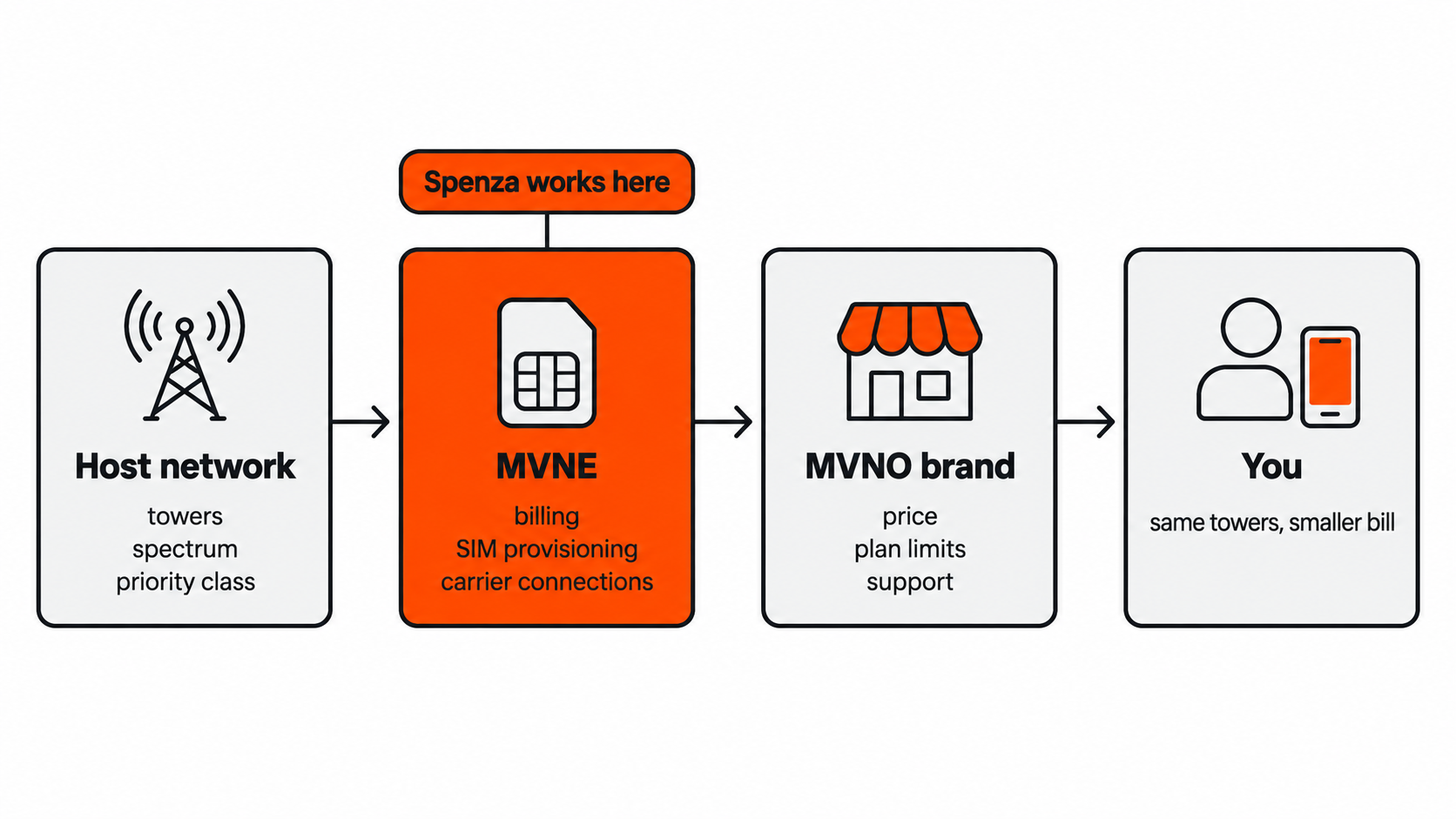
For companies that want to sell mobile plans, bundle connectivity with a device, or manage IoT SIMs across a fleet, an MVNE platform handles the infrastructure.
Spenza is an API-first connectivity enablement platform that lets any business procure, activate, and manage mobile plans across AT&T, T-Mobile, and Verizon. The platform handles:
- SIM and eSIM activation through a single API
- Real-time usage monitoring and intelligent plan adjustments
- Multi-operator billing and reconciliation
- White-label customer apps for end users
- A marketplace of operator plans across consumer, IoT, and enterprise use cases
A retailer bundling phone service with device sales, a fintech adding mobile plans to its ecosystem, or an enterprise managing a connected-vehicle fleet can launch in days rather than months.
Spenza acts as the connective layer between your business and the carrier networks, often described as the “Stripe for connectivity.” As an authorized reseller for AT&T, Verizon, T-Mobile, and more, Spenza helps B2B and B2C companies generate new revenue streams through branded mobile services.
The Bottom Line
Pick the network before the brand. If Verizon is strongest at your address, start Visible’s 15 day trial. If T-Mobile is, price Mint’s 12 month plans. If AT&T is, walk into a Cricket store or start its 14 day trial. If you cannot tell, US Mobile sells all three networks on one account and lets you move between them. Port your number only after a week of normal use on the new network.
If you came here for a business, a fleet or a brand of your own, a consumer list is the wrong tool. Start with the MVNO launch cost calculator, or tell us what you are building.
FAQs
Interested in launching your own branded mobile service? Contact Spenza to learn how the platform can help you become an MVNO without the traditional complexity.