


Why Most Business Mobile Policies Fail to Balance Cost and Quality
Business mobile services present a persistent challenge: how do you control escalating costs without compromising the connectivity your employees need to stay productive?
Most organizations treat this as a forced choice between low costs or high quality. They implement blanket policies (one device type, one carrier, one data plan for everyone) hoping simplicity will control expenses.
This approach consistently fails because it creates invisible costs that dwarf any initial savings.
Consider what happens in practice: A field service technician operating in rural areas suffers from poor network coverage. They miss critical schedule updates from dispatch. Appointments get delayed. Customers grow frustrated. Meanwhile, an office worker who spends their entire day on WiFi carries an unlimited data plan that costs your company $85 monthly but delivers zero productivity value.
The truth is that balancing cost and quality in business mobile services is not a zero-sum tradeoff. Organizations that implement comprehensive mobile optimization programs achieve measurable improvements across all dimensions simultaneously: lower costs, better service quality, improved compliance, and enhanced productivity.
What Is Business Mobile Cost Optimization?
Business mobile cost optimization is the process of reducing unnecessary mobile spending while maintaining the connectivity, device performance, security, and service quality employees need. It typically combines usage analysis, role-based plans, device lifecycle management, carrier optimization, and telecom expense management.
A complete optimization program looks beyond the monthly carrier bill. It evaluates devices, plans, usage, roaming, carrier coverage, contracts, billing accuracy, provisioning, and administrative effort together so organizations can optimize total mobile program cost rather than one expense category in isolation.
What Will You Get by the End of This Article?
By the end of this guide, you will understand how to eliminate wasteful mobile spending while simultaneously improving service quality for your workforce. You will discover three strategic approaches that Fortune 500 companies use to optimize their mobile programs, learn a proven five-phase implementation framework, and gain practical methods to measure both cost savings and productivity improvements.
The Three Hidden Costs of One-Size-Fits-All Mobile Policies
Traditional mobile policies create financial drains that rarely appear on budget reports but significantly impact your bottom line.
Productivity Loss from Coverage Gaps and Service Limitations
When your mobile workforce operates on inadequate networks, every dropped call and failed data connection translates directly into lost productivity.
Field technicians cannot access work orders in real-time. Sales representatives lose access to CRM data during client meetings. Customer service response times increase when employees struggle with connectivity issues.
A national field service company discovered that coverage gaps in rural service areas caused 50-75 missed or delayed appointments monthly. At an average service ticket value of $450, these connectivity failures cost the company over $30,000 monthly in lost revenue.
Financial Waste from Over-Provisioned Services
Blanket policies inevitably provide excessive services to employees who do not need them.
Office employees who spend 95% of their time on corporate WiFi carry unlimited data plans they never fully utilize. Executives receive premium device upgrades every 18 months despite minimal usage differences from standard models.
Organizations typically discover that 30-40% of their mobile spending goes toward unused or underutilized services when they conduct detailed usage analysis.
Administrative Overhead and Support Burden
Managing diverse mobile services without proper systems consumes significant IT and HR resources that could create strategic value elsewhere.
Teams spend dozens of hours monthly reconciling invoices across multiple carriers. HR processes reimbursement requests manually. IT troubleshoots device compatibility issues created by unmanaged BYOD programs.
The administrative burden often equals 20-30% of direct mobile service costs while delivering zero business value.
Three Proven Strategies to Optimize Business Mobile Cost and Quality
Organizations that successfully balance mobile cost and quality focus their efforts on three strategic levers that deliver immediate impact.
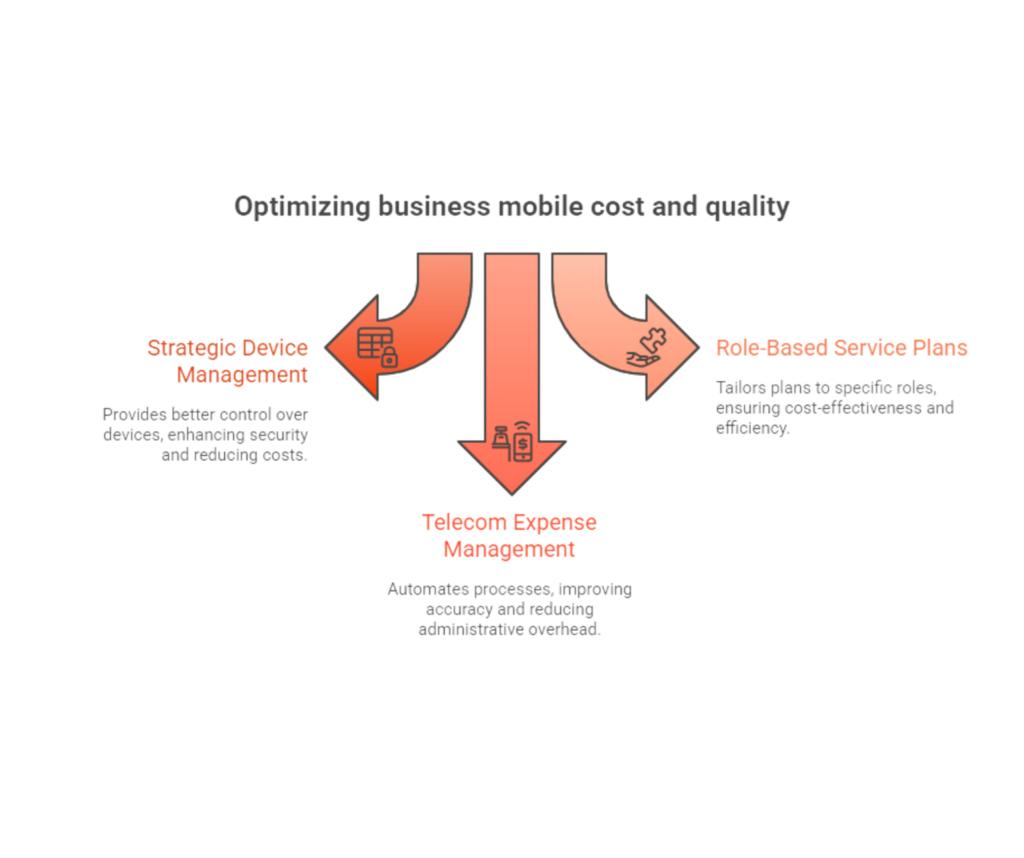
Strategy 1: Shift from BYOD to Strategic Device Management
Your device policy fundamentally determines both cost structures and productivity outcomes. Most organizations default to Bring Your Own Device (BYOD) programs because they appear cost-effective initially. This approach creates substantial hidden expenses and quality problems.
Why BYOD Programs Create Hidden Costs
BYOD policies generate device compatibility issues that increase IT support costs by 40-60%. Security vulnerabilities expand as organizations lose control over device configurations and security updates. Organizational satisfaction with BYOD lags behind employer-provided programs, with only 69% of BYOD companies reporting satisfaction with productivity improvements versus 78% of companies providing employer devices.
Stipend costs trend upward continuously as employees purchase increasingly expensive devices and expect reimbursement levels to match. Organizations implementing BYOD can save up to 11% compared to employer-provided device programs, but these savings often come with hidden costs in security, support, and administrative overhead.
The Employer-Provided Device Advantage
Transitioning toward employer-provided device (EPD) strategies delivers measurable improvements across multiple dimensions.
Organizations achieve consistent device-application integration, ensuring productivity tools function reliably for all employees. Security postures strengthen through standardized configurations, centralized management, and controlled update deployment. Research shows that using personal devices for work can boost productivity by up to 55% and increase employee happiness by 56%, but these benefits require proper security frameworks and management systems. Total costs for EPD programs average $1,415 per employee every two years (covering device, connectivity, software, and management) compared to $1,266 for BYOD programs, though EPD delivers superior security and consistency.
Strategy 2: Implement Role-Based Service Plan Optimization
Service plan optimization represents the fastest path to simultaneous cost reduction and quality improvement. Organizations that analyze actual usage patterns typically discover massive misalignments between services provided and needs required.
Match Network Coverage to Work Locations
Network coverage must align with where employees actually work, not where your headquarters is located. Evaluate carriers based on coverage quality in the specific geographic regions your workforce serves.
Field personnel require excellent coverage in rural or suburban areas where they conduct service calls. Remote workers need reliable coverage in residential areas nationwide. Office-based employees need only basic coverage since they primarily use corporate WiFi networks.
Right-Size Data Allocations Based on Usage Patterns
Data plans should match actual consumption patterns rather than providing uniform allocations that inevitably create waste.
Analyze historical usage data to understand consumption by role:
- Field Technicians: Require 10-20GB monthly for accessing cloud-based work order systems, streaming training videos, and conducting video consultations
- Sales Representatives: Need 5-10GB monthly for CRM access, email, video calls, and document sharing during client meetings
- Office Employees: Typically consume under 2GB monthly since they operate primarily on WiFi networks
- Executives: Usage varies significantly; analyze individual patterns rather than assuming premium plans are necessary
Organizations that implement usage-based plan optimization typically reduce monthly service costs by 15-25% while simultaneously improving service quality.
Deploy Multi-Carrier Strategies for Optimal Coverage and Cost
Relying on a single carrier forces compromises that create hidden costs. Organizations should evaluate the business case for using multiple carriers, selecting the optimal provider for each employee group.
While multi-carrier strategies increase management complexity, Telecom Expense Management platforms handle this complexity automatically while capturing significant value through better coverage and competitive pricing.
Strategy 3: Automate Management with Telecom Expense Management Platforms
Telecom Expense Management (TEM) platforms transform mobile services from administrative burdens into strategic assets. These systems automate manual tasks, consolidate multi-carrier billing, and provide actionable optimization insights.
Eliminate Administrative Burden Through Automation
TEM platforms automate invoice processing, eliminating manual reconciliation that typically consumes 20-40 hours monthly for organizations with 100+ mobile lines. They handle provisioning and deprovisioning automatically, ensuring new employees receive service immediately while terminated employees lose access the same day.
This automation frees IT and HR teams to focus on strategic initiatives that create business value.
Gain Spend Visibility Through Consolidated Billing
Organizations using multiple carriers receive separate invoices that obscure total spending and prevent trend identification. TEM platforms consolidate all carrier billing into unified dashboards that reveal spending patterns.
This visibility enables organizations to identify billing errors that commonly total 2-5% of charges, detect unusual usage patterns that indicate policy violations, and make informed decisions about service plan modifications.
Enable Continuous Optimization Through Usage Analytics
TEM platforms capture detailed usage data across the organization, creating opportunities for ongoing optimization. Organizations can identify employees consistently exceeding data limits and evaluate whether plan upgrades or policy reinforcement is appropriate.
The platforms also monitor compliance with usage policies, flagging violations like excessive international roaming or unauthorized hotspot usage for review.
Mobile Service Optimization Results: A Comparative Analysis
Understanding the tangible differences between optimized and unoptimized mobile programs helps quantify the opportunity available to your organization.
| Metric | Traditional Approach | Optimized Approach | Improvement |
|---|---|---|---|
| Monthly Cost per User | $85–110 | $65–85 | 20–25% reduction |
| Administrative Hours (per 100 users) | 30–40 hours/month | 8–15 hours/month | 50–65% reduction |
| Employee Device Satisfaction | 69% (BYOD average) | 78% (EPD average) | 13% increase |
| Coverage Complaint Rate | 15–20% of users | 3–5% of users | 70–85% reduction |
| Billing Error Rate | 3–5% of charges | <1% of charges | 60–80% reduction |
| Service-Related Support Tickets | 12–15 per 100 users/month | 4–6 per 100 users/month | 60% reduction |
Five-Phase Implementation Roadmap for Mobile Service Optimization
Successfully balancing cost and quality requires systematic implementation following a proven sequence that minimizes disruption while maximizing results.
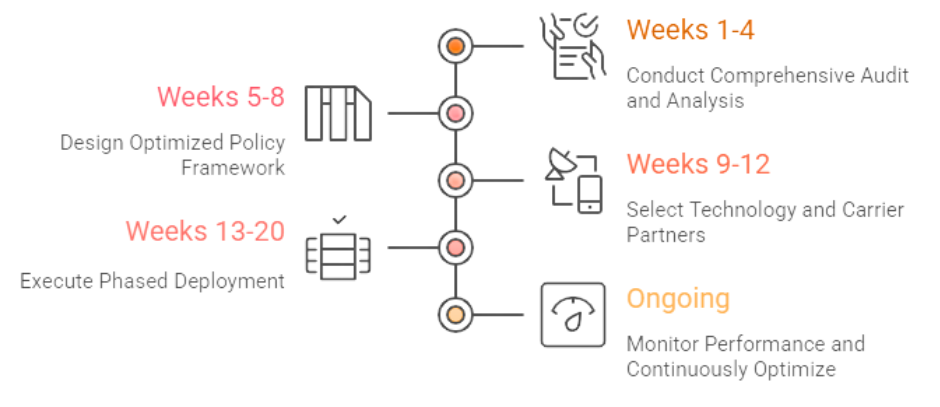
Phase 1: Conduct Comprehensive Audit and Analysis (Weeks 1-4)
Begin by documenting your current state across all dimensions of mobile service delivery.
Financial Analysis: Review mobile spending across all carriers, services, and cost categories. Document device costs, service plan charges, administrative expenses, and support costs. Establish baseline spending per user and per department.
Usage Analysis: Collect usage data for the past 6-12 months covering data consumption, voice minutes, text messages, and roaming activity. Segment this data by employee role, department, and location to identify patterns.
Employee Feedback: Survey employees regarding service quality, device satisfaction, application performance, and support responsiveness. Identify specific pain points including coverage issues and process frustrations.
Business Mobile Cost Optimization Audit Checklist
Before changing plans or carriers, audit these areas:
- Inventory: active, inactive, duplicate, and unused mobile lines.
- Usage: data, voice, SMS, hotspot, and roaming consumption.
- Plans: whether each employee’s plan matches actual usage.
- Devices: purchase cost, age, refresh cycle, support burden, and compatibility.
- Carriers: coverage, pricing, contract terms, and flexibility.
- Billing: recurring charges, billing errors, taxes, fees, and disconnected services.
- Policies: BYOD, roaming, international usage, hotspot, and personal-use rules.
- Operations: provisioning, deprovisioning, invoice reconciliation, and support workload.
The audit should establish a baseline cost per user, cost by department or role, and the main sources of avoidable spend before optimization begins.
Phase 2: Design Optimized Policy Framework (Weeks 5-8)
Based on audit findings, design a comprehensive mobile policy that aligns services with organizational needs.
Employee Segmentation: Define employee categories based on mobility requirements, usage patterns, and business criticality. Typical segments include field service personnel, sales representatives, remote employees, office workers, and executives.
Device Policy Design: Establish device categories with specific approved models for each employee segment. Define refresh cycles, damage/loss policies, and personal usage guidelines.
Service Plan Architecture: Create service plan tiers that match usage patterns identified in the audit. Specify data allowances, voice limits, international capabilities, and hotspot access for each tier.
KPI Definition: Establish key performance indicators for measuring program success including cost per user, employee satisfaction scores, coverage complaint rates, and policy compliance levels.
Phase 3: Select Technology and Carrier Partners (Weeks 9-12)
Partner selection significantly impacts long-term program success. Evaluate options thoroughly rather than defaulting to lowest-cost providers.
TEM Platform Evaluation: Assess platforms based on automation capabilities, multi-carrier support, reporting flexibility, existing system integrations, and implementation support quality. Request demonstrations using your actual usage data.
Carrier Evaluation: Evaluate network coverage in your specific operating areas using coverage maps and third-party quality metrics. Assess pricing for your anticipated usage profiles. Evaluate flexibility for plan modifications as needs change.
Contract Negotiation: Negotiate terms that provide organizational flexibility rather than locking into rigid multi-year commitments. Secure volume discounts based on user counts.
Phase 4: Execute Phased Deployment (Weeks 13-20)
Roll out optimized mobile services systematically to minimize disruption and enable learning.
Pilot Program: Select one employee segment (typically 25-50 users) for initial deployment. Implement new devices, service plans, and TEM platform for this group. Monitor closely for issues and gather detailed feedback.
Refinement: Address issues identified during pilot phase before expanding deployment. Adjust device selections, service plan specifications, or processes based on real-world experience.
Organization-Wide Rollout: Deploy to remaining employee segments in waves. Provide clear communication explaining changes, rationale, and benefits. Offer training on new devices and productivity applications.
Phase 5: Monitor Performance and Continuously Optimize (Ongoing)
Mobile optimization is an ongoing program rather than a one-time project. Establish processes for continuous improvement.
Monthly Monitoring: Review TEM analytics covering usage trends, spending patterns, policy compliance, and service quality metrics. Identify anomalies requiring investigation and optimization opportunities worth pursuing.
Quarterly Reviews: Conduct comprehensive program reviews examining performance against established KPIs. Assess whether current policies remain aligned with organizational needs.
Annual Strategy Assessment: Review overall mobile strategy considering organizational changes, technology evolution, and market developments. Evaluate opportunities for expanding optimization to related areas.
How to Measure ROI from Mobile Service Optimization
Successful mobile optimization delivers returns across multiple dimensions requiring comprehensive measurement approaches that capture both obvious and hidden value.
Tangible Financial Metrics
Monthly Service Cost Reduction: Compare total monthly telecom spending before and after optimization. Organizations typically achieve 15-25% reductions while maintaining or improving service quality. For an organization with 500 mobile users averaging $90 monthly, this represents $6,750-11,250 in monthly savings or $81,000-135,000 annually.
Administrative Time Savings: Track hours IT and HR teams spend on mobile-related tasks. Expect reductions of 40-60% through TEM automation. For organizations where mobile administration consumes 35 hours monthly at a fully-loaded cost of $75/hour, savings total $1,050-1,575 monthly or $12,600-18,900 annually.
Device Support Reduction: Monitor device-related support tickets and resolution time. Organizations typically see 30-40% reductions through better device standardization and automated provisioning.
Billing Error Recovery: Track billing errors identified and recovered through TEM platform auditing capabilities. Organizations commonly recover 2-5% of charges through error identification and correction.
Intangible Productivity and Quality Gains
While harder to quantify precisely, intangible benefits often deliver greater value than direct cost savings.
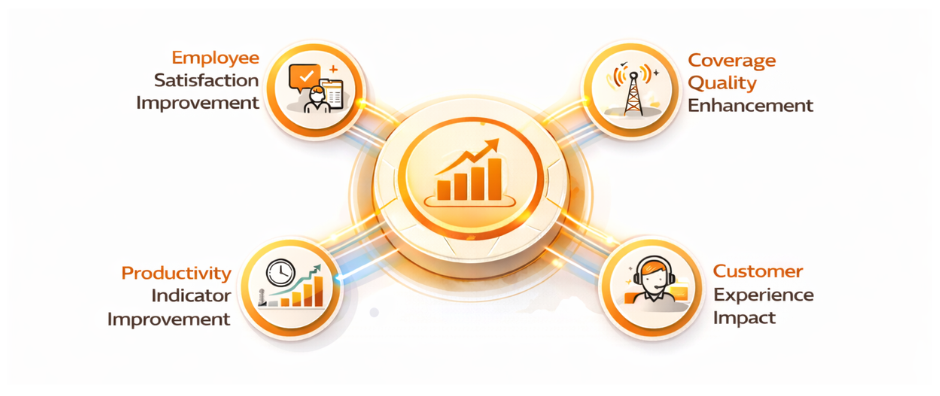
Employee Satisfaction Improvement: Survey employees regarding device satisfaction, service quality, and tool effectiveness. Compare results to baseline measurements. Improved satisfaction correlates with reduced turnover and enhanced productivity.
Coverage Quality Enhancement: Monitor coverage complaint rates and service quality feedback. Reduced complaints indicate improved employee productivity and reduced time wasted on connectivity issues.
Customer Experience Impact: Track customer satisfaction scores and communication-related complaint patterns. Improved mobile service quality enables faster response times and more reliable customer communication.
Productivity Indicator Improvement: Monitor proxy indicators including reduced missed appointments, faster average response times to customer inquiries, improved field service completion rates, and decreased time between customer contact and issue resolution.
How Spenza Helps Organizations Optimize Business Mobile Services
Successfully implementing mobile service optimization requires both strategic expertise and sophisticated technology platforms. Spenza provides comprehensive solutions that address all three strategic optimization levers while delivering measurable results.
Unified Connectivity Management Across Multiple Operators
Spenza’s operator-neutral connectivity enablement platform gives organizations a single pane of glass for managing mobile services across multiple carriers and service providers.
Instead of juggling separate invoices, management portals, and support channels for each carrier, organizations consolidate everything into Spenza’s unified platform. This consolidation delivers immediate administrative time savings while providing the visibility needed for data-driven optimization decisions.
For organizations managing IoT devices, employee mobile services, or specialized connectivity needs, Spenza’s aggregation capabilities eliminate complexity while preserving the flexibility to select optimal carriers for different use cases.
Procure-to-Pay Automation That Eliminates Administrative Burden
Spenza’s SaaS platform automates the entire mobile service lifecycle from initial provisioning through ongoing management and payment processing.
When new employees join, Spenza automatically provisions appropriate devices and service plans based on role-based policies you define. When employees leave, services terminate immediately without manual intervention. Monthly invoices consolidate automatically across all carriers, with Spenza handling payment processing and expense allocation.
Organizations that implement Spenza’s automation typically reduce administrative time spent on mobile management by 40-60%, freeing IT and HR teams for strategic initiatives.
Marketplace Access to Specialized Mobile Plans
Spenza’s integrated marketplace provides access to specialized mobile plans from multiple operators, enabling organizations to select optimal services for different employee segments and use cases.
Need aggressive data plans for field technicians who stream training content? Require cost-effective basic plans for office employees who primarily use WiFi? Looking for international roaming solutions for globally distributed teams? Spenza’s marketplace delivers flexible options that match actual organizational needs.
The marketplace model also creates ongoing competitive pressure that keeps pricing favorable while delivering continuous access to new service offerings as they become available.
Analytics and Optimization Insights
Spenza provides comprehensive analytics covering usage patterns, spending trends, policy compliance, and optimization opportunities across your entire mobile service portfolio.
Identify employees consistently exceeding data allocations who need plan upgrades. Spot employees with minimal usage who represent cost optimization opportunities. Track billing anomalies that indicate errors or policy violations. Monitor service quality metrics to identify coverage issues requiring carrier changes.
These insights transform mobile service management from reactive administration into proactive optimization that continuously improves cost efficiency and service quality.
MVNO Capabilities for Device Vendors and Specialized Use Cases
For organizations with unique connectivity requirements (connected device manufacturers, IoT solution providers, or businesses seeking branded mobile services) Spenza’s MVNO enablement platform provides comprehensive capabilities.
Launch branded mobile plans bundled with your devices. Deploy specialized connectivity for IoT sensors and edge devices. Create custom service offerings that differentiate your products in competitive markets.
Spenza’s platform provides the infrastructure, operator relationships, and operational capabilities required to become a mobile virtual network operator without the traditional complexity and capital investment.
Conclusion
Organizations that implement comprehensive mobile optimization programs achieve simultaneous improvements: reduced spending, enhanced service quality, improved employee satisfaction, and increased productivity. Success comes from focusing on three strategic levers: transitioning toward employer-provided device programs, implementing role-based service plans that match actual usage patterns, and deploying Telecom Expense Management platforms that automate administration while enabling data-driven optimization.
Ready to Transform Your Business Mobile Services? Spenza helps organizations implement comprehensive connectivity optimization that delivers measurable cost reductions while improving service quality and employee productivity. Our operator-neutral platform provides unified management across multiple carriers, automates administrative workflows, and delivers actionable analytics that enable continuous optimization.
FAQs
Contact us today to schedule a consultation and discover your mobile service optimization opportunities.


