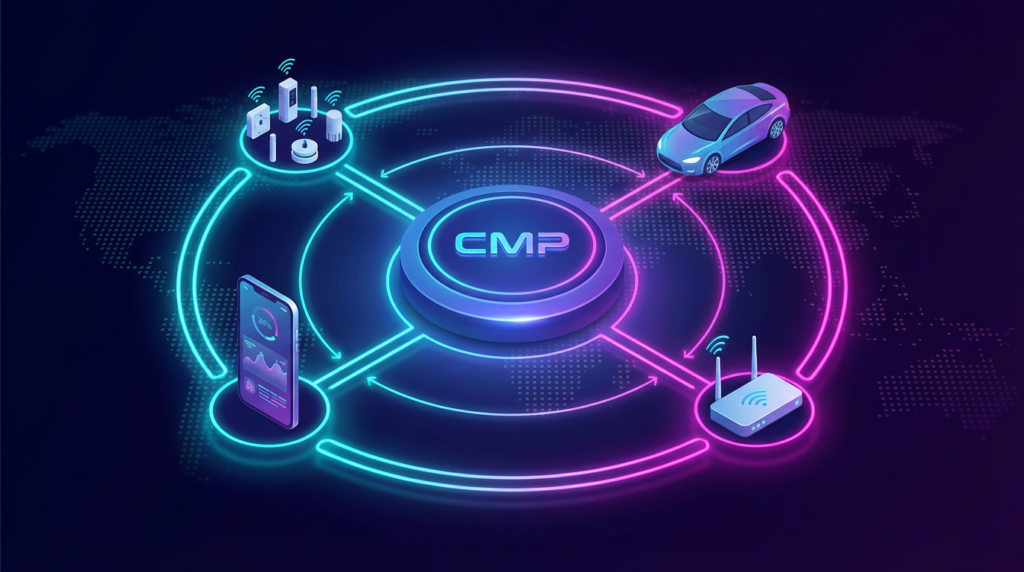
IoT connectivity now means managing, securing, and optimizing millions of devices worldwide. A robust IoT connectivity management platform gives teams one dashboard to control costs, maintain security, and scale operations across 190 countries — all without manual carrier hassle.
Your IoT Platform Is More Than a Dashboard, It’s Your Control Center
In the early IoT days, just getting a device online was a technical triumph. Now, with over 25 billion connected devices in 2025 and enterprises running fleets in the hundreds of thousands, the challenge is no longer connectivity but control. The goal is to manage IoT devices efficiently and securely through a single intelligent platform.
Many businesses still depend on basic carrier portals never built for global IoT scale. Those tools lead to spiraling costs, vulnerabilities, and hours of manual work. When connectivity costs climb past budget or a device goes dark in the field, that old portal offers no help.
CTOs, IoT Product Managers, and Operations Directors now treat connectivity management as a core infrastructure layer, not a side tool. They look for a modern IoT connectivity management platform that ties data usage, security, and automation into one system.
In this guide, we’ll define the 10 must-have features every IoT connectivity platform needs in 2025 to support profitable global deployments.
You can also explore how platforms simplify operations in Spenza’s IoT Connectivity Management Simplified article.
Part 1: Cost Management & Financial Control
IoT costs start small but explode at scale. Paying $0.50 per SIM a month may look trivial until you manage 10,000 devices, that’s $60,000 annually in fixed fees alone. Enterprises need an IoT connectivity management platform that automates budget control and eliminates waste before it hurts profitability.
You can see a detailed breakdown of cost patterns in Spenza’s IoT Connectivity Cost Guide 2025.
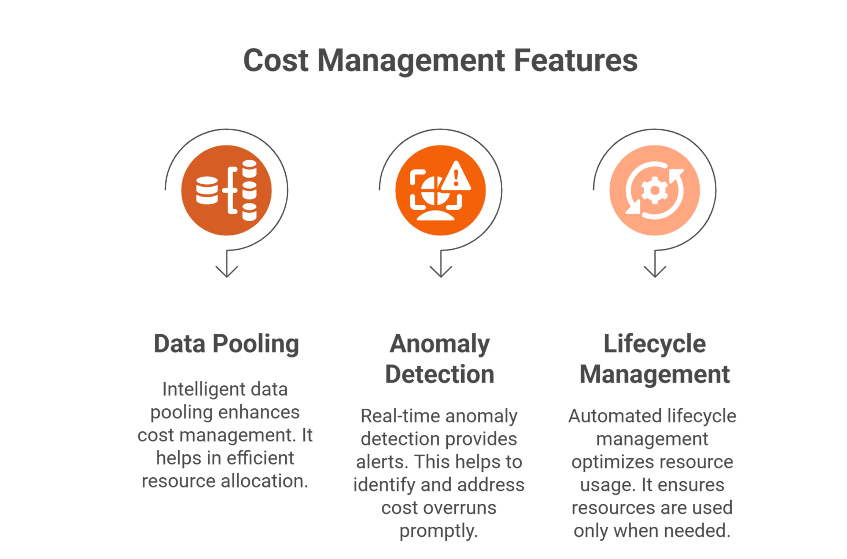
Feature 1: Intelligent Data Pooling
Why you need it: To avoid paying for unused data and stop costly overages.
Most companies still use per-SIM data plans. Half of those plans sit half-empty each month. An intelligent pooling engine inside your IoT connectivity platform combines all SIM plans into a single pool shared across devices. The platform tracks aggregate usage and balances it automatically.
If 1,000 devices each waste 100 MB monthly at $1 per 100 MB, that’s $12,000 lost annually. Pooling removes that waste and keeps data bills predictable.
Intelligent pooling also analyzes historical patterns and predicts future peaks. When holiday traffic or maintenance data surges, the pool expands temporarily without manual plan switching. Finance teams gain stability, and operations avoid throttling.
Transitioning to a pooled model is the first step toward global IoT connectivity efficiency. It lets you treat data like a shared utility rather than hundreds of separate plans.
For more on optimizing connectivity plans, read Spenza’s guide on how to choose IoT connectivity plans.
Feature 2: Real-Time Anomaly Detection & Alerts
Why you need it: To prevent bill shock and detect faults instantly.
A single device can drain your budget overnight. One firmware glitch sending 1 GB instead of 10 MB can create a $1,500 overage bill at $1.50 per MB. A modern IoT connectivity management platform monitors data flows in real time and flags anomalies immediately.
It compares usage against normal patterns, sending alerts or automatically suspending the SIM when limits hit. That single automation prevents thousands in unexpected charges.
Example: Real-Time Detection
| Scenario | Without Smart Alerts | With Anomaly Detection |
|---|---|---|
| Sensor loops data uploads | $3,000 bill later | Auto-pause after 50 MB |
| Roaming device jumps to premium carrier | 5× network charges | Switch to local profile |
| Faulty firmware sends 24/7 data | 48 hours of loss | Alert within 5 minutes |
Automation keeps control in your hands. You can define rules like auto-pause after daily thresholds or flag SIMs that triple their usage. With an AI-based monitoring engine, your platform learns patterns and prevents future waste proactively.
Companies that adopt real-time IoT SIM management see significant ROI within a few months. They detect problems early and protect their IoT budget automatically.
You can also learn how automation simplifies connectivity inSpenza’s single pane of glass for IoT connectivity management.
Feature 3: Automated Lifecycle Management
Why you need it: To stop paying for SIMs that aren’t used.
In every fleet, some devices get shipped late or decommissioned. Those SIMs stay active in billing systems, quietly costing money. An automated lifecycle engine inside your IoT connectivity platform tracks SIM activity and moves inactive ones into “inventory” mode at a fraction of the cost.
When a device connects for the first time, the SIM activates automatically. When it goes silent for 30 days, the platform suspends it and stops billing. This prevents “ghost SIMs.”
Cutting just 100 idle SIMs at $0.50 each saves $600 a year, easy wins for finance teams. Beyond money, this feature keeps inventory accurate and eliminates manual spreadsheets.
Automation also reduces human error and frees operations to focus on growth. As IoT deployments scale into tens of thousands of devices, manual management becomes impossible. Lifecycle automation keeps your connectivity lean and organized.
To see how automation drives efficiency in real deployments, readSpenza’s single pane of glass guide.
So far, we’ve focused on controlling costs. But IoT success isn’t just about budget savings, it’s about reliability and reach. Enterprises deploying globally need their IoT connectivity management platform to scale seamlessly across regions and networks. That’s what Part 2 is all about, global scalability and reliability.
Before moving on, check out Spenza’s IoT Connectivity Strategies 2025 for how companies plan global connectivity today.
Part 2: Global Scalability & Reliability
Global IoT deployments fail when connectivity is fragmented. Switching between carrier portals adds complexity and risk.
A modern IoT connectivity management platform must centralize visibility and deliver reliable coverage across countries.
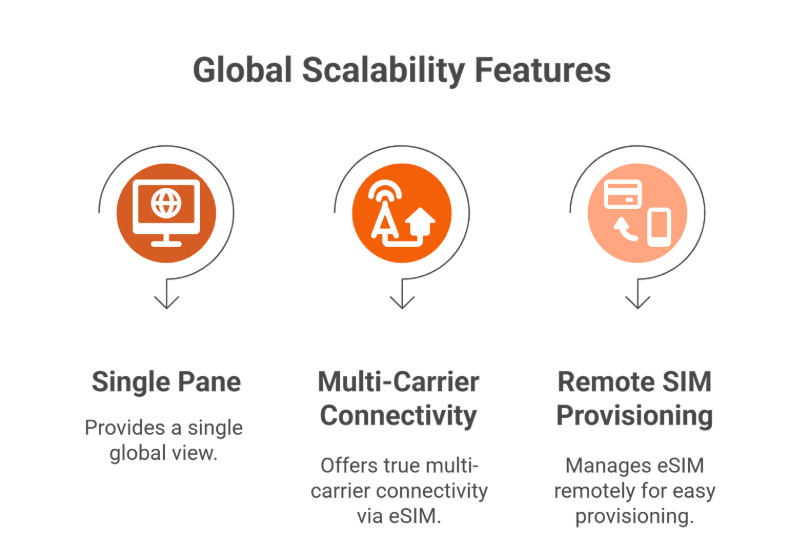
Feature 4: A Single, Global “Pane of Glass”
Why you need it: To see and control every device in one place.
A fleet spread across continents cannot be managed through ten different carrier dashboards. A single pane of glass brings every SIM under one view, usage, location, status, and alerts in a unified interface.
This is especially critical as IoT deployments scale beyond a million connections. The IoT connectivity market itself reaches $10 billion in 2025, with enterprises driving over 58% of that revenue due to global scale. That means visibility is no longer a luxury, it’s a survival tool.
A centralized dashboard lets your operations team spot issues instantly anywhere, whether a device is in Texas or Tokyo. You get a clear snapshot of network health without switching systems. This not only saves time but reduces errors and response delays.
A unified pane also helps you manage IoT devices at scale. It ties into inventory, billing, and support in one system for true operational clarity.
You can see how a single pane architecture simplifies workflows inSpenza’s single pane of glass for IoT connectivity management.
Feature 5: True Multi-Carrier Connectivity (eSIM / Global SIM)
Why you need it: To ensure coverage and redundancy worldwide.
IoT deployments depend on consistent, reliable coverage, no matter where devices operate. A strong IoT connectivity management platform should deliver seamless global connectivity that automatically adapts when networks change or fail. That’s what multi-carrier connectivity does: it keeps every device online, without manual effort.
Here’s why this capability is non-negotiable for global IoT operations:
- Automatic Carrier Switching: SIMs connect to multiple networks in one region and switch automatically if a carrier goes down. That means zero downtime and consistent uptime everywhere.
- Powered by eSIM & eUICC: These technologies make remote carrier switching possible. Nearly 2 billion devices use eSIM worldwide, and the number keeps climbing because it removes carrier lock-in and manual SIM swaps.
- Future-Proof for Network Changes: When 2G and 3G networks shut down, devices must migrate to LTE-M or NB-IoT. Multi-carrier, multi-mode connectivity ensures smooth transitions without field visits.
- Cost Optimization at Scale: Devices always select the most cost-efficient network. A low-bandwidth NB-IoT sensor can operate for under $5 per year, while a 5G camera averages $5–$10 per month, automated network choice keeps both efficient.
- Redundancy & Reliability: With more than one carrier option in every region, your global IoT connectivity stays resilient even when one provider experiences issues.
Multi-carrier connectivity is the backbone of global IoT performance. It combines redundancy, compliance, and cost control, all essential for enterprises managing thousands of devices across continents.
To explore how multi-carrier eSIMs transform fleet reliability, read Spenza’s Ultimate Guide to Every IoT Connectivity Type in 2025.
Feature 6: Remote SIM Provisioning (eSIM Management)
Why you need it: To future-proof and simplify global IoT operations.
Managing thousands of SIM cards across countries is no longer realistic. Manual swaps or field visits waste time and money. That’s where Remote SIM Provisioning (RSP) changes everything. With eSIM technology, you can update, replace, or switch carrier profiles over the air (OTA), no physical handling, no downtime, no manual errors.
Here’s why every modern IoT connectivity management platform must support RSP:
- Zero Physical Intervention: Teams update hundreds or thousands of devices remotely in minutes. No more truck rolls or site visits.
- Instant Global Flexibility: When a new operator offers a better rate—say, in Germany, you can push the new carrier profile instantly through the platform.
- Always Compliant: RSP ensures devices comply with telecom regulations that limit permanent roaming. You can download local profiles and stay legal in every region.
- Reduced Downtime: API-driven provisioning allows smooth carrier transitions without interrupting service.
- Future-Ready: Your IoT deployment stays prepared for upcoming technologies like 5G RedCap or private LTE networks.
- Unified Control: A robust IoT connectivity platform integrates eSIM provisioning, profile management, and real-time analytics, all in one dashboard.
A strong IoT connectivity management platform integrates eSIM provisioning, profile management, and real-time analytics in one interface. Spenza does exactly that. As a cloud-native, API-first MVNE, Spenza supports multi-carrier eSIMs across 190+ countries, providing truly global IoT connectivity from day one.
These first six features, cost controls, anomaly detection, automation, unified management, multi-carrier connectivity, and remote provisioning, form the foundation for reliable, scalable IoT operations. They create the financial and technical structure for growth.
Part 3: Security, Control & Operational Efficiency
As IoT fleets grow, so do the risks. Attackers now target connected devices because they’re often the weakest link in enterprise systems. That’s why every IoT connectivity management platform must include built-in, device-level security and network control.
A secure platform gives your team full visibility and total command over who and what connects to your network.
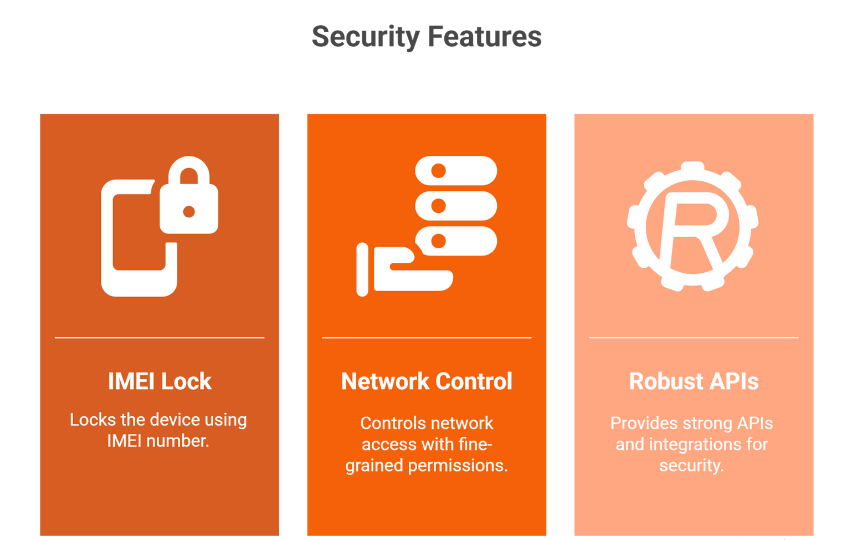
Feature 7: IMEI Lock & SIM Security
Why you need it: To protect your IoT investment from SIM theft and fraud.
SIM fraud is one of the fastest-growing IoT risks. Attackers pull SIMs from devices and reuse them elsewhere, causing huge billing losses. With IMEI lock, your IoT connectivity management platform ties each SIM to a single hardware identity. The SIM cannot function if removed.
This prevents unauthorized use and enforces true hardware-SIM binding. Security reports in 2024 show a 107 percent rise in IoT attacks in just one year,proving that basic protection is no longer enough.
Modern IoT connectivity platforms combine IMEI locking with SIM-level firewalls and private APNs. These features block internet access except to your servers through VPN or IPsec tunnels. That keeps your IoT data off public routes and away from hackers.
By implementing these controls, companies reduce the risk of fraud and network abuse that can cost up to $5 million per breach. It also satisfies compliance requirements such as GDPR and GSMA IoT security standards.
You can read how security builds into IoT strategy in Spenza’s Future of IoT Connectivity 2025.
Feature 8: Granular Network Access Control
Why you need it: To limit attack surface and protect data integrity.
Not every IoT device needs full internet access. Your IoT connectivity management platform should let you define network policies at the SIM level. That means only approved IP addresses or servers can talk to your devices.
With granular firewall rules, you can block unauthorized ports, protocols, and regions. You can even assign IoT SIM management profiles to different projects, for example, limiting a camera network to a video server while keeping sensors restricted to MQTT.
The benefits are huge. Attackers often scan for open ports or default credentials. If your connectivity platform automatically blocks everything except authorized traffic, breach risk drops dramatically.
Compliance teams also benefit because every change in access is logged for audit. That simplifies industry certifications and legal reporting.
Strong access control means IoT security by design. It keeps IoT operations stable and builds trust with customers and partners.
Feature 9: Robust APIs and Integrations
Why you need it: To connect your IoT operations to the rest of the business.
IoT connectivity touches every department,engineering, billing, support, and product. A robust API-first design is what ties everything together.
Your IoT connectivity management platform should include REST APIs and webhooks to pull real-time data into your internal systems. You can automate provisioning, sync usage data to ERP systems, and trigger alerts in your CRM.
For developers, that means no manual exports or spreadsheets. For business leaders, it means live visibility into connectivity cost and device health.
Example integrations:
| System | Integration Benefit |
|---|---|
| AWS IoT Core | Automate device activation and status updates |
| Microsoft Azure IoT Hub | Sync telemetry and connectivity metrics |
| CRM (Salesforce, HubSpot) | Create tickets on connectivity issues |
| Billing/ERP | Pull real-time usage for accurate invoicing |
APIs also simplify reporting. Operations teams can generate custom dashboards showing live connection counts or data usage per region. With an open platform, your connectivity becomes part of the entire IoT ecosystem.
That’s why Spenza’s cloud-native architecture comes with powerful API connectors. Learn more about integration capabilities inSpenza’s single pane of glass for IoT connectivity management.
Spenza: The Platform That Checks Every Box
Choosing the right IoT connectivity management platform is not just a technical decision, it’s a business one. Spenza was built to meet every feature outlined above.
Global Reach with Multi-Carrier Flexibility
With coverage in 190+ countries, Spenza ensures global IoT connectivity from day one.
Its IoT SIM management module handles both physical and eSIMs in a single interface, allowing teams to:
- Activate, suspend, or switch carriers remotely
- Eliminate manual SIM swaps
- Maintain uptime even during carrier changes or network sunsets
This flexibility ensures consistent coverage and compliance with regional telecom rules.
You can explore how Spenza simplifies global control inSingle Pane of Glass for IoT Connectivity Management.
Transparent Billing and Smarter Cost Control
Spenza’s customizable billing engine brings full financial transparency. The platform:
- Tracks real-time data usage for each device
- Applies intelligent data pooling across fleets
- Automatically flags anomalies and stops overage costs
Finance teams finally get a single view of total spend. No surprises, no bill shock, just predictable, controlled expenses.
Learn more about budget optimization in IoT Connectivity Management Platform.
Seamless API Integrations for Enterprise Efficiency
Spenza integrates directly with enterprise systems such as AWS IoT Core, Azure IoT Hub, and leading CRMs. Its API-first architecture enables you to:
- Automate SIM provisioning
- Sync usage data into your dashboards
- Manage IoT devices across teams and regions
The Result
Spenza transforms connectivity management into a unified experience.
It gives CTOs, IoT Product Managers, and Operations Directors complete control, combining automation, analytics, and security under one intuitive dashboard.
That’s what makes Spenza the IoT connectivity management platform for enterprises ready to scale globally with confidence.
Explore the complete platform at Spenza IoT Connectivity Management Platform.
Conclusion: Don’t Settle for a Basic Portal
Basic carrier portals belong to the past. In 2025, IoT leaders need a system built for automation, security, and scale. The right IoT connectivity management platform delivers three core outcomes: cost control, reliability, and growth.
Settling for less means higher costs, greater risk, and slower operations. Upgrading means peace of mind, consistent uptime, and stronger ROI.
If your current solution misses these features, now is the time to change.
FAQs
Is your current platform missing these capabilities? Request a free demo with Spenza today!