Fleet managers and telematics service providers need one consistent, connected ecosystem — not a patchwork of hardware, carriers, and portals. An integrated fleet-management connectivity solution turns fragmented setups into a reliable, real-time, and profitable stream of data across every network and region.
What Is an Integrated Fleet Connectivity Platform?
An integrated fleet connectivity platform is a system that combines network connectivity, SIM or eSIM management, device data, billing, and connectivity operations in one control layer. For fleet management, it helps maintain continuous vehicle connectivity, centralize device and usage management, automate SIM lifecycle processes, and provide consistent visibility across carriers and regions.
Your Fleet Dashboard is Lying to You
What happens when the truck icon on your dashboard goes grey? 47% of fleets say connectivity failures ruin their real-time tracking and delay response times.
Fleet managers spend thousands on advanced fleet management software, yet a single SIM outage turns those systems into blank screens. The data that drives dispatch, maintenance, and driver safety depends on uninterrupted fleet management connectivity.
In this blog, we’ll show why treating connectivity as a “cheap SIM card” is a costly mistake and why the only real solution is a deeply integrated connectivity platform that keeps your vehicles visible, compliant, and profitable.
The Problem (The “Grey Dot”)
Picture this: a logistics director monitors a high-value shipment crossing India. The truck icon on their dashboard turns grey. “Last seen 2 hours ago.” The driver doesn’t answer. The customer calls for an ETA. Nobody knows where the truck is.
That grey dot hides a bigger truth: your fleet management software is blind without consistent telematics connectivity.
The system isn’t broken; the data flow is. The truck’s IoT device lost its network. The SIM card attached to it works only on one carrier, so when that network drops, visibility disappears.
According to Grand View Research, the global IoT fleet management market was valued at approximately USD 7.0 billion in 2023 and is projected to reach USD 20.6 billion by 2030, representing a 16.6% CAGR from 2024 to 2030. The future of this industry depends on stable IoT connectivity for fleet operations yet many fleets still run on patchy SIM setups.
The reality: you’re not just tracking trucks; you’re managing live data streams that feed every decision. When connectivity breaks, everything else follows.
The Diagnosis: Data Gaps Kill Performance
Fleet managers trust dashboards to make real-time decisions. But those insights rely on live data. When the connection drops, metrics like fuel consumption, driver speed, and route status freeze.
A McKinsey & Company report shows connected-services revenue will define the next decade of commercial transport growth. Yet that growth relies on the invisible layer, the network.
Disconnected trucks mean:
- Missed service alerts and delayed maintenance.
- False route exceptions and inaccurate ETAs.
- Non-compliance fines for lost telematics data (up to $14,502 per incident, per flolive.net).
- Lost customer trust from inaccurate delivery times.
Your sophisticated system is only as smart as its weakest link. And the weakest link is almost always connectivity.
You can learn how Spenza simplifies IoT connectivity management for fleets here.
The Thesis: Connectivity Isn’t a SIM Card, It’s the System
The fleet management industry often treats connectivity as a small line item, a SIM slot on a device. That mistake costs real money.
Fleet operators expect fleet management connectivity to “just work.” But when you depend on single-carrier SIMs and disconnected portals, it doesn’t.
The data proves it:
- 41 percent of GPS-tracking users report ROI within one year; 21 percent within two.
- 55 percent achieve ROI in 18 months.
- Those returns exist only when connectivity stays live.
Connectivity isn’t a background feature, it’s the bloodstream of telematics. Without an integrated platform, every blind spot turns into downtime.
Learn how Spenza’s enterprise solutions help fleets run connectivity as a product, not a patchwork .
Why Does Fleet Management Need Integrated Connectivity?
Fleet management needs integrated connectivity because tracking, routing, maintenance, safety, and customer updates all depend on continuous telematics data. A unified connectivity layer can reduce coverage gaps, centralize SIM and eSIM management, automate device lifecycle operations, simplify billing, and provide consistent visibility across multiple networks.
The “Disconnected” Approach: Why Managing Connectivity Separately Fails
Every fleet leader knows the frustration of seeing “Offline” on the screen. That grey dot starts a chain reaction of calls, confusion, and cost.
The Blame Game
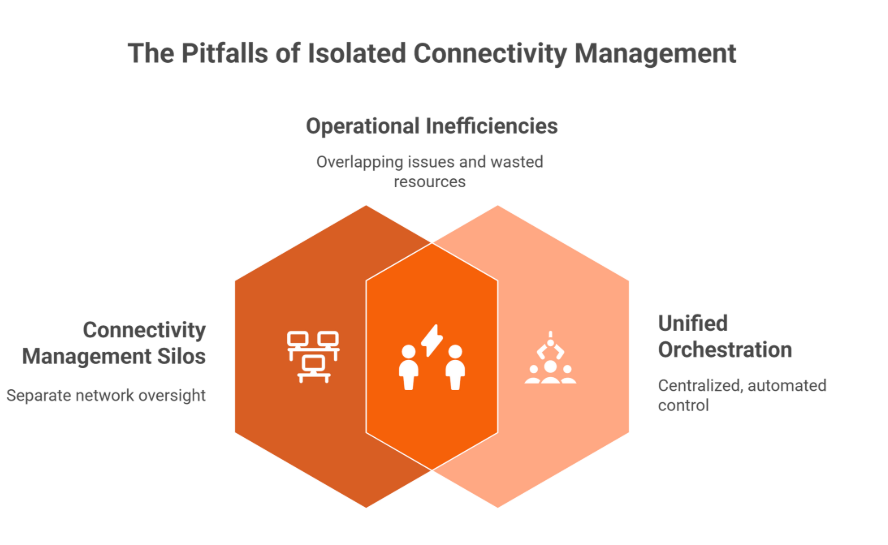
When a truck disconnects, chaos follows. The operations team calls the telematics service provider (TSP). The TSP blames the device vendor. The vendor blames the carrier. The carrier insists its towers are fine. Meanwhile, the truck remains invisible.
This endless loop happens because connectivity sits outside the core fleet management software. Each party controls one fragment. No one owns the whole picture.
Fleet management connectivity should be unified, not scattered between vendors. When data stops, accountability disappears.
Transition: Let’s see why this outdated approach fails at every level.
The “One-Carrier” Problem
Most fleets use single-carrier SIMs. They work fine in metro routes. But once the truck moves to a rural area, coverage gaps appear. The SIM cannot jump networks.
A report by flolive.net warns that such gaps cause multi-hour blind spots, delayed dispatches, and compliance risks. In some regions, record-keeping fines can hit $14,000 per violation.
The cost of downtime doesn’t stop there. Missed delivery windows lead to SLA penalties and customer churn.
If the IoT connectivity for the fleet can’t switch to a stronger network automatically, your business pays the price.
Multi-carrier connectivity prevents this but only when built into the platform. You can read how a multi-carrier SIM for fleet reduces such blind spots on Spenza’s IoT cost guide.
The Admin Nightmare
Beyond field failures, operations teams face another problem, administration. They juggle hundreds of SIMs across different carrier portals, each with its own login, billing cycle, and activation rules.
A simple request like “pause a SIM for a truck under repair” turns into a multi-step ticket. Teams manually track usage, overages, and renewals. Every mistake costs money.
According to US Fleet Tracking, a typical SIM plan costs $20–$60 per vehicle per month, plus $100–$600 per device. When mismanaged, overages can burn thousands monthly.
Fleet leaders lose time fixing SIM issues instead of optimizing routes. And TSPs face endless support calls from angry clients.
Integrated connectivity eliminates that noise. When the fleet management connectivity platform handles activation, suspension, and pooling automatically, the admin load drops to near zero.
Discover how Spenza’s IoT fleet cost management helps control cost and automate SIM lifecycles at scale.
The Patchwork Trap
Many companies buy cheap local SIMs to cut costs. But over time, they create a patchwork of plans, carriers, and contracts. Each one has different rules, coverage, and taxes.
This fragmented system blocks scaling. When you expand into new regions, your devices might need new SIMs. That means truck downtime, device swaps, and hours of manual setup.
By contrast, modern telematics connectivity platforms combine eSIM orchestration with unified billing and monitoring.
As shown on Spenza’s telematics portal, multi-operator eSIM orchestration lets you localize and switch profiles without touching the device.
Transition: You can’t fix a broken system by adding more vendors. You fix it by integration.
Common Failures vs Integrated Connectivity Platform
| Problem Area | Disconnected SIM Setup | Integrated Connectivity Platform |
|---|---|---|
| Network Reliability | Single carrier only; rural blackouts | Multi-carrier SIMs auto-switch to best network |
| Visibility & Data Continuity | Gaps in GPS and sensor feeds | Continuous data for real-time fleet tracking |
| Admin Control | Manual activation and billing | Automated lifecycle and pooled plans |
| Support | Multiple vendors blaming each other | One dashboard and one support team |
| Cost Predictability | Frequent overages and “bill shock” | Shared data pools and usage alerts |
| Scaling to New Regions | New SIM contracts per country | Global eSIM profiles with auto-localization |
Fleet management success today depends on continuous data. Treating connectivity as an afterthought turns million-dollar software into a blind dashboard.
The future belongs to fleets and telematics service providers (TSPs) that make fleet management connectivity a core capability, not a checkbox.
The Solution: What Is an Integrated Connectivity Platform?
A real fix starts with a new mindset. An integrated fleet management connectivity platform connects networks, devices, and data in one control layer. It turns a SIM from a dumb chip into an intelligent part of the fleet management software.
Think of it as the nervous system of the fleet, data never stops moving.
Instead of juggling multiple vendors, fleets manage everything through one window.
Core Elements
- Multi-Carrier SIMs: One smart SIM chooses the strongest signal automatically. When Airtel drops, it switches to Vi or Jio in seconds.
- Unified Dashboard: Every truck’s location, data use, and signal strength appear inside the same real-time fleet tracking screen.
- Lifecycle Automation: SIMs activate when ignition starts and pause when trucks go to maintenance.
- Single Support Stack: No finger-pointing. One support channel for both connectivity and telematics.
You can explore a detailed walkthrough at Spenza’s IoT Connectivity Management Simplified
Top 3 Benefits of an Integrated Approach
A modern platform changes how fleets operate. Here’s how.
1. Unbreakable ReliabilityL: No More Grey Dots
Fleet managers need uptime, not excuses. A multi-carrier SIM for fleet provides 99.9 percent availability, keeping every asset visible.
- Continuous coverage eliminates offline periods that create the “grey dot.”
- Automatic network switching ensures consistent telematics connectivity in rural or border zones.
- Predictable operations mean dispatchers trust ETAs again.
According to Verizon Connect, fleets using reliable connectivity record 16 percent lower fuel and labour costs and 22 percent fewer accident expenses. Those savings exist only when data never drops.
For example, if one truck loses visibility for two hours daily, that’s 60 hours monthly of blind operation. Integrated connectivity ends that loss entirely.
2. Drastic Reduction in Operational Overhead
Manual SIM management drains time and money. Automation changes everything.
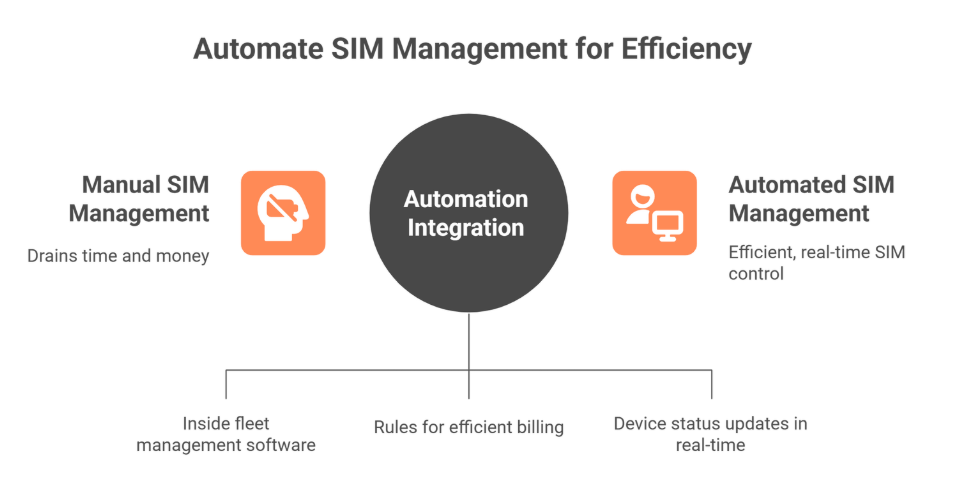
Before Integration
- Separate carrier portals.
- Delayed activations.
- Paper-based suspension requests.
After Integration
- One interface inside the fleet management software.
- Automatic billing rules.
- Instant device status updates.
Key benefits include:
- Zero manual tasks for activations or suspensions.
- Shared data plans that self-balance usage.
- Automatic alerts for malfunctioning units to avoid bill shock.
An analysis by US Fleet Tracking shows unmanaged SIM plans cost $20–$60 per vehicle monthly and hardware $100–$600. Fleet teams can save hundreds of hours yearly with a platform handling it all.
See real examples of automated lifecycle savings on Spenza’s IoT Fleet Cost Management 2025.
3. Total Cost Control and No More Surprises
Cost transparency builds trust. Integrated fleet management connectivity platforms track data across fleets and stop waste before it happens.
Smart Pooling and Alerts:
- Each device shares one data pool.
- High-use trucks are balanced by low-use ones.
- Threshold alerts flag “runaway” devices in real time.
This approach prevents the dreaded end-of-month invoice shock. For finance teams, one contract means one predictable invoice instead of hundreds of carrier bills.
Explore Spenza’s IoT Connectivity Cost Guide 2025 for examples of how shared plans and automation protect budgets.
How Spenza Powers the Integrated Fleet Solution
Spenza runs an operator-neutral connectivity engine that merges the control plane (multi-operator access + eSIM orchestration) with the business stack (OSS/BSS, billing, tax/KYC, and payments).
This structure turns connectivity into a true product.
For Fleet Operators
- Spenza ensures every truck stays online across networks.
- The platform combines multi-carrier coverage and eSIM switching under one interface.
- Fleet managers get one dashboard for devices, usage, and billing data.
It means real-time visibility, fewer service tickets, and peace of mind.
For Telematics Service Providers (TSPs)
- Spenza acts as the white-label backbone behind your fleet management software.
- You can integrate its APIs or use the portal to offer bundled connectivity.
- You own the customer experience and deliver reliability no competitor can match.
Instead of blaming carriers, TSPs control every connection.
That shift raises margins, strengthens client loyalty, and simplifies operations.
Learn how TSPs embed Spenza’s APIs directly into their software via Spenza Telematics.
Benefits at a Glance
| Goal | Old Way (Separate SIM) | Integrated Connectivity with Spenza |
|---|---|---|
| Coverage | One carrier, frequent dropouts | Multi-carrier access with eSIM switching |
| Visibility | “Offline” grey dots | 24/7 real-time fleet tracking |
| Admin Time | Manual activation & billing | Automated lifecycle management |
| Support | Multiple vendors to call | One platform and single support team |
| Cost Control | Overage fees & bill shocks | Shared data pool & usage alerts |
| Scalability | Local contracts per region | Global coverage and instant localization |
Conclusion: Don’t Buy a Blind Fleet Management Solution
A fleet management connectivity solution without integrated, intelligent connectivity is blind.
In 2026, total visibility is not optional. Customers want accurate ETAs, real-time driver safety, and data they can trust. Those goals happen only when the connectivity platform and the software act as one.
Spenza delivers that integration through a multi-operator marketplace and eSIM orchestration. It turns fragmented connectivity into a cohesive, profitable system for both fleets and TSPs.
FAQs
Ready to see integrated connectivity in action? Book a demo to experience the power of a unified connectivity platform that keeps your fleet moving smarter