What Is a Mobile Virtual Network Operator (MVNO)
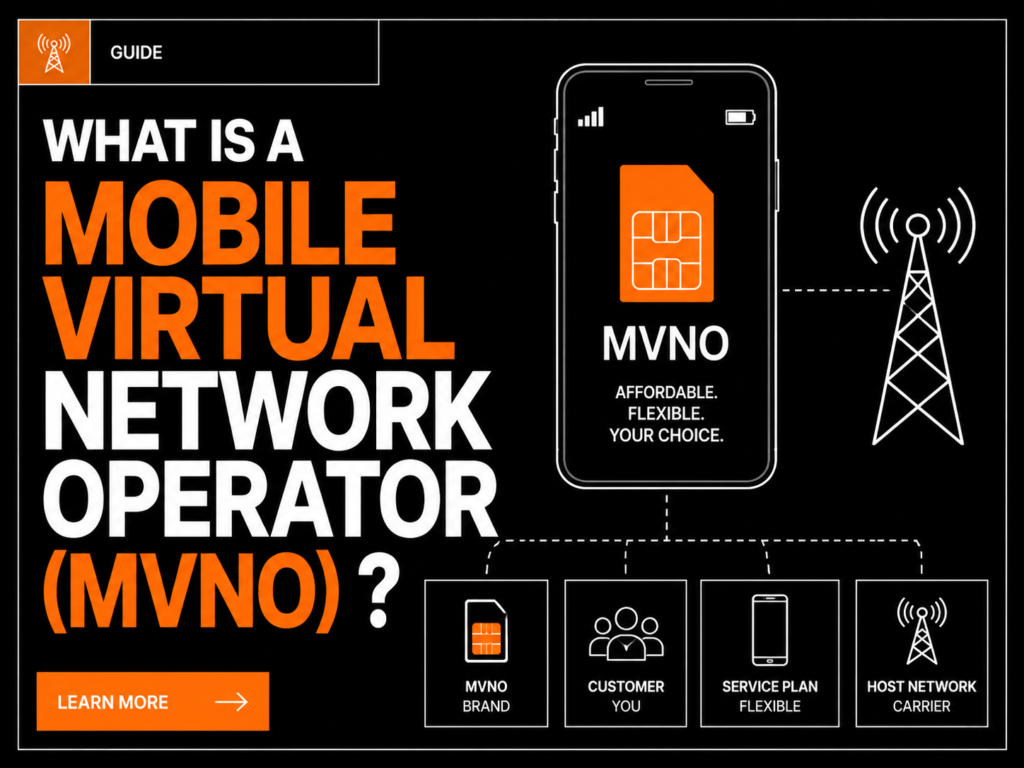
A Mobile Virtual Network Operator (MVNO) is a wireless provider that sells mobile services without owning cell towers or spectrum licenses. Instead, an MVNO leases network capacity in bulk from a Mobile Network Operator (MNO) like AT&T, T-Mobile, or Verizon, then resells that access under its own brand with its own pricing.
The simplest way to think about it: when you make a call or use data on an MVNO plan, your signal travels through the same towers as a direct carrier customer. The coverage is identical. The difference is that the MVNO handles your billing, customer support, and plan design, and typically charges 30 to 50 percent less because it has no network infrastructure to maintain.
Here is how the process works in practice. The MVNO signs a wholesale agreement with a host MNO to buy network capacity at bulk rates. It then designs its own data plans, added services, and customer experience. Subscribers sign up through the MVNO’s website or app, activate a SIM card or eSIM, and their service runs on the host MNO’s network infrastructure. The MVNO earns revenue on the difference between wholesale cost and retail price. Some MVNOs work directly with MNOs. Others partner with a Mobile Virtual Network Enabler (MVNE) like Spenza, which provides the billing systems, SIM management, provisioning, and carrier integrations so the MVNO can launch faster and avoid building a technology stack from scratch.
In this article, we cover everything from the technical definition and business models to detailed carrier comparisons, real-world statistics, and expert recommendations. By the end, you will know how to define MVNO in plain language, understand which MVNOs use Verizon’s network, evaluate the US Mobile MVNO offering, and decide whether switching to a mobile virtual network operator is the right move for you.
Types of Virtual Network Operator (MVNO) Models
Not every MVNO operates the same way. The level of control, investment, and infrastructure involvement varies by model. Here is a quick comparison:
| MVNO Type | Control Level | Infrastructure Owned | Investment | Best For |
|---|---|---|---|---|
| Branded Reseller (Skinny MVNO) | Low | None (uses host MNO for everything) | Low ($10K–$100K) | Fast market entry, brand-focused companies |
| Thin MVNO | Low–Medium | Billing and CRM only | Medium ($100K–$300K) | Startups wanting basic customization |
| Light MVNO | Medium | Billing, SIM management, customer support | Medium ($200K–$1M) | Growing brands needing more control |
| Thick MVNO | Medium–High | Core switching, HLR/HSS, billing | High ($500K–$3M) | Enterprise and IoT-focused operators |
| Full MVNO | High | Complete core network (minus RAN) | Very High ($1M–$10M+) | Maximum independence and margin control |
A Light MVNO is the most common choice for startups. You get enough control over customer care and billing to differentiate your brand, without the heavy cost of core network ownership. A Full MVNO makes sense for large-scale IoT deployments where you need direct control over SIM card provisioning and data routing.
For a deeper breakdown of all five models with 2026 cost data, read: MVNO Types Explained (2026)
MVNO Market in 2026: The Numbers That Matter
The MVNO market is growing fast, and the numbers back it up. Consumer demand for cost effective mobile plans, IoT device growth, 5G network maturation, and eSIM adoption are all pushing the market forward.
| Metric | Value | Source |
|---|---|---|
| Global MVNO Market (2025) | $89 to $98.7 Billion | Fortune Business Insights / Straits Research |
| Projected Global Market (2026) | $95 to $107 Billion | Multiple analyst firms |
| Projected Global Market (2034) | $171 to $195 Billion | Fortune Business Insights / FMI |
| U.S. MVNO Market (2026) | $46.76 Billion | Mordor Intelligence |
| U.S. MVNO CAGR (2026 to 2031) | 6.71% | Mordor Intelligence |
| Full MVNO Share (2025) | 45 to 58% | Straits Research / CMI |
| IoT MVNO Lines Growth | 16.95% CAGR | Mordor Intelligence |
| Cloud MVNO Architecture Share (U.S.) | 57.25% | Mordor Intelligence |
| 5G MVNO Segment CAGR | 18.7% | Niche Research |
| Global MVNO Subscribers by 2030 | 439 Million | Juniper Research |
The U.S. alone accounts for nearly half the global market. Cloud-based MVNO platforms are growing at almost 13% CAGR because they cut launch timelines from months to days and reduce operating costs by up to 40%. IoT connected device plans are another major growth engine, with IoT MVNO lines increasing at nearly 17% annually as enterprises outsource device connectivity.
What MVNO Uses Verizon? Virtual Mobile Networks on Verizon’s Network
This is one of the most searched questions in the mobile space. Dozens of MVNO carriers operate on Verizon’s network, which covers about 70% of the U.S. with 4G LTE and has growing 5G availability. Here are the top MVNOs that use Verizon’s network infrastructure in 2026:
| MVNO Carrier | Starting Price | Key Features | Best For |
|---|---|---|---|
| Visible | $25/mo | Unlimited data, unlimited hotspot, no contract | Best overall Verizon MVNO |
| US Mobile (Warp) | $10/mo | Multi-network access (Verizon, AT&T, T-Mobile) | Flexibility and budget |
| Xfinity Mobile | $15/mo | Bundled with Comcast internet, by-the-gig option | Comcast customers |
| Total Wireless | $26/mo | Family plans, shared data pools | Multi-line families |
| Twigby | $15/mo | Ultra-low-cost, 2GB plan with hotspot | Minimal data users |
| Straight Talk | $25/mo | Walmart distribution, simple plans | In-store shoppers |
| Red Pocket | $5/mo | Choose any of the Big Three networks | Extreme budget users |
| Page Plus | $12/mo | Basic plans on Verizon | Seniors and light users |
Visible is the standout here. For $25 per month you get unlimited data on Verizon’s network with an unlimited mobile hotspot, no contract. The Visible+ tier ($45/mo) removes data deprioritization entirely, meaning you get the same network priority as a direct Verizon postpaid subscriber. That is hard to beat.
US Mobile MVNO: The Most Flexible Carrier in 2026
US Mobile is one of the few mobile virtual network operators that lets you pick between all three major carriers: Verizon (branded as “Warp”), T-Mobile (“Light Speed”), and AT&T (“Dark Star”). You choose which network to run on, and you can switch between them using a feature called Teleport.
Founded: 2015, New York City
Networks: Verizon (Warp), T-Mobile (Light Speed), AT&T (Dark Star)
Cheapest Plan: $10/mo for 2GB shareable data
Unlimited Starter: $25/mo, 70GB high-speed data, 10GB hotspot
Unlimited Premium: $44/mo, 100GB premium data, 50GB hotspot
Network Switches: 2 free Teleport transfers per month
eSIM: Full eSIM activation for instant setup
What makes US Mobile particularly interesting is a pricing quirk on the AT&T (Dark Star) network. The $25/mo Unlimited Starter plan on Dark Star offers the same 200GB data allotment as the $44/mo Premium plan. That means budget-conscious users can access some of the largest data allotments from any AT&T MVNO at roughly half the price. If you are asking what MVNO uses Verizon and also want fallback options on AT&T or T-Mobile, US Mobile is the obvious answer.
Best MVNO Carriers of 2026: Complete Comparison
Choosing the best MVNO depends on your specific priorities: whether you value the lowest price, the most data, the best network coverage, or specialized features like international roaming or mobile hotspot capabilities. Below is a comprehensive comparison of the top MVNO carriers in 2026, covering pricing, host networks, and standout features
| MVNO Carrier | Starting Price | Key Features | Best For |
|---|---|---|---|
| Visible | $25/mo | Unlimited data, unlimited hotspot, no contract | Best overall Verizon MVNO |
| US Mobile (Warp) | $10/mo | Multi-network access (Verizon, AT&T, T-Mobile) | Flexibility and budget |
| Xfinity Mobile | $15/mo | Bundled with Comcast internet, by-the-gig option | Comcast customers |
| Total Wireless | $26/mo | Family plans, shared data pools | Multi-line families |
| Twigby | $15/mo | Ultra-low-cost, 2GB plan with hotspot | Minimal data users |
| Straight Talk | $25/mo | Walmart distribution, simple plans | In-store shoppers |
| Red Pocket | $5/mo | Choose any of the Big Three networks | Extreme budget users |
| Page Plus | $12/mo | Basic plans on Verizon | Seniors and light users |
For a comprehensive comparison of the best MVNO plans across all networks, including pricing tables and coverage analysis, see: Best MVNO Plans for 2026: Top Carriers & Coverage
Advantages and Disadvantages of MVNOs
MVNOs offer several compelling advantages over traditional mobile network operators (MNOs). Because they do not bear the enormous costs of building and maintaining network infrastructure, such as cell towers, spectrum licenses, and fiber backhaul, MVNOs can focus their resources on delivering a superior customer experience at lower prices. However, they also have a few disadvantages, including data deprioritization and roaming restrictions.
| Advantages | Disadvantages |
|---|---|
| Cost effective plans: save 30 to 50% vs. major carriers. The average U.S. family overpaid by roughly $2,200/year in 2025. | Data deprioritization: during peak congestion, data speeds may slow. Premium MVNO tiers eliminate this. |
| No-contract flexibility: switch, cancel, or upgrade any time without fees. | Fewer perks: no bundled streaming or device trade-in programs, though savings usually offset this. |
| Same network coverage: MVNOs use the exact same towers as AT&T, Verizon, and T-Mobile. | Roaming limits: some MVNOs cannot roam on partner networks the way direct carrier customers can. |
| eSIM support: activate a new plan in minutes from your phone, no store visit needed. | Customer support variability: smaller MVNOs may have limited support hours. Stick with established names. |
| Specialized data plans: tailored for IoT devices, seniors, students, international travelers, and businesses. | Limited 5G access: some budget tiers restrict 5G. Premium plans typically include full 5G. |
How to Choose the Right MVNO for You
With dozens of MVNO carriers available, selecting the right one requires a structured approach. Use this framework to evaluate your options:
1. Check coverage first. Go to the carrier coverage map for your area. If Verizon has the best signal where you live and work, focus on MVNOs on Verizon’s network like Visible or US Mobile Warp.
2. Match data usage to a plan tier. Under 5GB per month? Tello at $8/mo or US Mobile at $10/mo will handle it. Heavy user? Visible at $25/mo gives you unlimited data with a mobile hotspot.
3. Confirm your phone works. Make sure your device is unlocked and compatible with the MVNO’s host network. Most modern phones support all U.S. bands. Check eSIM support if you want instant activation.
4. Read the fine print on data speeds. “Unlimited” does not always mean full speed. Many MVNOs throttle after a threshold. Premium tiers from Visible+ and US Mobile remove deprioritization for heavy users.
MVNOs for Business: IoT Deployments, Enterprise Mobility, and New Revenue Streams
The MVNO model extends far beyond consumer phone plans. In 2026, businesses across retail, fintech, healthcare, logistics, and manufacturing are leveraging mobile virtual network operators to power IoT connected devices, manage enterprise mobility, and even create entirely new revenue streams by offering branded mobile services to their own customers.
IoT and MVNO: A Perfect Match
IoT deployments are one of the fastest-growing segments in the MVNO market, with IoT MVNO lines increasing at a 16.95% CAGR in the U.S. alone. IoT devices, including smart meters, fleet trackers, connected medical equipment, and retail point-of-sale systems, require reliable, cost-effective cellular connectivity that traditional carrier plans are often too expensive or inflexible to provide.
MVNOs solve this by offering specialized data plans designed for IoT use cases: low-bandwidth plans for sensors, pooled data for device fleets, and global SIM cards or eSIMs that work across multiple countries without manual configuration. A Full MVNO or Thick MVNO model gives IoT operators direct control over SIM card provisioning, real-time usage monitoring, and network routing, critical capabilities for large-scale IoT deployments.
Launch Your MVNO in Days with Spenza
Spenza is an operator-neutral, API-first platform that enables businesses to become an MVNO within days. As an authorized reseller of AT&T, Verizon, T-Mobile, and 40+ global operators, Spenza handles SIM and eSIM management, billing, usage analytics, and white-label apps.
It offers multi-carrier support across major U.S. and global networks, along with eSIM and physical SIM card management via API. The platform also includes a white-label marketplace and a no-code plan builder, allowing businesses to launch in as little as 7 days.
Everything You Need to Become an MVNO — In One Platform
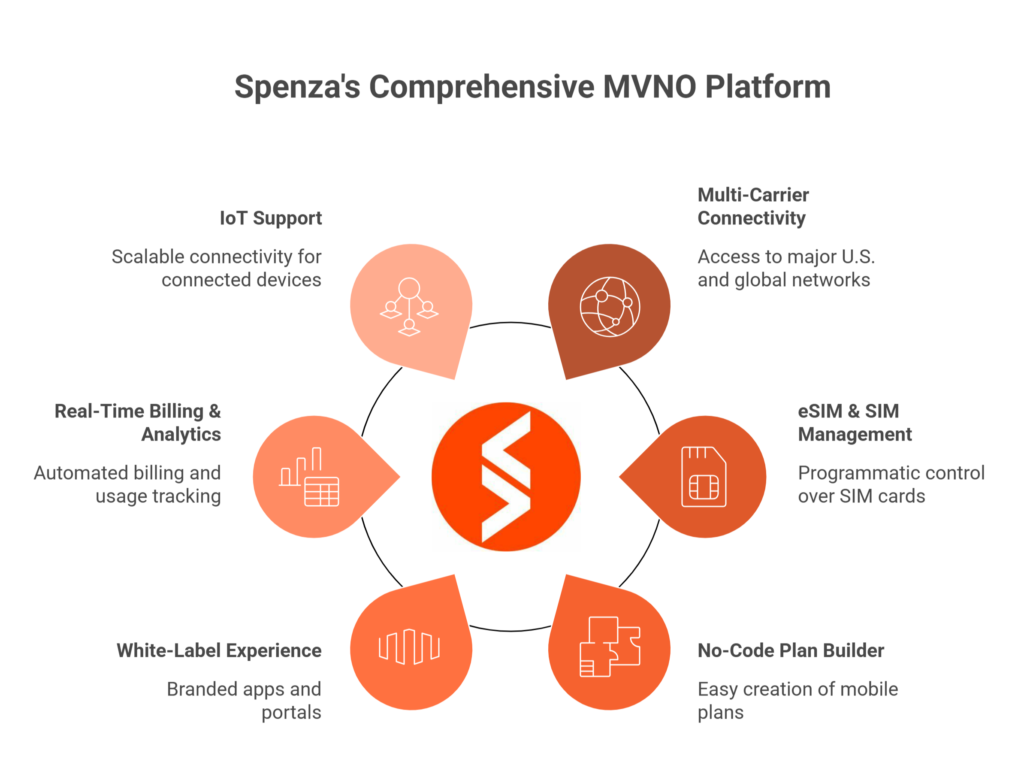
Instead of stitching together multiple vendors, Spenza gives you a single, unified system to launch, operate, and scale your connectivity business.
- Multi-Carrier Connectivity, Instantly
Access pre-integrated partnerships with leading operators across the U.S. and globally—without lengthy negotiations. This allows you to offer flexible plans across multiple networks from day one. - eSIM & SIM Lifecycle Management via API
Provision, activate, and manage both eSIMs and physical SIM cards programmatically. Whether you’re serving consumers or IoT devices, everything is controlled through a single platform. - No-Code Plan Builder & White-Label Experience
Design and launch your own mobile plans without engineering overhead. Deliver a fully branded experience through white-label apps, portals, and storefronts tailored to your business. - Real-Time Billing, Analytics & Cost Optimization
Automate billing, track usage, and optimize telecom spend with AI-powered insights—all from a unified dashboard. Businesses can even reduce wireless costs significantly through automated expense management. - Built for IoT & Modern Use Cases
From connected devices to global fleets, Spenza supports IoT deployments with scalable connectivity, real-time monitoring, and centralized control across carriers.
Whether you’re building for consumer apps, enterprise connectivity, or IoT deployments, Spenza provides the infrastructure, tools, and flexibility to turn connectivity into a scalable revenue stream, without building the telecom stack from scratch.
Key MVNO Technology Trends Shaping 2026 and Beyond
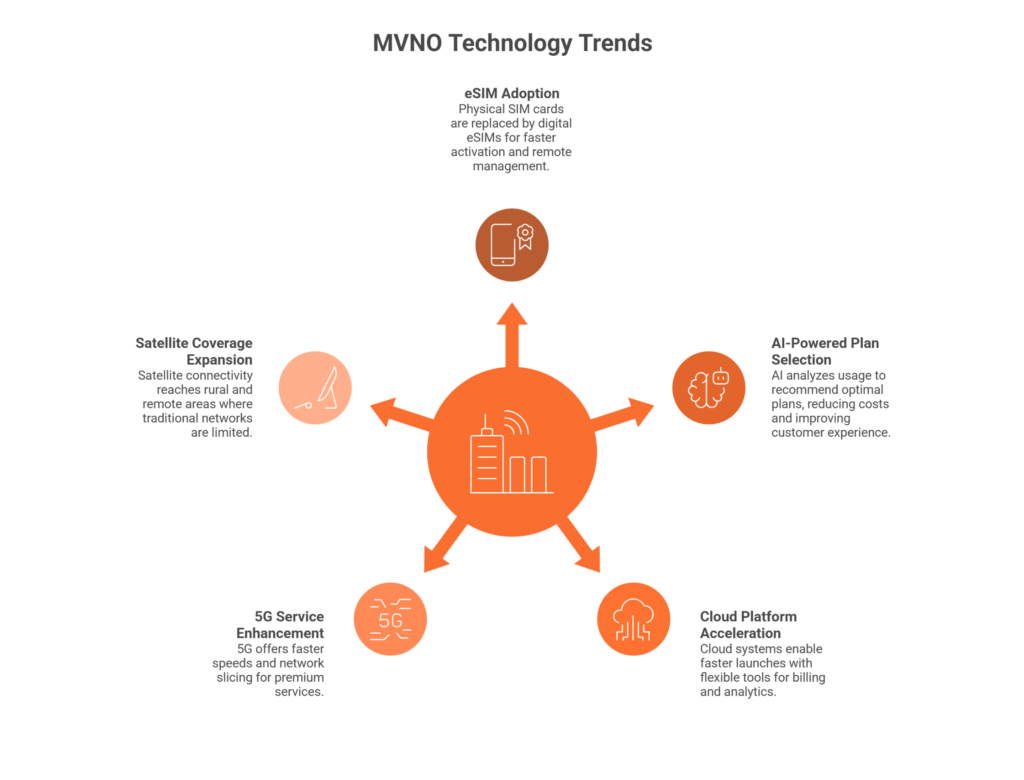
- eSIM becomes standard
Physical SIM cards are fading out as more smartphones support eSIM. Users can activate plans in minutes without visiting stores. This also helps businesses manage devices remotely at scale. - AI improves plan selection
MVNOs are using AI to track usage and recommend better plans automatically. This reduces costs for users and improves customer experience. - Cloud platforms speed up launches
Cloud-based MVNO systems let companies launch faster with flexible tools for billing, analytics, and provisioning. This lowers costs and speeds up market entry. - 5G enables better services
5G allows faster speeds and supports features like network slicing. This helps MVNOs offer premium services, especially for business and IoT use cases. - Satellite expands coverage
Satellite connectivity is growing quickly and helps MVNOs reach rural and remote areas where traditional networks are limited.
Conclusion: The Future of Virtual Mobile Networks Is Here
The MVNO market in 2026 offers more choice, better pricing, and stronger network performance than ever before. Whether you are an individual looking to cut your phone bill in half, a family searching for affordable multi-line unlimited plans, or a business exploring MVNO operations to create new revenue streams, there is a carrier or platform that fits your needs.
For personal use, start by checking which networks offer the strongest coverage at your address, then match your typical data usage to the right plan tier. Carriers like Mint Mobile, Visible, and US Mobile consistently deliver exceptional value across a wide range of use cases.
For businesses interested in launching their own branded mobile services, IoT connectivity, or enterprise mobility solutions, Spenza provides the fastest path from concept to market. With pre-integrated carrier relationships, API-first architecture, and support for both physical SIM cards and eSIMs, Spenza eliminates the traditional barriers to becoming a Mobile Virtual Network Operator.
FAQs
Ready to launch your own MVNO? Contact Spenza for a free demo and start building your branded mobile service today.